August 2025

August  2025
I DON'T NEED A RIDE. I NEED AMMUNITION.

Translate

Showing posts with label Johnny Behan. Show all posts

Thursday, October 27, 2022

TOMBSTONES Chapter Nineteen


I know what Billy Clanton (above) was thinking when the shooting stopped. When photographer C.S. Fly bent down to take the empty Colt revolver from his hand, Billy Clanton told him, "Give me more cartridges". A few moments later, when they lifted the 19 year old's bleeding body he cried out in pain, "They have murdered me. I have been murdered."  Of course, he was trying to murder somebody, when he was.
Inside the Harwood House, after Dr. Gibberson softened his pain with morphine, Billy was boastful again, threatening Wyatt - "If only I could get my teeth into that son-of-a-bitch's throat, I'd die happy." But when he realized he was slipping into the gentle night, Billy ordered the gawkers to, "Go away and let me die." But Billy was the appointed Hector of Tombstone, the last hero of the melodrama, and his public was not to be denied.
The funeral of Billy and the McLaury brothers was staged - and that is the right word - the very next day, a cold gray Thursday, 27 October, 1881. Andrew Jackson "Andy" Ritter propped the three caskets up in the front window of Ritter and Ream City Undertakers, behind a sign which read "Murdered on the Street of Tombstone" so they could be photographed (above). The Democratic Tombstone Nugget that day cried that “Three Men" had been "Hurled Into Eternity In the Duration of a Moment.” 
And at about 4:00pm - fashionably late - the 3 hearses, 22 carriages and 300 mourners,  all led by the volunteer firemen (above),  made their way to the Old Cemetery - it would not be called Boot Hill until the arrival of 20th century tourists. 
 Some 2,000 watched the procession, and even Cochise County Republicans were uneasy with the violence which had exploded on the streets of Tombstone..
It was lucky for the Democrats that Ike Clanton, the Paris in this Cow Boy Iliad, the man most responsible for the gun fight, ran away and lived.  Four days later Ike filed murder charges against the Earps and Holliday.  Older brother William McLaury, who was a practicing lawyer, came up from Texas to help prosecute the case. And a New York Democratic editorial cartoonist depicted wild man Virgil Earp, two guns blazing, trying to herd Arizona into statehood with violence (above).  In fact the shoot out helped delay Arizona statehood until Valentines Day, 1912 - making it the last of the 48 contiguous states to join the union.
The one clearly disinterested witness at the Earp's trial, a tuberculosis sufferer named Henry F. Sills, who was a fireman on the Atcheson, Topeka and the Sante Fe Railroad and had only arrived in Tombstone the day before.  He supported the Earps in all important details. The hearing judge decided the Earps had done nothing illegal. But like all violence, the shoot out did not merely end. There were aftershocks.
Half an hour before midnight, on Wednesday, 28 December, 1881, Virgil Earp (above) was shot from ambush while walking into the Cosmopolitan Hotel.  Dr. Goodfellow had to remove 4 inches of Virgil's left humerus, making him a cripple for life. The suspected shooters were Phin and Ike Clanton, Cow Boys Johnny Barnes, Johnny Ringo, Hank Swilling and Pete Spence. Although arrested, all 6 were released on $1,500 bail. No trial was ever held.
Ten minutes before eleven on the evening of Saturday, 18 March, 1882,  Morgan Earp (above) was shot through the spine while playing billiards. He died soon after. A coroner's jury would conclude the assassins were Pete Spence, Frank Stillwell, Frederick Bode and Florentino "Indian Charlie" Cruz. Convinced the Republican Party had abandoned his family, and the local Democratic courts would never punish the Cow Boys the Earps had been sent to Tombstone to breakup, Wyatt gathered a small band of supporters, and rode out to punish those who had injured his loved ones. In true epic tradition, it would be called his vendetta ride.
It began the night of Monday, 20 March, 1882. The wounded Virgil Earp, his wife and Morgan's widow boarded a Southern Pacific train to take Morgan's body to California for burial. The next morning, between the railroad tracks, the little dandy, Frank Stillwell (above), was found so full of lead the coroner described his corpse as "the worst shot up man I ever saw." Frank was the first. 
Indian Charlie died second, on 23 March. And on 24 March, Johnny Barnes was shot to death, along with William "Curley Bill" Brocius (above)  at Iron Springs, in the Whitestone Mountains, northeast of Tombstone. All of them were presumably murdered by Wyatt Earp, in revenge.
John "Johnny Ringo" Peters, so called "King of  the Cow Boys"  evidently committed suicide in July of 1882. 
Wanted for rustling, loudmouth, alcoholic Issac "Ike" Clanton was killed while avoiding arrest in 1887.  His elder brother, Phin Clanton,  served 17 months in the Yuma Territorial prison, also for rustling. He died in 1906. 
The ex-Texas Ranger and stage robber, Pete Spence (above),  aka Elliot Larkin Ferguson,  also did 18 months in Yuma, but for manslaughter. In 1910 he married Phin Clanton's widow, and died in 1914. Thus the villains of Tombstone.
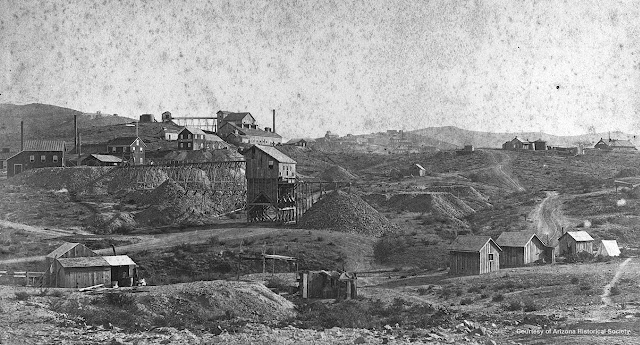
The subterranean towers of this Ilium   -  the mines of Tombstone - were drowned in 1887 after fires destroyed the pumps that kept them workable, just about the same time the price of silver plummeted. Fire also destroyed Fly's Boarding House and the Harwood house as well. 
The dawning 20th century made copper the new gold, and by 1929 the Copper Queen mine in Bisbee drew the Cochise County seat there, leaving Tombstone to fade into the Sonora desert. During the 1930's Arizona politicians tried to kill the town by using New Deal money to "improve" Fremont Street, plowing over the site of the shoot out  (above) and obliterating the history. But Tombstone refused to die.
Tuberculosis killed 36 year old John Henry "Doc" Holliday (above), in Glenwood Springs, Colorado, in November of 1887.  He died alone, in the company of a hired nurse. 
Almost all of the stories of robberies and murders attributed to Doc Holliday and the Earps originated with John Harris Behan (above), the corrupt sheriff of Cochise County. When the mines failed, Johnny moved on, leaving behind debts and missing funds. He was the brutal superintendent of the Yuma Prison for 2 years, stealing an estimated $50,000. Always a Democratic appointee and always corrupt, by the turn of the century he was in Washington, D.C., but quickly returned to the Southwest. He died in Tucson in 1912, of heart failure brought on by 30 years of syphilis, which he had contracted in Tombstone. Like most villains, he was usually guilty of the very sins he attributed to others.
The Southern Pacific Railroad provided a California job for the handicapped Virgil Earp, and supported him until he died of his wounds on 19 October, 1905. 
Wyatt Earp died of a urinary tract infection in January of 1929, at the age of 80. 
His second common law wife, Josephine Sarah Marcus Earp, died on 20 December, 1944. Neither of them suffered from syphilis. But like most gamblers "Sadie" died broke. Her funeral was paid for by silent movie cowboy William S. Hart, and Hollywood theater owner Sid Grauman. Thus the heroes of the Tombstone saga.
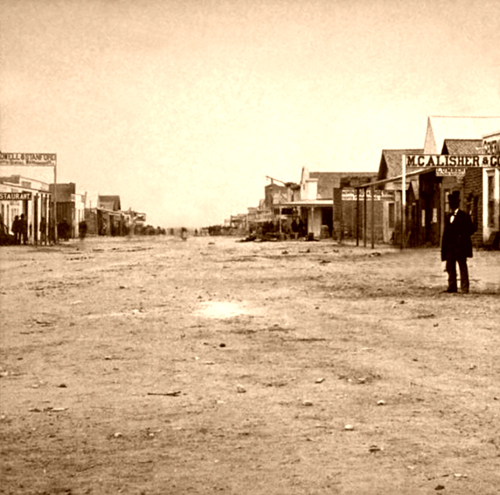
Between 1860, when Frederick Brunckow discovered silver ore along the banks of the San Pedro River, to 1890, when the mines drowned, something around $85 million dollars worth of silver was harvested from the black veins around Tombstone, Arizona. Figuring in the efforts of those who fed and entertained the miners, treated their wounds, physical and emotional, and buried their bodies, Tombstone's silver fulfilled thousands of dreams and millions of nightmares. Those who died in the effort in this desert would have died someplace else, at some other time. But this is where they died, and this was when, because the earth cracked here long before humans ever set eyes upon the place.
And asking why their tombstones were erected here, may not be worth the effort.
But nothing that happened in Tombstone was an accident, anymore than the way rocks crack along molecular lines is an accident, or the way greed drives humans to murder is an accident. But of the two ways to get rich, the fastest is to not bother with reason, and simply grab anything and everything you can. Reason is far slower to show a profit,  but it makes you far richer, and for far longer. As they said in the saloons and brothels along Allen Street,  "Name your poison, stranger."
- 30 -

Tuesday, October 25, 2022

TOMBSTONES Chapter Seventeen


I know the distance Wyatt Earp had to cover after he stepped off the plank walkway in front of 44 year old Colonel Roderick Hafford's Saloon, just before 3:00pm, Wednesday, 26 October, 1881.  It was was just 310 feet. At an average walking speed of 3 miles an hour, they would reach the corner of Fourth and Fremont in less than 20 seconds, and 312 Fremont Street, Mollie Fry's boarding house,  in another 30 seconds. Fifty seconds between life and death. And another 30 seconds to determine who would die and how.
Oddly, this fight which would come to symbolize the violence of the American West occurred after the crest of the wave. The peak had come in 1878, when there were 36 recorded gunfights along the frontier. The next year that dropped to 14, but in 1880 there were 25, and the one about to occur would be one of 27 in 1881. But after this bloody year, the total would never rise above 20 in any given year - at least until historians stopped counting in 1900.
In part this was a function of how few men actually made their living at least part time through gun violence. Out of the 365 documented gunmen in the American West, most had been born before the civil war - average birth year was 1853 - but most were too young to have fought in that conflict. Almost a third - 110 - worked at least part time as lawmen, like the Earps and Johnny Behan. And the badge extended their lives. Of the remaining 255, 35 were good enough to be full time professional hired guns, while another 174 could be called Cow Boys - ranchers and rustlers who used gun violence to achieve other ends. Almost all of these men ended up at the end of a rope or being shot to death, dead at an average age was just 35.
Waiting in the 15 foot wide alleyway (above) between the boarding house and the home of William Arthur Harwood - second mayor of Tombstone (above, left) - stood 6 Cow Boys. Wesley "Wess" Fuller, was deepest in the alley. This 26 year old gambler and Cow Boy had been posted to warn of anyone approaching from the Allen Street entrance. He was now deepest in the alley, speaking to Billy Claiborne. To Billy's left stood Ike Clanton. To his left stood Robert Findley "Frank" McLaury, holding in his left hand the bridle of his brother's horse . Frank had abandoned his guard post south of Fourth and Allen to deliver with Johnny Behan a warning that the Earps were alert. To his left was his brother, Thomas Clark "Tom" McLaury. To Tom's left stood 19 year old Billy Clanton. The odds are the six were arguing about what to do next - leave town at once or go inside the boarding house and murder Doc Holliday in his bed, and then leave town.
Because of their arrests, Ike Clanton (above) and Frank McLaury were still unarmed. Ike had tried to buy a pistol in the hardware store, but the manager took one look at his bandaged head and refused to take Ike's cash. There is no indication any of the Cow Boys protested this "violation" of his Second Amendment rights. And once again not having access to a gun, saved Ike's life.
It is important to note who might have been in the alley that afternoon. Pete Spence and Frank Stillwell were still in jail in Tuscon, awaiting trial for the Bisbee stage robbery. Curley Bill Brocius (above),  the smartest and best shot of the Cow Boys,   was in New Mexico, trying to pick up the pieces of the Rustlers' Trail, after the Guadalupe Canyon Massacre. The gang was off balance, making it a bad time to move against the Earps. But this reflexive lashing out was just the kind of angry hot blooded assault Frank McLaury was well known and well feared for.
As the 4 lawmen reached the corner and turned onto Fremont they were accosted by Cochise County Marshal Johnny Behan (above).  Johnny assured Virgil he had already disarmed the Cow Boys. 
That was a lie.  Behan and Frank McLaury had walked south on Allen, before passing through the alley, drawing Wes Fuller with them, to a conference in the alley between Fly's Boarding House and the Harwood House. There the  Cochise County Marshal warned the Cow Boys that the Earps were alarmed and ready for a fight.  Frank McLaury, Billy Clanton, Wess Fuller and Billy "The Kid" Claiborn still wore their guns.  Behan now suggested the Cow Boys disarm or just leave town,  But the hot head Frank McLaury insisted he would disarm only if the Earps disarmed first.  Behan had run back up the street to deliver this false compromise to the Earps   But the McLaurys and Clantons had reneged on every promise made to the Earps over the last year. The lawmen kept walking.
The quartet walked west on Fremont, staying close to the south side store fronts. They had been told by several civilians where the Clantons and McLaury's were gathered -  in the alleyway (above).  And by hugging the packed sand walkway they would be visible to the Cow Boys only if one of them stepped out into the street and made themselves vulnerable.  And none did that.
But Behan's lie did have an effect, and it was disastrous.. Striding west on Fremont, as they passed the rear entrance to the OK Corral,  Wyatt, VIrgil and Morgan all three pocketed their 8 inch long 3 pound Smith & Wesson 44 caliber hand guns.   Doc was carrying the coach gun, but also had a nickel-plated .41 caliber "Long" Colt Thunderer in a holster under his arm.  If the lawmen had kept the pistols in their hands, visible,  they would have left the Cow Boys no choice but to hand over their guns, peacefully.  But by introducing doubt into the lawmen's minds, Johnny Behan had insured there would be a gun fight.  The lie, meant to protect his allies, had driven the final nail into coffins for 3 of them.
As the 4 lawmen turned into the alley, Wyatt Earp was on the right, the furthest forward, three steps into the alley, the wall of Fly's boarding house protecting his left flank.  To Wyatt's right stood Virgil Earp. To his right was Morgan Earp. And to his right, still armed with the Coach Gun under his coat, was Doc Holliday. The Earps materialized without warning, no more than 6 feet away from Ike Clanton and Frank McLaury.  Doc Holliday was no more than 10 feet away from 19 year old Billy Clanton. In a breath the Earps had gotten "the drop" on the Cow Boys, just as  a year earlier when the Earps were looking for the stolen Army mules. If their guns had been in their hands, the odds are the Clantons and McLaury's would have surrendered at once.
Before any of the Cow Boys had time to react, Virgil Earp called out, "Throw your hands up, I want you guns." Shocked,  "Wess" Fuller and Billy Claiborne bolted,  running north, into the rear of Fly's boarding house. That left  4 Cow Boys facing 4 lawmen. But unknown to the Earps, only 2 of the Cow Boys were armed.
Frank McLaury and Billy Clanton put their hands on their holsters, each containing their 3 pound, 13 inch long Colt 1873 revolvers. Virgil immediately yelled out, "Hold! I don't mean that!" or "I don't want that!" But as he did  he shifted the cane to his left hand, freeing his right to draw his weapon. Wyatt and Morgan put their hands on their own pocketed weapons as well.
And in the next breath, just at that instant, Doc Holliday swung the 7 pound 37 inch long Coach Gun out from under his coat and cocked both barrels. The sound of that metallic double click ignited the tension. What happened next is best described as chaos.
- 30 -

Monday, September 26, 2022

TOMBSTONES Chapter Fourteen


I can't imagine what the hell Pete Spence - aka Elliot Larkin Ferguson - was thinking when he and that smug violent little (5.4") lunatic Frank Stillwell (above) held up the south bound Bisbee Stage on Thursday, 8 September, 1881. The Sandy Bob line carried no strong boxes so this less than dynamic duo were reduced to robbing the passengers, miners and gamblers who had little cash southbound, going into the little mining town 25 miles south of Tombstone. 
And probably every one of the 200 residents squeezed into the narrow "Puerta de los Mulos", "Queen of the Copper towns" knew Pete and Frank personally, since the pair jointly owned a livery stable in Bisbee. Stillwell was just 24, but he had already gunned down an Hispanic waiter who brought him tea instead of coffee. But Spence had been a Texas Ranger. Not for long, since he was also a little crazy, but he should have been too smart for this hold up.
Some thought this lunatic larceny had something to do with Robert Crouch, a 50 year old California coach driver who had entered a cut-throat competition with the established Arizona Mail and Stage Company. Because the new entrepreneur had red hair and a freckled face, they called him and his business the "Sandy Bob" line.  And it was a hard business in the best of times. Paying passengers and freight barely met operating costs. The Arizona Mail could also count on a $15.00 a month fee for carrying Wells Fargo insured strong boxes 3 times a week between Charleston and the rail head at Benson. But the real profits were in carrying the United States Mail. Seeking to promote growth, the USPS paid $50 a month for daily delivery between Tombstone and Charleston, and $78.00 for three times a week delivery between Tombstone and Bisbee.
But when Arizona Mail and Stage balked at delivering to the tiny San Pedro River community of Hereford, 7 miles due west of Bisbee, "Sandy Bob" snapped it up.  He was even willing to wait to be reimbursed by Arizona Mail, which continued to collect from the USPS. So maybe there was a nefarious plot to generate bad publicity for the upstart Sandy Bob line, and they hired Frank and Pete as their agents. But that seems unlikely because the future of all stagecoach lines in Arizona had been determined in March around a conference table in far off Boston, Massachusetts.

On one side of that table sat William Barstow Strong, President of the Atchison, Topeka and the Santa Fe Railroad conglomerate. On the other sat the President of the Southern Pacific Railroad et al., Mr. Charles Crocker. At this meeting the SP agreed to lease their tracks between Lodi, New Mexico and Benson, Arizona for use by ATSF trains. And ATSF agreed to share profits from a new line they would build south from Benson, through the mill town of Fairbank, Arizona, to the border at Nogalas Mexico, where it would connect with their Sonoran line, reaching the Pacific via the port of Guaymas. The minute that agreement had been reached, the most profitable stage coach lines in Arizona were living on borrowed time. So why go to all the trouble to annoy a competitor when everybody's business was going to shrink over the next six months to a year?
Like the Guadalupe Canyon Massacre, the beginning of the Benson to Guaymas rail line was another indication that the age of outlaws was coming to an end. Two months earlier, about midnight on Thursday, 14 July 1881, the career of freelance and infamous hot head Henry McCarthy, aka William Bonney, aka Billy the Kid (above), came to an abrupt end in rural Lincoln County, New Mexico when he was shot dead slipping into his girlfriend's bedroom. 
 And the day before the Bisbee Stage Mutt and Jeff robbery, a successful 15 year criminal career, which included at least 9 bank robberies, 8 train and 4 stage coach holdups also came to an end. On a tight turn 2 miles west of Glendale, Missouri the James gang pulled off their last armed train robbery. The division of the paltry $6,000 take, caused some discouragement among the members.
And 6 months later, in St. Joseph Missouri, Mr. Thomas Howard, aka Jesse James himself, would be assassinated by one of his own gang. These were indicators.
In a decade the Federal government would recognize what was happening that summer of 1881. The Census Bureau would announce in 1890 there was no longer anywhere in America with less than 2 persons per square mile, nor significant numbers migrating west. The frontier had ceased to exist. And according to historian Fredrick Jackson Turner (above), "The Significance of the Frontier..." in America was that it had made Americans exceptional - more violent, more inventive, less restricted by traditions. 
The same census also determined that over the previous 40 years the population of native Americans had been reduced by almost half - 401,000 to 248,000 - proof that Americans were not like other nations who butchered and starved minorities, such as the Ainu in Japan, the Armenians in Turkey, the Hindus in Pakistan, the Muslims in India, and the Romani, the Cathars and the Irish in Europe. Except of course we did.  But all that was big picture stuff.
The little picture was that Pete Spence and Frank Stillwell needed a couple of hundred dollars for the up coming weekend. And Frank was so disliked that one Tombstone resident predicted that when he died Frank would be the "chief attraction" in hell.  So on that dark night of 8 September, 1881, these two chuckle heads wearing masks blocked the road and forced the passengers to hand over any "sugar" they had on them. All noticed the smaller of the thieves repeatedly used that word - "sugar" - to refer to money. It was a favorite phrase of Frank Stillwell, a man whose inquest jury laughed when the coroner described his body as the most shot up corpse he'd ever seen. And Cochise County Marshal Johnny Behan knew the instant he received the telegram announcing the Sandy Bob hold up, that Frank Stillwell had to be the chief suspect. He was, after all, one of Johnny's own deputies..
And this might be the proper moment to ask why the crooks never thought to cut the telegraph lines which criss-crossed southern Arizona. The Apache did, every chance they got.  But "white" criminals never seemed to think of delaying law enforcement by just clambering up the nearest pole and snipping the thin wire. And it was not just the fools Stillwell and Spence. In March the would-be robbers of the Benson stage had also left the telegraph wires intact, allowing for immediate pursuit. But I digress.
Part of Deputy Marshal Frank Stillwell's job was collecting county taxes, but Behan noticed the money from Bisbee always seemed to be late and always seemed to be short, which meant so was Johnny's 10% cut.  So Behan, not usually known for his dedication, wasted no time in dispatching to Bisbee ,a 28 year old mining engineer, fast draw shooter and part time deputy, David Nagal  along with 35 year old Deputy William Milton "Billy" Breakenridge (above).   Billy was also a Federal Deputy Marshal, and a cool man with a gun. And knowing that Frank Stillwell was the suspect, he and Dave were joined by deputized Federal Marshals Wyatt and Morgan Earp, and Wells Fargo detective, Marshal Williams.
The Tombstone lawmen interviewed the passengers of the held up stage, and learned about the thief who asked for "sugar". And in checking the crime scene they identified a distinctive boot heel mark in the sand. Checking with a Bisbee cobbler, they were told that Frank Stillwell had new heels put on his boots that very morning. A search of the shoemaker's trash produced the source of the distinctive heel prints, and all 5 lawmen proceeded directly to the livery stables where they found Frank and Pete, still recovering from their post crime spree celebration. The master criminals were arrested and transported directly back to Tombstone. Which is where things started to get confused.
Charged with highway robbery and theft, both men were arraigned in front of a Justice of the Peace on Tuesday 13 September.  Bail was set at a hefty $7,000 each. And then, to the Earps surprise, Frank's bail was guaranteed by his old boss, Charles Hamilton "Ham" Light.  Light had managed teamsters in Prescott, and Frank Stillwell had been his labor enforcer. Then about 1880, "Ham" moved to Tombstone. He owned a corral there, and rented out apartments on the northwest corner of 3rd and Fremont, in his Aztec house. It got is name because it also contained the offices of his Arizona Trading Company. In other words, Charles "Ham" Light was far more than he appeared to be.
Light's willingness to put up $7,000 in property to guarantee Frank Stillwell's appearance in court, would seem to indicate a couple of things. Either "Ham" trusted that Frank would show up or he feared what Frank would tell the lawmen about his old employer.  There was also the possibility that like Luther King before him, once out of jail, Frank Stillwell would shortly be dead. That possibility was reinforced when Johnny Behan chose this time to fire Frank for "accounting irregularities".   But the rapidity with which both bails were supplied - Ike Clanton guaranteed Pete Spence's $7,000 bond - hinted that if "Ham" Light and Ike Clanton were not the money men behind the Cochise County Cowboy's rustling ring, they were both closely connected to those who were.
Whatever the reason for the quick bond, the Earps (above) were not willing to allow these two miscreants out of their clutches. Almost immediately Pete and Frank were re-arrested, and transferred to Tuscon for trial in Federal court, beyond the immediate reach of the Cow Boy forces in Tombstone. To make matters worse, the Republican Tombstone Epitath now insisted the pair were being charged with the robbery of the Tombstone to Contention stage coach. 
Knowing Pete Spence (above) and Frank Stillwell were innocent of that charge, the McLaury brothers and the Clanton family were convinced the Earps were now framing their opponents, as the Cow Boys had done to Doc Holliday. As Wyatt Earp later testified, "since the arrest of Spence and Stilwell, veiled threats were being made that the friends of the accused will 'get the Earps.'" In fact there was no mention of the Contention stage in the charging papers. The pair was only charged with interfering with the United States Mail, which justified the Federal charge.
It didn't matter. By the end of September 1881, with Pete (above) and Frank in jail, the Cow Boys could feel walls, real and imagined, closing in on them.  They were willing to believe in a conspiracy against them, because they had conspired against others.  And in response to the rising tensions, the Earps moved their families into adjoining rooms at the Cosmopolitan Hotel. Both sides were hunkering down into armed camps. 
- 30 -

Blog Archive