August 2025

August  2025
I DON'T NEED A RIDE. I NEED AMMUNITION.

Translate

Showing posts with label Curley Bill Brocius. Show all posts

Thursday, October 27, 2022

TOMBSTONES Chapter Nineteen


I know what Billy Clanton (above) was thinking when the shooting stopped. When photographer C.S. Fly bent down to take the empty Colt revolver from his hand, Billy Clanton told him, "Give me more cartridges". A few moments later, when they lifted the 19 year old's bleeding body he cried out in pain, "They have murdered me. I have been murdered."  Of course, he was trying to murder somebody, when he was.
Inside the Harwood House, after Dr. Gibberson softened his pain with morphine, Billy was boastful again, threatening Wyatt - "If only I could get my teeth into that son-of-a-bitch's throat, I'd die happy." But when he realized he was slipping into the gentle night, Billy ordered the gawkers to, "Go away and let me die." But Billy was the appointed Hector of Tombstone, the last hero of the melodrama, and his public was not to be denied.
The funeral of Billy and the McLaury brothers was staged - and that is the right word - the very next day, a cold gray Thursday, 27 October, 1881. Andrew Jackson "Andy" Ritter propped the three caskets up in the front window of Ritter and Ream City Undertakers, behind a sign which read "Murdered on the Street of Tombstone" so they could be photographed (above). The Democratic Tombstone Nugget that day cried that “Three Men" had been "Hurled Into Eternity In the Duration of a Moment.” 
And at about 4:00pm - fashionably late - the 3 hearses, 22 carriages and 300 mourners,  all led by the volunteer firemen (above),  made their way to the Old Cemetery - it would not be called Boot Hill until the arrival of 20th century tourists. 
 Some 2,000 watched the procession, and even Cochise County Republicans were uneasy with the violence which had exploded on the streets of Tombstone..
It was lucky for the Democrats that Ike Clanton, the Paris in this Cow Boy Iliad, the man most responsible for the gun fight, ran away and lived.  Four days later Ike filed murder charges against the Earps and Holliday.  Older brother William McLaury, who was a practicing lawyer, came up from Texas to help prosecute the case. And a New York Democratic editorial cartoonist depicted wild man Virgil Earp, two guns blazing, trying to herd Arizona into statehood with violence (above).  In fact the shoot out helped delay Arizona statehood until Valentines Day, 1912 - making it the last of the 48 contiguous states to join the union.
The one clearly disinterested witness at the Earp's trial, a tuberculosis sufferer named Henry F. Sills, who was a fireman on the Atcheson, Topeka and the Sante Fe Railroad and had only arrived in Tombstone the day before.  He supported the Earps in all important details. The hearing judge decided the Earps had done nothing illegal. But like all violence, the shoot out did not merely end. There were aftershocks.
Half an hour before midnight, on Wednesday, 28 December, 1881, Virgil Earp (above) was shot from ambush while walking into the Cosmopolitan Hotel.  Dr. Goodfellow had to remove 4 inches of Virgil's left humerus, making him a cripple for life. The suspected shooters were Phin and Ike Clanton, Cow Boys Johnny Barnes, Johnny Ringo, Hank Swilling and Pete Spence. Although arrested, all 6 were released on $1,500 bail. No trial was ever held.
Ten minutes before eleven on the evening of Saturday, 18 March, 1882,  Morgan Earp (above) was shot through the spine while playing billiards. He died soon after. A coroner's jury would conclude the assassins were Pete Spence, Frank Stillwell, Frederick Bode and Florentino "Indian Charlie" Cruz. Convinced the Republican Party had abandoned his family, and the local Democratic courts would never punish the Cow Boys the Earps had been sent to Tombstone to breakup, Wyatt gathered a small band of supporters, and rode out to punish those who had injured his loved ones. In true epic tradition, it would be called his vendetta ride.
It began the night of Monday, 20 March, 1882. The wounded Virgil Earp, his wife and Morgan's widow boarded a Southern Pacific train to take Morgan's body to California for burial. The next morning, between the railroad tracks, the little dandy, Frank Stillwell (above), was found so full of lead the coroner described his corpse as "the worst shot up man I ever saw." Frank was the first. 
Indian Charlie died second, on 23 March. And on 24 March, Johnny Barnes was shot to death, along with William "Curley Bill" Brocius (above)  at Iron Springs, in the Whitestone Mountains, northeast of Tombstone. All of them were presumably murdered by Wyatt Earp, in revenge.
John "Johnny Ringo" Peters, so called "King of  the Cow Boys"  evidently committed suicide in July of 1882. 
Wanted for rustling, loudmouth, alcoholic Issac "Ike" Clanton was killed while avoiding arrest in 1887.  His elder brother, Phin Clanton,  served 17 months in the Yuma Territorial prison, also for rustling. He died in 1906. 
The ex-Texas Ranger and stage robber, Pete Spence (above),  aka Elliot Larkin Ferguson,  also did 18 months in Yuma, but for manslaughter. In 1910 he married Phin Clanton's widow, and died in 1914. Thus the villains of Tombstone.
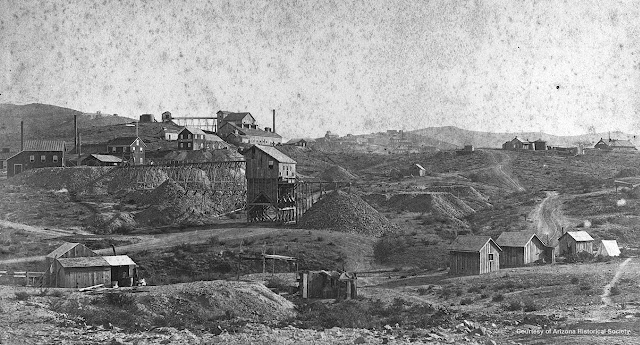
The subterranean towers of this Ilium   -  the mines of Tombstone - were drowned in 1887 after fires destroyed the pumps that kept them workable, just about the same time the price of silver plummeted. Fire also destroyed Fly's Boarding House and the Harwood house as well. 
The dawning 20th century made copper the new gold, and by 1929 the Copper Queen mine in Bisbee drew the Cochise County seat there, leaving Tombstone to fade into the Sonora desert. During the 1930's Arizona politicians tried to kill the town by using New Deal money to "improve" Fremont Street, plowing over the site of the shoot out  (above) and obliterating the history. But Tombstone refused to die.
Tuberculosis killed 36 year old John Henry "Doc" Holliday (above), in Glenwood Springs, Colorado, in November of 1887.  He died alone, in the company of a hired nurse. 
Almost all of the stories of robberies and murders attributed to Doc Holliday and the Earps originated with John Harris Behan (above), the corrupt sheriff of Cochise County. When the mines failed, Johnny moved on, leaving behind debts and missing funds. He was the brutal superintendent of the Yuma Prison for 2 years, stealing an estimated $50,000. Always a Democratic appointee and always corrupt, by the turn of the century he was in Washington, D.C., but quickly returned to the Southwest. He died in Tucson in 1912, of heart failure brought on by 30 years of syphilis, which he had contracted in Tombstone. Like most villains, he was usually guilty of the very sins he attributed to others.
The Southern Pacific Railroad provided a California job for the handicapped Virgil Earp, and supported him until he died of his wounds on 19 October, 1905. 
Wyatt Earp died of a urinary tract infection in January of 1929, at the age of 80. 
His second common law wife, Josephine Sarah Marcus Earp, died on 20 December, 1944. Neither of them suffered from syphilis. But like most gamblers "Sadie" died broke. Her funeral was paid for by silent movie cowboy William S. Hart, and Hollywood theater owner Sid Grauman. Thus the heroes of the Tombstone saga.
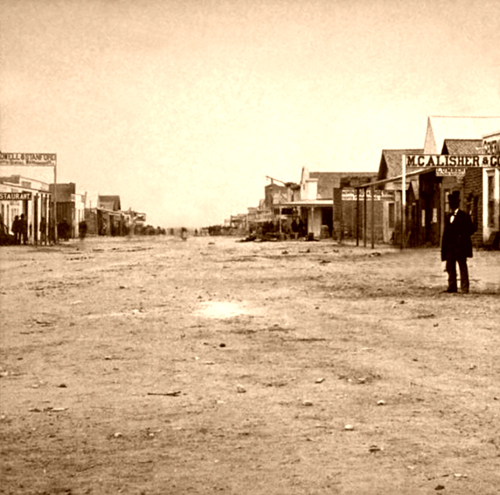
Between 1860, when Frederick Brunckow discovered silver ore along the banks of the San Pedro River, to 1890, when the mines drowned, something around $85 million dollars worth of silver was harvested from the black veins around Tombstone, Arizona. Figuring in the efforts of those who fed and entertained the miners, treated their wounds, physical and emotional, and buried their bodies, Tombstone's silver fulfilled thousands of dreams and millions of nightmares. Those who died in the effort in this desert would have died someplace else, at some other time. But this is where they died, and this was when, because the earth cracked here long before humans ever set eyes upon the place.
And asking why their tombstones were erected here, may not be worth the effort.
But nothing that happened in Tombstone was an accident, anymore than the way rocks crack along molecular lines is an accident, or the way greed drives humans to murder is an accident. But of the two ways to get rich, the fastest is to not bother with reason, and simply grab anything and everything you can. Reason is far slower to show a profit,  but it makes you far richer, and for far longer. As they said in the saloons and brothels along Allen Street,  "Name your poison, stranger."
- 30 -

Friday, August 26, 2022

TOMBSTONES Chapter Eight


I am pretty certain what 31 year old Town Marshal Frederick G. "Fred" White (above) was thinking, as he approached the empty lot near the corner of Sixth and Allen Streets. It was just about 12:30 on the chilly morning of Thursday, 28 October, 1880, and Fred had spent most of the evening chasing down and collecting guns from drunken cowboys. None of these intoxicated miscreants wanted to hurt anyone. But the difference between a chimpanzee thrashing the underbrush with a branch, and a human, is that humans have invented gunpowder and alcohol.
This was why Tombstone made it illegal to carry a gun in the city limits, except when entering or leaving town. As a man of average intelligence - which by all accounts Fred was - and being a friendly and compassionate fellow - as everyone knew him to be - Fred knew that guns plus people plus alcohol plus time eventually equals somebody getting shot. As freelance journalist Clara Spalding Brown noted the same idea when writing about Tombstone and its environs - "When saloons are thronged all night with excited and armed men, bloodshed must needs ensue occasionally."
There were half dozen men in the vacant lot between Tough Nut and Allen Streets. They were just "shooting at the moon", using their pistols as noisemakers. Fred approached the men quietly but firmly, as he always did. The drunk "Cow Boys" - Frank Patterson (of stolen mule fame), Ed Collins, James Johnson (who worked on the Clanton ranch with his brother Bill), Arthur Ames, Robert Lloyd and Curley Bill Brocius - all knew Fred and liked him. And even knowing they faced a $10 fine, they all seemed willing to hand over their guns. Fred must have been certain this would be his last such encounter that night.
The first to surrender his gun was "Curly Bill" Brocius (above). Brocius was pretty drunk, and yanked the weapon out of his pocket. As Fred White grabbed the barrel, the gun went off. The crack shattered the Arizona night. Fred groaned, doubled over and fell. In an instant a new figure stepped out of the dark, and pistol whipped Brocius to the ground.
When the confrontation began,  Wyatt Earp (above) was one block to the east, beneath the tent canvas of Owen's Saloon (below, right), where he dealt faro. Republican friends had recently secured him an appointment as a deputy sheriff for the southern part of Pima County, making him a tax assessor and collector as well. That earned him 10% of everything he collected. But that was "maybe" income, and for Wyatt, dealing faro was a sure thing. 
Still, hearing the gunfire, Wyatt walked away from the table to investigate. He saw Fred White approaching the men, and sensing danger, Wyatt borrowed a pistol from fellow stagecoach guard Fred Dodge, and walked down the street to back up the sheriff. When Ed White was shot, it was Wyatt who leapt to the wounded man's defense and disabled the shooter. The other cowboys scattered into the dark of a nearby wash and somebody started shooting at Wyatt. Almost immediately Wyatt was joined on the street by Morgan Earp and Fred Dodge.
Fred Dodge recalled years later that, "When "Morg" and I reached him, Wyatt was squatted on his heels beside Curly Bill and Fred White. Curly Bill's friends were pot-shooting at him in the dark...." In his book "Under Cover for Wells Fargo", Dodge explained, "Wyatt said to me, "Put the fire out in Fred's clothes." When he looked, Dodge saw that Brocius' shot had been so close, the muzzle blast had set Marshal White's vest smoldering.  Added Dodge,  in a letter, "Wyatt's voice was even and quiet as usual."
Once the shooting from the arroyo had slackened, volunteers carried Marshall White to the Fifth Street side of the Golden Eagle Brewery building (above), and up the stairs to the second floor office of Doctor H.M. Matthews, who was also the county coroner. At the same time Dodge and the Earps led Curley Bill off to the "lockup", a 10' X 12" windowless structure. All the way there, Billy Brocius kept asking, "What have I done?" The lawmen then proceeded to track down the others in the confrontation. Within hours all 6 of the drunks were safely in the lockup.
According to Dr. Matthews, the bullet from Brocius' gun entered Fred White's body "Four inches below and three inches to the left of the naval.... traveling downward...(and) pierced the small intestine..." Eighty years before the discovery of antibiotics, to all intents and purposes Fred White was dead the instant the bacteria inside his intestines were released into his abdomen. 
Opiates kept Fred White pain free for 2 days, giving him time to dictate a statement that the shooting had been accidental. He died on Sunday, 31 October, with his father and friends at his bedside. The gun belonging to Curley Bill Brocius was picked up in the street. It had only one round fired. Curley Bill had not even been responsible for the shooting that drew Marshall White to the confrontation. He's been trying to stop it.
In the morning, in the courthouse at Third and Toughnut Street (above), in front of Tucson's Judge Gray, Frank Patterson pleaded that he had been trying to quiet the shooting party. The others, who paid a $10 fine, each supported his story. Arthur Ames was fined an additional $30 for carrying a concealed weapon. Brocius asked to have his case held over until he could get an attorney. And given the popularity of Ed White, the Earps thought it best to transport the cowboy to Tucson to stand trial.
The first result of the shooting was that Deputy Federal Marshal Virgil Earp was asked to temporarily fill the job as Town Marshall, until a special election could be held on Saturday, 13, November, 1880.  But with the bounty of economically business opportunities available in Tombstone, the race eventually narrowed to either Virgil or the 33 year old miner, Benjamin Sippy.  The financially challenged Sippy won the November ballot, 311 to 259 votes for Virgil. Editor of the "Epitath", John Clum (above)  chose to be optimistic, suggesting Sippy "...should receive the support and assistance of all good citizens."  In fact, Ben Sippy would prove to be brave, clear headed and determined, when he was on duty.  He spent his first months in office arresting speeders on the streets of Tombstone.
Later that November, William "Curley Bill" Brocius stood trial in Tucson for Fred White's death, before Judge Neugass. Fred White's dying statement was read into the record and Wyatt Earp even testified he thought the gun had gone off "half cocked".  
Judge Neugass had little choice, and dismissed the charges. Curley Bill (above) walked out of court a free man.  Even though Wyatt's testimony had helped clear him of the murder charge, Brocius never forgave Wyatt Earp for the pistol whipping. It was yet another firm step on the road to the most iconic 30 seconds of violence in the American history.
- 30 -

Monday, October 29, 2018

TOMBSTONES Chapter Twenty

I know what Billy Clanton (above) was thinking when the shooting stopped. When photographer C.S. Fly bent down to take the empty Colt revolver from his hand, Billy Clanton told him, "Give me more cartridges". A few moments later, when they lifted the 19 year old's bleeding body he cried out in pain, "They have murdered me. I have been murdered." 
Inside the Harwood House, after Dr. Gibberson softened his pain with morphine, Billy was boastful again, threatening Wyatt - "If only I could get my teeth into that son-of-a-bitch's throat, I'd die happy." But when he realized he was slipping into the gentle night, Billy ordered the gawkers to, "Go away and let me die." But Billy was the appointed Hector of Tombstone, the last hero of the melodrama, and his public was not to be denied.
The funeral of Billy and the McLaury brothers was staged - and that is the right word - the very next day, a cold gray Thursday, 27 October, 1881. Andrew Jackson "Andy" Ritter propped the three caskets up in the front window of Ritter and Ream City Undertakers, behind a sign which read "Murdered on the Street of Tombstone" so they could be photographed (above). The Democratic Tombstone Nugget that day cried that “Three Men" had been "Hurled Into Eternity In the Duration of a Moment.” 
And at about 4:00pm - fashionably late - the 3 hearses, 22 carriages and 300 mourners,  all led by the volunteer firemen (above),  made their way to the Old Cemetery - it would not be called Boot Hill until the arrival of 20th century tourists. 
 Some 2,000 watched the procession, and even Cochise County Republicans were uneasy with the violence which had exploded on the streets of Tombstone..
It was lucky for the Democrats that Ike Clanton, the Paris in this Cow Boy Iliad, the man most responsible for the gun fight, ran away and lived.  Four days later Ike filed murder charges against the Earps and Holliday.  Older brother William McLaury, who was a practicing lawyer, came up from Texas to help prosecute the case. And a New York Democratic editorial cartoonist depicted wild man Virgil Earp, two guns blazing, trying to herd Arizona into statehood with violence (above).  In fact the shoot out helped delay Arizona statehood until Valentines Day, 1912 - making it the last of the 48 contiguous states to join the union.
The one clearly disinterested witness at the Earp's trial, a tuberculosis sufferer named Henry F. Sills, who was a fireman on the Atcheson, Topeka and the Sante Fe Railroad and had only arrived in Tombstone the day before.  He supported the Earps in all important details. The hearing judge decided the Earps had done nothing illegal. But like all violence, the shoot out did not merely end. There were aftershocks.
Half an hour before midnight, on Wednesday, 28 December, 1881, Virgil Earp (above) was shot from ambush while walking into the Cosmopolitan Hotel.  Dr. Goodfellow had to remove 4 inches of Virgil's left humerus, making him a cripple for life. The suspected shooters were Phin and Ike Clanton, Cow Boys Johnny Barnes, Johnny Ringo, Hank Swilling and Pete Spence. Although arrested, all 6 were released on $1,500 bail. No trial was ever held.
Ten minutes before eleven on the evening of Saturday, 18 March, 1882,  Morgan Earp (above) was shot through the spine while playing billiards. He died soon after. A coroner's jury would conclude the assassins were Pete Spence, Frank Stillwell, Frederick Bode and Florentino "Indian Charlie" Cruz. Convinced the Republican Party had abandoned his family, and the local Democratic courts would never punish the Cow Boys the Earps had been sent to Tombstone to breakup, Wyatt gathered a small band of supporters, and rode out to punish those who had injured his loved ones. In true epic tradition, it would be called his vendetta ride.
It began the night of Monday, 20 March, 1882. The wounded Virgil Earp, his wife and Morgan's widow boarded a Southern Pacific train to take Morgan's body to California for burial. The next morning, between the railroad tracks, the little dandy, Frank Stillwell (above), was found so full of lead the coroner described his corpse as "the worst shot up man I ever saw." Frank was the first. 
Indian Charlie died second, on 23 March. And on 24 March, Johnny Barnes was shot to death, along with William "Curley Bill" Brocius (above)  at Iron Springs, in the Whitestone Mountains, northeast of Tombstone. All of them were presumably murdered by Wyatt Earp, in revenge.
John "Johnny Ringo" Peters, so called "King of  the Cow Boys"  evidently committed suicide in July of 1882. 
Wanted for rustling, loudmouth, alcoholic Issac "Ike" Clanton was killed while avoiding arrest in 1887.   His elder brother, Phin Clanton,  served 17 months in the Yuma Territorial prison, also for rustling. He died in 1906. 
The ex-Texas Ranger and stage robber, Pete Spence (above),  aka Elliot Larkin Ferguson,  also did 18 months in Yuma, but for manslaughter. In 1910 he married Phin Clanton's widow, and died in 1914. Thus the villains of Tombstone.
The subterranean towers of this Ilium   -  the mines of Tombstone - were drowned in 1887 after fires destroyed the pumps that kept them workable, and the price of silver plummeted. Fire also destroyed Fly's Boarding House and the Harwood house as well. 
The dawning 20th century made copper the new gold, and by 1929 the Copper Queen mine in Bisbee drew the Cochise County seat there, leaving Tombstone to fade into the Sonora desert. During the 1930's Arizona politicians tried to kill the town by using New Deal money to "improve" Fremont Street, plowing over the site of the shoot out  (above) and obliterating the history. But Tombstone refused to die.
Tuberculosis killed 36 year old John Henry "Doc" Holliday (above), in Glenwood Springs, Colorado, in November of 1887.  He died alone, in the company of a hired nurse. 
Almost all of the stories of robberies and murders attributed to Doc Holliday and the Earps originated with John Harris Behan (above), the corrupt sheriff of Cochise County. When the mines failed, Johnny moved on, leaving behind debts and missing funds. He was the brutal superintendent of the Yuma Prison for 2 years, stealing an estimated $50,000. Always a Democratic appointee and always corrupt, by the turn of the century he was in Washington, D.C., but quickly returned to the Southwest. He died in Tuscon in 1912, of heart failure brought on by 30 years of syphilis, which he had contracted in Tombstone. Like most villains, he was usually guilty of the very sins he attributed to others.
The Southern Pacific Railroad provided a California job for the handicapped Virgil Earp, and supported him until he died of his wounds on 19 October, 1905. 
Wyatt Earp died of a urinary tract infection in January of 1929, at the age of 80. 
His second common law wife, Josephine Sarah Marcus Earp, died on 20 December, 1944. Neither of them suffered from syphilis. But like most gamblers "Sadie" died broke. Her funeral was paid for by silent movie cowboy William S. Hart, and Hollywood theater owner Sid Grauman. Thus the heroes of the Tombstone saga.
Between 1860, when Frederick Brunckow discovered silver ore along the banks of the San Pedro River, to 1890, when the mines drowned, something around $85 million dollars worth of silver was harvested from the black veins around Tombstone, Arizona. Figuring in the efforts of those who fed and entertained the miners, treated their wounds, physical and emotional, and buried their bodies, Tombstone's silver fulfilled thousands of dreams and millions of nightmares. Those who died in the effort in this desert would have died someplace else, at some other time. But this is where they died, and this was when, because the earth cracked here long before humans ever set eyes upon the place.
And asking why their tombstones were erected here, may not be worth the effort.
But nothing that happened in Tombstone was an accident, anymore than the way rocks crack along molecular lines is an accident, or the way greed drives humans to murder is an accident. But of the two ways to get rich, the fastest is to not bother with reason, and simply grab anything and everything you can. Reason is far slower to show a profit,  but it makes you far richer, and for far longer. As they said in the saloons and brothels along Allen Street,  "Name your poison, stranger."
- 30 -

Blog Archive