August 2025

August  2025
I DON'T NEED A RIDE. I NEED AMMUNITION.

Translate

Wednesday, September 04, 2013

GOD AND EGO

I believe that if Uthman ibn Affan had been a cruel and heartless man, millions of lives might have been saved, and history would have been kinder to today's followers of Islam. This is ironic because for most of his life Uthman had been a successful merchant, with a real talent for the cold heartless logic of an account book. It was only after he accepted the migrating embrace of Islam, and became the third Caliph, or “Commander of the faithful”, in 644 C.E.., that Uthman’s compassion for his fellow Muslims, inspired directly by the teachings of his friend and leader, the Prophet Muhammad, that Uthman's humanity lead to the greatest threat facing Islam today.
Muhammad died peacefully in 632, leaving his followers to make what they could of his life’s work. Abu Bakr, the first man to issue the public call to prayer in Mecca, was elected the first Successor of the Messenger of God, or Caliph,  Rasul Allah. During his two year reign he managed to put down rebellions, invade and begin the conversions of Iran, Syria and what is today Palestine. Abu Bakr died on Monday, August 23rd , 634, naming Umar as his successor. Umar, also known as Farooq the Great, ruled as the second Caliph for ten years, conquering the Persian Empire. He was attacked by an assassin at morning prayers in 644, and lived just long enough to name a committee to pick his successor. And as we all know, no good could can come from a selection committee.
The choice of the next Caliph fell to an election, or shura, amongst five men. Two stated publicly that they were willing to take on the burden of being Caliph; Mohammad’s cousin and son-in-law, Ali ibn Abi Talib and Uthman, known as the “man of two lights” because he had married two of the Prophet’s daughters. In the shura among the remaining three, two split, one supporting Ali and the other supporting Uthman. This left the choice to Abd al-Rahman. He announced his decision at a public meeting at a mosque - Uthman. The general acclimation left Ali with little choice but to support his competitor. But he felt cheated.
Uthman was from the Umayyad clan, one of the 15 families within the Quraysh tribe of Arabs. The Umayyard were patricians, merchants and power brokers in the city of Mecca (above), a holy city long before the rise of monotheism. Nestled amongst mountains, 50 miles inland from the Red Sea, this oasis had been founded by Abraham himself. But the center of government for the new empire was in Medina, 200 miles north of Mecca. Here the power lay in the hands of the Hashemite clan – the family of Ali ibn Abi Talib..
Once in Medina, Uthman found himself in charge of a growing military and religious empire. But Uthman saw himself as primarily a religious leader. His behavior was so pious that even the Prophet himself had said of Uthman that “angels feel bashful before him.” Uthman was a handsome man and vain enough that he dyed his beard. Every time he smiled he flashed gold, a hint of his wealth. He was a patrician, and most of his close friends even within the faith, were also wealthy. And that was to prove his blind spot.
From the first day of his 10 year reign, Uthman was the target of complaints of graft and favoritism. Some of those complaints were probably true - in an expanding empire such growing pains were to be expected. And grumblings are always heard even under good government. But there was an undercurrent of discontent nurtured by the man who might have been Caliph, the Shiat Ali Talib. And in the eleventh year of Uthman’s reign, the whispers sparked into action, just across the Red Sea, in Egypt.
In 656 Uthman called for a special Hajii, the holy journey to Mecca each Muslim is expected to make at least once in their lives. This special Hajii was to be for those unhappy with Uthman’s reign. The Caliph publicly promised to listen to any complaints, and promised to solve the legitimate ones. For the shiat Ali this was bad news. Uthman possessed the personality to sway any dissident in his immediate presence. Something would have to be done about Uthman before the holy winter months filled Mecca with hundreds of thousands of his supporters.
In the summer of 656, 1,000 Egyptians arrived in Medina, and publicly begged Ali to accept the Caliphate; publicly he refused. It was a fine show of humility, and the Egyptians next moved on to Uthmans’s house and surrounded it. They announced that no harm would come to any Uthman supporter who did not resist them. And Uthman countered by instructing his supporters to offer no resistance to the Egyptians. He even freed his slaves, saying he did not wish any blood shed in his defense.
Thus began the most amazing 20 days in all of Islam. It reminds me a bit of Thomas Becket, calmly conducting vespers while the four knights closed in to slaughter him. At first Urthman was allowed to travel to the mosque and lead prayers, the Egyptians even praying with him. Then, angry words were exchanged between Uthman’s supporters and the Egyptians. Stones were thrown, one of them striking Uthman in the head. He was carried back to his house, bloody and unconscious.
Even now, when his supporters begged to be allowed to defend him, Uthman refused, insisting he did not wish to spill the blood of Muslims. But with the Hajii beginning, there remained the possibility that the thousands gathering at Mecca would be induced to march to Medina and rescue their Caliph. At least that was what worried the Shiat Ali. The decision was made to take action.
The siege of Uthman’s home became complete, shutting off even food and water. Finally, one night, as the Caliph was saying prayers with his wives, three Egyptians burst into the bedroom and began to strike the old man in the head with clubs and swords. His wife Naila attempted to block the blows, and lost her fingers. She was tossed aside, and Uthman was beaten to death.
It had been a political assassination, and the trauma it caused burdens Islam to this day. The supporters of Ali ibn Abi Talib, now called Shi'ite (from Shiat Ali) believe that Ali had been chosen by Mohammad, and that the Caliphs who preceded him, especially Uthman, were false leaders. The supporters of the murdered Uthman believe that the Prophet himself wished the leadership to be chosen by elections, by shura. And they take their name from that concept of a democratic religion: Sunni.
Ali finally achieved the rank and office of Caliph in 656, but it brought him little comfort. First he had to put down a rebellion by one of Muhammad’s wives, Aisha. Then, he quickly faced a more serious rebellion led by Mu'awiya Ummayad, the governor of Damascus and Uthman’s cousin. This time the battle was a draw, and in order to hold onto his hard won office, Ali was forced to compromise with the Sunni’s. But this offended the more radical shi'ites, who, in God’s name, had already murdered one Caliph. It was a small step for them, in 661, to murder a second, the very man they had committed the first murder for.
The Ummayad clan would later be almost wiped out by the Shi’ites of the Hashemite in the year 750 at the Battle of Zab. And while the Sunni are today the majority in Iraqi, the Hassemite Shi’ites are the ruling family of Saudi Arabia, and guardians of Mecca and Medina, ensuring that the majority of Muslims across the rest of the world today, are Shi’ites.
The reasons and justifications for and even the truth about the death of Caliph Uthmen would seem difficult to see clearly,l  fourteen hundred years later. But what is important is that his murder stands as yet another example of humans thinking they hear the voice of God, when in fact they are only hearing the echo of their own ego. And Muslims do not have the patent on that.
- 30 -

Sunday, September 01, 2013

TOWER OF BABBEL - ONE

I offer proof there is no such thing as useless information, as illustrated by the fate of the 600 elite German paratroopers who floated down or thudded into rough glider landings on the dirt air field of Maleme in Western Crete, at about eight on the morning of May 20th, 1941. Six short hours later 400 of them were dead, killed by poorly armed, badly disorganized and under strength New Zealand infantry. And what largely killed those confident well trained, well armed Teutonic warriors was information uncovered forty years earlier and sixty miles to the east, written 4,000 years before men could fly.
The second imperial palace built at Knossos on bronze age Crete was so large visitors got lost in its labyrinthine corridors. It had been built for King Minos, and was occupied for over 400 years. It had hot showers, and flush toilets, and gardens. Its walls were adorned with colorful frescoes of sacred bulls, graceful women, and brave men. Its gold came 300 miles from Egypt, its olive oil 100 miles from Greece, its ceder throne, 400 miles from Lebanon. And then about 1375 B.C., this kingdom simply disappeared. Time eventually even wiped out its memory. For most of human history, people had no idea the acrobats of Crete were cartwheeling over the horns of bulls before Moses challenged Pharaoh. Then a British archaeologist went looking for a new meaning in his life.
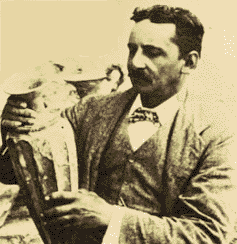
Little Arthur Evans (above)  - he stood just five feet two inches tall - had always been fascinated with ancient history, but only ancient history. He almost failed his final exams at Oxford because he knew nothing that had happened after Richard the Lion Heart died, in 1199 A.D. Evans spent half his life as a dilettante archaeologist, digging about the edges of the crumbling Ottoman Empire. When his wife Margaret died in the spring of 1893, the heartbroken 43 year old Evans went digging with a new purpose. He used his inheritance to buy land already identified as a palace three miles south of the port of Heraklion on Crete.
Beginning in the year 1900, Evans spent six years unearthing the great palace at Knossos. Its murals were so exuberant, its architecture so confident, its wealth so obvious, that Evans was certain it had been the center of a great empire which rose and fell while the ancient Greeks were still barbarians. The record of its achievements and soul were right at hand, in the thousand or so clay tablets scattered about the palace. But they were written in what seemed to be two unknown languages, younger by a millennium than the cuneiform tablets of Sumer and Babylon, but older by a century than the oldest Egyptian hieroglyphs.
Evans labeled the languages Linear A and B. His obvious choice was to attack Linear B (above) first, since the majority of the tablets were in that language. But the best brains in England were unable to read the words. After more than a decade of study the only thing Evans was certain of, was that it was not Greek. After World War One more tablets with the same mysterious pictographic language were unearthed in the palaces at Pylos, Thebes, Corinth and Mycenae, on mainland Greece As the number of uncovered tablet shards approached 3,000, the best brains in the world were still unable to read them. How could you decipher an unknown language, once the authors and speakers, and everyone who ever read or spoke the language, was long dead?
For 1,500 years the most popular method to decipher coded messages was the one invented by the Syrian mathematician Al-Kindi - frequency analysis. In essence, he reduced the language to a math problem, figuring the most common letter used in each word, (in English it is, “e”) and working back from there. But none of the symbols used in Linear B appeared in any statistically significant variation. The diligent mathematicians Evan's hired simply did not have the resources to crack the puzzle of Linear B. But the effort did provide a good testing ground for new theories, just in time to deal with an ambitious electrical engineer who thought he had a great way to get rich.
His name was Arthur Scherbius, and in 1918 he marketed his new mechanical rotor device under the name “Enigma”. Pushing the letter “e” on Scherbius's keyboard turned a mechanical rotor (above) one spot forward. There were twenty-six spots on each rotor, so the letter produced by the rotor would be a different, totally random letter from the one input, determined only by the original position of that rotor. Putting the rotors in sequence would make the code practically impossible to break, unless you knew the starting setting of each rotor. And those could be changed either randomly or according to a schedule.  In 1926 Scherbius sold his machine to the German Navy, and the following year to the German Army, who thought the code was unbreakable.
And it might have been, but in 1928 a minor bureaucrat on the Army General Staff did something stupid. Instead of sending their new Enigma machine (above) to their embassy in Warsaw, Poland in a diplomatic pouch, he sent it by mail. When it failed to promptly arrive, the ranking German officer in Warsaw panicked, and asked the Poles to please look for the package. Intrigued, the Polish postal workers searched for, found and opened the box, and got their first look at the Enigma machine. Polish intelligence service spent a long weekend disassembling it and building a duplicate machine. Then they carefully repackaged the original and delivered it to the relived German embassy staff.
The Germans had little reason to worry even if they had known. With eight rotors wired in sequence, Scherbius had figured it would take 1,000 technicians using frequency analysis, 900 million years to try every possible combination of keys and rotor settings just to read a single message. And he was right. The Polish code breakers struggled with the machine for a decade, but came up with nothing. Finally in 1939, facing an impending German invasion, the Poles shared their duplicate Enigma with British Intelligence. And in 1941, a brilliant English mathematician named Arthur Turing, built his own electro-mechanical machine (above) which could try each of the millions of possible mechanical rotor settings on Enigma in a matter of hours. With that, it became possible to break the unbreakable German codes.
The first use of this British “Ultra Secret” was on April 28th, 1941, when their commander on Crete was given details of the coming German invasion. General Freyberg was not sure he could completely trust this new source, and divided his troops between the sea coast and the air bases, where Ultra said the attack would come. 
But enough men were guarding Maleme airfield on May 20th 1941 to slaughter the German units as they landed. British Prime Minster Winston Churchill pointed out that “"At no moment in the war was our intelligence so truly and precisely informed.” 
In the end it did not save Crete, because the German air force prevented General Freyberg from bringing his reinforcements back from the coast. Eventually German reinforcements swamped the New Zealanders and forced the British to evacuate the island.. The battle cost the British 3,990 dead and 17,000 captured. But it cost the Germans 6,698 dead, and 370 aircraft destroyed. Their decimated parachute battalions never made another massive combat drop.
A little over two months before the fall of Crete, little Arthur Evans (above) died in England, still convinced that Linear B was an as yet unknown language. And through the multiplying effect of tenure and graduate students, he was able to reach out from beyond the grave to influence the effort to decode his tablets for another generation. The solution, it turned out, had been offered by the 13th century Franciscan monk and philosopher Roger Bacon, from his study atop Folly Bridge (below). Bacon wrote, “Prudens quaestio dimidium scientiae”, or “Half the answer is asking the right question.”
-30 -

Friday, August 30, 2013

TRUE BELIEVERS


I will tell you, Neal Dow was the worst type of politician - a true believer. If you travel long enough down any philosophical path you always reach the land of ad nausea. But the true believer will never admit that such a place exists in their philosophy. So having reached ad nausea this spiritual Puritan in Quaker garb, this five foot two inch tall Napoleon of Temperance, this two term Mayor of Portland, Maine, Neal S. Dow, could never find his way back to sanity. Even the Rum Riot of 1855 failed to convince Mayor Dow that his own blindness had set the cause of sobriety in America back by a generation.
The first time Neal Dow (above) was elected Mayor was in April of 1851. He had been carried into office on his support of the new “Maine Law”, which made the sale of alcohol in the state illegal, except for medicinal and industrial uses. Wrote Neal, “Portland wharves groaned beneath the burden of West India rum.” Eighteen other states quickly followed Maine's moralistic lead. But as in all the other states, the new law was popular in Calvinist Maine only so long as it was easily avoided.
The most famous bootlegger became “Handsome Jim” James McGlinchy, who along with his three brothers, operated the Casco Brewery, after the original name for Portland. It and a few distilleries survived the Maine Law because, officially, they exported all of their product. But a good part of all that rum seeped back into Maine. Such leaks in his prohibition boat infuriated Mayor Dow, who was also president of the Temperance League. And after raiding every Irish “grog shop” in Portland failed to plug the local traffic in the demon rum, the Mayor insisted on searching all trains, boats and wagons entering the city. Since Portland was the primary rail and sea connection with Canada, the delays this created infuriated merchants up and down the eastern seaboard. Dow was even burned in effigy on Boston Common. And in April of 1852, when Mayor Dow came up for re-election, merchants from all over New England funded his opponent, Albion K. Parris. Mayor Dow lost re-election by 542 votes out of 3,300 cast.
Being a true believer (his maternal great-grandfather had the given name of “Hate-Evil”), the diminutive Mr. Dow could not believe the fault was his or his cause's . He was convinced he had been victimized by a conspiracy of merchants who provided fake I. D.s for the 2,200 Irish immigrants in Portland who had brought to America their strange religion and their vulgar sinful ways. Even worse, they almost all voted Democratic. Still at least the new Mayor Parris was also a temperance man, if not quite as enthusiastic an enforcer of the law. So“The Grand Pooh-bah of temperance” as the Irish nick-named him, retreated to his house at 714 Congress Street, to lick his wounds, and plan his comeback.
Under the theory that the only problem with his temperance law was that it was too weak, in 1853 Dow lobbied the state legislature in Augusta to doubled down. The new sterner temperance law they passed allowed a search warrant to be issued if three private citizens claimed liquor was present in an establishment. It also made the mere possession of alcohol proof of intention to sell. Thus ever user was now a dealer. By now Dow was convinced the temperance movement was so strong...“The voters...will turn upon that point.” The little dictator even saw the growth of the Republican Party across the northern states not as primarily a condemnation of slavery, but as a rejection of alcohol.
In March of 1855 Maine passed two other pieces of legislation which Dow had come to see as essential for the eradication of liquor. First all immigrants must register and show their naturalization papers three months prior to election day. This disenfranchised hundreds of qualified voters for the approaching April elections, under the theory that what a local newspaper described as “Irish cattle” were also  “illegals” with false papers. The second law took care of most of the rest of Irish voter-wanna-be Americans. From now on, any voter rejected at the polls for whatever reason in Republican Maine, must appeal in Federal court. Cases here could take weeks just to get on the docket. The Democratic paper, the Eastern Argus put it best. “Dow...and company...have made up their minds to rule the state at all hazards.”
And they did. Dow was re-elected Mayor in April of 1855. But out of the 3,742 votes cast, Neal Dow's margin of victory was a mere 46 votes. Ignoring that slim margin his close friend and political ally, Elder Peck, said it was “...a victory over Rum…Catholicism, and Corruption.” In his inaugural address, the zealot Mayor Dow warned, “I shall not fail... to employ all the power which the law has put into my hands.” He even suggested that his administration would “restrain the right of suffrage, now exercised by our foreign population...to prevent their overawing and controlling our elections, as they have done.” Mayor Dow had thrown down the gauntlet. And it would slap him right across the mouth.
As part of his new duties, Mayor Dow and the city council were supposed to jointly appoint a committee to pick a new liquor agent, whose job it would be to purchase liquor which would then be legally sold to the apothecaries and industries of the city. However Mayor Dow was so certain of his own nobility, he appointed himself to the selection committee, and to save even more time appointed himself the temporary liquor agent. As such he purchased $1,500 of booze (in his own name) and had it shipped to City Hall. Only after it arrived did he notify the city council. After all, who could question the morals of Mayor Dow?
The answer was the city council could. Their council members got into a shouting match with the Mayor over his actions. And one of them leaked details of the shipment to the Eastern Argus. On Saturday June 2, 1855 the paper printed up and posted handbills all over Portland, which laid out the facts, in particular that the liquor had been bought under the name of Neal Dow. The handbills then asked, “Where are our vigilant police... who think it their duty to...often push their search (of the poor man's cider) into private houses, contrary to every principle of just law? We call upon them by virtue of Neal Dow’s law to seize Neal Dow’s liquors and pour them into the street....Let the lash which Neal Dow has prepared for other backs be applied to his own when he deserves it.”
The timing could not have been worse for Mayor Dow. This was the four year anniversary of the original Maine Law. Three men found a judge who witnessed their testimony that there was illegal alcohol in City Hall, and he was thus required to issue a search warrant. A small crowd gathered at City Hall, mostly to see if the police were going to arrest Mayor Dow. They were not. But still the crowd stayed. And as the day wore on, and the shifts at the locomotive plant and other factories let out, the crowd began to grow. By seven that evening there were 2,500 people milling around City Hall, their anger fueled by what they saw as the hypocrisy of the biggest temperance man in the state having his own $1,500 stash of booze protected by the police. To avoid antagonizing the crowd the ten police officers locked themselves in the Liquor Room in City Hall, with the booze. Mayor Dow sent word to two “private” militia companies to come quick.
At least one member of the militia sensed the approaching disaster. But when Sargent William Winslip suggested the militia should load blanks, Mayor Dow responded, “We know what we are about sir. We’ve consulted the law, sir.” At that point Sargent Winslip dropped out of the militia. At ten that night one company of about twenty men, formed up in front of City Hall. Backed by armed troops, Mayor Dow ordered the crowd to disperse. The crowd responded with a hail of trash and garbage. Dow now ordered the troops to fire over the heads of the crowd. But their commander, Captain Green, said he needed more men. And for the only time that day Mayor Dow let a cooler head over-rule him.
It was a mistake. The sight of the twenty militia men retreating encouraged the crowd to surge forward. Rocks and bricks now replaced the garbage. One energetic fellow, a 22 year old sailor from Deer Isle named John Robbins, crawled through a broken window into the liquor room, unlocked the door, and the crowd stormed in.  At this moment the reinforced militia returned, and under Dow's command, opened fire. The uneven battle continued for twenty minutes. Only the fact the militia were armed with flintlock muskets prevented the death toll from being higher. Robbins was killed, and seven others wounded. Eventually the crowd dispersed. To Republicans it was the Rum Riot. To Democrats it was the Portland Massacre.
Dow was charged with breaking the law he had helped pass, but he was acquitted after a one day trial for two reasons – first it was obvious the liquor was not really his, and second because the judge, Henry Carter, was a strong temperance man and a Dow supporter. Still, Mayor Dow learned nothing from the debacle. He immediately issued a “...Message on the Riot” which he blamed on un-named anti-temperance men, and claimed John Robbins was an Irish immigrant who was wanted by the law. But that charge fell apart when several witnesses under oath testified that John was a native American (i.e. born in America),  had never been arrested, was a mate on the barque Louisa Eaton and was a “steady, honest man, remarkable for his good nature and peaceable disposition.”  But whatever Robbins' disposition had been, it was suddenly clear the mob had been outraged at Mayor Dow's behavior and had not even been mostly Irish.
That fall the voters drove that point home by electing Democratic majorities to both houses of the state legislature, and the Governor's office, too. And quickly the Maine Law was overturned, ending Maine's five year experiment with prohibition. John Robbins was buried in the old Eastern Cemetery, with honors. Mayor Dow did not bother to even run for re-election. And even though prohibition was re-instated two years later, Neal Dow stayed out of that fight.
The new prohibition law was again rarely enforced. Thus it stayed on the books until the Federal government passed its own “noble experiment” in 1920. By then the bootlegger James McGlinchy had died, in 1880. He left behind an estate worth $200,000, marking him as one of the richest men in Portland. As for the true believer Neal Dow, he was lucky not to live long enough to have seen his dream produce what he feared most, the funding of organized crime, largely made up of foreigners,  and an increase in public drunkenness and alcohol addiction. The Napoleon of Temperance died still blind to the truth in 1897 at the age of 93.
And if there is a lesson from the life of Neal Dow, it is that ad nausea is the land where all ideas end up. Or, to put it another way, life is not about perfection, its about balance - it's about leaning into the wind, and staying upright as long as you can. Everybody falls off at least once, in the end. And the lucky ones do it a couple of times. Because they learn from every failure, and they keep getting back on the wire.
-  30  -

Wednesday, August 28, 2013

FLUSH WITH SUCCESS

I always assumed the key hole shaped double holes of a Roman toilet was for male dripppers and dribblers:. au contraire. Feminine dribblers lack the arc that male drippers project, making the slit redundant for that purpose on the woman's side. And yet it is a unisex feature in Roman lavatories. Atmospheric circulation, perhaps? Moving air is not as vital in a public toilet as moving water, which is why Roman lavatories were always built adjacent to the public baths. Dirty soapy water pouring out of the bathing pools not only removed the solid waste it also quickly carried away the odor, thus killing two birds with one stone. Except they weren't using stones. And that was the reason for two holes.
The oldest human paleo-poop may be older than humans. It was uncovered by Dr. Louis Leaky at Oldivi Gorge in the African rift valley. These million year old Tanzanian turds, also known as coprolites (fossilized faeces) failed to produce DNA, so we're not certain they were made by would- be people or would-be people eaters. But they were found next to proto-human bones and stone tools, so it is logical to assume this stone shiza was also proto-human made. Other suspected human keester cakes have been located in South Africa, and France. But so far the oldest confirmed human droppings are a mere 18,000 years old, from Wadi Kuabbaniya in southern Egypt
However, ground zero in the historic hunt for brown October is the western United States, where six fossilized 14,000 year old tuchus tots have been retrieved from the four Paisley Caves, in south-central Oregon. Other pre-Clovis intestinal sculptures have tested positive for human DNA in Colorado, and the Gypsum Plain in southwest Texas. Some of this per-historic doodie has even been re-hydrated. Warns one scientific paper, “Human coprolites sometimes produce an intense odor when reconstituted...(those from) Texas are some of the most odoriferous we have ever encountered.” Of course, nobody from Texas will admit their re-hydrated coprolites smell.
If you think about it – and I clearly have - human fecal matter should be far more numerous than human fossils. We release a coeliac flux anywhere between three times a day and three times a week, depending on our diet and age. So do the math; there can be up to 1,095 products of Uranus for every year for every human who ever lived. If half of it fossilized we should be building pyramids out of the stuff. Luckily it doesn't, else this would be a much smellier world than it is, except in Texas, whose residents insist they produce only odorless excretta.
The logical solution, so to speak, was water. Most ancient human settlements were established beside ancient lakes (as in Paisley Caves, above), near rivers or the sea shore, which provided a fresh water bidet to carry away the evidence of any Mr Hanky. The abrasive alternative was grasses and leaves - contraindicated for an upright creature such as humans. If you want an idea of how compromised the design of our species is, look a chimpanzee straight in the butt. Their rectum projects away from their body, whereas ours is repressed between muscular buttocks, squeezed almost to the point of being an internal organ. Physical evolution has left us without a clean poop shoot. Social evolution was our only hope to solve our poop problem, if as they say in Texas, we had the stones for it..
Pebbles had three advantages as a toiletry. They were readily at hand – so to speak – even in the desert, they were cheap and easily transportable, often in a small bag similar to those used by boys of my generation to carry marbles. And the more they resembled marbles, the more like two ply they were. The ancient Greek proverb taught “Three stones are enough to wipe your ass”, which was the parsimonious Parthenon party pooper's prudent policy. The upscale merde producer in ancient Greece could even splurge on designer toilet pebbles, or “ostraca ”, from their local amphora maker.
These were the big Terra cotta jugs used to transport wine, and ostraca were chunks from broken ones, small ceramic pieces reused for everything from scratch paper to ballots. The public would vote by dropping an ostraca in one of two baskets. If most of the ostraca were left in the “throw the bum out of town” basket, the offender would be “ostracized”, or ejected from the community. Ostraca used as toilet stones have been found in ancient cesspits below the Parthenon, marked with the names of politicians, even the name “Socrates”: a variation on the idea of wiping your feet on your enemies corpse.
In Roman Latin the “ostraca ”became the “pessoi”, forerunner of our word pebble, and these now had the rough edges ground off and smoothed, something for an entry level slave to work at. But the pessio were usually for the poorer classes, for use at the lavatories and baths of Caracalla, which had seating for over 1,600 users at once, and was six times larger than St. Paul's Cathedral. Pessio were also part of the travel kit for soldiers and salesmen. Still, as Dr. Philippe Charlier notes in his article for the British Medical Journal, “The abrasive characteristics of ceramic suggest that long term use of pessoi could have resulted in local irritation, skin or mucosal damage, or complications of external haemorrhoids.” Or, as the biblical prophet said, “He who is without sin, cast the first stone. And for God's sake, make it a smooth one.”
Still, the 144 “toilet publica” in Rome must have been lively places, with patrons sitting cheek to cheek, sharing gossip, arguing politics, farting and grunting, groaning and laughing, making business deals or even fielding dinner invitations. As the first century poet Marcus Valerius Martialis explained, “Why does Vacerra spend his hours in all the privies, and day-long sit? He wants a supper, not a shit.” The only modicum of privacy and propriety was provided by a discreetly draped toga, hardly sound or odor proof. Since neighborhoods in Rome were financially segregated, there was no mixing of lower class excreta with upper class poo-poo. But watching your competitor strain over a heavy load must have provided a business insight but faintly replaced by modern day spreadsheets and the Wall Street Journal. And that brings us back to those mysterious keyhole slits.
The toilet tool of choice for the ruling class was the “tersorium” (above) - basically a sponge on a stick. A long stick. The bark was scrapped off most of the 12”, but left on the end to provide a good grip. Once you had set your toxic turdeys free, you took the tersorium from the ariensis spongia (toilet attendant) and thrust it between your legs (through the bottom of the keyhole), where the sponge was applied to your bare bodkin - the inside of each buttock. After the sponge, which had already given its life in the service of Rome, had given again, it was rinsed in a small stream of used bath water, running along a channel at your feet. Then it was either handed back to the attendant, who was careful not to grab “the short end of the stick", to be dropped, sponge down, in a jug of vinegar, a.k.a., carboxylic acid. After a short sanitizing dip, it was available to be used by the next patron.
So that is why there are two connected holes in a Roman toilet. Access. And that was why a surprising number of business deals and political conspiracies were hatched in Roman toilets. Access. Once you walked into a ruling class public toilet, you had intimate access to men of power. And that is why no man of power in Rome went to the toilet without his body guards. Given all the points of access in a public toilet, it must have been a very crowded place at times.
Sewers and politics share a long and intimate history. Along with sponges.
- 30 -  

Blog Archive