August 2025

August  2025
I DON'T NEED A RIDE. I NEED AMMUNITION.

Translate

Showing posts with label Protests. Show all posts

Sunday, April 26, 2015

HIT THE ROAD JACK

I should point out that when Martin Van Buren (above) was humiliatingly dumped into an Indiana hog wallow, ruining a very expensive pair of pearl gray trousers and coating his elegant frock coat with everything a happy swine leaves behind in a porcine sauna, he deserved it. Of course “The Red Fox of Kinderhook” was far too crafty a politician to admit he had been humiliated. That would just draw more  humiliation. As the venomous Virginia politician John Randolph observed, Martin Van Buren always “rowed with muffled oars.” But everybody knew this traffic accident had been staged as payback for Van Buren having insulted Hoosiers. What goes around comes around. And it was useless to point out that the insult had mostly come from Van Buren's predecessor, the still popular Andrew Jackson.
Even the frail shadow of federal authority which existed in 1828 was too much for incoming President Andrew Jackson (above). Over his two terms, Jackson did his very best to attack "big government",  in all its endeavors except the ones of which he approved. Jackson vetoed a new charter for the National Bank - precursor of the Federal Reserve - which left the entire banking system unregulated. He streamlined the sale of public lands, which energized land speculators and overcharged yeoman farmers. He cut entire programs out of the Federal budget, and insisted the states take over many others. And at the same time he backed the Seminole Indian nation into a war.
But it was not until three months after his successor Van Buren's inauguration in March of 1837 that these pigeons came home to roost. The massive real estate bubble suddenly popped. Over half of the nation's unregulated banks suddenly failed. And by January of 1838 half a million Americans were unemployed. Or to put it more simply, suddenly it was prom night and Martin Van Buren was dating Carrie. And like Carrie's date, Van Buren then made things worse by slashing out at everything in sight. Oh, he continued the unending expensive Seminole war. But he insisted on killing Federal funding for the National Road, which had reduced mail time between Washington and Indianapolis from several months to less than a week. Van Buren was so doctrinaire he even sold off the construction workers' picks and shovels. And for frontier farmers trying to get their produce to market, that made any economic recovery that much harder.
See, once across the Ohio border, the $7,000 a mile construction costs for the National Road was supposed to be supplied by land sales. But when the real estate bubble popped in 1837, that funding evaporated. Maintenance for the 600 mile road was paid for by the tolls of four to twelve cents per ten mile section (the equivalent of $2.50 today), paid by the 200 wagons, horseback riders, farmers and herds of livestock that used each section of the road every day. But after 1837 that $36,000 a year (almost a million dollars today) had to do double duty, finishing the road and providing maintenance for the road already completed  And it was not enough.
Particularly in Indiana, there were long sections beyond the two urban centers, ((Indianapolis and Richmond) where farmers using the road to drive their livestock to market faced forests of 14 inch high tree stumps. These provided clearance for the farmers' and emigrants' high riding Conestoga wagons, but between the stumps, the road bed was in such bad shape that constant repairs to their equipment bankrupted many of the 200 stagecoach lines trying to survive in Indiana. And every frontier farmer and businessman knew exactly who was to blame for all of this –“President Martin Van Ruin”.  As a result, in the election of 1840, in Hendricks County, (just southwest of Indianapolis), and along the National Road, Van Buren received 651 votes, while Whig candidate William Henry Harrison received 1,189 votes. Nationwide, Van Buren carried just 7 of the 26 states.
Normally this Hoosier hostility would not have lasted long, but just six months after taking office, the new President Harrison died of a pneumonia, and all previous assumptions had to be rethought . The Whigs had picked John Tyler as Vice President, mostly to get rid of him. Now, disastrously, he was the head of their party. The overjoyed Democrats began referring to Tyler as “His Accidency.” The adroit and dapper Martin Van Buren began thinking he could avenge his defeat and take the road back to the White House in 1844. All he needed was a cunning plan, which he just happened to have. 
In February of 1842, Van Buren (above) journeyed to Nashville, Tennessee, for an extended visit with his mentor Andrew Jackson, hoping some of Old Hickory’s popularity would rub off on him. It did not. Heading north, Van Buren then set off for a tour of the frontier states. He was well received in Kentucky, and the pro-slavery areas around Cincinnati, Ohio, but the closer he got to Indiana the more reserved the crowds became.
In early June he was met at the Indiana border by 200 loyal Democrats, and gave them a speech at Sloan's Brick Stage House on Main Street (the National Road) in Richmond, Indiana. But the vast majority of the local Quakers remained skeptical. And while Van Buren was speaking, noted the Richmond Palladium newspaper, “...a mysterious chap partially sawed the underside of the double tree crossbar of the stage...so that it would snap on the first hard pull…”
The next morning the stagecoach and its distinguished passenger headed for Indianapolis, the “Capital in the Woods”. But just two miles outside of Richmond, while bouncing over ruts and stumps, the carriage splashed into a great deep mud hole. And when the horses were whipped to yank the carriage out, the weakened cross brace snapped. Dressed in his silk finery, Martin Van Burn was forced to disembark into the foul waters and wade to shore.
There was no indication of any further sabotage on Van Buren's 74 mile ride across the mostly open prairie, which took the better part of three days. The ex-President and future candidate made it to the Hoosier capital in time to keep his appointments and make his speeches over the weekend of June 9-10. He took two more days to make political contacts, shaking hands and trading confidences, before, on Wednesday, June 13, he boarded yet another mail coach for the 75 mile journey to Illinois. But just six miles down the road, Van Buren had to pass through the Quaker bastion of Plainfield, Indiana.
The town earned its name from the “plain folk” who had laid out the town ten years earlier on the east bank of White Lick Creek. This Henricks county town was straddled by the National Road, which provided Plainfield's livelihood. Less than a quarter mile up Main Street from the  ford over the "crick", amidst a stand of Elms, the Quakers had built a camp ground and built a meeting house. And here, that Wednesday morning, were gathered several hundred Wigs and Quakers, in their “Sunday, go to meeting clothes”, to see the once and maybe future President ride past. The crowd may have even been increased because the driver of this particular leg of the President's journey was a local boy, twenty-something Mason Wright. Soon, the crowd heard the blast of the horn from Mason's lips, warning of the VIP's bouncing approach down the gentle half mile slope toward White Lick Creek.
The disaster occurred abruptly. The coach rushed into view, with Van Buren's arm waving out of the coach's open window, while Teamster Wright whipped the horses to move faster. Faster? Shouldn't he be slowing down to let people get a view of the President?  And then, just as carriage came abreast of the center of the campground, the coach was forced to veer to the right to avoid a large "hog waller" mud hole in the very center of the dilapidated National Road. And as if  it had been planned, the right front wheel bounced over the hard knuckle of an exposed bare Elm root. The carriage teetered for an instant until the rear wheel bounced over the same root. The teetering coach then careened past the point of no return.  Mason Wright leaped free while the coach crashed heavily onto its side into the very center of the smelly, sticky, hot black hog waller. Martin Van Buren had been dumped again.
A Springfield Illinois newspaper would note a few days later, “He was always opposed to that road, but we were not aware that the road held a grudge against him!” Wrote a more bitter Wig newspaper, “the only free soil of which Van Buren had knowledge (of) was the dirt he scraped from his person at Plainfield.”  The driver and witnesses blamed the Elm (above), which could not defend itself. Van Buren was uninjured, but once again had to extricate himself from his injured coach. After pouring the mud and other unidentified muck from his boots, Van Buren made his way on foot further west along the National Road to Fisher’s Tavern, at what is now 106 E. Main Street, Plainfiield. There, Mrs. Fisher helped the President clean up his pants and coat, and wash the mud from his wide brimmed hat.
Back at the campground. the honest Quakers helped to right the stage, re-attach the horses, and carefully and respectfully deliver the coach to Fishers to collect the President. But it is hard to believe that, as Mr. Van Buren splashed across White Lick "crick" many of those Quakers were not smiling with the sly satisfaction of a job well done. 
A few days later Teamster Mason Wright was awarded a $5 silk hat, although it was never explicitly stated it was for his skill in staging a stage crash - call it political slapstick. But the tree who's root had provided the fulcrum for the prank would forever more be known as the Van Buren Elm.  In 1916 (above) the Daughters of the American Revolution even gave the tree a wooden plaque of its own.
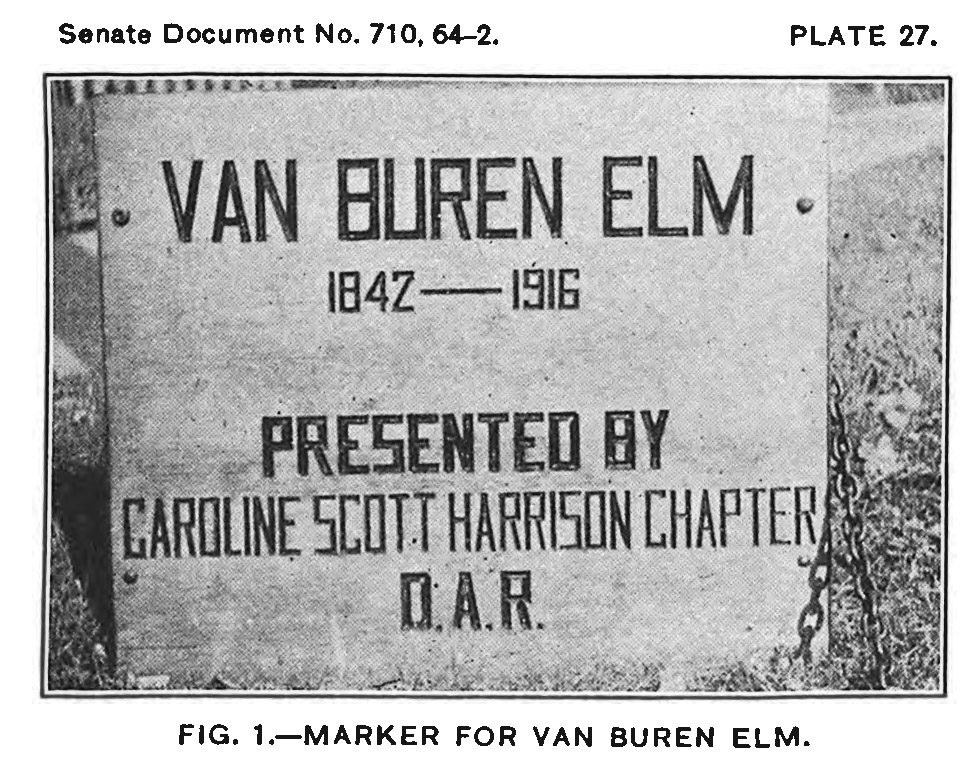
But the hard winter of 1926 brought the Van Buren Elm down, and a local doctor lamented, “The many friends of the old historic tree are loath to have it removed from their midst.”
Van Buren (above) made it safely to Illinois without further accidents. He was  met a few miles outside of Springfield by a small delegation of legislators, including the young Abraham Lincoln. But Mr. Van Buren was never elected to public office again. The judgement of Hoosiers stood firm.
The Quakers' Meeting House still stands among the Elms at 256 East Main Street (corner of Vine) in Plainfield.  After the original Buchan Elm fell, a replacement was planted, and it received a bronze plaque (above).  This inspired a local grade school to be named for the dapper Democrat who stumbled in their town, and a street was named after him as well. But in Plainfield the National Road (now U.S. Route 40), is still called Main Street. That is true of many Midwestern towns bisected by the National Road. It truly was America's Main Street. And Martin Van Buren had been wrong about that.
 - 30 -

Friday, March 07, 2014

PAY BACK

I should point out that when Martin Van Buren (above) was humiliatingly dumped into an Indiana hog wallow, ruining a very expensive pair of pearl gray trousers and coating his elegant frock coat with everything a happy swine leaves behind in a porcine sauna, he deserved it. Of course “The Red Fox of Kinderhook” was far too crafty a politician to admit he had been humiliated. That would just draw more  humiliation. As the venomous Virginia politician John Randolph observed, Martin Van Buren always “rowed with muffled oars.” But everybody knew this traffic accident had been staged as payback for Van Buren having insulted Hoosiers. What goes around comes around. And it was useless to point out that the insult had mostly come from Van Buren's predecessor, the still popular Andrew Jackson.
Even the frail shadow of federal authority which existed in 1828 was too much for incoming President Andrew Jackson (above). Over his two terms, Jackson did his very best to attack "big government",  in all its endeavors except the ones of which he approved. Jackson vetoed a new charter for the National Bank - precursor of the Federal Reserve - which left the entire banking system unregulated. He streamlined the sale of public lands, which energized land speculators and overcharged yeoman farmers. He cut entire programs out of the Federal budget, and insisted the states take over many others. And at the same time he backed the Seminole Indian nation into a war.
But it was not until three months after his successor Van Buren's inauguration in March of 1837 that these pigeons came home to roost. The massive real estate bubble suddenly popped. Over half of the nation's unregulated banks suddenly failed. And by January of 1838 half a million Americans were unemployed. Or to put it more simply, suddenly it was prom night and Martin Van Buren was dating Carrie. And like Carrie's date, Van Buren then made things worse by slashing out at everything in sight. Oh, he continued the unending expensive Seminole war. But he insisted on killing Federal funding for the National Road, which had reduced mail time between Washington and Indianapolis from several months to less than a week. Van Buren was so doctrinaire he even sold off the construction workers' picks and shovels. And for frontier farmers trying to get their produce to market, that made any economic recovery that much harder.
See, once across the Ohio border, the $7,000 a mile construction costs for the National Road was supposed to be supplied by land sales. But when the real estate bubble popped in 1837, that funding evaporated. Maintenance for the 600 mile road was paid for by the tolls of four to twelve cents per ten mile section (the equivalent of $2.50 today), paid by the 200 wagons, horseback riders, farmers and herds of livestock that used each section of the road every day. But after 1837 that $36,000 a year (almost a million dollars today) had to do double duty, finishing the road and providing maintenance for the road already completed  And it was not enough.
Particularly in Indiana, there were long sections beyond the two urban centers, ((Indianapolis and Richmond) where farmers using the road to drive their livestock to market faced forests of 14 inch high tree stumps. These provided clearance for the farmers' and emigrants' high riding Conestoga wagons, but between the stumps, the road bed was in such bad shape that constant repairs to their equipment bankrupted many of the 200 stagecoach lines trying to survive in Indiana. And every frontier farmer and businessman knew exactly who was to blame for all of this –“President Martin Van Ruin”.  As a result, in the election of 1840, in Hendricks County, (just southwest of Indianapolis), and along the National Road, Van Buren received 651 votes, while Whig candidate William Henry Harrison received 1,189 votes. Nationwide, Van Buren carried just 7 of the 26 states.
Normally this Hoosier hostility would not have lasted long, but just six months after taking office, the new President Harrison died of a pneumonia, and all previous assumptions had to be rethought . The Whigs had picked John Tyler as Vice President, mostly to get rid of him. Now, disastrously, he was the head of their party. The overjoyed Democrats began referring to Tyler as “His Accidency.” The adroit and dapper Martin Van Buren began thinking he could avenge his defeat and take the road back to the White House in 1844. All he needed was a cunning plan, which he just happened to have. 
In February of 1842, Van Buren (above) journeyed to Nashville, Tennessee, for an extended visit with his mentor Andrew Jackson, hoping some of Old Hickory’s popularity would rub off on him. It did not. Heading north, Van Buren then set off for a tour of the frontier states. He was well received in Kentucky, and the pro-slavery areas around Cincinnati, Ohio, but the closer he got to Indiana the more reserved the crowds became.
In early June he was met at the Indiana border by 200 loyal Democrats, and gave them a speech at Sloan's Brick Stage House on Main Street (the National Road) in Richmond, Indiana. But the vast majority of the local Quakers remained skeptical. And while Van Buren was speaking, noted the Richmond Palladium newspaper, “...a mysterious chap partially sawed the underside of the double tree crossbar of the stage...so that it would snap on the first hard pull…”
The next morning the stagecoach and its distinguished passenger headed for Indianapolis, the “Capital in the Woods”. But just two miles outside of Richmond, while bouncing over ruts and stumps, the carriage splashed into a great deep mud hole. And when the horses were whipped to yank the carriage out, the weakened cross brace snapped. Dressed in his silk finery, Martin Van Burn was forced to disembark into the foul waters and wade to shore.
There was no indication of any further sabotage on Van Buren's 74 mile ride across the mostly open prairie, which took the better part of three days. The ex-President and future candidate made it to the Hoosier capital in time to keep his appointments and make his speeches over the weekend of June 9-10. He took two more days to make political contacts, shaking hands and trading confidences, before, on Wednesday, June 13, he boarded yet another mail coach for the 75 mile journey to Illinois. But just six miles down the road, Van Buren had to pass through the Quaker bastion of Plainfield, Indiana.
The town earned its name from the “plain folk” who had laid out the town ten years earlier on the east bank of White Lick Creek. This Henricks county town was straddled by the National Road, which provided Plainfield's livelihood. Less than a quarter mile up Main Street from the  ford over the "crick", amidst a stand of Elms, the Quakers had built a camp ground and built a meeting house. And here, that Wednesday morning, were gathered several hundred Wigs and Quakers, in their “Sunday, go to meeting clothes”, to see the once and maybe future President ride past. The crowd may have even been increased because the driver of this particular leg of the President's journey was a local boy, twenty-something Mason Wright. Soon, the crowd heard the blast of the horn from Mason's lips, warning of the VIP's bouncing approach down the gentle half mile slope toward White Lick Creek.
The disaster occurred abruptly. The coach rushed into view, with Van Buren's arm waving out of the coach's open window, while Teamster Wright whipped the horses to move faster. Faster? Shouldn't he be slowing down to let people get a view of the President?  And then, just as carriage came abreast of the center of the campground, the coach was forced to veer to the right to avoid a large "hog waller" mud hole in the very center of the dilapidated National Road. And as if  it had been planned, the right front wheel bounced over the hard knuckle of an exposed bare Elm root. The carriage teetered for an instant until the rear wheel bounced over the same root. The teetering coach then careened past the point of no return.  Mason Wright leaped free while the coach crashed heavily onto its side into the very center of the smelly, sticky, hot black hog waller. Martin Van Buren had been dumped again.
A Springfield Illinois newspaper would note a few days later, “He was always opposed to that road, but we were not aware that the road held a grudge against him!” Wrote a more bitter Wig newspaper, “the only free soil of which Van Buren had knowledge (of) was the dirt he scraped from his person at Plainfield.”  The driver and witnesses blamed the Elm (above), which could not defend itself. Van Buren was uninjured, but once again had to extricate himself from his injured coach. After pouring the mud and other unidentified muck from his boots, Van Buren made his way on foot further west along the National Road to Fisher’s Tavern, at what is now 106 E. Main Street, Plainfiield. There, Mrs. Fisher helped the President clean up his pants and coat, and wash the mud from his wide brimmed hat.
Back at the campground. the honest Quakers helped to right the stage, re-attach the horses, and carefully and respectfully deliver the coach to Fishers to collect the President. But it is hard to believe that, as Mr. Van Buren splashed across White Lick "crick" many of those Quakers were not smiling with the sly satisfaction of a job well done. 
A few days later Teamster Mason Wright was awarded a $5 silk hat, although it was never explicitly stated it was for his skill in staging a stage crash - call it political slapstick. But the tree who's root had provided the fulcrum for the prank would forever more be known as the Van Buren Elm.  In 1916 (above) the Daughters of the American Revolution even gave the tree a wooden plaque of its own.
But the hard winter of 1926 brought the Van Buren Elm down, and a local doctor lamented, “The many friends of the old historic tree are loath to have it removed from their midst.”
Van Buren (above) made it safely to Illinois without further accidents. He was  met a few miles outside of Springfield by a small delegation of legislators, including the young Abraham Lincoln. But Mr. Van Buren was never elected to public office again. The judgement of Hoosiers stood firm.
The Quakers' Meeting House still stands among the Elms at 256 East Main Street (corner of Vine) in Plainfield.  After the original Buchan Elm fell, a replacement was planted, and it received a bronze plaque (above).  This inspired a local grade school to be named for the dapper Democrat who stumbled in their town, and a street was named after him as well. But in Plainfield the National Road (now U.S. Route 40), is still called Main Street. That is true of many Midwestern towns bisected by the National Road. It truly was America's Main Street. And Martin Van Buren had been wrong about that.
 - 30 -

Friday, June 07, 2013

BIRTH OF THE BOYCOTT


I can describe the exact moment of conception. On the evening of 22 September, 1880,  Father John O’Malley was sharing a meal with American journalist James Redpath. At some point in the meal the priest noticed that the American had stopped eating. When queried, Redpath explained, “I am bothered about a word. When a people ostracize a land grabber..." And Redpath struggled for a moment, before explaining, "But ostracism won't do" The priest, according to Redpath, "tapped his big forehead, and said, 'How would it do to call it "to boycott him?” Mr. Redpath wrote, “He was the first man who uttered the word, and I was the first who wrote it.” (Talks About Ireland, 1881) And thus was born another contribution to the English language. Of course the importance of this invention requires a little explanation.
Freed from its incubator in the central highlands of  Mexico, 'Phytophthora infestans' -  the Potato Bligh - arrived in Ireland in the 1830’s. By then the humble potato, which had preceded the blight,  had become the primary food for the 8 million people of Ireland. It could be grown almost year round. It produced so much protein per square foot that a family could be supported on a quarter of an acre of land. But because of this dependence, in the decades after 1845, the blight created "The Starving Time". Each year more and more of the crop was consumed by the moldy blight.  But because it did its work underground, unseen, its ravages could not be seen until the crop was harvested. By 1855 20% of the population of Ireland had starved to death, and another 20% had emigrated.
The British government struggled to respond to the disaster with church based relief, but politics then compounded the human misery. Potatoes were molding away in the fields. But wheat, which was growing healthy and abundant in Ireland, was too expensive for the starving Irish to buy,  thanks to the Corn Laws. These were duties (taxes) charged on imported grain. This was done to protect the Irish landowners from having to compete with cheap American wheat. But by 1880, of the four million souls still surviving on the emerald isle, fewer than 2,000 owned 70% of the land. The three million tenant farmers owned nothing, not even their own homes, and over the two previous years their rents had been increased by 30%, and many were being thrown out of the homes they lived in (above). . The very life was being squeezed out of the people of Ireland.
Meanwhile, most of the largest, wealthiest landowners, those benefiting from the Corn Laws, were absentee landlords, Englishmen and women who hired local farmers to manage their Irish estates. “Captain" Charles Cunningham Boycott was one of these local farm owners/managers. Those tenants who could not pay their rent were evicted by the managers. Those who were evicted usually died. To argue it was not intended as “genocide” misses the point. Intended or not, it was mass murder. Ireland was teetering on the edge of a revolution.
On Tuesday, 3 July, 1880, outside the quaint village of Ballinrobe, County Mayo, three men emptied their revolvers into the head and face of twenty-nine year old David Feerick,  an agent for a absentee landlord.  No one was ever charged with that murder.  In early September, outside of the same village, “Captain” Charles Boycott, called on the tenants to harvest the oat crop of absent landlord Lord Erne. 
“Captain” Boycott would be described by the New York Times (in 1881) as 49 years old; "a red faced fellow, five feet eight inches tall, the son of a Protestant minister who had served in the British Army." He earned his title of Captain not in the military but for his daring attitude in sport. He owned 4,000 acres of Irish farmland, and besides managing Lord Erne's property.  The day he called them back to work Boycott also informed the tenants that their wages were being cut by almost half.  The tenants simply refused to work at those wages.
The Boycott family and servants by themselves struggled for half a day to cut and harvest the oats before admitting defeat. Mrs. Boycott then appealed to the tenants personally. They responded to her by bringing in the oat crop before the winter rains ruined it.
On Sunday, 19 September 1880,  Irish politician Charles Stuart Parnell (above), addressed a mass meeting in the town of Ennis.  Parnell called on the crowd to shun any who took over the property of an evicted tenant. “When a man takes a farm from which another has been evicted, you must show him on the roadside when you meet him, you must show him in the streets of the town, you must show him at the shop counter, you must show him in the fair and the marketplace, and even in the place of worship, by leaving him severely alone — putting him into a kind of moral Coventry — isolating him from his kind like the leper of old.”  It was the birth of the modern non-violent protest. Unstated, was the reality that this was a religious war, the Catholic south of Ireland against the Protestant controlled north and England.
On Tuesday, 22 September, 1880, a local process server, under orders from "Captain Boycott",  and accompanied by police, issued eviction notices to eleven of Lord Erne's tenants.  The tenants were not surprised. Speaking of Boycott, one tenant told a local newspaper, “He treated his cattle better than he did us.”  The server would have issued even more eviction notices, but a crowd of women began to throw mud and manure and the agent and his police escort had to retreat into the Boycott home. That night, in the house of Father O'Mally, the word "Boycott", as a verb, was invented.  It was put to immediate use.
The next morning, Wednesday, 23 September, a large crowd from Ballinrobe (above) marched to the Boycott home and urged the servants to leave. By evening the Boycotts and a young niece living with them, were alone in the house.
A letter written by “Captain” Boycott was published in the London Times. It made no mention of the raising of rents, only of the refusal to pay those rents. It made no mention of the cutting of salary, only of the refusal to work. It did detail the travails of Captain Boycott and his family. His mail was not being delivered. He was followed and mocked whenever he left his farm. “The shopkeepers have been warned to stop all supplies to my house. I can get no workmen to do anything, and my ruin is openly avowed…”
 Harpers Weekly Illustrated News for 18 December, 1880,  reported what happened next. “A newspaper correspondent first started the idea of sending assistance to Captain Boycott…one person alone promised to get together 30,000 volunteers.  Mr Forester, Chief Secretary for Ireland, at once vetoed the project of an armed invasion…
"It was accordingly decided to pick out some fifty or sixty from the great number of Orange (Protestants) from northern Ireland who were anxious to volunteer. Under military protection (of 1,000 troops) these men harvested Captain Boycott’s crops… The cost of this singular expedition was about ten thousand pounds…” (over $20,000).
It took two weeks under military guard for the inexperienced Ulster men to bring in the crop of turnips, wheat and potatoes, valued by Boycott as worth about three hundred and fifty pounds ($800).  Mr. Parnell estimated the harvest had cost the English government “one shilling for every turnip.”
Boycott left Ireland with his family on Wednesday, the first of December, 1880,  shrouded in the back of a military ambulance and escorted by soldiers.  His exit had been achieved by nonviolence. He never returned. Some one described his exile as the “death of feudalism in Europe".  
- 30 -

Blog Archive