August 2025

August  2025
I DON'T NEED A RIDE. I NEED AMMUNITION.

Translate

Showing posts with label Plutarch. Show all posts

Tuesday, March 09, 2021

ET TU Part Eight CLIMAX


I find it very telling that on 13 March, 44 B.C.E, just two days before the planned assassination of .Julius Caesar, the driving forces behind the plot, Gaius Cassius Longinus , warned his fellow conspirators that, should Caesar uncover their plans, all of them would have to commit suicide. 
This was not the advice of a ideological leader. Rather, it indicates conspirators haunted with second thoughts. Simply put, there were too many who knew too much. Estimates of members in on the plot range up to 40  And to galvanize the plotters and hold them to their purpose, Cassius did not appeal to their patriotism, but to their sense of class. A serf suffers humiliation every day. It is the staff of their lives. But an aristocrat, faced with loss of privilege, usually prefers death to humiliation, meaning a loss of money.  This was the warning Cassius delivered to his nervous conspirators; we succeed or we die. It never seems to have occurred to the privileged forty, that victory could also be fatal.
The object of Cassius' hatred, Giaus Julius Caesar, elected Roman dictator for life, intended on leaving Rome on 18 March.  But even Caesar, at 56, must have been daunted at the prospect of campaigning in the Parthian desert, which 12 years before had consumed his old patron Crassus. Every year for the last five years opposition by the Senate aristocrats, first in Italy, then Spain, Greece, Egypt, Anatola, North Africa, and Spain again had forced Caesar to campaign. On this day, the Ides of March, which was until this year, New Years Day, Caesar had intended on staying close to home. The historian Plutarch says he was not feeling well, and everyone agrees his wife was having nightmares Whichever the excuse he used to dissuade his followers, it seems clear he wanted a little down down time. Someone had to get him out of the house, someone close, someone he could not deny.
The obvious choice was Marcus Junius Brutus, the son of Cesar's long time mistress, and so often forgiven by Caesar that it was rumored he must be Caesar's illegitimate son. But Brutus had a new wife at home, Porcia Catonis. They had been married just the year before, in 45 B.C. Porcia was the daughter of the aristocratic Senator Cato, who hated Cesar so much that when cornered in North Africa in 46 B.C., he had chosen suicide. It must have been her, aided by Crassus, who had stiffened Brutus back, and driven him to murder. But even Brutus was not willing to lure Caesar to his death. So that job fell to his younger brother, Decimus Brutus.
On the morning of 15 March, 44 B.C., Decimus was welcomed into Caesar's home, where he  extended an invitation to a gladiatorial display in one of the larger halls at Pompey's theater.  It was a subject certain to pique Caesar's interests. Before crossing the Rubicon, Caesar had been checking up on one of his own gladiatorial schools. He now agreed to accompany Decimus to the theatre. He had no intention in attending the Senate, which was meeting in the Curia Pompey, part of the same complex.
As the pair entered the complex through a side entrance, crowds pushed toward Caesar, forcing petitions into his hands, comments on government policy and requests for assistance. One of the messages handed to Caesar was from his lieutenant, Mark Anthony, warning of rumors concerning the Senate meeting today. Like the others notes handed to Caesar this morning, it would not be opened until it was too late.
Was there a man in the street warning Caesar to “Beware the Ides of March”? Probably, given the depth of religion in the pagan world, there were people wandering the streets of the largest city outside of China, prophesying doom about every dawn, and in particular about the dawn of an abandoned New Years Day. But Caesar had become Dictator by ignoring such ominous warnings. Today the soothsayer was right. The previous ten thousand mornings he had been wrong.
Once inside the walls of Pompey's Theatre, Caesar and Decimus, made their way along the walks toward the meeting room to inspect the gladiators. But as they passed the Curia they were waylaid by Decimus' older brother, Brutus. Now he urged Caesar to stop in the Curia,  to allow the Senate to wish him gods' speed on his invasion of Parthia. Exasperated, Caesar acquiesced, and the three men crossed the portico and entered the temporary Senate Chambers.
As he sat down, Caesar could not have missed the electric tension in the room. But what did it mean? Many were avoiding eye contact with him. A few were looking at their feet, or fingering the daggers hidden in their Senatorial robes. But even those Senators who were not in on the plot must have recognized that something was wrong. And when Senator Lucius Tillus Cimber thrust forward a petition asking that Caesar allow his brother to return from exile, Caesar pushed it away, into the hands of an aide. Whereupon Tillus Cimber grabbed the hem of Caesar's toga, and pulled. Caesar pulled away, demanding, “Be careful, there is no need to use force!” As Caesar turned to a guard to seek assistance, Senator and Tribume Publius Servilius Casca Longus, slashed forward, stabbing Caesar in the neck, just missing his throat.
Caesar grabbed Casca's arm and stabbed him with a pen. Startled, Casca screamed, “Help, brother!” As he tried to stand, Caesar was stabbed again. He now realized the aristocrats had surrounded him, and they all had knives. He tried to run, but fell, and was brutally stabbed over and over as he lay on the floor. The autopsy would reveal 23 wounds. So many knives were slashing that Brutus was stabbed by one of his allies.
Rather than being proud of their act, the aristocrats fled the scene as quickly as they could, escaping back inside the city walls, where Cesar's soldiers were not allowed to carry arms. And the abandoned body of Julius Caesar lay a crumpled heap on the floor of the Curia Pompey, his robes soaking in his blood, for three hours. Finally three slaves worked up the courage to load his corpse on a litter, and carry him home to his wife. Thousands stood in shock to see the body pass on the street, one arm hanging off the litter, uncovered , bouncing to the steps of nervous slaves.
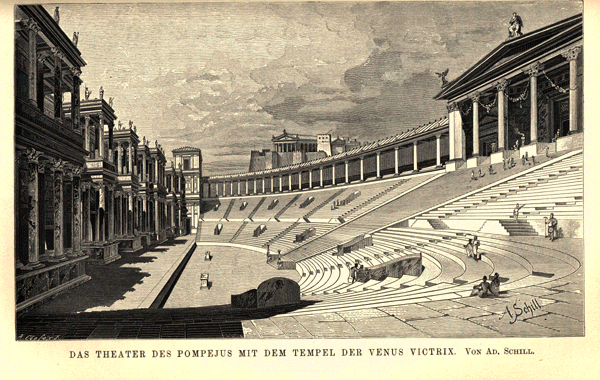
The site of Caesar's murder did not become a shrine. It became a public toilet. Pompey's theatre remained in use for almost 1,500 years. Eventually the large latrine which had shared a wall with Curia was enlarged, and engulfed the spot on the floor where Caesar had bled out.  Finally it was walled off and forgotten. And when the theatre, and the latrine, fell on hard times midway through the fifteenth century A.D., the populace turned it into a quarry, scavenging building stones for their homes and shops. Even today, those who come to look upon the space where Giaus Julius Caesar died, will find only an arch, and an ancient concrete wall
Within two years most of the aristocratic assassins were dead. Cassius, Casca, Cimber, Brutus - all died by their own hands. A few of the forty were killed in battle, and a few even fought for their lives in the courts, and won. They were allowed to return to Rome and live in somewhat reduced privilege. Caesar's will left his fortune to his nephew Octavian, and eventually the boy overturned the rotten remains of the Republic and disposed of the tawdry trappings of its dead democracy, which had really been killed by the aristocrats.  Octavian became Augustus, the first Roman Emperor. Retroactively, he made his uncle divine. The deceased Julius Caesar had become the thing the aristocrats said they  feared he wanted to become, a god.
But the dream of a representatives government, giving the people a voice in their own governance, had been set back by 2,000 years.
- 30 -

Friday, March 05, 2021

ET TU Four Jewel of the Nile

I don't always believe the accuracy of Roman historian Plutarch (above).  Still, Plutarch always told a good story.  His version of the death of Pompey the Great is a perfect example. According to Plutarch, after losing at Pharsalus, Pompey sought refuge in Egypt.
The general was expecting support from fourteen year old Theos Philopator -  Pharaoh of Egypt, also known as Ptolemy 13.  Interesting number, don't you think?  Pompey had loaned his father, Ptolmey 12, enough money to put down a revolt, and figured the son would feel obligated to help him.  But Ptolmey 13 was having a few problems of his own.
You see, Pompey unexpectedly ran into Ptolemy 13 was in Pelusium, the silt plagued port and fortress at the eastern edge of the Nile delta. The new Pharoh was there because he was avoiding his two sisters, both of whom were trying to kill him. It was a great confused mess, and a very bad time to arrive in Egypt seeking help. But then Pompey's timing had never been very good.
Pompey's arrival on 29 September,  48 B.C.E., presented Ptolemy 13's advisors with a bit of a conundrum. If they helped Pompey they would anger Julius Caesar, who had just defeated Pompey's army at Pharsalus. It they sent Pompey packing and he later won his civil war with Caesar, Pompey would make sure bad things happened to Ptolemy 13 and his advisers. However, there was a simple solution to this problem, and I am surprised it never occurred to Pompey. It certainly occurred to Ptolemy 13's advisers.
According to Plutarch, Ptolemy 13's advisors sent a boat out to Pompey's ships, which were anchored just outside the harbor of Pelesium.  In the boat was a Roman centurion named Lucius Septimius, who had been sent to Egypt by Pompey to reinstate Ptolemy 12.   
Septimius assured his old commander that it was safe to come ashore.  So, leaving his wife and children on board, Pompey climbed down into the boat. As they approached the shore, Pompey could see Ptolemy 13 in his sedan chair, waiting on the beach. But something did not seem right, and Pompey hesitated. Then one of Ptolemy's generals, a half Greek named Achilles, called out that the Pharaoh was very busy but could give Pompey a few minutes of his time, right now. It still smelled fishy, but Pompey really had very little choice. His crews and his family needed water, and food, and somebody who knew the coastline down to Tunisia, where he had more legions and allies...So the old fool got in the boat. Well, as they say in  Apocalypse Now, "Never get out of the fucking boat".
According to Plutarch, as the boat passed the breakwater Pompey was rehearsing his Greek greetings for the Ptolemy 13, when Septimius stabbed him in the back. They then dragged the boat ashore and then dragged the wounded Pompey up onto the sand. There they  chopped off his head   It was a cold and heartless thing to do, particularly since Pompey's wife was watching from the galley off shore. But it wasn't anything Pompey hadn't done to countless others. And that was the death of Pompey the Great, one of the most overrated generals in history, a man whose greatest sin was in believing his own press releases, which he had written.
That was one problem solved, leaving Ptolemy 13's advisers with their original problem, his sisters - in particular his elder sister. She had hired an army, and she and it were hovering out in the Sinai desert, short of food, water and money to pay her soldiers.  It  looked as if she was about to crushed by Ptolemy 13's army when, just two days later- 1 October, 48 B.C. - yet another Roman annoyance arrived off shore. This time it was Julius Caesar (above), with a single Roman legion. Dutifully, the advisers of Ptolemy 13 sent a boat out to Caesar, carrying the head of Pompey.   But if Ptolemy 13's advisers expected Caesar to thank them for eliminating his enemy, leaving them free to finish off their sororicide without further distraction, they were sadly mistaken. Oh,  Caesar did sail off from Pelusium. He just didn't didn't sail for Rome. A few days later Cesar landed in Alexandria and took over the empty royal palace.
I honestly don't know if Caesar really cried when he saw Pompey's head. He said he did. But Caesar must have known the instant he looked into those foggy dead eyes that he had won his civil war. There was more fighting to be done, of course. He would have to move on to Tunisia, to finish off Pompey's troops there. But there was no longer any need to rush. With Pompey dead the Senate aristocrats had lost their champion and rallying point. Caesar could allow their army in Tunisia to wither on the vine a little, while he took advantage of an opportunity right here in Egypt. 
Ptolemy's army at Pelusium might be blocking his sister's army from entering Egypt, but Caesar's 5,500 man force in Alexandria was sitting on the Egyptian treasury, and the gold used to pay Ptolemy 13's soldiers. To paraphrase an American Vietnam War general, grab them by their ingots and their hearts and minds will follow. Caesar now summoned both Ptolemy 13 and his sisters to Alexandria to settle their civil war. And to be honest with you, I don't think Caesar particularly cared which ones, if any of them, showed up.
It turned out they all did - Ptolemy 13 and his two sisters, Asinoe 4, and Cleopatra 7. Ptolemy 13 had the easier time getting to the Alexandria, but even Cleo made it, and she first had to slip around her brother's army and be smuggled into the palace in a rolled up carpet - if you believe Plutarch. But once she was there, Caesar was required to protect her since he had summoned her. And as Caesar was a heterosexual, he quickly fell under the spell of this extraordinary young woman.
She was 21, and he was 52. He came from a world where women were not allowed to compete with men. The only thing that had kept her head on her shoulders to this point was her brains. A modern Egyptologist described the lady this way, “Cleopatra was a mistress of disguise and costume. She could reinvent herself to suit the occasion, and I think that's a mark of the consummate politician.” 
Was she a great beauty? Plutarch, who was born a half-century after she died, wrote that she was not. But he also consulted every word written about her by people who had known her, and the consensus was that “her presence...was irresistible.... (Her) character...was something bewitching.” Wrote another Roman historian, she was “...brilliant to look upon and to listen to, with the power to subjugate every one, even a love-sated man already past his prime.” By all indications, the love-sated old man succumbed the very first night.
The advisers of Ptolemy 13 saw which way the perfumed wind was blowing.  They formed a secret alliance with Cleopatra's younger sister, Asinoe 4. She slipped out of Alexandria and hurried to join Ptolemy 13's army at Pelusium. But, once there she started calling herself Pharaoh, and when the commander of the Ptolemy 13's army, General Achilles, protested her use of the title. She had him killed. Well, turn about is fair play, isn't it? The army did not approve of the lady's ego trip, and offered her in trade for Ptolemy 13. For some reason Caesar accepted the deal.  But once back with his army, Ptolemy 13 and his advisers chose to lay siege to Cesar in Alexandria in December of 48 B.C.
Caesar was trapped in the city, with just one legion, and that was not enough. But he had already called for reinforcements, and when they arrived in early January of 47 B.C. they smashed Ptolemy 13's army. On 13 January  the fifteen year old Ptolemy 13 was drowned in the Nile, maybe by accident and maybe by a bribed Egyptian. But however the boy died, Cleopatra 7 was now the Pharaoh in Egypt. Caesar had Asinoe 4 placed under arrest, probably to protect her from Cleopatra – the lady had an understandably heightened sense of self preservation.
Just 8 months after Cleopatra 7 first rolled out of a carpet at the feet of Julius Caesar, on 23 June, 47 BC, she gave birth to a son. It was observed that as the boy, Ceasarian, grew, the more he resembled Caesar. This infant was one of two males who may have been Caesar's sons. The other was the child of Caesar's widowed girlfriend, Servilla. That boy, whom Caesar never officially adopted, was Marcus Junius Brutus.

                                          - 30 - 

Blog Archive