
I doubt Charles Addison Boutelle was legally insane, but when he was re-elected to his ninth term as a Republican Congressman he was confined to an asylum - even if the contentious old sailor's margin of victory was well below his usual level. But sane or not, his whole life was a testament to the power of one crazy man in a world run by people who want to believe they are sane.

The dictatorial speaker of the House, Hoosier Joe Cannon, opined that Charles Boutelle (above), “Could get into more controversies in shorter time than any man I ever knew.” And Boutelle's own daughter, in praising her father, asserted, “He could always command attention. No one ever dozed or attended to their correspondence when he was speaking.” Between those two quotes lies the shadow of a politician whose mouth (and pen) got him into a lot of trouble. And calling him “The handsomest man in the Congress”, which he was well known as, seems the reverse to describing a woman as having a good personality. So, I'm pretty sure that Charlie was indeed loony, the kind of guy who drives friends and enemies absolutely nuts because he is so certain he is right and is so wrong.

The young Lt. Boutelle had led the Union naval charge into the Confederate stronghold of Mobile Bay, in August of 1864. He came home to Bangor an official hero. After the war, first as editor and then from 1874 co-owner (along with his brother Edward) of the Bangor Daily Whig and Courier, Boutelle's dynamic and hyperbolic editorials made him a Republican power across New England. And his willingness to directly buy votes (there was no secret ballot, yet) built the Republican dominance of Maine over the post war generation.

Boutelle first threw his editorial support behind the ambitious and avaricious James Blaine (above, in shame), known accurately as “the continental liar from the state of Maine”. Mr. Boutelle attended the Republican convention in 1876, and in 1880 he was the national chairman of the Blaine Clubs. Blaine came within a handful of votes of being the Republican Presidential nominee both election cycles. Finally in 1884 Boutelle 's unwavering support paid off. He was named the state Party Chairman, and heading into the Presidential campaign that year, the Bangor editor was considered Blaine's “right hand man...and is even now talked of for a cabinet position”. But the nation was saved this turn of events when Blaine lost the election to Grover Cleveland by ½ of 1% of the popular vote

In the meantime, the “robustly-conservative” Boutelle had decided to run for congress himself, selling a mix of jingoism and empire building. He lost his first attempt in September of 1880, by 855 votes. I guess he ran out of money. But two years later he threw his growing fortune into his election for Maine's “at-large” seat in Congress, and in September of 1884 he won Maine's 4th district seat, which he was to occupy for most of the rest of his life.

Boutelle was a supporter and friend of the legendary Speaker of the House, “Czar” Thomas Reed (above), also from Maine. Then in 1890, the New York Times observed election day in several small Maine towns, and noted that Reed had influenced the results with cash. “Boodle has elected him, operating directly in the purchase of votes and indirectly by discouraging the Democrats to such an extent as to keep hundreds of them away from the polls.” The story went on to say, “...the richest and most influential man in Wells, sat in the (city hall) with a pile of (dollar) bills in his lap and...in the presence of scores of people, exchanged money for votes for Reed...at least 300 votes (were) purchased in Biddeford”, a small town near the New Hampshire border, at up to $20 a vote."
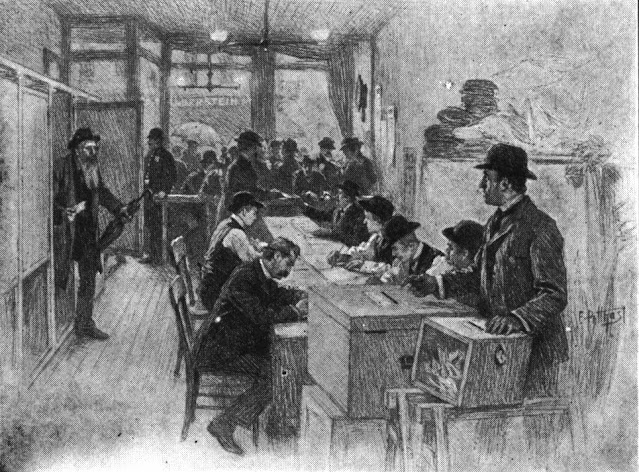
It was a smear, of course. No Republican needed to buy an election in Maine. But by the following Sunday, preachers in pulpits across Maine were lecturing on the need for a secret ballot, as was used in Australia. When in 1891 the Maine legislature seriously considered what was called "the Australia ballot", Reed and Boutelle sent a joint letter, warning that such procedures were too complicated for the average voter. But they were swimming against the tide. Under the new system, in the September 1894, Reed won re-election by 17,383 votes. But by September of 1898 his margin of victory had slipped to 12, 380. Change was on the wind, if still faint.

And it shifted most dramatically during the 1896 presidential campaign, when a surrogate speaker for the Democrat candidate William Jennings Bryant (above), visited Maine. He was Alexander Troop, editor of the Democratic leaning New Haven Connecticut Union newspaper. Well, Boutelle could not resist throwing some mud at his New England business rival, running an un-credited story that Troop had once been arrested for indecent exposure. The outraged Troop filed a libel suite, demanding a retraction. As the trial date approached, friends convinced the bull headed Boutelle to leave the negotiations up to his friend, Speaker Reed. Finding that Troop would not take a quiet payoff, Reed wrote out a retraction on the spot. Boutelle responded by telegraph that he would be “damned” if he would print anything like that in his paper. Even after Reed explained that without a retraction, it might not remain his paper for long, Boutelle refused to budge. The arguments swung back and forth until Reed threatened to walk away from their friendship. Boutelle finally ate crow on the front page of his newspaper. But by then the Democrat Bryant had been beaten, and both Reed and Boutelle were safely re-elected by the usual wide margins.

Then, on the afternoon of Thursday, 21 December, 1899, Charles Boutelle was entertaining in the electrified Young's Hotel (above), on Court street, in the financial district of Boston. Charles had used the hotel for years as a lay over between his homes in Washington and Maine, and a place to make personal and political deals out of the public eye. But this afternoon, after an otherwise normal morning, Charles collapsed in the 100 foot long dining room. Rather than taking him upstairs to his suite, he was carried unconscious into a parlor. Dr. F.W. Johnson, a well known surgeon, was sent for, but would only tell the press that Boutelle's condition was “serious, but not necessarily fatal”. Some considered that report optimistic. In fact Boutelle was delirious and ranting. Late that night Boutelle's brother Edward arrived from Bangor, and about midnight told the press Charles was suffering from “congestion of the brain, brought on by acute indigestion”, or as his Bangor Whig newspaper reported it, “by the strain and overwork in connection with his official duties”.

The next day Charles was carried via a private rail car back to Bangor. But it was quickly realized that he was too violent to be treated at home. The 62 year old was transported back to Boston, and taken to the McLean asylum in Belmont, Massachusetts. Seventy years earlier, it was McLean staff member Mary Sawyer, whose relationship with a pet had inspired the poem “Mary Had A Little Lamb”. But it was also the first psychiatric hospital in America which studied the biological causes of mental illness. Just five years earlier, under Superintendent Dr. Edward Cowles, the hospital moved to a new hill top “cottage plan” campus (above), where patents could be treated in a residential environment. At week's end the New York Times reported that although “officials are very reticent in the matter...(Congressman Boutelle was) not considered in any immediate danger.” But other than an occasional day trip, he would never leave the McLean Hospital again. And his medical bills would force his daughters and brother to sell the Whig Courier newspaper that March..

It wasn't that Maine was short of loyal Republicans eager to replace the “handsomest man in congress”, nor that Maine voters did not think it important they be represented by a functional congressman. But 1900 would be a Presidential election year, and Speaker Reed simply had too much else on his plate. So, at the end of December, it was announced that the Navy committee which Boutelle chaired, would return to work in January, with the now hospitalized congressman still officially its chairman. His daughters still collected his salary, and his party still had the use of his patronage. Come September Charles Boutelle won his last election, probably already unaware he had ever held public office. He won it by only 10,000 votes, instead of his usual 18,000. And in November the powers of his office, exercised by his friend Speaker Thomas Reed, were able to help fellow Republican and fellow Maine man, William McKinley, to win the White House, defeating (again) the Democrat Bryant.

As soon as the election was over, Reed moved in the House to have Charles (above) retroactively appointed a retired captain in the U.S. Navy. Considering his Civil War record, and his dedication in creating the “Great White Fleet” which had just won the Spanish American War of 1898, this seemed a reasonable reward to an eight term congressman, who at the time had no other pension. To encourage the Senate to agree, Dr. Cowles who came down from Boston, was authorized to issue a public statement on the first anniversary of Boutelle's admission to McLean's. “At the present time,” said the doctor, “the indications are not so favorable...for a degree of recovery.. .In my own opinion he should never resume the cares of active life or under take any business responsibilities, and he may live but a few years.”

It seems likely Charles had suffered for years from an advanced case of Altzeimers, first identified by Dr. Aloysius Alzheimer. In 1901 “Alois” began working in Frankfurt on the Main, Germany, with a 51 year old woman named Auguste Deter (above), who had suddenly begun screaming in the middle of the night. She was befuddled and had lost increasingly large chunks of her memory. When Dr. Alzheimer questioned her, she would repeat, “Ich hab mich verloren” - “I am lost”. Her dementia progressed rapidly until her death on 8 April, 1906. In a November 1906 speech, after examining slides of her brain tissue using a new staining technique, Dr. Alzheimer identified plaque build-up on the neurons in Auguste's brain as identifying the disease. In effect the disease destroyed her identity from the inside, as it had done five years earlier in America to Charles Boutelle.

On Wednesday, 16 January, 1901, Charles' captain's pension went into effect. And on Sunday, 3 March, Charles (above) submitted his resignation from congress, the day before the new congress convened. It was a play, of course. By this stage of his disease, it is very unlikely Charles was capable of signing a letter. Still the smooth transition did honor to its probable architect, Speaker James Reed. Call it the last act of friendship for an old argumentative ally. And as if part of the same plan, eleven weeks later, on Tuesday, 21 May, 1901, Charles Addison Boutelle died of pneumonia, a build up of fluid in his lungs, caused by his inability to get out of bed.
He remains the only congressman on record to be re-elected while confined in a mental institution. But the country is young, yet. Given us another 200 years, and I 'm sure we will get at least one more. And maybe this one will actually be just plain crazy.
- 30 -


 The Democratic convention in Buffalo, New York ended on July 11th 1884, after having nominated hometown hero, “Honest” Grover “The Good” Cleveland. Just ten days later the “Buffalo Evening Telegraph” reported “A Terrible Tale”; that in 1874 Cleveland had an affair with a young widow from New Jersey, naamed Maria Helpin. In September Mrs. Helpin had given birth to a son she named Oscar Folsom Cleveland (Folsom was Cleveland’s law partner). According to the “Telegraph”, Maria ended up in an asylum and the poor innocent boy had ended up in an orphanage. The Republican faithful began the chant, “Ma, Ma, where’s my Pa? Gone to the White House, ha, ha, ha.”
 It was a great story, and parts of it were true. But Cleveland refused to panic and instructed his followers to “Just tell the truth”, which is easy to say at those rare times when the truth actually helps you. The truth was that Mrs. Helpin had affairs with several men (something that probably happened a lot more often than anyone in 1884 was willing to publicly admit), and there were several men who might have been the father. Cleveland never admitted parentage. But he had supported the infant after Maria started drinking. Later, when it became clear Maria was not going to get sober anytime soon, Cleveland had paid her $500 to give up Oscar, and the boy was adopted by friends of Cleveland’s, and eventually ended up graduating from medical school; so the initial Blaine attack had resulted in Cleveland sounding more honest than before. The second Blaine attack backfired even worse.
 There were two “third parties” in 1884; the Greenback Party and the Prohibition Party. The Greenback Party seemed likely to hurt the Democrats most, so Blaine’s supporters actually gave them money. “The Dry’s” had nominated John St. John, three time governor of Kansas. Blaine’s people were worried that St. John would siphon off Republican votes in upstate New York. They urged St. John to drop out of the race, and when he refused they spread the story that St. John had abandoned a battered wife and child in California. Again, the smear was true, sort of. After his parents had died when St. John was 15, he had joined the ‘49ers, looking for his fortune in the gold fields. He didn’t find gold but at the age of 19 he had found a wife and fathered a child. And at his wife’s request he had “granted” her, to use the old phrase, a divorce, before returning, broke back to Ilinois.
 Like most smears this one hurt St. John the most amongst his most fervent supporters. Prohibitionists have always been a priggish bunch of humorless unforgiving bores, and they abandoned St. John as if they had just discovered the sacramental wine was actual wine. But St. John had that other trait you often find in prohibitionists; he considered revenge a matter of principle. Knowing he now stood no chance of even winning Kansas, St. John concentrated his efforts in upstate New York, just the spot the Republicans were the most worried about.
 Meanwhile, James Blaine, the Republican candidate, had his own problems, with the “Mugwumps”. This was yet another group of holier than thou Victorian prigs, but these prigs were Republicans, and they had a hard time deciding whether or not to support Blaine because he was so…well, crooked. They took their name from a supposed Algonquin word for “big leader”, but it was "New York Sun" columnist Charles Dana who defined them as Republicans who had their “mugs” on one side of the fence and their “wumps” on the other. Republican commentators went so far as to imply that the Mugwumps were “effete”, or to use the vernacular, “Man millners”, i.e. homosexuals. Stories like this one are what make me smile when I read that in 2004 Karl Rove dragged politics to a new low, or that in 2008 Barak Obama has decided to raise the level of the debate. As a nation we gain an advantage when history books actually try to tell the unvarnished truth about the past; its called perspective.
 Mean while, the Democrats were throwing everything they could think of at "James Blaine, the Continental Liar From the State of Maine", like calling him "Slippery Jim". They dragged up the old charge of “Burn this letter after reading”.


 In the end it was difficult to say precisely why Cleveland won and Blaine lost. The popular vote cast on Election Day, November 4, 1884, was four million eight hundred seventy-four thousand for Cleveland (48.5%) and four million eight hundred forty-eight thousand (48.2%) for Blaine. But as we all know the popular vote is meaningless. What counted was the Electoral College, and there Cleveland won two hundred nineteen votes to one hundred eighty-two for Blaine, giving Cleveland a 37 vote electoral victory.


