August 2025

August  2025
I DON'T NEED A RIDE. I NEED AMMUNITION.

Translate

Wednesday, February 28, 2024

THE FIRST DAY Chapter Eighteen


I don't know who 33 year old Virginian Colonel Robert Mercer Brockenbrough pissed off, but they must have been important. The farmer and lawyer been twice bumped up to brigade commander, the last time just before Chancellorsville, after his boss, Henry Heth, was promoted to Division commander.  
Then, Brockenbrough's brigade took 50% casualties stopping a Federal counterattack, saving the victory for General Lee. And still Lee refused to consider Brockenbrough (above) for permanent promotion. The insult sapped the spirit out of Brockenbrough and seeped down to the 800 survivors in his brigade - all of which contributed in no small way to Lee's defeat at Gettysburg.
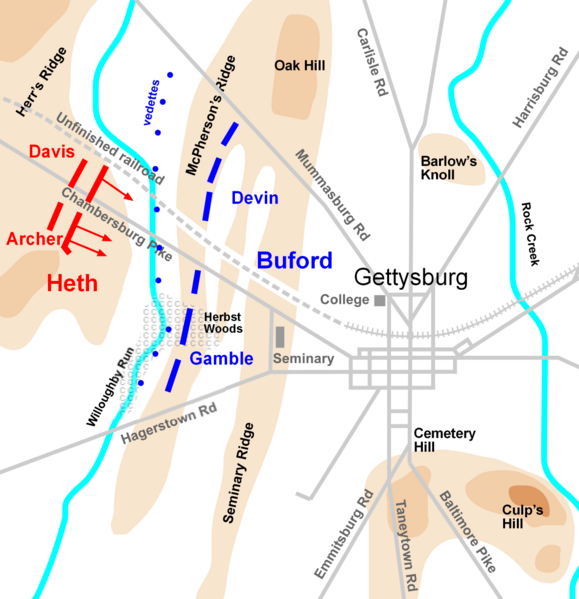
While Archer's brigade of 1,200 men charged up Herr's Ridge north of the Chambersburg Pike, and then threw itself across Willoughby Run and up McPherson's ridge, Brigadier General Davis's brigade was doing the same south of the pike. But Davis noted that Brockenbrough's brigade, between the two “...refused to advance."  Many maps of the battle (above) don't even bother to include them. And when the Federal Iron Brigade smashed into Archer's men and drove them back across the creek, Brockenborough's troops refused to fire on the Federals, pleading they feared hitting Archer's men. Even then, the dispirited Virginians might have charged the Federals to save the 200 of Archer's men forced to surrender. Instead they watched it happen. And soon the same fate was was to befall Davis' brigade.
The 38 year old Joseph Robert Davis (above)  was a nephew of Confederate President Jefferson Davis. That linage granted him certain disadvantages. His uncle's enemies initially denied his promotion as Brigadier General. But once promoted, Davis was, by all accounts, competent. And driving the Federal cavalry skirmishers back across Willoughby Run, he was quick to take advantage of the ground, specifically the unfinished railroad cut through McPherson's ridge. 
There were no iron rails or cross ties laid down yet. But using the cover provided by the earthen embankments, Davis pivoted his 2,000 North Carolina and Mississippi soldiers, and they hit this portion of the Iron Brigade on the flank, across the Chambersburg Pike.
Rushing to the defense of their brigade members,  was the reserve  of the Iron Brigade, the 6th Wisconsin regiment and a battery of cannon. And once in position their commander, Lieutenant Colonel Rufus Robertson Dawes (above), grandson of William Dawes who had spread the alarm with Paul Revere, gave the order to open fire.
Under the first volley said Dawes, “The rebel line swayed and bent, and suddenly stopped.” Sargent William Ray remembered, the Wisconsin boys, “just mowed the rebs, all in front of our Regiment was just mowed down. … Battery B was just in the rear of us... and every gun poured in the grape which swept the rebs.”
Slowly the rebels began to retreat, toward the protection of the railroad cut. Dawes then, “ordered my men to climb the over the turnpike fences and advance." And just as the Wisconsin boys were clambering over the rails, the 95th New York regiment of the 2nd brigade under Major Edward Pye, came up to the fence line in support. Colonel Dawes shouted to Pye, “We must charge!” And Pye replied, “Charge it is!” And with that, the 2 regiments began screaming and running across 400 yards toward the railroad cut with fixed bayonets.
From the shelter of the railroad cut three confederate regiments – the 2nd and 42nd Mississippi and the 55th North Carolina, poured a deadly fire into the 2 attacking federal regiments. Colonel Dawes wrote his wife, "The only commands I gave as we advanced were, 'Align on the colors! Close up on the colors! Corporal James Kelley of Company B, shot through the breast...said, "Colonel, won't you write to my folks that I died a soldier?"  Dawes added in his memoir: "..The colors fell upon the ground several times but were raised again by the heroes of the color guard. Four hundred and twenty men started in the regiment from the turnpike fence, of whom about two hundred and forty reached the railroad cut."  The collision when it came, was unimaginable.
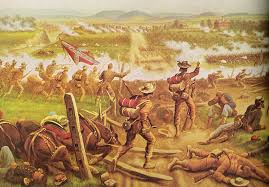
Recalled Sargent William B. Murphy, the 2nd Mississippi regiment standard bearer, “...a squad of soldiers made a rush for my colors...Over a dozen men fell killed or wounded, and then a large man made a rush for me and the flag.” The large fellow was Corporal Francis (Frank) Ashbury Waller, from Company I of the 6th Wisconsin. Said Murphy, “As I tore the flag from the staff, he took hold of me and the color.” Waller and Murphy struggled over the cloth (above), falling to the ground, until Waller yanked the Mississippi battle flag from Murphy's hands.
The 14th Brooklyn regiment (Cutler's brigade) now appeared, flanking the rebels and firing directly up the railroad cut from above, where 200 of the 2nd Mississippi  were trapped between the earthen walls - the rest scattering for the rear. Colonel Dawes ran forward and "...I found myself face to face with hundreds of rebels, whom I looked upon in the railroad cut...four feet deep. I shouted, 'Where is the colonel of this regiment?....Surrender, or I will fire.' The officer replied not a word, but promptly handed me his sword and his men...threw down their muskets.”
Brigadier General Davis admitted, "subjected to a most galling fire of musketry and artillery that so reduced the already thinned ranks...there was nothing left but to retire."  Colonel Dawes lead 420 Wisconsin men up the Emmitsburg road on 1 July, 1863. They left 30 dead on McPherson's ridge, 170 causalities in total. Both New York regiments lost over 110 men each. 
And the 2nd Mississippi regiment had 40 dead and 183 wounded, and surrendered 7 officers (including its commander Major Blair) and 225 enlisted men in the unfinished railroad cut.  That evening only 60 men answered roll call of the Confederate regiment.  After noon on 1 July,  the battlefield west of Chambersburg Pike quieted down out of exhaustion, and every soldier and civilian within earshot caught their breath, and took stock of what had been achieved and what had been wasted.
Two of Heth's brigades, Archer's and Davis', had been badly punished. The third under Colonel Brockenbrough had blackened their reputation a little more. But the largest brigade in Heth's division, – the largest in the entire rebel army – under Brigadier General James Johnson Pettigrew, had not yet been committed to combat. It's regulation to the rear of a column that was assumed to be marching into battle, had made that battle more difficult. It all highlighted the abilities and the failings of the division commander
Major General Henry Heth (above) , who had been ordered not to start an engagement, had done just that. And having started it,  he had pushed his men blindly forward, into an ambush he had been warned might be waiting. 
And now, with a major engagement begun, he was forced to pause to bring up reinforcements, which would take time, which was just what the federals wanted. Win or lose, men die in battle, men are wounded and scared in battle. It is not a General's job to save lives. But it is the obligation of every officer in a combat unit to make certain the loss of life and limb and soul are worth the sacrifice. By that fundamental measure, Henry Heth had failed this morning.
On the Federal side the cost had been equally high, and it had been worth the sacrifice. Time had been won. Time to march up the Emmitsburg road. Time to occupy the ridges west and north of town. Time to keep the rebels off of Little Round Top.  And the First Day of Gettysburg was just barely half over.
- 30 -

Tuesday, February 27, 2024

THE FIRST DAY Chapter Seventeen


I believe only two people had a clear idea of what was happening at Gettysburg this morning.  One was Brigadier General John Buford. His troopers  - 3,000 men and a single battery of six  3-inch rifled cannon - were  blocking Henry Heth's division of 7,000 infantry and 15 cannon. 
They were also about to be outflanked by the converging Rhodes division of another 7,000 rebel infantry and 16 cannon coming down from Carlisle, and Early's division approaching from York with another 5,400 rebel infantrymen and 16 cannon – almost 20,000 men and 47 cannon about to crush Buford's tiny command.
At 10:30p.m. on Tuesday, 30 June, 1863 Buford (above) sent his cold and emotionless appraisal of the situation to three men - General Pleasanton, commander of the Federal Cavalry Corps and Buford's boss, and General Meade, newly named commander of the entire Army of the Potomac. 
But the first recipient was the most important - commander of the only troops close enough the help Buford's men, commander of the First Corps of the Army of the Potomac - 11,000 men and 28 cannon – and the only  other person who fully comprehended the importance of the strategic and tactical situation in Gettysburg on the following morning - Major General John Fulton Reynolds.
His older brother had gone into the navy, and risen to captain. John Reynolds (above) had become a soldier, enduring the lonely life serving on the western frontier, negotiating and fighting the native peoples of the Great Plains and in the 1859 part of the almost war with Britain over an island between Canada and Washington Territory. His devotion to the Union was unquestioned. His bravery undoubted. His mind sharp and clear. His subtly not present. 
General Reynolds had spent the last part of that brief night between June and July of 1863, 5 miles north of Emmitsburg, Maryland, wrapped in a blanket and sleeping on the floor of the empty Mortiz tavern (above) on Marsh Creek, about 7 miles south of Gettysburg, Pennsylvania. It is amazing how little sleep the officers on both sides of any war get while on campaign, which may explain many of the mistakes and oversights that cost so many lives. On this night, Reynolds was awakened again at 4:00a.m. by his aide Major William Riddle.
Riddle had to read the day's marching orders from General Meade out loud several times while the sleep deprived Reynolds tried to process them. He was now in charge of the left wing of the army, and there was little doubt in any one's mind that his was the force that was going to contact Robert E. Lee's rebels first. Buford’s late night missive made it clear to Reynolds, that this would be the day. Three hours later Reynolds effective second in command, Brigadier General Abner Doubleday, would arrive for his instructions. While they were talking, the first shot would be fired from Herr Ridge, opening the battle. And at about 8:00a.m. Reynolds and his staff would mount up and trot toward Gettysburg.
Awakening that morning just 6 miles south of Gettysburg were the 3,800 men of the 1st division, commanded by “the richest brigadier in this army”, 55 year old white haired politician and philanthropist, James Samuel Wadsworth (above) of  New York. His men loved the hesitant Republican, and during the march to Gettysburg, Wadsworth was reputed to have commandeered shoes off the feet of cheering civilians, to replace the worn out souls of his men's foot ware. Unlike Heth, Wadsworth had his strength in front, the 1,800 men of the famous Iron Brigade, under Brigadier General Solomon Meredith.
The Iron Brigade was composed of five western regiments - the 2nd , 6th and 7th Wisconsin, the 19th Indiana and the 24th Michigan - which had fought as a unit in every major eastern battle since Bull Run. Under their second commander, General John Gibbon, the brigade had converted their dress broad brimmed soft black hats into their standard uniform, making them distinct. Gibbon had also given them their legendary discipline. One private remembered, “There were early morning drills, before breakfast drills, forenoon drills, afternoon drills, evening and night drills...” Another soldier observed that “Probably no brigade commander was more cordially hated by his men.” 
But witnessing Gibbon's troops under fire at the 1862 battle of South Mountain, first commander of the Army of the Potomac, General George McClellan, had said, “They must be made of iron.” The label stuck, but it cost. After 2 years of war, of the 1,000 men who had joined the 2nd Wisconsin volunteer regiment in 1861, there were only 300 men left.
Meredith's brigade was followed by the 2,000 members of the 2nd Brigade – the 7th Indiana, the 56th Pennsylvania, and the 76th, 84th, 95th and 147th New York regiments - under 56 year old Hoosier Brigadier General Lysander Cutler (above). He was a real self made man. Born in North Carolina, Cutler had walked to Indiana and climbed from store clerk to State Representative. He was maybe the poorest officer in the army.  His men were on the road by 6;00a.m. that morning, and would be in Gettysburg in about 3 hours.
Leaving after his infantry, Reynolds quickly outdistanced them, riding to the sound of the guns, through waves of civilian refugees, many African Americans fleeing the rebel impressment gangs. Shortly after 9:30a.m. Reynolds reached the Lutheran Seminary (above, distance)  and greeted Buford with the question, “What's the matter, John?” Buford replied, “The devil's to pay.” 
The 2 men talked in the cool mist for a few moments, before General Reynolds' sent a messenger back to General Wentworth. His division was advance at the double-quick and relieve the cavalrymen on McPherson's Ridge, west of Gettysburg. 
Reynolds also sent a messenger to General Howard in Emmitsburg, telling him to bring the Eleventh Corps forward to Gettysburg at once. A message was also sent to General Sickles, ordering the Third Corps to move to Gettysburg via the Emmitsburg Road. A fourth message went back to General Meade, saying, “...we will hold the heights to the south of the town, and...I will barricade the streets...if necessary.”
Had Lee been at the front, he would have seen the strategy for what it was, and possibly broken contact and withdrawn back to the Cashtown Gap. 
But Lee was 10 miles back, not even reaching Cashtown until mid-day. Meanwhile  Reynolds was at the the front, and clearly the strategic superior of Henry Heth.
Marching at the double -quick across McPherson's ridge, the 2nd Wisconsin did not have time to load their muskets before Reynolds himself threw them into the 5 acre stand of trees known as Herbst's Woods. These trees topped the crest of the ridge, protecting the advancing rebel regiments of Archer's 1,200 men as they came up the hill. Reynolds was determined they must not win that crest – at lest not yet. The rebels had to be thrown back, or not enough of the Federal army would have time to occupy the round tops 2 miles to the north.
Under Reynolds orders, the Wisconsin boys fixed their bayonets at the run. Reynolds urged them into the stand of trees adjacent to a field of corn, shouting, “Forward men! Forward for God’s sake, and drive those fellows out of those woods!” Seeing the Federals approaching through the trees, Archer halted his 1,200 rebels and unleashed a murderous volley of musket fire. A third of the 2nd Wisconsin regiment went down, dead and wounded. Every man in the color guard was out of action. But the remaining 200 men showed their iron, pressing forward. One of the rebels about to receive the fierce charge supposedly remarked, “Those are those damned black hat fellows again. Tain't no militia. That's Army of the Potomac!” Archer's men then continued their own charge, and the Tennessee and Alabama rebels engulfed the outnumbered Wisconsin boys. But as they did, without intending to, they turned their own flanks, to swallow the Yankees in a sea of gray and butternut brown.
Just as this catastrophe was occurring to the Iron Brigade, Generals Doubleday and Williams led the rest of the Iron Brigade in a more organized charge, and the fresh Federal troops fell upon the rear of Archer's turned flanks. In the shock and noise and violence, Archer's brigade was broken, smashed, its individuals falling back across Willoughby Run. 
In the assault, 200 rebels found themselves surrounded in a group of willows on the west bank of the creek, and were taken prisoner – including the “Little Game Cock” who had tried to warn Henry Heth of the dangers of such an assault - General James Archer (above). As he was being led to the rear, General Doubleday saw his old army comrade and greeted him, “Good morning, Archer. How are you? I'm glad to see you, Archer.” To which the bitter Archer replied, “Well, I'm not glad to see you, by a damn sight.”
At that moment, adrenaline rushing through his blood, Doubleday was unaware of the catastrophe which had just befallen his corps. In that volley let loose from Archer's brigade against the 2nd Wisconsin, General Reynolds and several members of his staff had also been hit.  Reynolds slumped in the saddle. 
Suddenly free from the pressure control of its rider, and perhaps hit itself, the General's horse trotted out of the line of attack, bearing Major-General John Fulton Reynolds a few yards into the open stand of trees (above, right). There, his surviving staff gathered the reins, calmed the horse and lowered their commander to the ground. They loosened his uniform, looking for the wound. By the time they found it, he was dead.
This was no sharpshooters work. A single Minnie ball had entered behind Reynolds right ear, and burrowed its way through his brain. He was effectively dead before the horse could be stopped. 
What killed John Reynolds was a random shot, a death by the anarchy, the unmitigated insanity of combat. It may even have been fired from a union musket. Like all war, this single shot had no meaning in and of itself. It was given meaning afterward to satisfy the humans who had to live with the consequences of their own arrogance and stupidity. 
One of his aides, Major Joseph Rosengarten, tried to understand the grief a decade and a half later. “...Reynolds, in the full flush of life and health," marveled Rosengarten,  "....a glorious picture of the best type of military leader, superbly mounted, and horse and man sharing in the excitement of the shock of battle.”
They carried his body off the field and into the town, leaving him in a house while the battle continued around it. That night they crept into the no man's land of Gettysburg to retrieve his cold corpse, and sent it home to his family. His sisters would bury him in their home town of Lancaster, Pennsylvania, on 4 July. I prefer to think of John Fulton Reynolds' sacrifice as a monument to the courage and the stupidity of the entire war. And every monument to every war in the all of human history, including the battle of Gettysburg, and that memorial, and all memorial to the heroes and victims of every war, should all bear the same inscription: "What A Waste."

- 30 - 

Monday, February 26, 2024

THE FIRST DAY Chapter Sixteen


I would call it an ominous beginning. Under a cold drizzle in the predawn darkness of Wednesday, 1 July, 1863, the 7,000 veterans of 38 year old Major General Henry Heth's - pronounced “Heath” - division were roused from an uneasy sleep along the Chanbersburg Pike. The men in the ranks knew the enemy was nearby. They expected that some of them would be dead by noon, and that more would suffer the limited skills of the surgeons 
But who among their ranks would bleed this day, and which of them were witnessing their last sunrise they could not know. Still, they rose and ate their rude breakfasts, packed their meager belongings and formed up for the 7 mile march to Gettysburg, Pennsylvania. They were brave men fighting for an evil cause.
The day before, Tuesday 30 June, 1863, the 1st brigade under 35 year old Brigadier General James Johnson Pettigrew  (above) had spotted blue clad cavalry just entering the Gettysburg. Following General Lee's orders to “Avoid all contact with the enemy until the entire army has arrived”, Pettigrew immediately withdrew back to Cashtown and reported the Yankee's presence. 
Pettigrew suspected the Yankee horsemen were regulars. But his commander, the ambitious and charming Henry Heth (above), believed they were merely militia. The story is that Heth assured his Corps commander, Lieutenant General A.P. Hill, “... if there is no objection, I will take my division tomorrow and go to Gettysburg and get those shoes...Hill replied, “None in the world.”
This myth did not appear until 25 years after the war, in an article written by Heth.  There were no shoes in Gettysburg. Jubal Early's division had marched through Gettysburg the week before, Jenkin's cavalry too. They had stripped the town's businesses of most everything of use. And no one even mentioned shoes and Gettysburg in the same sentence until Henry Heth, a quarter of a century later. No veteran in the Army of Northern Virginia marched 140 miles into Pennsylvania on bare feet. We might as well believe they marched into battle already wounded. We have no photo's of either prisoners or war dead (above) without shoes. A soldier may want newer, better fitting shoes, but the barefoot rebel is a myth created to justify Henry Heth ignoring orders to “avoid all contact”. And the myth does a disservice to the men who followed Henry Heth down that road.
The truth was that Henry Heth was one of Lee's favorites, the only staff officer the aristocratic Lee ever called by his first name. Having served Lee early in the war, Heth transferred to East Tennessee for a year, where he proved himself a brave field commander. Returning to the Army of Northern Virginia in the spring of 1863, Heth's aggressiveness, almost to the point of insubordination, mirrored his mentor's aggressive nature, and endeared him to General Lee. 
That Wednesday morning, A.P. Hill ordered a 2 division “reconnaissance in force”, and Heth volunteered his division to lead the march. And the unit General Heth picked for point was the 1,200 man brigade – 3 Tennessee and 2 Alabama regiments - commanded by his “Little Gamecock” - the 45 year old irascible Marylander Brigadier General James Jay Archer (above).
Second in line was the 2,000 man brigade – 3 Mississippi and 2 North Carolina regiments – under Brigadier General Joseph Robert Davis. Then came the understrength 2nd Brigade of 4 Virginia regiments, about 800 men under 33 year old Colonel John Brockenbrough. And finally, punished by being regulated to the rear of Heth's division, was the largest brigade in the entire Confederate Army, the 2,500 men - in 4 North Carolina regiments – under the scholar and plantation owner, Brigadier General James Pettigrew. With his weight in his tail, it appears General Heth anticipated brushing aside the militia cavalry like annoying flies. Taking to the Chambersburg turnpike (above)  about 2 hours behind Archer's brigade were the 6,700 man North Carolina division under 29 year old strict disciplinarian, Major General William Dorsey Pender.
Stepping off at about 6:00am, Archer's brigade moved at a route march – about 2 miles an hour - down the slope from Cashtown Pass toward Gettysburg. About 4 miles west of town – making it about 7:30am - the first shot was fired from atop Herr Ridge at the First Tennessee brigade, perhaps even at 25 year old Major Felix Grundy Buchanan. He threw his 281 men into a skirmish line centered on the road. But the outnumbered enemy pickets, armed with faster firing carbines, held their ground. So Heth was forced to throw his entire division into a line of battle on both sides of the Chambersburg Pike. Which took time.
First each regiment of Archer's 1,200 man brigade had to march in column to the head of the line of march. Then they “wheeled column left march” into the open ground south of the Pike. Each regiment then “double left oblique (marched) until they reached their position in the line of battle, when they faced FRONT, shouldering arms and dressing up...” And as soon as Archer's brigade had cleared the road, Davis' 2,000 man brigade had to do the same on the north side of the Chambersburg Pike. These were largely veterans, who had spent endless hours drilling these very maneuvers, but still it took time. And with the road finally cleared, Brockenbrough's half sized brigade came forward to occupy the center of the position in column.
The push up Herr Ridge finally began shortly after 8:00 that misty Wednesday morning. And with the advance of 3,000 men, the blue clad skirmishers grudgingly began to fall back – but not before their skill and tenacity convinced the rebels that these were not militia, but Federal regulars. Major General Heth remained unconvinced, but after capturing Herr Ridge he spread Lieutenant Colonel John Garnett's 4 batteries of artillery along the high ground to provide support for his men, as they flowed down the steep eastern face of the ridge into the tangle of wood along a creek called Willoughby Run.
The first shot from Garnett's guns brought accurate return shots from Federal cannon. This caused the advance to pause again. Frustrated, Heth ordered his two brigades to push across the creek and up the next slope – McPherson's Ridge. This order brought General Archer to seek out his superior on the battlefield, where Heth's “Gamecock” urged caution. Might it not be better to bring forward Pettigrew's large brigade, to extend his line, before Archer or Davis sent their troops across the creek? The weight of Lee's orders to “Avoid all contact” could be felt in Archer's hesitancy.
But Heth's temper was now up. This was taking too much time. He was still convinced the Federal Army was still camped in Maryland, and not within a 2 day march from this place. And every suggestion he was mistaken, made him angrier. Any delay was unacceptable. General Heth ordered Archer and Davis to not only cross Willoughby Run and the slope, but capture the crest of McPherson's ridge as well.
Henry Heth would write in his after action report, “It may not be improper to remark that at this time--9 o'clock on the morning of July 1--I was ignorant what force was at or near Gettysburg, and supposed it consisted of cavalry, most probably supported by a brigade or two of infantry. On reaching the summit...it became evident that there were infantry, cavalry, and artillery in and around the town. A few shots from...Marye's battery) scattered the cavalry vedettes...”  In point of fact, it did not. No Federal cavalry pickets (vedettes) anywhere on the Gettysburg battlefield scattered. They all withdrew as the trained, veteran soldiers they were.
Three miles to the east, in the high cupola of the Lutheran Theological Seminary, Brigadier General John Buford was watching the battle at Herr and McPherson ridges develop just as he had intended. In his after action report he wrote that “Colonel (William) Gamble made an admirable line of battle....we having the advantage of position, he (Heth) of numbers. The First Brigade held its own for more than two hours, and had to be literally dragged back a few hundred yards to a position more secure and better sheltered.” At which point, Buford ordered his Second Battalion under Colonel Thomas Casimer Devin, to extend the battle line along the east side of Willoughby Run.
Buford knew he could not stop a rebel infantry division. And he knew that he was asking his men to sacrifice their bodies and risk their lives by standing in Heth's way this morning. But he knew it was worth the sacrifice because close behind him was the First Crops of the Army of the Potomac, under Major General John Reynolds. And because the position Buford was defending was not Herr ridge, nor McPherson Ridge, nor even Seminary Ridge. The position Buford was actually defending at Herr Ridge was 4 miles to the southwest - the higher Cemetery Ridge.
Every Federal Trooper under Buford (above) knew the ground they were defending. But by just after 9:00am, Wednesday, 1 July, the rebel officers, like Henry Heth, had at best a hazy idea of the ground they were asking their men to die for.
 - 30 -

Blog Archive