August 2025

August  2025
I DON'T NEED A RIDE. I NEED AMMUNITION.

Translate

Sunday, June 19, 2016

THE FIRST DAY Chapter Twenty - Two

I believe that 47 year old Lieutenant General Richard Stoddert Ewell  (above) was the "reigning eccentric" in the army. He was courageous under fire and generous to a fault, an insomniac and a hypochondriac. At times his enormous bomb-shaped bald head seemed too heavy for his neck, and when he was tired it tipped toward one shoulder or the other. When excited, profanity poured from his 5'8" frame in a shrill high voice. And he was prone to interrupting himself with quiet, unrelated interjections, like, "Now why do you suppose President Davis made me a Major General, anyway?", and "What would my grandfather think of that?" In comparison to his other traits, Ewell's pronounced lisp almost seemed normal.
He had finally married in May, just before leaving on this campaign, to the woman who nursed him back to health after losing his left leg at Second Bull Run. His new bride was his first love and his first cousin, the iron willed and wealthy widow, Lizinka Campbell Brown. His personal aide was Lizinka's eldest son, and now "Baldy" Ewell's stepson, Major Campbell Brown (above). And on this crucial Wednesday, Major Brown spent most of the day carrying messages between Ewell and his stepfather's boss, General Robert E. Lee.
Just after 1:00 p.m. Major Brown had found General Lee atop Herr's Ridge. He informed Lee of Ewell's arrival on the battlefield, leading General Rodes' division. According to the Major, Lee was unhappy to find Archer and Davis' Brigades of Heth's division attacking McPherson's Ridge. When the rebels were thrown back, General Heth asked if Rodes division would join the assault. Lee replied, "No, I am not prepared to bring on a general engagement today. Longstreet is not (yet) up." Major Brown then added that Lee "asked me with a peculiar searching...querulous impatience... whether General Ewell had heard anything of General Stuart...This from a man of Lee's habitual reserve, surprised me." Added Major Brown, Lee "impressed upon me, very strongly, that a general engagement was to be avoided until the rest of the army had arrived."
It took Brown over an hour to find Ewell again.   Old Baldy was now atop Oak Hill and was staring down upon the Dutchmen of Howard's XI Corps on Oak Ridge. Ewell wrote later, he felt, "It was too late to avoid an engagement without abandoning the position already taken up.” Brown warned his stepfather that Lee was "seething with anger". But Ewell launched Rodes' 9,000 man division at the XI Corps. Again the first rebel assault was thrown back, but when Early's division arrived, and Ewell threw its 5,000 men at Barlow's Knoll, seeking to outflank Oak Hill.
Finally, Lee (above) was forced to acknowledge reality and order all units to attack - well,  not so much order as release his commanders to continue their disobedience. Earlier, Lee had explained his philosophy of command to Captain Justus Scheibert, a Prussian observer with the army. "I plan and work with all my might to bring my troops to the right place at the right time," Lee had said, "(and) with that I have done my duty. As soon as I order the troops forward into battle, I lay the fate of my army in the hands of God.” And the divine's repeat of the Chancellorsville flanking attack encouraged Lee to accept his subordinate's disobedience.
At 5:00 p.m., as Lieutenant General Ewell was following his troops into the town of Gettysburg, the positive side of Lee's command style was on full display. The day had been the 23rd largest battle of the American Civil War. Lee's  27,000 soldiers in 4 divisions had swept 22,000 Federal troops in 2 corps off the ridges west and north of Gettysburg. Confederate casualties numbered about 6,000, while the Federal forces had lost almost 9,000 dead,, wounded and missing. After Gettysburg, neither the I or XI Union Corps would appear on another battlefield. But after 5:00 p.m. the reverse side of Lee's command style made itself known.
It was now that Lee's aide, 25 year old Major Walter Herron Taylor (above),  arrived with new orders for General Ewell. As was usual with Lee, they were verbal. And because they were, exactly what they were depends on who heard what was said.
Major Taylor (above, right) remembered Lee (above, center) issuing the following orders -  "The enemy is retreating over those hills in great confusion. You only need press those people to secure possession of the heights. Do this, if possible." Having delivered the order, Taylor returned to the newly captured Seminary Ridge. 
Lieutenant General Ewell, his staff and his Division commanders, Major Generals Rodes and Early, rode a mile out the Hanover Road to where it crossed the rise called Benner's Hill, to get a close look at towering Culps Hill. A mile across the fields they saw troops moving at the base Culps Hill and assumed they were Federal infantry.
At about the same moment, atop Cemetery Hill, General Winfield Scott Hancock (above) was sitting on a stone wall with General Carl Schurz, watching the rebels struggling to adsorb their gains and lick their substantial wounds. Most of the Federal troops on the hill had been badly mauled, and were exhausted. 
But they were still determined to fight, and with 85 cannon backing his men as they dug in, Hancock told Shurz he could hold the position until reinforcements arrived. And in a report dated at 5:25 p.m. Hancock told General Meade, "We have now taken position in the cemetery and cannot well be taken." But Hancock was facing west and north. And a mile directly behind and above him was Culp's Hill.
Standing atop Benner's Hill, Ewell, Early and Rodes contemplated the situation. All three saw Federal infantry on Culp's Hill (above).
Behind them, in the town of Gettysburg, their own units were intermingled and scattered. Rodes' division had suffered heavy causalities, as had Early's division - just how many dead and wounded could not be estimated until the units could be reformed, and a quick head count made. Many of the soldiers who were able to fight were tied up guarding the thousands of Federal prisoners just taken. 
The only Division in Ewell's III Corps not yet bled in this fight were the 6,000 men under 47 year old Major General Edward "Allegheny" Johnson (above).  Johnson's division had not quite reached Carlisle on 29 June, when Lee's orders to immediately concentrate the army at Chambersburg, arrived. The logical route was to turn Johnson's men around and march them back the way they had come - 30 miles south on the Cumberland Valley Pike. Logically General Rode's division, then at Mechanicsville, returned via Carlisle where they turned south, expecting to meet General Early's division at Gettysburg.
Then Lee shifted the concentration point to Cashtown. The change meant his army would be protected by the wall of South Mountain. And it also meant that as he approached from the north General Rodes would turn off the Carlisle Road and follow secondary roads toward's Mummitsburg. By luck on the afternoon of 1 July this delivered Rodes on the flank of Heth's division as it attacked the ridges west of Gettysburg. But it also meant that Johnson's division, reaching the Cashtown Gap turn off from the Cumberland Valley Pike, now needed the same road as Lieutenant General A.P. Hill's supply trains, and Longstreet's I Corps. Inserting Johnson's men into the columns delayed both Johnston and Longstreet in reaching Gettysburg.
As Ewell, Early and Rodes were planning their assault on Culp's Hill, and awaiting Johnston they were interrupted by the arrival of Lieutenant Frederick Waugh Smith, son of 65 year old Brigadier General William "Extra Billy" Smith (above). Being the oldest general on the battlefield, and an ex-and the next (governor elect) Governor of Virginia, "Extra Billy" carried an authority greater than either his rank or his talents deserved. Before the campaign, Early had asked General John Gordon to keep a close eye on the politician turned soldier turned politician. After entering Gettysburg, Gordon had sent Smith's 800 men 2 miles out the Hanover Pike as a flank guard. But Smith seemed unable to detach himself from the drama of the battle.
"Freddy" Smith (above) was the second messenger dispatched from his father. The first had warned General Early of Federal troops approaching down the Baltimore Pike. 
But now the "overly excited" Freddy announced a large Federal force was forming up on the Baltimore Pike for an attack large enough to overwhelm Smith's small brigade along the Hanover Pike.  Nobody on Benner's Hill except "Freddy Smith" believed there was a large Federal force on the Baltimore Pike. But General Early told his boss, "I don’t much believe in this, but prefer to suspend my movements until I can send and inquire into it.’ When Ewell agreed, Early sent a second brigade to reinforce Smith, and get him under control.
That left Ewell with only Rodes' exhausted division to work with - not enough to take Culp's Hill against Federal infantry. So "Baldy" Ewell dispatched Captain James Powers Smith (above) - no relation to the governor -  to General Lee, asking for reinforcements from A.P. Hill's Corps to make the assault. While waiting for the reply, Major General Johnson's division came in from their second 25 mile march in 2 days.
It was after 6:00 p.m. before Johnson's men finally stumbled into positions facing Cemetery Hill. Ewell issued Johnson the same orders Lee had given him. Johnson was to assault Cemetery Hill if he thought it possible. Johnson took a look at his weary men and a look 70 feet up the slope at the rows of Federal artillery staring down at him and decided it was not possible.
Just about the moment that Johnson was reaching his decision, Captain Smith returned from General Lee. with bad news. A.P. Hill had no fresh troops available, in large part because Johnson's march had delayed the rest of A.P. Hill's Corps.   There would be no reinforcements for an assault on Culp's Hill. But, added Lee, Ewell should go ahead with the attack "if practicable.” Again there were no written orders, and again the verbal ones carried a modifying phrase which weakened them. But Lee then went further, repeating his original written order, without a modifying phrase. Ewell was not to bring on a general engagement until the rest of the army - meaning Longstreet's Corps - had arrived.
With Early's division chasing shadows in the deepening dusk, and now out of position to attack Culp's Hill,  Ewell decided to let his victorious men rest. Tomorrow there would be time to clear the Federals off Cemetery Hill and ridge. Except...
The infantry Ewell, Early and Rodes had seen at 5:30 p.m. were a Massachusetts brigade under General Thomas Ruger (above)  from the Federal XII Corps, just arriving at Gettysburg..
 And shortly thereafter Ruger received orders to withdraw for the night and encamp along the Baltimore Pike. These were the men "Extra Billy" Smith had seen gathering in the distance. But by 6:30 p.m., when Early's assault would have been launched, there were no Federal troops on the high ground overlooking Cemetery Hill and Ridge.

- 30 -

Wednesday, June 15, 2016

BLOODY JACK Chapter Twenty-One

I was amazed to discover that London in 1888 - a city of 5.6 million people - had only 63 recorded murders – including 9 abandoned newborns and the 5 victims of Jack the Ripper. That is a rate of less than 1 murder for every 200,000 people. In modern day London (2014) there are more than 16 murders for every 200,000 people – about the same number as New York City, but less than the 13 in Los Angeles or the 23 murders per 200,000 residents of Houston or Dallas, Texas.
Of course a lot of murders went unrecognized in 19th century London. Was a death murder by poisoning or a result of ingesting spoiled meat or polluted water? The police had no way of telling, and coroners were not required to have a medical license until well into the 20th century. Suspicious deaths of professionals and the wealthy were investigated. 
But a worker on the London docks, a scullery maid, a “hawker” who sold trinkets in the street, a porter at the Spitafield Market or a middle aged prostitute, when these working class were mugged on Whitechapel Road, garroted into unconscious, knocked senseless outside a pub or left bleeding and robbed in a dark alley, these crimes were rarely reported to either the police or the newspapers. One researcher has discovered that according to official records, no women in Whitechapel had their throats slashed during all of 1886 or 1887. That contention seems so unlikely as to be absurd.
It wasn't that the officials did not know what they were dealing with, even if they could not give it a name. “The Spectator” had speculated as early as the middle of September, “...the motive was blood thirst,— that is, the crime itself was its own impelling cause”. The magazine added that knowing the details of the victim's life was “...of comparatively little use, for it usually helps only to detect motive, and here the motive is...useless as an aid to identification” But, The Spectator admitted, there were a few things that were know about the killer. “He must...know that district of Whitechapel well...And he is not a man to excite by his mere appearance...or his victim would not have gone with him...Those seem the only facts fairly clear, and they...scarcely help the police, and they do not help the population at all...” But this last time, the killer had left a new clue behind.
The latest victim was Catherine Eddowes,  a 46 year old cheerful prostitute who was a loud and argumentative drunk, and had been in police custody at the Bishopgate station until 1:00 a.m. that Sunday morning. As she left the station house, her last words to the desk sergeant were a cheery “Goodnight, old cock.” She was a ten minute walk from Mitre Square. At 1:45 that Sunday morning she would be found in the square, killed in the now classic Ripper fashion. She had been first strangled from the front, and once unconscious or dead was lowered to the ground where her throat was slashed. Then and only then was she mutilated.
Her inquest started on Thursday, 4 October, and Dr. Frederick Gordon Brown, the City Police Surgeon described the condition of her body. “She lay on her back. Head turned toward her left shoulder. Arms at her side...Clothes were pushed above her abdomen, Thighs were naked..Abdomen exposed. Bonnet at back of her head...
"Face disfigured. Throat was cut. Intestines were drawn out and placed over right shoulder. Another section of intestines were placed between left arm and body. Clotted blood on pavement near left side of neck...Fluid blood under neck and right shoulder.” Dr. Brown did not share with the public that her vagina, her womb and part of one kidney had been removed and taken away by the killer. But he did add, “My attention was called to the apron - it was the corner of the apron with a string attached...”.
City of London Detective Sergeant Daniel Halse had also noticed the apron, because “a piece of her apron was missing. About half of it. It had been cut with a clean cut.”  They were ubiquitous in Whitechapel, (Above, left) used by the working poor women to protect their dresses. Dr. Brown even had the opportunity to compare the section found on the dead woman, with another piece of white cloth found on Goulston Street, in Whitechapel. “I fitted the piece of apron,” he told the inquest, “the seams of the borders of the two actually corresponding - some blood and apparently fecal matter was found on the portion found in Goulston Street"
Goulston Street was a north south byway which connected the east west running Wentworth to the Aldegate High Street.  Like George Yard, it had undergone a slum clearance project, with the worst slums on its northern end cleared out and replaced in 1887 with the Brunswick Buildings, new “model dwellings”. 
And it was in the open entryway of numbers 108 to 119 Brunswick Buildings on Goulston (above), near the corner of Wentworth, that the majority of the white cloth apron had been discovered just before 3:00 a.m. that Sunday morning by Police Constable Alfred Long – 1 hour after Catherine Eddows was discovered murdered, and no more than 1 hour 15 minutes after the murder had been committed.
PC Long had passed this same doorway at about 2:20 a.m. while walking his beat, and he was positive the bloody cloth had not been there, then. A careful reading of all accounts makes it clear the apron was not far inside the doorway, but in the open, visible to anyone.  Other police officers, moving by prearranged plan to blanket the area between the murder scene and Whitechapel, questioned all the men they saw, and saw no one suspicious. 
Specifically, Detective Sergeant Halse had come down Goulston, passed the same doorway about 2:25 a.m. and also saw nothing and no one. So the killer had come this way sometime between 2:30 and 2:55 a.m. It reinforced the belief that the killer had escaped Mitre Square -  just over the border of the City of London - by retreating into Whitechaple, where he felt safe. Where he lived.
The most direct route would have been to exit Mytre Square (above, lower left)  next to the Great Synagogue, then turn south on Duke Street to Aldegate High Street, turn right and walk past the Aldegate East Underground Station before turning left, heading north up Goulston street to where the apron was found (above, red dot).  That path was the most public, the mostly heavily covered by police. 
Or the killer might have gone north on Duke Street, cut east to Houndsditch Street, jogged south 1 block to Grave Lane,  then south to the short New Goulston Street, or jogged north to Turn Alley, ending opposite 108-119 Goulston Street (above, blue circle). However he had jogged, turned and hidden in the dark, he had remained unseen while the alarm was raised all around him.  Walked briskly he could have covered the distance in about ten minutes. Moving carefully, Detective Halse had done it in 20 minutes. And we know he beat the Ripper to the Goulston Street because the bloody apron fragment was not there when he passed the spot at about 2:15 a.m..
The most logical explanation for taking the apron was to carry away his trophies, the organs stolen from Catherine Eddowes. But the missing organs were never found - overlooking the infamous kidney mailed to George Akin Lusk (above), the 49 year old self-made Chairman of the Whitechapel Vigilance Committee, which was probably just another journalistic publicity stunt.  The organs were in that entryway and stairwell with the killer, sometime between 2:20 a.m. and 2:55 a.m. - a 35 minute window. 
And they left with the killer. Only the bloody apron fragment remained behind. But how did he carry the organs after he left this entryway? Did he live in the new buildings? Every resident was questioned, all the apartments and buildings were searched. It seemed clear the killer paused here, to transfer his stolen goods to another container or bag. But where did he go from here?
The question was never fully asked because of what PC Long discovered next.  Scrawled on the door jam above the bloody apron was a message written in chalk - “The Juwes are not the men that will be blamed for nothing.’   What it meant was not and is not clear, other than being antisemitic and written by a non-native English speaker. And different officers remember the wording differently. 
They reacted to the message differently, as well.  Basically, the City of London Police wanted the message left right were it was until it was light enough to be photographed. The Metropolitan Police, in whose area this was,  wanted it washed away, at once.
In a couple of hours (it was not approaching 4:00 a.m.)  Goulston Street would be filling with Jewish and Gentile peddlers and Gentile and Jewish customers.  When they heard about the murder and saw the writing, a riot would be a real possibility. Except of course for other nasty writings scattered around Whitechaple. 
The issue was settled at about 5:15 a.m., when Sir Charles Warren, head of the Metropolitan Police arrived on Goulston Street (above).  He ordered the writing to be washed away at once. And that was when all hell broke loose, breaking right on top of Sir Charles' head.
- 30 - 

Tuesday, June 14, 2016

THE SPITTING LYON

I can prove the regularity of Senator William Blount's intestinal functions, because his enemies in the U.S. Senate depended on them. Their trap was sprung on a Tuesday morning, while Blount was visiting “The Necessity” behind Philadelphia's “Congress Hall”. The Senatorial conspirators gained time because Blount had to go all the way downstairs and out to the little shed, to do his business. But they need not have rushed because he took his time – such things should never be hurried – and by the time he returned the letter had been read and William Blount's political career was toast. It was Monday, 3 July, 1797, and if he were not so arrogant (and regular) Senator Blount (below) might gone on to great things. I'll bet even the “Spitting Beast of Vermont” wished he had.
“Dear Cary”, the letter began, “I wished to have seen you before I returned to Philadelphia,...I believe  the plan...will be attempted this fall...(and) in a much larger way then we talked about....I shall probably be at the head of the business on the part of the British...You must take care...not to let the plan be discovered by...any other person in the interest of the United States or Spain...I am, and etcettera, William Blount.”
The plan was the invention of John Chisholm, who owned a tavern (above) across the street from Senator Blount's Knoxville, Tennessee mansion. Chisholm figured it was only a matter of time before Spain would be forced to sell their American colonies to France. And if France controlled Louisiana and Florida, they might deny American ships access to New Orleans. That would bankrupt all the western farmers. So Chisholm planned was to use local militia and Creek Indians to capture Pensacola and New Orleans, in the name of the British Empire - who would then promise to allow Americans to use New Orleans as if they owned it.
It was a fantasy of course, but the more Senator Blount thought about this idea, the more he thought it was his idea - particularly after he had improved it by creating a well paid job for himself as a British agent. So Blount wrote the letter to James Cary, who was a translator with the Creek Indian nation in eastern Tennessee. Senator Blount expected Cary to convince the Creeks to join the conspiracy. Instead, Cary shared the letter with his bosses in the War Department, who immediately shared it with President John Adams. Adams was a Federalist and he saw a chance to embarrass his own Vice President, Thomas Jefferson, who presided over the Senate (above) and was also the leader of the opposition party, the Democrat-Republicans - of whom Senator William Blount was an important member.  So Adams sent a copy of the "Dear Cary" letter to Federalists in the Senate, but insisted it be kept secret until Senator Blount could do nothing to stop the public reading of the letter. Blount's toilet trip provided that opportunity.
By noon half of Philadelphia (above) wanted to hang Blount as a traitor, and the other half was trying to deny they had ever met him . The President's wife even said it was too bad America did not have the guillotine. Senator Blount was arrested trying to slip out of town. Dragged in front of the Senate he denied writing the letter. He was arrested anyway and posted bail. And once fee he hightailed it back to Knoxville – where the anti-government conspiracy had made him something of a hero. A week later the Senate voted 25 to 1 to expel him. For the next six months both parties downstairs in the House of Representatives, Federalists and Democrat-Republicans, tried to make the impeachment of Senator Blount work for them in the upcoming 1798 Congressional elections. And that is how our story came to involve an expectorant infused Congressman from the Green Mountain State.
His name was Matthew Lyon, and he had been a Second Lieutenant in the Green Mountain Boys when they captured Fort Ticonderoga in 1776. The next year General Horatio Gates ordered Captain Lyon to take 60 men north to the Onion River. And just as they arrived, word came of a party of 500 Indians coming to attack them. Lyon said later, “The soldiers considered themselves sacrificed”, and they decided to retreat.  Despite Lyon trying to talk his independent minded soldiers to stay, Gates still ordered Lyon courtmartialed.   He lost his command, but he was not reduced in rank. Captain Lyon later fought bravely in the battles of Bennington and at Saratoga, rising to the rank of colonel. After the war he twice ran for election to Congress from Vermont, and failed when the courtmartial was used against him. Third time was the charm, however, and in 1796 he won, running as a radical Democrat-Republican. Two years later he was even re-elected.
And that was how Lyon ended up delivering a speech from the well of the House chamber on Tuesday, 30 January, 1798, chastising Connecticut Federalists for not defending the honor of their citizens by impeaching Senator William Blount. That suggestion brought Federalist Connecticut Congressman Roger Griswald to his feet. As Lyon stepped away from the podium, Griswald, in his best snarky voice, asked if Lyon would be defending the people of Connecticut with his wooden sword.
Now, Lyon never had a wooden sword. Occasionally, an officer convicted of cowardice would be required to wear a wooden sword, as a way of embarrassing him before the army. That had not happened in Lyon's case, because he was not accused of running from the enemy, but was tried for not maintaining discipline among his men. General Gates' later career provided ample evidence of his cowardice and incompetence, as Lyon's later career provided evidence of the reverse. But that was reality, and politics is about image - just ask John Kerry who was Swift Boat'ed over 200 years later.
Well, Lyon had been hearing this Federalist smear since the war. It had been used to defeat him twice in his congressional campaigns. And hit in the back of the head with it, the Green Mountain boy in Lyon reacted instinctively. He spun on Roger Griswald, and spit in his face. We can assume it was pretty disgusting logy. The forty year old Lyon was a tobacco user, and mouth wash and dentistry were still in their infancy. And then, having expectorated his peace, Lyon turned his back on Griswald again. In the words of an historian, from that moment “No man in the whole Republican party...(not even) Thomas Jefferson...was so hated and despised (by Federalists) as Matthew Lyon.”  Griswald went ape and charged at Lyon.
Cooler heads from both sides rushed to separate the two. And then, this being Congress, the argument about the traitor Senator Blount became about the “spitting Lyon” and the hot head Griswald. Federalists wanted Lyon censured for “gross indecency” - for spitting on a college - making him the first Congressman honored with an ethics charge.  Democrat-Republicans wanted Griswald censured for the insult,  making him the second Congressman so honored. In the end, both charges were dropped. So two weeks later, it got worse.
On Thursday 15 February, Roger Griswold entered the house chamber carrying a cane he had been loaned by a friend. He walked directly to Matthew Lyon's desk, and began beating the Democrat-Republican with the stick. Covering his head, Lyon struggled to his feet, and retreated toward the fire pit, meant to take the morning chill off the chamber. He grabbed a pair of tongs from the wood pile, and began an insane fencing duel with his attacker (above). Again, cooler heads separated the two
The spitting only made the attacks on Matthew Lyon's honor louder. One bad Federalist poet even manged to include the insult into an ode to a theatrical Boston pig. “You boast your little pig can spell the hardest word; But did your little pig ever wear a wooden sword?....Though your piggy screws his snout in such learned grimaces, I defy the squeaking lout to spit in Christians’ faces...,Then tell us no more of your little grunting creature, But confess that the LION is the GREATEST BEAST in nature.”  As I said, he was a bad poet.
The Spitting Lyon so angered the Federalists members of Congress,  it made it easier for them to pass both the Alien and the Sedition Acts, the second of which was signed on 14 July, 1798, six months after the assault by and on the “Spitting Lyon.”  It's actual title was “An Act for the Punishment of Certain Crimes” (above), the crimes being writing or publishing anything false or malicious against members of the government.  It also forbid the defendant from pleading the truth of their writing. Three months later, on 10 October, Matthew Lyons was convicted under the Sedition Act, and sentenced to four months in jail.
But Representative Lyon had the last laugh.  Twice.  First he was re-elected from his jail cell, with 55% of the vote. Then, the Presidential election of 1800 was a tie, and thrown into the House of Representatives. The contest became a 35 ballot knock down drag out between Democratic Republicans Jefferson and Aron Burr, engineered by the lame duck Federalist majority. The issue was finally settled on the 36th ballot, when the Federalist Representative from Vermont abstained. This allowed Matthew Lyon, the Democrat-Republican from Vermont, to cast the deciding ballot making Thomas Jefferson Third President of the United States.
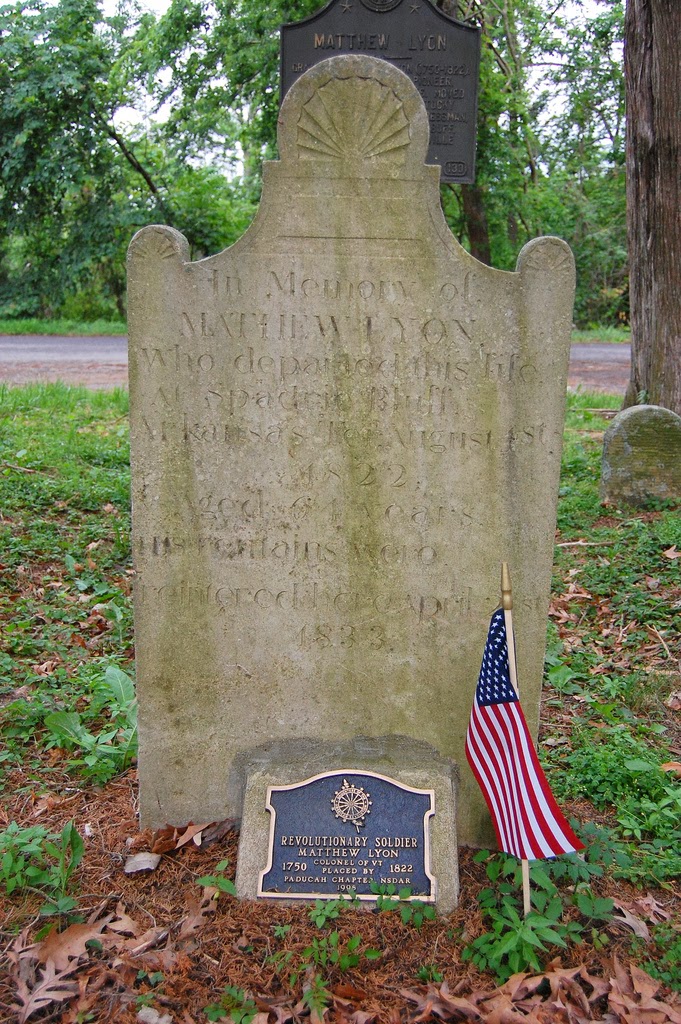
So it turned out, Senator Blount's act of betrayal did not end up preventing Jefferson from winning the White House. The arrogant Blount did not witness the victory, having died in his home (above) during an epidemic in March of 1800. The next year Matthew Lyon moved to Kentucky, and won election to Congress from that new state six times, finally retiring in 1811, and dying in 1822. The Spitting Lyon, the Green Mountain Beast, was then buried in the Blue Grass state (below). And what a shame we have allowed his memory to fade, in part because we insist upon neutering our "founding fathers" - denying them and us both our shared humanity, warts and all. The lessons are usually in the warts, you know.
- 30 -

Blog Archive