

I imagine myself standing in a topless hut on the rocky shores of Spitsbergen, half way between the fjords of Norway and the North Pole. It is July 11th, 1897, and most of the hut is taken up by a huge hydrogen balloon. In the basket suspended beneath that leaking gas bag is a jar headed Swedish engineer named Salomon Andree.
It was Andree who had dreamed up this plan for a hydrogen balloon flight to the North Pole, and sold the idea to investors, from average patriotic Swedes to scientific geniuses like Afred Nobel. Now, as he reaches out to shake my hand, a puzzled look comes over Andree's face. Where, he must be wondering, did I come from? But there is no time for explanations. I grasp his hand and pull him close. I whisper in his ear a final warning, “Ekholm was right. You have failed to face reality. That makes you the biggest idiot within ten thousand miles.” Andree nods and smiles absently. After all, he doesn’t speak English. He shouts, “Strindberg! Fraenkel!” Instantly, obediently, the slender Nils Strindberg and bullet shaped Knute Franknel leap into the basket, like two sacrificial lambs. The ropes are cut, and the Ornen (the Eagle) rises into the cold clear air and floats away. The three men are never seen alive again. What an idiot.  Nils Ekholm had joined Andree in Spitsbergen for his first attempt at floating a balloon to the North Pole in 1896, but the southerly winds Andree had confidently predicted never showed up. The delay gave Ekholm time to crunch some additional numbers and he came to the disturbing revelation that the Ornen was leaking like a kitchen sieve. It would never, he realized, stay inflated long enough to reach the Pole, let alone safety on a farther shore like Alaska or Russia. When he expressed his reservations, Andree expressed disappointment with Ekholm’s lack of enthusiasm. After the flight was cancelled for the year Ekholm made alternative travel plans for the summer of 1897. And that was how Knut Fraenkel earned a chance at immorality and trichinosis; lucky him.
If the leaking gas bag had been the only problem, the expedition would have have still been in trouble. Instead there was an almost endless list of mistakes and false assumptions that insured doom, and all of them lead straight back so Salomen Andree.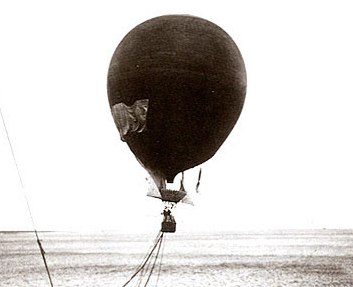
Andree had invented a clever and simple device for steering the balloon by dragging ropes along the ice or water (note the trailing lines, above). It didn’t work. Andree had designed three clever sleds that folded away for easy storage in the balloon. They were so rigid you could break your back trying to pull them across the ice. 
Andree invented a collapsible boat that they would end up dragging across the ice ridges until they collapsed. And Andree stocked the balloon with a ton or more of food, almost none of which could be easily transported by foot, should the balloon go down. Their tiny cook stoves often failed, releasing toxic fumes. But luckily they had also brought guns, assuming they would be able to feed themselves on seal and polar bear meat if they were forced down on the ice. But when prepared upon the innefficent stoves, they undercooked the meat, contracted trichinosis and died of dysentery; not the fate most 19th century explorer-romantics usually envisioned for them selves, death by constant toilet.
After they dissapeared into the sky on July 11th, for 33 years the assumption was that the brave trio had made it to the Pole but crashed while floating to landfall in Russia or Alaska, a thousand miles beyond rescue. Then in August of 1930 a Norwegian scientific ship stumbled on the remains of their last camp, not more than 200 miles from their starting point. The Norwegians found not only the three bodies but Andree and Franknel's journals and Strindberg's extraordinary photographs of the dead men. That was when the whole truth became known.  On July 14th, the Ornen had crashed onto the ice, after just 51 hours in the air. (Stridberg took extensive photos of the 'landing'.) The three men then spent a week unpacking and deciding what to do. Only then did they set out for home.
They left behind the champagne and beer, but struggled to carry the cans of condensed milk and sausages and cheese. A week’s trek across the ice taught them the lesson and they abandoned almost half of their burden in big pile, and kept going. They had no brought no furs but only their heavy woolen clothing, covered at times by oilskins, that trapped the moisture underneath until they were swimming in their own sweat.  As they marched, each two steps they took to the south were countered by the floating ice pack which carried them one and a half steps toward the north and east.
They clambered over two story high pressure ridges, sometimes reduced to crawling on all fours. They struggled over broken ice alternating with water leads that forced them into and then out of their clumsy boat, soaking their woolen clothing again and again. 
Slowly they came to the realization that they were not making much progress. By the middle September they decided they were going to have to winter on the ice. They built an elaborate snow hut and prepared to float southward on the ice, which they knew they were finally doing by watching the shores of White Island (now called Kvitoya Island) drift slowly past their camp.
But in early October the pack ice cracked right down the middle of their new home, and they were forced to drag their gear onto the rocky shores of Kvitoya island, barely 200 miles to the northeast of their starting point. They used the last of their strength to build a new hut on the island. Shortly after they landed Strindberg died of an apparent heart attack and his comrades buried him under stones in a cleft in the rocks. And within a few days Franknel and Andree also died in their little hut. A hunk of polar bear meat found frozen solid thirty-three years later near their stove was infected with trichinosis spores.
They had survived for 11 weeks on the open ice, perhaps the most ill-prepared polar explorers in history. But they had transcended their own stupidity with courage and tenacity. In the end they were killed by a bad plan and bad planning. But as one writer has since noted, “Posterity has expressed surprise that they died on Kvitøya, surrounded by food…The surprise is rather that they found the strength to live so long".
I would put it slightly differently. I find it unimaginable that Saloman Andree would ever admit defeat, even if he knew he was dieing.
- 30 -


 Gillmore had proven the power of his logic at Fort Pulaski (above), whose massive brick walls guarded the outskirts of Savannah, Georgia. Gillmore’s advantage at Fort Pulaski was the Parrot Gun, the invention of the precise and logical mind of Robert Parker Parrott, who ran the West Point Foundry in Cold Spring, New York.

 On the southern shoulder of Charleston’s inner harbor loomed the battered remnants of Fort Sumter, where the Civil War had begun in April of 1861. The Washington Republican newspaper waxed poetic when describing Gillmore's technical attack upon this birthplace of the rebellion. “From well-known mechanical laws, ...the penetration of the 24 pound shot at 3,500 yards…in brickwork, is six inches. The penetration of the 10 inch projectile will therefore be between six and seven feet of the same material…equal to the united blows of 200 sledge hammers weighing 100 lbs each, falling from a height of ten feet and acting upon a drill ten inches in diameter.” It could have been lifted from General Gillmore’s notebooks, and probably was.
 By midsummer Gillmore’s Parrott guns had reduced Fort Sumter to “a shapeless and harmless mass of ruin.” Yet Charleston still held out, because defending the outer harbor on Morris Island was Fort Wagner, situated directly astride the channel ships used to approach Charleston. Fort Wagner’s low packed sand and timber walls simply swallowed whole the explosive shells from Gillmore’s Parrotts, and punished the 54th regiment when they tried a direct ground assault (above - from the movie "Glory"). In his frustration Gillmore came to the logical conclusion that the Confederates would surrender when faced with the correct application of the power of his guns.
 On the morning of July 16, 1863, Gillmore ordered Colonel Edward W. Serrell of the engineers to find a spot for a new battery within range of Charleston itself. Col Serrell and an aide spent the day wandering across the slat marshes “…carrying a fourteen foot plank…Where the inundation would not bear them they sat on the plank and pushed it forward between their legs. When the soil appeared stiffer, they carried the plank until they reached the soft mud once more.” (Battles & Leaders of the Civil War, Vol. 4, Underwood et al, The Century Co. 1884) By evening this method had located a rectangle of more or less solid ground (in the low brush in the background, above) 8,000 yards from Charleston, at the maximum range of the Parrotts.
 It took a month to build a battery (above) amongst the muck, and on August 21st Gillmore sent a note to General Pierre Gustave Toutant Beauregard, the rebel commander, warning that if he did not at once surrender both forts Wagner and Sumter, Charleston would be bombarded with “Greek fire”. However, the note did not arrive until 10:45 p.m., and General Beauregard had gone to bed. And in any case the note bore no signature. The offended gentlemen of the Confederate headquarters returned the offensive note for signing. The 19th century industrial revolution and just run up against 18th century social graces.
 The amended note re-arrived at Beauregard’s headquarters at 9:00a.m the morning of August 23rd, and Gustave Toutant responded in his best Southern aristocratic outrage. “It would appear, sir, that despairing of reducing these works you now resort to the novel measure of turning your guns against the old men, the women and children, and the hospitals of a sleeping city.” In response Gillmore gave the Confederates a truce of 24 hours to evacuate Charleston before the Swamp Angel would continue its bombardment. In fact the Parrott had slid out of position after 16 shots and it would take hours of work to move the 8 ton cannon back into place.
 As darkness fell the Angel opened fire again. But this time, as the barrel heated up the shells began to show a nasty tendency to explode in the barrel, and the breech band expanded so that it started to slide around on the breech. Col. Serrell wisely had a second lanyard tied to the first, to give his men some distance when they fired the darn thing, and after another 13 shots, as the Swamp Angel let go her 38th attempt at burning Charleston to the ground, the gun exploded, blowing off the breech band, cracking the breech itself, blowing three feet off the end of the barrel, and landing the cannon atop her own battery (below). This exercise in the application of violence was finished, for the moment.
 Not that Gillmore was about to give up. The relentless bombardment of Fort Wagner had converted that post into an open wound through which the defenders were slowly bleeding to death. Two weeks after the Swamp Angel blew up, on September 7, 1863, Beauregard pulled his troops out.
 In far off New York, Herman Melville, a man who knew something about the dark effects of obsession on the human heart, was inspired to put pen to paper; “There is a coal black Angel, With a thick African lip, And he dwells (like the hunted and harried), In a swamp where the green frogs dip. But his face is against a City, Which is over a bay of the sea, And he breathes with the breath that is blastment, and dooms by a far degree…Who weeps for the woeful City, Let him weep for our guilty kind; Who joys at her wild despairing – Christ, the Forgiver, convert his mind.”
 You can see that terror now, in Cadwallader Park in the city of Trenton, New Jersey, preserved as a memento of one of humanities’ early attempts at a logical application of terror. And, no, it didn't work; terror rarely works, and never for long.

 The most immediate cause of the tragedy at Malbone station was the construction of The Manhattan Bridge. This third suspension span across the East River, which opened on the last day of 1909, was meant to make travel between Brooklyn and Manhattan safer and easier. The bridge even had its own mass transit, The Bridge Three Cent Line. But the inconvenience of having to transfer from the Bridge Line to the trains of the Brooklyn Rapid Transit (later the Brooklyn-Manhattan Transit, or BMT) drove the bridge lines out of business, and by 1915 you could take an elevated BMT train all the way from Coney Island to City Hall.
 But making the connection to the bridge required the BMT to complete considerable reconstruction. And while this re-construction was going the directors of the BMT built a temporary 90 degree right hand blind curve (recommended to be taken at a reduced speed of just six miles an hour) which funneled the trains leaving the elevated right-of-way on Flatbush and Ocean Avenues and Malbone Street, in Prospect Park, toward the Manhattan Bridge. Worse, this temporary junction required a rail switch-over as well, making this one of the most complicated rail connections in the entire city of New York. Still the junction worked smoothly during the lengthy reconstruction as long as the operating personal were well trained and familiar with the system. And that is what made the wild cat BMT strike of 1918 such an invitation to disaster.
 The strike was the result of an attempt by politicians to keep transit fares low. All the transit companies in New York City were still private entities, but their fares were regulated and for five long years were locked in at a nickel per trip. The voters approved. But eventually wartime inflation put the squeeze on the company, which responded by holding the line on salaries. And in the fall of 1918 the desperate members of The Brotherhood of Locomotive Engineers went out on a wildcat strike. The BMT management stepped in, following the typical American management anti-union animosity. They shifted personnel and hired strike breakers (scabs) to keep the trains running on normal scheduals. And that was how a 23 year old dispatcher named Edward Luciano found himself at 6:40 PM, on Friday November the First, starting his second ten hour shift of the day, working at a job he had not been trained for; operating a crowded, standing room only, five car train approaching the Malbone station junction, which he had never seen before, in the dark. And he was running late.
 He was bound to make a mistake. It was almost guaranteed. He was tired. He was confused. He was harried. He had never driven this route before. And he did make a mistake. As he came down the long grade (above) and approached the curve, he clicked over the points on the switchover and found himself headed into the Malbone station, rather than around the curve, leading to the bridge and City Hall.
 The front truck under the first drive car somehow made it around the curve, even tho the right side, leaning on the curve, smashed into the tunnel wall. But the rear truck derailed. This dragged the two following cars off the rails and threw them into the tunnel walls.
 An historian described how “The second car (above) slammed violently into a concrete abutment, losing its roof and one of its sides…The third car disintegrated into a tangled mass of wood and glass. Dozens of passengers died immediately, many of them decapitated or impaled by shards of wood and glass.” The New York Times provided all the grizzly details. “Scores of men, women and children were flung by the impact…against the pillars and concrete wall, where they were killed instantly or ground under the wheels after falling upon the tracks. Some…were killed when they fell upon the broken seats, splintered timbers and iron beams which projected through the shattered bottoms of the car…” The fourth and fifth cars, both being a motor cars, suffered almost no damage at all. But as the horrible echoes of the crash faded in the tunnel, things got worse.
 When the cars derailed they pulled up the third rail, supplying power to the motor cars. This automatically shut off the power for the entire system. But supervisors at the power station had been briefed and assumed the sudden shutdown was the result of union sabotage. They immediately threw the power back on. Dozens of injured and uninjured passengers in the damaged and undamaged cars were immediately electrocuted to death.
 One who survived was motorman Edward Luciano. He stumbled from the tunnel, dazed and slightly injured, and with a growing terror based on the horror he had witnessed. He panicked and went home. Behind him the New York Times recorded the scene; “Nearly every man, woman and child in the first car (sic -second car) was killed, and most of those in the second (sic - third car) were killed or badly injured…At 11 o’clock eighty-five bodies had been taken from the wreckage, and the police announced that no more bodies were in the tunnel…police estimate that at least 100 had been injured.” The final count, including those who died later of their injuries, came to 103 dead and more than 100 injured.
 Edward Luciano and both of the BMT authorities were acquitted of manslaughter charges, and no one was ever held morally or financially responsible for the 103 deaths. Within a few months the construction work was finished on the new connection line, and the blind curve was regulated to an occasional service of a shuttle line, which it still operates today, usually safely (below). The BMT line now enters Manhattan directly, avoiding the Manhattan Bridge. And out of respect for the dead and the living, Malbone Street was renamed Empire Avenue.


