

I don’t know who the two fishermen pulled out of the high tide off tiny Pilsey Island (above)on June 9, 1957. It was probably the earthly remains of Commander Lionel “Buster” Crabb. But the body had been in the water for so long that when they lifted the corpse into the boat the head fell off and was lost amongst the mud flats. The hands were already gone, whether by accident or design. Margaret Player, Lionel’s ex-wife, could not identity what was left and neither could his current girlfriend, Patricia Rose. At the inquest a diving partner, William McLanachan, identified a scar on the left knee as Lionel’s, but later recanted. DNA technology was still a half century in the future, but still the evidence seems convincing. The diving suit matched the 2 piece type Lionel had been wearing. The stature of the corpse matched his. The body hair matched. The clothing Lionel had been wearing under the suit, matched. Even the “hammer toes” of the corpse matched photographs of Lionel Crabb’s feet. The coroner ruled that it was Lionel Crabb and that he was dead. And if the suspected body was claimed to have belonged to anyone else but Commander Lionel Crabb, the mystery would have ended right there, in the tidal flats of Chichester Harbor, 17 miles to the east of Plymouth Harbor. But what if I suggest that the body was claimed to be that of Commander James Bond? Would you still be so certain?
 Lionel Crabb didn’t look like the movie version of James Bond, but he was a dead ringer for the Bond from the books. He hated to exercise. He was a chain smoker, and an aficionado of “boilermakers” (whisky with a beer chaser). He distrusted academics and experts (he would have shot Q long ago). And Lionel couldn’t swim three lengths of a swimming pool without collapsing from exhaustion. Still, a friend described him as having, “…a singular ability to endure discomfort…His lack of fear was unquestioned….(a) curmudgeonly but kindly bantam cock,…a most pleasant and lively individual. (However) His penchant for alcohol remained undiminished.”
 Lionel Crabb started out as a Merchant seaman. And when World War Two began he was already thirty years old, well past his physical prime. He joined the Royal Navy in 1940 and eventually ended up as a bomb safety officer on Gibraltar, a job requiring calm dedication and not for a dare devil. But that is where the legend of Commander “Buster” Crabb really begins.
DNA technology was still a half century in the future, but still the evidence seems convincing. The diving suit matched the 2 piece type Lionel had been wearing. The stature of the corpse matched his. The body hair matched. The clothing Lionel had been wearing under the suit, matched. Even the “hammer toes” of the corpse matched photographs of Lionel Crabb’s feet. The coroner ruled that it was Lionel Crabb and that he was dead. And if the suspected body was claimed to have belonged to anyone else but Commander Lionel Crabb, the mystery would have ended right there, in the tidal flats of Chichester Harbor, 17 miles to the east of Plymouth Harbor. But what if I suggest that the body was claimed to be that of Commander James Bond? Would you still be so certain?Lionel Crabb didn’t look like the movie version of James Bond, but he was a dead ringer for the Bond from the books. He hated to exercise. He was a chain smoker, and an aficionado of “boilermakers” (whisky with a beer chaser). He distrusted academics and experts (he would have shot Q long ago). And Lionel couldn’t swim three lengths of a swimming pool without collapsing from exhaustion. Still, a friend described him as having, “…a singular ability to endure discomfort…His lack of fear was unquestioned….(a) curmudgeonly but kindly bantam cock,…a most pleasant and lively individual. (However) His penchant for alcohol remained undiminished.”Lionel Crabb started out as a Merchant seaman. And when World War Two began he was already thirty years old, well past his physical prime. He joined the Royal Navy in 1940 and eventually ended up as a bomb safety officer on Gibraltar, a job requiring calm dedication and not for a dare devil. But that is where the legend of Commander “Buster” Crabb really begins.
Across the straights from Gibralter, in Algeria, was a force of Italian divers who were skillfully planting limpet mines on British transports and warships in the anchorage of Gibraltar Harbor (above). Lionel became part of the team assigned to protect those ships. 
He learned to dive in the war zone, wearing the bulky “Sladen Suits” (above), often referred to as “Clammy Death”, and using the ancestor of the aqualung, the re-breathers invented by the American Dr. Lambersten. The British team didn’t even have swim fins until two Italian divers where machine gunned by a sentry one night and Lionel retrieved their fins and started using them out of curiosity. Working often in the black of night Lionel would inspect hulls for any sign of explosives, then carefully remove them, bringing them to the surface and disarming them, which was the only part of the job he had actually been trained for. For his work Lionel was awarded the St. George Medal in 1944. By that time he was commanding the entire unit. Lionel was a pioneer in the field, learning to disarm the new German magnetic mines. In August of 1945 he was assigned to disarm mines placed by Zionists terrorists on shipping in the port of Haifa. He received another medal for his role in disarming mines and explosives in Europe left over from World War II.
  And in 1949 Lionel managed to produce underwater photographs of a British cruiser’s spinning propellers while the big ship plowed through the sea within feet of him. He explored a British submarine lost in the Thames esturary (above), and helped build the outflow system for a top secret nuclear weapons factory. Lionel had become the “go-to guy” on anything involving underwater espionage, not because he was a genius at it but because he was the only person doing it.
 Lionel was released from active service in 1953 but remained in the Reserves. And in October of 1955, when the new Soviet cruiser Sverdlov paid a “good will” visited to Portsmouth, Lionel and a friend, Sydney Knowles, made nighttime dives, examining and measuring the hull, in an attempt to explain the ship’s powerful maneuvering abilities. And so both men seemed obvious picks to repeat that dive in April of 1956 when the Soviet Cruiser Ordzhonikidze (above) paid call to Portsmouth carrying Premier Nikolai Bulganin and Communist Party Leader, Nikita Khrushchev on a state visit.
 The matter might never have become public knowledge except that after the visit the Soviets filed an offical protest that a British diver was seen close to the Soviet cruiser on April 19th. Lionel’s war record had made him the most famous diver in Britain, and the press quickly tracked him to the Sally Port hotel in Old Portsmouth (above) where he registered the night before the incident. (The day after the press discovered the ledger, the page was ripped out of the book.) The British navy eventually claimed that Lionel had been testing new diving equipment in the Solent to the West of Portsmouth, when he had disappeared and was presumed to have drowned. But that story seemed so absurd it produced even more speculation.
  It is speculated that the new British Prime Minister, Anthony Eden, had hopes of reaching a rapprochement with the Soviet leadership and had forbidden Lionel from making this second dive inside Portsmouth harbor. But the CIA and reactionary factions within the British government had stepped in to encourage Lionel to make the attempt even without official endorsement. Those who believe this version are either pro or con toward Anthony Eden’s alleged policy of appeasement. What we do know about this version is that Eden issued a public statement on May 14, saying that “It would not be in the public interest to disclose the circumstances in which Commander Crabb is presumed to have met his death. I think it necessary, in the special circumstances of this case, to make it clear that what was done was done without the authority or the knowledge of Her Majesty’s Ministers. Appropriate disciplinary steps are being taken.” Shortly thereafter the head of Britain’s MI6 was relieved.
 But from this point the stories only multiply. In 2007 Eduard Koltsov claimed he had been a diver onboard the Cruiser Ordzhonikidze when, while on underwater patrol, he spotted Lionel fixing a mine to the Soviet ship, and had cut his throat. Lionel’s fiancé claimed in 1974 that he had defected and was training Soviet frogmen in the Black Sea. Another version says Lionel suffered a heart attack while inspecting the Ordzhonikidze, had been rescued by Soviet divers but had died on board the Soviet ship, perhaps under torture, perhaps several days later, and that they dumped his body overboard after leaving port.
 What we know for certain is that on April 17, 1956 Lionel and another man checked into the Sally Port Hotel, in Portsmouth. On the 18th, Lionel entered the water from The King’s Stairs Jetty (above), about 80 yards from where the Soviet warship was berthed. Lionel returned to the surface just 20 minutes later, having gotten confused in the dark amongst the pier’s pilings. The decision was made to try again in daylight.
Working often in the black of night Lionel would inspect hulls for any sign of explosives, then carefully remove them, bringing them to the surface and disarming them, which was the only part of the job he had actually been trained for. For his work Lionel was awarded the St. George Medal in 1944. By that time he was commanding the entire unit. Lionel was a pioneer in the field, learning to disarm the new German magnetic mines. In August of 1945 he was assigned to disarm mines placed by Zionists terrorists on shipping in the port of Haifa. He received another medal for his role in disarming mines and explosives in Europe left over from World War II. And in 1949 Lionel managed to produce underwater photographs of a British cruiser’s spinning propellers while the big ship plowed through the sea within feet of him. He explored a British submarine lost in the Thames esturary (above), and helped build the outflow system for a top secret nuclear weapons factory. Lionel had become the “go-to guy” on anything involving underwater espionage, not because he was a genius at it but because he was the only person doing it.Lionel was released from active service in 1953 but remained in the Reserves. And in October of 1955, when the new Soviet cruiser Sverdlov paid a “good will” visited to Portsmouth, Lionel and a friend, Sydney Knowles, made nighttime dives, examining and measuring the hull, in an attempt to explain the ship’s powerful maneuvering abilities. And so both men seemed obvious picks to repeat that dive in April of 1956 when the Soviet Cruiser Ordzhonikidze (above) paid call to Portsmouth carrying Premier Nikolai Bulganin and Communist Party Leader, Nikita Khrushchev on a state visit.The matter might never have become public knowledge except that after the visit the Soviets filed an offical protest that a British diver was seen close to the Soviet cruiser on April 19th. Lionel’s war record had made him the most famous diver in Britain, and the press quickly tracked him to the Sally Port hotel in Old Portsmouth (above) where he registered the night before the incident. (The day after the press discovered the ledger, the page was ripped out of the book.) The British navy eventually claimed that Lionel had been testing new diving equipment in the Solent to the West of Portsmouth, when he had disappeared and was presumed to have drowned. But that story seemed so absurd it produced even more speculation. It is speculated that the new British Prime Minister, Anthony Eden, had hopes of reaching a rapprochement with the Soviet leadership and had forbidden Lionel from making this second dive inside Portsmouth harbor. But the CIA and reactionary factions within the British government had stepped in to encourage Lionel to make the attempt even without official endorsement. Those who believe this version are either pro or con toward Anthony Eden’s alleged policy of appeasement. What we do know about this version is that Eden issued a public statement on May 14, saying that “It would not be in the public interest to disclose the circumstances in which Commander Crabb is presumed to have met his death. I think it necessary, in the special circumstances of this case, to make it clear that what was done was done without the authority or the knowledge of Her Majesty’s Ministers. Appropriate disciplinary steps are being taken.” Shortly thereafter the head of Britain’s MI6 was relieved.But from this point the stories only multiply. In 2007 Eduard Koltsov claimed he had been a diver onboard the Cruiser Ordzhonikidze when, while on underwater patrol, he spotted Lionel fixing a mine to the Soviet ship, and had cut his throat. Lionel’s fiancé claimed in 1974 that he had defected and was training Soviet frogmen in the Black Sea. Another version says Lionel suffered a heart attack while inspecting the Ordzhonikidze, had been rescued by Soviet divers but had died on board the Soviet ship, perhaps under torture, perhaps several days later, and that they dumped his body overboard after leaving port.What we know for certain is that on April 17, 1956 Lionel and another man checked into the Sally Port Hotel, in Portsmouth. On the 18th, Lionel entered the water from The King’s Stairs Jetty (above), about 80 yards from where the Soviet warship was berthed. Lionel returned to the surface just 20 minutes later, having gotten confused in the dark amongst the pier’s pilings. The decision was made to try again in daylight.
Lionel returned to the jetty just after 7 a.m on April 18th, in full daylight this time, and re-entered the waters of Portsmouth harbor (above). He came back up just 20 minutes later complaining of some problem with his equipment. Repairs were made, and within a few minutes Lionel went down again for another try. But this time he did not resurface, at least not until fourteen months later when his body was supposedly pulled from the shallow tidal inlet some seventeen miles further up the coast, to the West. But was that really the body of Commander Lionel Crabb? We still don’t know for certain, and won’t until at least 2057, when the British government has promised to tell all they know.
Of course they had originally promised to do that in 1987, but then they changed their minds. They could do that again, too.
- 30 -


 America, in her centennial year, was a nation of about 45 million people. And they seem such different people than our 300 million today. The frontier then began where the railroad tracks and the telegraph lines ceased to reach. Robert Marlin tries to explain the lives of the soldiers on the frontier; “…the cavalry became a place to simply disappear. Most cavalry units operated outside the borders of the states and provided a new start in life with few questions asked. Early on, many of those enlisting in the cavalry had arrest warrants outstanding…Some joined the service as an alternative to serving jail time… Immigrants, especially those from Ireland and German, filled the ranks. Others came from England, France and Italy. While most of the American recruits did not read or write, the immigrants who did not speak English compounded this problem….A trooper started off at the pay of $13 per month. By the time he finished his first hitch and re-enlisted this was raised to $15. By now the trooper was a “50-cent-a-day professional”.
 “The day usually started at 5:30am,” writes Marlin, “with the dreaded call of Reveille, and ended at 10:00pm with the bugle sounding Taps.” A regiment, like the seventh Cavalry, consisted of 12 troops, labeled A through M (and skipping “J” because in quickly written note, a “J” might be confused with an “I”). Four troops made up each battalion, and each troop consisted of one captain, two Lieutenants, six sergeants, four corporals, two trumpeters, four farriers (to care for the horses) and 78 privates. At any given moment about 20% of the regiment was on detached service, recruiting or on extended leave.
 The average cavalry recruit was in his mid-twenties, and stood about five feet eight inches tall. He suffered from bad teeth, a bad back, and 10% had suffered from some form of healed trauma, usually to the head. Twenty-two percent of the privates (311 men) serving in the seventh cavalry on June 25th , 1876, had been in the service for less than a year; 23 in A troop, 43 in B troop, 39 in C troop, 26 in D troop, etc. There was little that would have convinced a man to remain in the service after one hitch, including the food. Each soldier received each day 12 ounces of pork or bacon, 22 ounces of flour or bread (or 16 ounces of hard bread when in the field) and less than an once of ground coffee. Every ten men were to receive per month; 15 lbs of beans or peas, 10 lbs of rice or hominy, 30 lbs of potatoes, 1 quart of molasses, 15 lbs of sugar, 3 lbs 12 ounces of salt, 4 ounces of pepper and 1 gallon of Vinegar. It was not a diet well supplied with vitamins, and it has been observed that, “…while the men did not suffer true malnourishment, they were not well fed.”
 As the army needed soldiers, it also needed laundresses. (above, tools of the trade.) They were as much in service of the country as the soldiers they served. And it would seem logical that the reasons a young man might join the cavalry were similar to the reasons a young woman might become a laundress for those soldiers; a roof over your head, food in your belly and a new start in life. Linda Grant De Pauw lays out the vulnerbility for such women in “Battle Cries and Lullibies; “…a laundress wrote to Major L.H. Marshall at Fort Boise, Idaho describing how she had been arrested, charged as a murderess, and confined in a guardhouse for hitting her husband with a tin cup that he claimed was an axe…(she was) sentenced to be drummed off that post at fixed bayonets …she and her three children had to live in a cold house, without the food ration they depended upon."

 Mrs. Nash also built a reputation as a dependable mid-wife and “few births occurred without her expert help”. So it was natural that she would be encouraged to follow the regiment when it moved to Fort Abraham Lincoln, in Dakota Territory. She was a valuable member of the garrison. There is no record that she ever served as a prostitute (above), another option for the laundresses even if one not encouraged should she became notorious.
 She kept a bright and tidy home, planting and maintaining flowers in front of their modest quarters. And she restored her nest egg. And for five years they were a contended and happy couple, the center of the social circle of Suds Row east of the Fort Lincoln parade grounds (above), and were a significant part of the larger post’s social life.
 The Bismarck Tribune went so far as to headline a story, “Mrs. Nash has (testicles) as big as a bull!” The eastern papers picked the story up, and commented upon it. So that when poor Corporal Noonan returned from patrol all his protestations of innocence and unawareness fell upon deaf ears. Quickly the ridicule and the questions, asked and unasked, became too much to bear and two days after returning from patrol to find his “wife” dead, John Noonan deserted his post and on November 30, 1878, shot himself to death with a rifle. He lies buried now in the National Cemetery adjacent to the Little Big Horn Battlefield, his tombstone no different than any of the others who died in the service of their country .
 But there is no headstone for Mrs. Nash; no recognition of her years of service to the unit, of the babies she delivered, of the hardships she endured. And there is no recognition today that without a "liberal" endorsment and without a liberal media encouragment, at least one human being found it preferable to live in constant fear of having their secret revealed, in exchanged for the privilage of living as God made them, internally and externally.


 New Guinea was a place where, explained one soldier, “It rains daily for nine months and then the monsoon starts.” It was a place plagued by mud, mountains, malaria, monotony and “moozies”, as the Aussie diggers described the coastal mosquitoes. Went one popular story, two moozies selected a tasty staff sergeant sleeping with a hole in his mosquito net. Asked the first moozie,“Shall we take him down to the beach and eat him?” “Na”, replied the second, “if we take him down to he beach, the big chaps will get him.” Went another story, an anti-aircraft gunner mistook a moozie for a zero fighter and one shell set his tail on fire. The offended moozie threw a rock at the gunner, beaning him on the noggin. And along with malaria the soldiers of both sides suffered from dengue fever, dysentery, scrub typhus and dozens of other unnamed debilitating illnesses.
 Bruce Kingsbury had been born in 1918, just after his parents had emigrated from England. And as often happens, the child of immigrants adopted his new country to a degree his parents never could. Bruce rejected his father’s white collar career and instead opted to work on a sheep station like his livelong friend, Allen Avery. In 1940 Bruce and Allen joined the army together. After they finished basic training, Bruce became engaged to marry Miss Leila Bradbury. But they shipped out the Middle East before Bruce could obtain a marriage license.
 Japanese forces landed at Buna, on the Northeast coast of Papua, New Guinea, on July 21st, and immediately began to push south. And immediately the island became the enemy of both sides. George H. Johnston observed in his book, “The Toughest Fighting in the World”, The Japanese troops "...covered the sixty miles…from Buna (to the Kokoda Pass) in five days. To push ahead another thirty miles took fifty days,…”
 The seventh Australia division saw action against Vichy French units in Lebanon. And Bruce Kingsbury’s last assignment before returning to defend his home land, was the burial of Australian and French dead. The 7th division sailed from Alexandria, Egypt on January 30th 1942. They arrived in Melbourne, Australia on March 16th. Bruce was granted a week at home to see his parents and Leila. After further training and re-equipment for jungle fighting, he shipped out of Brisbane on August 5th. This time Bruce was bound for Port Moresby.
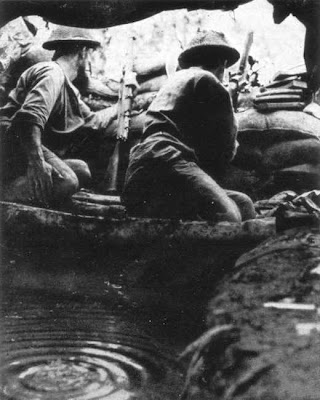 The Japanese moved up the trail against continued resistance. Noted a modern travel guide; “Scattered along the trail…are the numerous Australian pits. Each is always sited on a small rise, tucked away from three to twenty feet from that narrow slippery, root ridden life line.” In each of those pits, unseen and unheralded, Australian solders risked their lives to slow the Japanese advance, and the Japanese soldiers risked their lives to overcome them. The diary of Lieutenant Toshiro Kuroki noted that rice supplies were running so low the soldiers in the front lines were obsessed with the endless hunt for “…potatoes! …You do not find smiling faces among the men in the ranks in New Guinea. They are always hungry….every other word has something to do with eating. At the sight of potatoes their eyes gleam and their mouths water.” Between Kokoda and Isurava “the track often climbed up gradients so steep that it was heartbreaking labor for burdened men to climb even a few hundred yards." And yet, on both sides, they climbed.
 At Isurava (above), using the time so dearly paid for, the Aussies established their headquarters unit on a ridge line, overlooking yet another narrow river valley. But Major General Tomitaro Horii, the Japanese commander, had found a parallel track and at dawn on August 28th threw his men down the parallel trail against the Aussies. The diggers resisted but the Imperial soldiers, reduced by desease and hunger, drove them back. The next morning, suffering under heavy Australian fire, the Japanese climbed the almost vertical slope in a frontal attack and broke through the Australian lines and captured the ridge top. They had now isolated the headquarters unit. General Horii wrote that night, “The annihilation of the Australians is near, but there are still some remnants…and their fighting spirit is extremely high.”
 The line of communications for the Aussie headquarters unit had to be restored and at once, or the entire 400 man defensive force might be destroyed. A platoon was thrown together from the survivors of several platoons overrun the day before, including Corporal Bruce Kingsbury, and his mate, Allen Avery. They were ordered to drive the Japanese away.
 Twice the desperate diggers threw themselves against the desperate Japanese. Twice the Japanese gave ground, but refused to retreat. And that was when Bruce Kingsbury grabbed a borrowed machine gun and led yet another charge, reaching a large bolder half way up the slope, from which he could rake the Japanese positions. An exhausted Lt. Colonel Phil Rhoden watched. “You could see his Bren gun held out and his big bottom swaying as he went with the momentum he was getting up, followed by Alan Avery. They were cheerful. They were going out on a picnic, almost.” Another witness wrote, “The fire was so heavy (coming from the Japanese) that the undergrowth was completely destroyed within five minutes.” Private Shegenori Doi, on the other side of that undergrowth, wrote, “I remember that an Australian soldier, wearing just a pair of shorts, came running toward us…this warrior was far braver than any in Japan.” Bruce’s mate, Allen Avery, wrote of Bruce, “He came forward…and he just mowed them down. He was an inspiration to everybody else around him.”
  Bruce’s citation for the Victoria Cross says that he “…rushed forward firing his Bren Gun from the hip through terrific machine gun fire and succeeded in clearing a path through the enemy…(Then he) was seen to fall to the ground shot dead, by the bullet from a sniper hiding in the wood….Private Kingsbury displayed a complete disregard for his own safety. His initiative and superb courage made possible the recapture of the position which undoubtedly saved the Battalion Headquarters…” Allen Avery charged into the jungle after the sniper, but never found him. Then he hefted Bruce up onto his back and alone Allen carried Bruce to an aid post. But by the time they got there, Bruce was dead.
 The battle of Isurava lasted for four long days and nights. The fighting was without quarter. In the end, out of ammo and battered with over half their strength down with wounds and malaria, the Aussies were forced to withdraw. The Japanese followed. But General Horii had already been informed that American troops had landed on Guadalcanal Island, 1,500 miles to the west. Horii’s commander told him there would be no reinforcements. The Japanese effort had shifted to retake Guadalcanal. The sacrifice of his soldiers on New Guinea had been judged a wasted effort, while in the view of history the sacrifice of Bruce Kingsbury had been judged worthy. But for the soldiers on both sides the judgments made by historians were meaningless. All that mattered was that at this time and this place their sacrifice had been asked for and had been given, on both sides. And that is always the soldier's duty.


