

I believe that Bruce Kingsbury gave up his life willingly. But he was caught in a place and a time where the description “willingly” has a different connotation than in “normal” times.
The time was August 29, 1942 and the Japanese Empire was making a grasp for complete control of the world’s largest tropical island, New Guinea. To secure their hold Japanese soldiers would have to capture the tiny village of Port Moresby (above), on the island’s south eastern coast.
And to reach Port Moresby they would have to cross the 14,000 foot high Owen Stanley Mountain Range using only the Kokoda Track, a foot wide trail hemmed in by dense jungle, which clambered up a series of endless precipitous mountain ridges separated by vicious whitewater streams. But for the Japanese the goal was worth the effort. Port Moresby was less than 1,000 miles from Darwin, capital of Australia’s Northwest Territory, and just 1,100 miles from Brisbane, on Australia’s east coast.  New Guinea was a place where, explained one soldier, “It rains daily for nine months and then the monsoon starts.” It was a place plagued by mud, mountains, malaria, monotony and “moozies”, as the Aussie diggers described the coastal mosquitoes. Went one popular story, two moozies selected a tasty staff sergeant sleeping with a hole in his mosquito net. Asked the first moozie,“Shall we take him down to the beach and eat him?” “Na”, replied the second, “if we take him down to he beach, the big chaps will get him.” Went another story, an anti-aircraft gunner mistook a moozie for a zero fighter and one shell set his tail on fire. The offended moozie threw a rock at the gunner, beaning him on the noggin. And along with malaria the soldiers of both sides suffered from dengue fever, dysentery, scrub typhus and dozens of other unnamed debilitating illnesses.
 Bruce Kingsbury had been born in 1918, just after his parents had emigrated from England. And as often happens, the child of immigrants adopted his new country to a degree his parents never could. Bruce rejected his father’s white collar career and instead opted to work on a sheep station like his livelong friend, Allen Avery. In 1940 Bruce and Allen joined the army together. After they finished basic training, Bruce became engaged to marry Miss Leila Bradbury. But they shipped out the Middle East before Bruce could obtain a marriage license.
 Japanese forces landed at Buna, on the Northeast coast of Papua, New Guinea, on July 21st, and immediately began to push south. And immediately the island became the enemy of both sides. George H. Johnston observed in his book, “The Toughest Fighting in the World”, The Japanese troops "...covered the sixty miles…from Buna (to the Kokoda Pass) in five days. To push ahead another thirty miles took fifty days,…”
New Guinea was a place where, explained one soldier, “It rains daily for nine months and then the monsoon starts.” It was a place plagued by mud, mountains, malaria, monotony and “moozies”, as the Aussie diggers described the coastal mosquitoes. Went one popular story, two moozies selected a tasty staff sergeant sleeping with a hole in his mosquito net. Asked the first moozie,“Shall we take him down to the beach and eat him?” “Na”, replied the second, “if we take him down to he beach, the big chaps will get him.” Went another story, an anti-aircraft gunner mistook a moozie for a zero fighter and one shell set his tail on fire. The offended moozie threw a rock at the gunner, beaning him on the noggin. And along with malaria the soldiers of both sides suffered from dengue fever, dysentery, scrub typhus and dozens of other unnamed debilitating illnesses.Bruce Kingsbury had been born in 1918, just after his parents had emigrated from England. And as often happens, the child of immigrants adopted his new country to a degree his parents never could. Bruce rejected his father’s white collar career and instead opted to work on a sheep station like his livelong friend, Allen Avery. In 1940 Bruce and Allen joined the army together. After they finished basic training, Bruce became engaged to marry Miss Leila Bradbury. But they shipped out the Middle East before Bruce could obtain a marriage license.Japanese forces landed at Buna, on the Northeast coast of Papua, New Guinea, on July 21st, and immediately began to push south. And immediately the island became the enemy of both sides. George H. Johnston observed in his book, “The Toughest Fighting in the World”, The Japanese troops "...covered the sixty miles…from Buna (to the Kokoda Pass) in five days. To push ahead another thirty miles took fifty days,…”At the top trail, on August 9th, in a vicious struggle to win the village and airstrip at Kokoda, the 5,000 strong Japanese Imperial force believed they were opposed by 1,200 Aussie diggers. In fact, there just 77 Australian soldiers blocking the Japanese advance to Port Moresby. The diary of one Japanese soldier explained the obstacles. “The sun is fierce here…Thirst for water, stomach empty. The pack on the back is heavy. My arm is numb like a stick…We reach for the canteens…from force of habit, but they do not contain a drop of water.” The seventh Australia division saw action against Vichy French units in Lebanon. And Bruce Kingsbury’s last assignment before returning to defend his home land, was the burial of Australian and French dead. The 7th division sailed from Alexandria, Egypt on January 30th 1942. They arrived in Melbourne, Australia on March 16th. Bruce was granted a week at home to see his parents and Leila. After further training and re-equipment for jungle fighting, he shipped out of Brisbane on August 5th. This time Bruce was bound for Port Moresby.
The seventh Australia division saw action against Vichy French units in Lebanon. And Bruce Kingsbury’s last assignment before returning to defend his home land, was the burial of Australian and French dead. The 7th division sailed from Alexandria, Egypt on January 30th 1942. They arrived in Melbourne, Australia on March 16th. Bruce was granted a week at home to see his parents and Leila. After further training and re-equipment for jungle fighting, he shipped out of Brisbane on August 5th. This time Bruce was bound for Port Moresby. 
There were now some 2,500 Japanese troops descending the Kokoda track toward Port Moresby, and the best the Australians could do was to rush the first 400 soldiers off the transports up the track to the jungle village of Isurava to stop them. Author William Manchester tried to describe that desperate march up the track. He could have just as well been describing the Japanese march down the track as well. “In places the winding trail, a foot wide at most, simply disappeared. It took an hour to cut through a few yards of vegetation. The first man in a file would hack away with a machete until he collapsed of exhaustion…In that climate the life expectancy of the men who lost consciousness and were left behind was often measured in minutes.”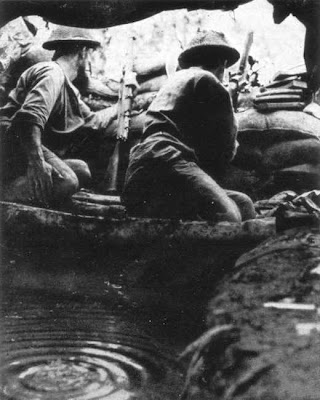 The Japanese moved up the trail against continued resistance. Noted a modern travel guide; “Scattered along the trail…are the numerous Australian pits. Each is always sited on a small rise, tucked away from three to twenty feet from that narrow slippery, root ridden life line.” In each of those pits, unseen and unheralded, Australian solders risked their lives to slow the Japanese advance, and the Japanese soldiers risked their lives to overcome them. The diary of Lieutenant Toshiro Kuroki noted that rice supplies were running so low the soldiers in the front lines were obsessed with the endless hunt for “…potatoes! …You do not find smiling faces among the men in the ranks in New Guinea. They are always hungry….every other word has something to do with eating. At the sight of potatoes their eyes gleam and their mouths water.” Between Kokoda and Isurava “the track often climbed up gradients so steep that it was heartbreaking labor for burdened men to climb even a few hundred yards." And yet, on both sides, they climbed.
 At Isurava (above), using the time so dearly paid for, the Aussies established their headquarters unit on a ridge line, overlooking yet another narrow river valley. But Major General Tomitaro Horii, the Japanese commander, had found a parallel track and at dawn on August 28th threw his men down the parallel trail against the Aussies. The diggers resisted but the Imperial soldiers, reduced by desease and hunger, drove them back. The next morning, suffering under heavy Australian fire, the Japanese climbed the almost vertical slope in a frontal attack and broke through the Australian lines and captured the ridge top. They had now isolated the headquarters unit. General Horii wrote that night, “The annihilation of the Australians is near, but there are still some remnants…and their fighting spirit is extremely high.”
 The line of communications for the Aussie headquarters unit had to be restored and at once, or the entire 400 man defensive force might be destroyed. A platoon was thrown together from the survivors of several platoons overrun the day before, including Corporal Bruce Kingsbury, and his mate, Allen Avery. They were ordered to drive the Japanese away.
 Twice the desperate diggers threw themselves against the desperate Japanese. Twice the Japanese gave ground, but refused to retreat. And that was when Bruce Kingsbury grabbed a borrowed machine gun and led yet another charge, reaching a large bolder half way up the slope, from which he could rake the Japanese positions. An exhausted Lt. Colonel Phil Rhoden watched. “You could see his Bren gun held out and his big bottom swaying as he went with the momentum he was getting up, followed by Alan Avery. They were cheerful. They were going out on a picnic, almost.” Another witness wrote, “The fire was so heavy (coming from the Japanese) that the undergrowth was completely destroyed within five minutes.” Private Shegenori Doi, on the other side of that undergrowth, wrote, “I remember that an Australian soldier, wearing just a pair of shorts, came running toward us…this warrior was far braver than any in Japan.” Bruce’s mate, Allen Avery, wrote of Bruce, “He came forward…and he just mowed them down. He was an inspiration to everybody else around him.”
  Bruce’s citation for the Victoria Cross says that he “…rushed forward firing his Bren Gun from the hip through terrific machine gun fire and succeeded in clearing a path through the enemy…(Then he) was seen to fall to the ground shot dead, by the bullet from a sniper hiding in the wood….Private Kingsbury displayed a complete disregard for his own safety. His initiative and superb courage made possible the recapture of the position which undoubtedly saved the Battalion Headquarters…” Allen Avery charged into the jungle after the sniper, but never found him. Then he hefted Bruce up onto his back and alone Allen carried Bruce to an aid post. But by the time they got there, Bruce was dead.
 The battle of Isurava lasted for four long days and nights. The fighting was without quarter. In the end, out of ammo and battered with over half their strength down with wounds and malaria, the Aussies were forced to withdraw. The Japanese followed. But General Horii had already been informed that American troops had landed on Guadalcanal Island, 1,500 miles to the west. Horii’s commander told him there would be no reinforcements. The Japanese effort had shifted to retake Guadalcanal. The sacrifice of his soldiers on New Guinea had been judged a wasted effort, while in the view of history the sacrifice of Bruce Kingsbury had been judged worthy. But for the soldiers on both sides the judgments made by historians were meaningless. All that mattered was that at this time and this place their sacrifice had been asked for and had been given, on both sides. And that is always the soldier's duty.
The Japanese moved up the trail against continued resistance. Noted a modern travel guide; “Scattered along the trail…are the numerous Australian pits. Each is always sited on a small rise, tucked away from three to twenty feet from that narrow slippery, root ridden life line.” In each of those pits, unseen and unheralded, Australian solders risked their lives to slow the Japanese advance, and the Japanese soldiers risked their lives to overcome them. The diary of Lieutenant Toshiro Kuroki noted that rice supplies were running so low the soldiers in the front lines were obsessed with the endless hunt for “…potatoes! …You do not find smiling faces among the men in the ranks in New Guinea. They are always hungry….every other word has something to do with eating. At the sight of potatoes their eyes gleam and their mouths water.” Between Kokoda and Isurava “the track often climbed up gradients so steep that it was heartbreaking labor for burdened men to climb even a few hundred yards." And yet, on both sides, they climbed.At Isurava (above), using the time so dearly paid for, the Aussies established their headquarters unit on a ridge line, overlooking yet another narrow river valley. But Major General Tomitaro Horii, the Japanese commander, had found a parallel track and at dawn on August 28th threw his men down the parallel trail against the Aussies. The diggers resisted but the Imperial soldiers, reduced by desease and hunger, drove them back. The next morning, suffering under heavy Australian fire, the Japanese climbed the almost vertical slope in a frontal attack and broke through the Australian lines and captured the ridge top. They had now isolated the headquarters unit. General Horii wrote that night, “The annihilation of the Australians is near, but there are still some remnants…and their fighting spirit is extremely high.”The line of communications for the Aussie headquarters unit had to be restored and at once, or the entire 400 man defensive force might be destroyed. A platoon was thrown together from the survivors of several platoons overrun the day before, including Corporal Bruce Kingsbury, and his mate, Allen Avery. They were ordered to drive the Japanese away.Twice the desperate diggers threw themselves against the desperate Japanese. Twice the Japanese gave ground, but refused to retreat. And that was when Bruce Kingsbury grabbed a borrowed machine gun and led yet another charge, reaching a large bolder half way up the slope, from which he could rake the Japanese positions. An exhausted Lt. Colonel Phil Rhoden watched. “You could see his Bren gun held out and his big bottom swaying as he went with the momentum he was getting up, followed by Alan Avery. They were cheerful. They were going out on a picnic, almost.” Another witness wrote, “The fire was so heavy (coming from the Japanese) that the undergrowth was completely destroyed within five minutes.” Private Shegenori Doi, on the other side of that undergrowth, wrote, “I remember that an Australian soldier, wearing just a pair of shorts, came running toward us…this warrior was far braver than any in Japan.” Bruce’s mate, Allen Avery, wrote of Bruce, “He came forward…and he just mowed them down. He was an inspiration to everybody else around him.” Bruce’s citation for the Victoria Cross says that he “…rushed forward firing his Bren Gun from the hip through terrific machine gun fire and succeeded in clearing a path through the enemy…(Then he) was seen to fall to the ground shot dead, by the bullet from a sniper hiding in the wood….Private Kingsbury displayed a complete disregard for his own safety. His initiative and superb courage made possible the recapture of the position which undoubtedly saved the Battalion Headquarters…” Allen Avery charged into the jungle after the sniper, but never found him. Then he hefted Bruce up onto his back and alone Allen carried Bruce to an aid post. But by the time they got there, Bruce was dead.The battle of Isurava lasted for four long days and nights. The fighting was without quarter. In the end, out of ammo and battered with over half their strength down with wounds and malaria, the Aussies were forced to withdraw. The Japanese followed. But General Horii had already been informed that American troops had landed on Guadalcanal Island, 1,500 miles to the west. Horii’s commander told him there would be no reinforcements. The Japanese effort had shifted to retake Guadalcanal. The sacrifice of his soldiers on New Guinea had been judged a wasted effort, while in the view of history the sacrifice of Bruce Kingsbury had been judged worthy. But for the soldiers on both sides the judgments made by historians were meaningless. All that mattered was that at this time and this place their sacrifice had been asked for and had been given, on both sides. And that is always the soldier's duty.- 30 -


 Physically, Richard was gorgeous. He spoke fluent French. He even wrote poetry in French. In fact he didn't speal English at all. He was tall and athletic, with red hair and soft grey eyes. He also had a passion for violence and poetry that was the romantic ideal in the 12th century. And most of the press in the English speaking world remains favorable towards Richard even now; but then he only spent 6 months in England in his entire life, so they never got to know him very well.


 The first thing the new King did, after cleaning up all those Jewish corpses, was to lay heavy taxes on everybody to pay for a Third Crusade, to rescue the Holy Land from the Muslims, and to save Richard's immortal soul from punishment for all the sins he had already committed. “I would have sold London if I could have found a buyer,” said Richard, in a statement his loyal subjects in England never heard.

 When Acre fell, (and while its citizens were being slughtered) Richard’s banner and that of Phillip of France were planted on the cities’ walls. So was the banner of Leopold V, of Austria, who figured he was entitled as the sole representative on this crusade of the Holy Roman Emperor, who had died enroute. But Richard disagreed and had Leopold’s banner torn down. Well, Leopold already had a problem with Richard because Leopold was related through his mother to the ruler of Cyprus, whom Richard had imprisoned. And the instant his banner floated down to the gutters of Acre, Leopold pulled his army out of the Crusade and sailed for home.
 That little faux paux ensured that Saladin, who had been trying to negotiate a peace treaty with the Christians, would continue the war just to make Richard bleed as much as possible. At the same time Richard’s overbearing personality had produced a rebellion in Cyprus, which eventually forced him to sell his island conquest to a cousin.
 In September 1192 Saladin finally decided to provide Richard with enough of a fig leaf to let him escape the hole he had dug for himself. Salidin agreed to allow Christians to visit Jeruselum at anytime of year, something he had secretly negotiated with Conrad de Montforrat, before Conrad had been murdered. Richard could now claim to have secured the religious freedom of the Holy Land, even if nobody outside of Richard's sycophants believed that.


 His mommy, that’s who; Eleanor of Aquitaine laid out her personal fortune, and put the squeeze on churches, the nobility, merchants and peasants from the mountains of Aquitaine to the beaches of Normandy, to the misty shores of Ireland. Of course, at the same time Richard’s own younger brother John, together with Phillip the king of France, were offering 80,000 pounds of silver if Leopold would just hold on to Richard for another year. I guess you could say that Eleanor won this contest, in that, in February of 1194, King Phillip sent brother John the following terse note, “Look to yourself. The devil is loose.”

 On his deathbed Richard had insisted that the young crossbowman Bertrand was to be pardoned and set free with 100 shillings, but of course that didn’t happen. Instead one of Richard’s captains, named Mercadier, had the boy skinned alive and hanged. It was a fitting legacy for one of the most violent lunatics of the middle ages, made King, as the thinking at the time was, by the grace of God.


 Big Jim owned a stable in St. Louis, but that was just his dodge. He was “a born crook” and the high pillow to hundreds of finders, passers, runners, smashers, bindle stiffs, butter and egg men and fake-a-loo artists, in short everyone and anyone who passed the queer soft on to unsuspecting marks. So with Ben doing a decade in the Joliet caboose (above) you would guess that Big Jim would to be looking for a new slant. Instead he came up with a plan that was a real bunny; he would steal the body of Abraham Lincoln, and exchange it for the live body Benjamnn Boyd - plus $200,000, just as an afterthought.
 Late in January of 1876 Big Jim reached out to one of his Chicago passers, Ben Sheridan, who was looking for a vacation anyway after getting pinched and jumping bail. Ben was a cool customer and played the Jasper in his fancy suit with a full beard. Big Jim figured him as the man who knew just how far he could push the bulge.
 The rectangular granite monument sat atop the highest point in the cemetery. Two curving, confusing corridors met in the center of the marble monument at two rooms. In one room rested the body of Mary Todd Lincoln. In the other rested the President’s sarcophagus.
 The monument itself was surrounded by tall oaks that would hide any nighttime visitors. The cemetery was two miles outside of town, the room containing the sarcophagus had but a single padlock on its gate, the groundskeeper lived elsewhere, there were no bulls on duty at night and questioning a custodian revealed that the casket itself had been sealed with simple plaster of Paris.
 By the end of June things looked so Jake to Sheridan that he took a night off to relax. And that was when he stuck his foot in it. Drunk on corn in a local "can house" (above), Sheridan boasted to a chippy that on the night of July the third he was going “steal old Lincoln’s bones”. Well, the chippy called copper, which is to say she notified the local bulls, and in the morning the buttons paid a visit to Sheridan’s establishment just to let him know the caper was blown. Big Jim was not happy. He repossessed the liquor stock, locked the tavern tight and ordered the whole crew back to Chicago.
 That fall, in the back room of The Hub, a saloon at 294 West Madison Street in Chicago, Big Jim met with his second choice of conspirators; Terrence Mullen (above), the bar owner, and a passer named Jack Hughes (below).
 They caught the night train for Springfield and arrived at six on the morning of November seventh, and checked into the St. Charles Hotel. In their luggage they brought a can of blasting powder, a six foot fuse, a small file and a saw. They gang caught some sleep, leaving a call for 10:30 A.M. After breakfast Louis Swegles and Jack Hughs paid a visit to the monument. Hughes assured his fellows they wouldn’t need their tools to open the locked gate on the tomb. “I could fall against it and open it,” he boasted. Terry Mullen wanted to be certain, so that afternoon he stole an axe from a hardware store.
 About nine o’clock that night they slipped into the looming silent monument. While Swegle held the lantern, Mullen began to saw through the padlock that Hughes had shown such disrespect for. And almost immediately the saw blade broke. Mullen was reduced to working the padlock with the file. It felt like it was going to take forever.
 After waiting a few moments for Swegles to reappear, Hughes and Mullen decided it would be better if they waited outside. They were standing under an oak tree a hundred feet away from the service door when they heard the crack of a gunshot echoing from inside the monument. Being experienced theives, they ran for it. Outside the cemetery walls they boarded the last streetcar for the night bound for downtown Springfield, and heard more shots and shouting behind them. Hughes and Mullen did not return to their hotel, but split up and made their seperate ways out of Springfield on foot.
 By November 9th Mullen was back in Chicago, tending bar at the Hub as if nothing had happened. Two days later Swegles reappeared with a harrowing tale of having escaped the bulls by the skin of his teeth. A week afterward Hughes showed as well. They were all thinking themselves very lucky to have escaped the Bulls.
 Oddly enough there was no law in Illinois against grave robbing, so Hughes and Mullen were convicted only of the theft of Lincoln’s coffin, value set at $75.00. They were sentenced to one year each at hard labor and then dissappeared from the pages of history. Big Jim would be convicted in 1880 of a land fraud in New Mexico Territory, and end up serving his time in the Joliet prison, the same institution once occupied by his onetime printer, Ben Boyd.


