

I believe the legend that the first time Major-General Louis Berthier met Napoleon Bonaparte, in March of 1796, he confided to a fireside comrade, “I don’t know why, but the little bas---d scares me.” He was called “Berthier the Ugly” because of his squat build, his hook nose that rose out of his cheeks like a beak, and a head that seemed three times larger than it ought to. In addition he was clumsy and given to chewing his fingernails. Add in a dose of social ineptness and you have Berthier, the man. He was also a genius of detail. He spent his entire adult life in the military, rising through the ranks under the “Old Regime”. He had even fought with distinction under Rochambeu at Yorktown, Virginia in 1781 during the American revolution.
But Napoleon, at 26, was already a comet on the French political scene, while “ugly, little” Berthier, who was 42 years old, had survived the revolution by keeping his huge head so low it could not be conveniently guillotined. But perhaps Berthier sensed impending disaster on that blistery March morning. Perhaps at some level he understood that the “Little Corsican” who stood before him would use him over the next 20 years to slaughter a million Frenchmen and three million others who would die opposing Napoleon. I wonder if he also sensed the sacrifice of all those bunnies, as well.
Napoleon’s amazing string of victories began at Montenotte, in Piedmont on April 12 and continued at the bridge at Lodi on May 10, 1796. Berthier was there, sharing the hardships as Napoleon’s chief of staff, translating Napoleon’s detailed instructions into coherent orders, organizing the advance of his armies from the "Battle of the Pyramids" in Egypt to the capture of Haifa in 1798. And when Napoleon abandoned his Egyptian army in 1799 he was careful to bring Berthier back to France with him. And Berthier repaid his master, insuring the victory pulled from defeat at Marengo, in 1800. Four years later, in the spring of 1805, it was Berthier, a Marshal of France now, who meticulously directed the lightning strike of Le Grande Armiee's swing across the Rhine to crush the Austrians at Ulam, capture Vienna, and defeat the combined Austrian and Russian armies at the Emperor of France’s greatest victory, "Austerlitz". In 1806 Berthier oversaw Napoleon’s crushing of Prussia at "Jena", and the frozen bloodbath against the Russians at "Eylau", followed by the decisive victory over the Czar at "Friedland". By the summer of 1807 Napoleon was the master of Europe, referred to by his implacable English foes as "The Beast of Europe". And he would not have been so accomplished if it were not for the efforts of ugly little Berthier. And so it was obvious that when the Emperor sought an afternoon’s diversion, a summer picnic and a hunt in the countryside outside of Paris, it would be Berthier who would organize the entire affair. Surely the man who could plan the conquest of nations could arrange a simple afternoon’s hunt.
 They arrived en masse, like a column of revolutionary infantrymen swarming a defensive position. The Emperor went nowhere alone anymore. A regiment of cavalry stood guard. Messengers arrived and were dispatched forth, for an Empire run by one man cannot survive long without assurance that the master is always watching.
Four years later, in the spring of 1805, it was Berthier, a Marshal of France now, who meticulously directed the lightning strike of Le Grande Armiee's swing across the Rhine to crush the Austrians at Ulam, capture Vienna, and defeat the combined Austrian and Russian armies at the Emperor of France’s greatest victory, "Austerlitz". In 1806 Berthier oversaw Napoleon’s crushing of Prussia at "Jena", and the frozen bloodbath against the Russians at "Eylau", followed by the decisive victory over the Czar at "Friedland". By the summer of 1807 Napoleon was the master of Europe, referred to by his implacable English foes as "The Beast of Europe". And he would not have been so accomplished if it were not for the efforts of ugly little Berthier. And so it was obvious that when the Emperor sought an afternoon’s diversion, a summer picnic and a hunt in the countryside outside of Paris, it would be Berthier who would organize the entire affair. Surely the man who could plan the conquest of nations could arrange a simple afternoon’s hunt.They arrived en masse, like a column of revolutionary infantrymen swarming a defensive position. The Emperor went nowhere alone anymore. A regiment of cavalry stood guard. Messengers arrived and were dispatched forth, for an Empire run by one man cannot survive long without assurance that the master is always watching.There were ambassadors and royalty and a dozen Marshalls covered in glittering gold braid. There were Generals to carry their superior's eyeglasses and purses and fans. There were servants to serve the lunch and keep the Champaign glasses bubbling over. There were chiefs to cook the lamb and fish and chicken Marengo. There were dozens of carriages and wagons to carry them all from their palaces and mansions and back home again. And once the repast was digested the Emperor and his guests put away their knives and Champaign glasses and took up their weapons. Berthier had prepared this too, down to the smallest detail. (That's him in an 'offical' painting above, with the reality edited out of him.) In regard to the hunt, Berthier tried to obtain wild rabbits captured on local farms, but the local peasants had been taxed so heavily to pay for the 'Grande Army' and all that gold braid that they had stripped the local woods and fields of wild game.
Berthier had prepared this too, down to the smallest detail. (That's him in an 'offical' painting above, with the reality edited out of him.) In regard to the hunt, Berthier tried to obtain wild rabbits captured on local farms, but the local peasants had been taxed so heavily to pay for the 'Grande Army' and all that gold braid that they had stripped the local woods and fields of wild game. So the ever resourceful Berthier had bought every domesticated rabbit in the Paris market, some 30,000 of them in all, fattened in pens and cages all their lives. They had been released the afternoon before, in an adjacent field. There were beaters, to drive the bunnies to the guns, for an Emperor does not have all day to spend stalking his prey. So as the Emperor Napoleon advanced into the field with his shotgun held at the ready, Berthier gave the signal and the beaters advanced. And such was a sight then seen, the likes of which had never been seen before in all of history. And never would be seen again, either. Thirty-thousand Leporidae Oryctolagus cuniculus (European bunny rabbits) charged desperately toward the first human they had seen in 24 hours; humans being the source of all food and warmth in their entire sheltered lives, and the answer to a domesticated rabbit’s hopes and prayers after an endless cold night in the strange, forbidding emptiness of a field; the Emperor Napoleon Bonapart.
Thirty-thousand Leporidae Oryctolagus cuniculus (European bunny rabbits) charged desperately toward the first human they had seen in 24 hours; humans being the source of all food and warmth in their entire sheltered lives, and the answer to a domesticated rabbit’s hopes and prayers after an endless cold night in the strange, forbidding emptiness of a field; the Emperor Napoleon Bonapart.If they could have spoken they would have cried out in unison in their little bunny voices, “Take me home, take me home, get me out of here!” But they could not cry out. They could not speak. And so what Napoleon saw and heard, as he entered the field with “rodenticide” in his heart, was thirty thousand rodents stampeding silently, remorselessly, toward him, perhaps with regicide in their hearts.  Where they afflicted? Where they part of a devilish English plot to murder him? Napoleon had no way of knowing, and little time to decide. But even if the Emperor suspected the actual cause behind the stamped of cottontails, hunting is not a sport when the prey rush you and offer themselves up to be butchered en masse. The servants thrashed at the rabbits with whips, the ambassadors and royalty snickered behind their lace cuffs and the generals and Marshals of France threw their gold braid between the homesick bunnies and their Emperor. But in the end Napoleon was forced to retreat to his royal coach, and then to withdraw back within the walls of his palace, his afternoon sport spoiled. It was prescience of the night after Waterloo, of the snowy road home from Moscow, of the voyage to exile on Elba and Helena. At a time when no force could stand up to the 'Beast of Europe', Napoleon had been defeated by an army of bunny rabbits. Vive la Peter Cottontail!
Where they afflicted? Where they part of a devilish English plot to murder him? Napoleon had no way of knowing, and little time to decide. But even if the Emperor suspected the actual cause behind the stamped of cottontails, hunting is not a sport when the prey rush you and offer themselves up to be butchered en masse. The servants thrashed at the rabbits with whips, the ambassadors and royalty snickered behind their lace cuffs and the generals and Marshals of France threw their gold braid between the homesick bunnies and their Emperor. But in the end Napoleon was forced to retreat to his royal coach, and then to withdraw back within the walls of his palace, his afternoon sport spoiled. It was prescience of the night after Waterloo, of the snowy road home from Moscow, of the voyage to exile on Elba and Helena. At a time when no force could stand up to the 'Beast of Europe', Napoleon had been defeated by an army of bunny rabbits. Vive la Peter Cottontail!- 30 -


 It was at this point in the evolution of the idea that chance intervened, in the form of a love sick 22 year old woman in far off Bristol, England. On May 8, 1885 Miss Sara Ann Henley received a note from her boyfriend breaking off their engagement. In a fit of pique Miss Henley walked half way across the Clifton Suspension Bridge, above the Avon River Gorge, and threw herself off. As she plummeted the 245 feet toward oblivion her crinolined petticoats caught the air like a parachute and slowed her descent. Luckily she landed in shallow waters along the shore, where her landing was softened by thick forgiving mud. She was badly injured, but she lived. Her extraordinary survival made all of the English papers, and was picked up and republished in America.
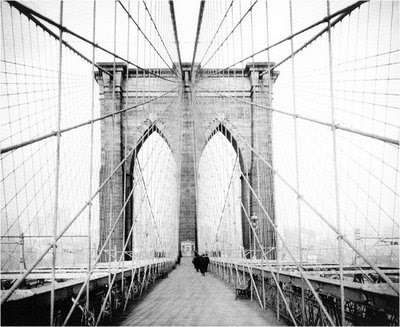
 A week after Miss Henley’s great fall the New York police got word that ‘Professor’ Odlum had been inspired to give the Brooklyn bridge another “go”. They alerted the toll collectors, and on Sunday afternoon, May 19, 1885 (ten days after Miss Henley’s plunge) a collector reported a suspicious cab lingering on the bridge. Officers found it parked against the outside rail half way across the span. But it was a decoy. While they were searching the cab, two wagons further back "Professor" Odlum leapt from beneath a covered flatbed wearing a swimsuit emblazoned with his name, clambered over the railing and before the cops could reach him, threw him self into space.
 Imagine Robert Odlum’s surprise when he discovered that the cops had been right. He entered the water feet first (as was the accepted diving position at the time) and shattered every bone in his frame from heel to skull. He was pulled from the river unconscious and died a half hour later. His friends shipped his body home, and Robert’s sister came to town ten days later to demand that the coroner explain what had become of her brother’s liver and heart. She never got a satisfactory answer, but my guess is they had both been reduced to jelly by the impact. A little math shows that “Professor” Odlum hit the water going sixty-three and a half miles an hour. At that speed water is as fluid as cold concrete.
 But it was Robert Odlum’s tragic foolishness that was the catalyst for the Irish hero of our bad idea. He was 23 years old by this time making his living as a newsboy and a bookie amongst the denizens of the Bowery. Like a certain actress he had worked with, Steve Brodie needed to escape the chorus, except in his case the chorus was a carcophony of poverty. The story that he later told was that a friend, James Brennan, had dared him on a $100 bet that he would not jump off the Brooklyn Bridge, and survive. But I doubt that Mr. Brennan had ever seen $100 in his life.
 Brodie parleyed his 15 minutes of fame into his own bar, with a little theatre in the rear where he re-enacted his alledged dramatic plunge into the East River several times a week for the tourists. In 1891 promoters built a Broadway melodrama (“Mad Money”) around his dive and another in 1894, (“On the Bowery”).
 In 1895 Mrs. Clara McArthur, married to a disabled railroad worker and mother to a young daughter, jumped off the bridge at 3:30 in the morning. She was seeking a share of Steve Brodies’ pot of gold for her destitute family. The desperate Clara was wrapped in an American flag. She had water-wings strapped under her arms and a punching bag tied to her back to keep her afloat after landing. Her socks were filled with sand to keep her feet below her head (again the accepted best attitude to enter the water). But she hit the water on her side, spreading the impact over the length of her body. Still, the impact ripped the water wings under her arms, to shreds. She struggled to the surface but the punching bag kept flipping her over, onto her face, and the socks kept pulling her down. Clara finally passed out, face down in the water.
 Steve Brodie is not counted as one of those ten. He was always an agreable fellow. If he had money, his friends and family shared in it. He gave generously to charity his entire life. But it is extremely doubtful that he actually made the jump. He tried to extend his fame by claiming to have lepted off a railroad bridge in upstate New York, and later claiming to have gone over Niagara Falls wrapped in inner tubes and metal bumpers. The Niagara stunt, real or not, almost killed him. He settled in Buffalo, New York, and operated a bar there for a few years before his asthma forced him to move to San Antonio, Texas, where he died in 1901 of complications of diabetes. Steve Brodie was all of 38 years old. He is buried in Calvary Cemetery, in Woodside, Queens, New York. Thankfully the idea of jumping from the bridge for fame and fortune died with him.
 The longest living survivor of all these daredevils was the accidental one. Sara Ann Henley (below), the woman who tried to commit suicide in 1885 by jumping 240 feet off the Clifton Suspension bridge, finally earned her angel’s wings in 1948. She was 84 years old, married but with no children, perhaps because of injuries sustained in her fall into the Avon River Gorge. Such feats, for fame or to protest fortune, are never good ideas.

 At 7:48 a.m. on December 7, 1941, out of a clear blue sky, 353 Japanese bombers, torpedoe planes and fighters of the first wave began their attack on Pearl Harbor. The United States Pacific fleet was caught flat footed, unprepared, with our war planes on the ground. How could we have been caught so unprepared if not by a conspiracy?

 Just an hour later, as the first wave of Japanese planes banked to return to their carriers, they left behind 8 ships sunk in Darwin harbor. They had damaged a dozen other ships (including a hospital ship), destroyed the limited harbor facilities, as well as destroying 10 P-40 fighters, one B-24 bomber, 3 C-45 transports, 3 PBY flying boats and 6 Lockheed Hudson Australian Bombers, as well as knocking out Darwin’s electricity and fresh water systems, and killing at least 243 military personnel and civilians and wounding 200 more. The Darwin raid has been called “Australia’s Pearl Harbor”. How were the Japanese able to achieve another surprise attack after so many warnings?
 At 6:20 a.m. on the morning of April 18, 1942 (now 102 days since the Pearl Harbor attack) Japanese Vice Admiral Boshiro Hosogaya, commander of the Japanese Fifth Fleet aboard the heavy cruiser Kiso, was awakened to read an urgent message from picket boat Number 23, the Nitto Maru. The message read; “Three enemy carriers sighted -Position 650 nautical miles east of Inubo Saki.” The Nitto Maru failed to respond to calls for further information. The vice-admiral alerted the command of the Combined Fleet headquarters. He advised them that with the known range of American carrier based bombers, the Americans would not be within range to attack the home islands for another 24 hours. The combined fleet immediately sent the following message to all commands; “Tactical Method 3 against United States Fleet.” In response elements of the First and Second Fleets sortie-ed out of their bases at Yokosuka and Hiroshima and began searching for the American carriers. Japanese aircraft carriers as far away as the Indian Ocean began to steam at all possible speed toward home waters. They would not be in time.
 Ten targets were struck in Tokyo by the B-25 meidum range land based bombers, and one each in four other Japanese cities. A carrier under construction was hit by a single bomb. One bomb even landed inside the grounds of the Imperial Palace. Of the attackers, one B-25 received some minor damage from anti-aircraft fire, and another had to dump its load into the sea when it was attacked by fighters. The two American carriers that had launched The Doolittle Raid, and all escorting ships, escaped unharmed. It would be weeks before the American public was informed of the attack, but the Japanese responded immediately by diverting fighter squadrons and anti-aircraft units back to the home islands, and with more extreme measures. Long before another American bomb landed on Japan, 10% of Tokyo had been plowed under to form fire brakes across the city, which proved ineffectual in the B-29 fire raids of 1945.
  The common thread connecting these three nations from December 1941 to April 1942 was the assumption that war could be restrained by the plans of politics or strategy. But all wars appear out of a clear blue sky, even to those who start them. And no strategy survives the first contact with the enemy. So all wars are a form of compulsory education for those foolish enough to think they have nothing to learn. And the three lesson that war teaches are always the same. The only sin in war is losing. The only assurance of losing is arrogance. And arrogance always leads to war.


