August 2025

August  2025
I DON'T NEED A RIDE. I NEED AMMUNITION.

Translate

Tuesday, May 19, 2020

WINING THE NOMINATION - Lincoln's Path to Success

I know that Abraham Lincoln read Shakespeare, which makes the events at the Illinois Republican state convention in Decatur on 9 May, 1860, so revealing. Three times the 22 delegates demanded that Lincoln “identify your work!”, and three times their nominee refused to claim which of the boards supporting his campaign banners had come from logs he himself had split. Like Julius Caesar three times refusing the crown of a Roman king, each display of modesty drove the crowd into a greater frenzy. It was this invention of “Lincoln The RailSplitter” which marked “Honest Abe” as a real contender for the Presidential nomination, one week later at the Republican National Convention. Clearly, Abraham was prepared to perform exactly the kind of theatrics required in politics.
Just a year earlier Lincoln appeared to have given up any Presidential ambitions. In March of 1859 he had written a friend, “Seriously, I do not think I am fit for the Presidency.” But two events in early 1860, changed his mind. First, at the end of February, Lincoln gave a speech at the prestigious New York City private college, the Cooper Union. His arguments against slavery in that speech were reprinted in newspapers across the north and received positively. And secondly, in the last week of April the Democratic Party convention in Charleston adjourned after 57 ballots, unable to agree on a nominee. With Democrats splitting into three wings, the young Republican party had a real chance to win the November election.
Senator William Seward was the presumptive Republican nominee. At 70 members, his own New York delegation was the largest. The dour NYC banker and merchant Edwin Morgan (above), also a Seward man,  was the Republican Party National Chairman. And the crafty Thurlow Weed, “The Wizard of the Lobby”, who had helped build Seward's reputation for more than two decades, was in Chicago, where the convention would be held. Even eight members of the Illinois delegation were suspected of preferring Seward to Lincoln. Chairman Morgan had even chosen the city of 100,000 on the lake as a bribe for Illinois Party Chairman Norman Judd., as was the tempting offer to name Judd, Seward's nominee for Vice President.
All that Lincoln had to offer was himself, but for a few that was enough. Their leader was the imposing Judge David Davis (above). He had presided over the Illinois Eighth Circuit Court, deciding almost 90 cases lawyered by Lincoln. And although he decided only forty in Lincoln's favor, Davis trusted the younger man enough to ask him to substitute for the judge occasionally. Davis described Lincoln as “a peculiar man; he never asked my advice on any question.” 
But when new lawyer Leonard Swett joined the circuit, he was introduced to Davis and Lincoln, dressed in their nightshirts, as they engaged in a boisterous pillow fight. Swett became Lincoln's most trusted friend. Also working for the prairie lawyer was Lincoln's longtime law partner, the big, jovial hard drinking Virginian born, Ward Lamon (above).
Judge Davis was an abolitionist. Lamon's family owned slaves and he hated abolitionists. Swett (above) preferred a good fight, a guitar and a jug of whiskey over politics. This diverse trio, along with a few dozen others, sacrificed their time and money to win the nomination for Lincoln. 
They started late, having to beg people to give up their reservations at the Tremont hotel (above). Davis spent $700 out of his own pocket to empty the needed rooms, and more to stock them with  whiskey and food, but on the Friday, four days before the convention opened, the Lincoln men were headquartered at the Tremont, ready to the seduce the arriving delegates.  Said Swett,  “I did not, the whole week I was there, sleep two hours a night.”
The delegates arrived by foot and horseback, carried on lake steamers or the dozen rail lines serving Chicago - 10,000 delegates, alternates, reporters and spectators, all converging five blocks from the Tremont, at a two story, 5,000 square foot timber building which had not existed five weeks earlier. They called the $6,000 structure “The Wigwam” (above). 
Writer Isaac Hill Bromley described the scene, “The stage proper (left) was of sufficient capacity to hold all the delegates, who were seated on either side of a slightly elevated dais...
 The galleries were reserved (FG) (for)...the miscellaneous public (center)...four or five thousand stood in the aisles and all the available unoccupied space....the delegates could be seen from all parts of the auditorium...Something of convenience was sacrificed to dramatic effect. The convention was just then ‘The greatest show on earth.”
There were just 465 voting delegates from 24 states, and the District of Columbia. As they arrived - but especially the delegates from the four swing states that would likely carry the November election,  Illinois, Indiana, Pennsylvania, and New Jersey -  they were met and courted by agents representing Seward, Lincoln and a half dozen other “favorite son” candidates. The Seward men,  headquartered in the upscale Richmond House, were particularly blunt in their tactics. Before the convention had even started, on Tuesday, 15 May, the Illinois delegation was offered a campaign chest of $100,000 for the fall election, if they would vote for Lincoln as Seward's Vice President. The same offer was made to the Indiana delegation, and New Jersey. It was an attempt to derail Lincoln, and win the nomination for Seward on the first ballot. But it backfired. Illinois party chief Norman Judd felt betrayed, realizing he was probably just one of many offered the V.P. spot. When the convention opened the next day at ten minutes after noon, Judd threw his full support behind Lincoln.
The 54 members of the Pennsylvania delegation were pledged to vote on the first ballot for their “favorite son”, Senator Simon Cameron (above).  Cameron, meanwhile had assured Thurlow Weed he would sell his delegation for a cabinet post, and Seward expected to win the nomination on the second or third ballot. In fact almost half of the Pennsylvania delegation hated Cameron so much, they were secretly prepared to vote for anybody else. The only question was for whom? 
In another sign Thurlow Weed had over played his hand, the dapper Illinois party chairman Norman Judd (above) managed to isolate the New York delegation in the back of the stage, and seated the Keystone delegates between the Indiana and Illinois delegations – 22 and 26 delegates each– where Illinois Lieutenant Governor Gustave Koerner and Indiana Gubernatorial candidate Caleb Smith could reminded the Pennsylvanians that Lincoln was an alternative to Seward and Cameron.
Missouri's delegate's were pledged to vote for Representative Edward Bates (above), despite his being an unrepentant Know Nothing, who despised Catholics and foreigners - such as the German Catholics in St. Louis, Chicago and Cincinnati.  
Bates was being marketed by the owner and editor of the New York Tribune, Horace Greeley (above). Even tho the newspaperman had never been west of Iowa, Greeley was an Oregon delegate, and would deliver Oregon's 8 votes, along with Missouri's 18, to Bates because Greeley was convinced Seward was too radical to carry the swing states.  Ohio's 48 delegates were pledged to support Salomen P. Chase, who was openly opposed to slavery, and therefore, according to the experts, even more un-electable, than Seward. 
Seward's perceived radicalism also worried party leaders in Maine and Massachusetts – 16 and 26 delegates respectively. The New York Senator (above, right) had told the truth, that democracy and slavery were in an "irrepressible conflict",  just as Lincoln had said "a house divided against itself, can not stand". But Seward told his truth in 1858, on the senate floor, and earned the hatred of Mississippi Senator Jefferson Davis (above, left). The perception was that Seward was the radical. So the New Engenders had already reached a quiet deal with most of the delegates from Pennsylvania and Ohio to jointly, that after the first ballot, they would abandon their favorite sons and support somebody, anybody, but Seward. The only question was, who? The name that kept coming up was Lincoln. 
Although he had been a favorite son candidate at the 1856 convention, Lincoln was still an unknown quantity to most of the delegates But thanks to Judge Davis' strategy, he had become, the convention's second choice. If they couldn't have Seward, or Bates, or Chase, then the vast majority of delegates was willing to nominate Lincoln. But to strengthen that argument, Judge Davis figured Lincoln had to get at least 100 votes on the first ballot, just under half way to the 233 needed to win the nomination.
It is true that Lincoln telegraphed from Springfield, warning Judge Davis that he would not make political compromises to become President. But years later Chicago Attorney Wirt Dexter suggested that Davis was guilty of the same sin he had accused Thurlow Weed of - offering duplicate rewards to politicians from several delegations. “You must have prevaricated somewhat”, suggested Dexter. To which Judge Davis shouted in his high pitched voice, “PREVARICATED, Brother Dexter? We lied like hell!”
On Friday, as the temperature and emotions inside and outside the Wigwam climbed, Thurlow Weed pulled a final rabbit out of his hat - retired bare knuckle champion, Tom Hyer (above). The 6'2”, 185 pound boxer earned his living as an enforcer for William “Bill The Butcher” Poole, leader of a notorious five points gang, until Bill had been shot and killed in an 1855 bar fight. 
The now 41 year old Hyer was reduced to a Know Nothing celebrity thug, and this Friday he was leading a brass band and 2,000 New York “pug-ugly” Seward (above) supporters, marching to the Wigwam, singing “Oh, isn't he a dar-ling! With his grace-ful ways,. And his eye so gay. Yes, he's a lit-tle dar-ling. To me he is di-vine. He loves me too, with a heart so true. This charming beau of mine.” 
It was an impressive and enthusiastic parade, until Hyer and his iron voiced shouters reached the convention hall, where their way was blocked by a crowd of perhaps 25,000 loungers and fast food sellers.  When they finally worked their way to the doors and presented their tickets, they were denied entrance to the Wigwam. The spectator gallery, even the standing space between the aisles was already full. And every person inside had a ticket,  just like all the pug-uglies now trapped outside.
1
The man responsible for this feat of legerdemain was Lincoln's hard drinking Virginian troubadour, Ward Lamon (above). He had printed up several thousand counterfeit tickets for the Wigwam, and the Lincoln supporters had presented their forgeries at 9 a.m., flooding the building an hour before Tom Hyer's parade arrived. The Seward forces made desperate calls for the Sargent-at-arms to check spectator tickets, but given that the day before Judge Davis had charged the Seward forces with handing out counterfeits, and that the building was crammed almost to bursting, the functionaries decided not to get involved in the infighting. Besides, the real battle was on the stage, among the delegates.
When Lincoln's name was placed in nomination, the screaming was so loud the Wigwam’s windows trembled “as if they had been pelted with hail.” Said Swettt, “Five thousand people leaped from their seats, women not wanting...A thousand steam whistles, ten acres of hotel gongs, a tribe of Comanches might have mingled in the scene unnoticed.” On the first ballot, Seward (above,being thrown overboard) led as expected, with 173 votes. But Lincoln (at the stern) was second with 102 votes. Cameron got 50 of Pennsylvania’s 54 votes, just ahead of Ohio's Salomen Chase's 49 votes. The best that Horace Greeley's (right of Lincoln) candidate Edward Bates (right of Greeley)  could collect was 48, with 8 other favorite sons getting less than 14 each.
Immediately Lincoln's men moved for a second ballot, before Thurlow Weed (above) could get the attention of the chairman, or could reach out to sway delegates. At the same time Judge Davis managed to solidify a deal with the sleazy Simon Cameron of Pennsylvania, agreeing to make him Lincoln's Secretary of War. In fact the Pennsylvania delegates had already agreed to bolt for Lincoln, and on the second ballot Weed gained 11 votes for Seward, but Lincoln gained 79, most of those coming at the expense of Cameron and Bates.
Seward's fate was sealed on the third ballot. He lost 4 more votes. Lincoln gained another 50 votes, most coming from Maryland, Kentucky and Virginia. The Rail Splitter was now just one vote away from the nomination. The Wigwam erupted in shouting, cheering and cursing, until the chairman of the Ohio delegation, David Cartter, got the chairman's attention, and stuttered, “I-I arise, Mr. Chairman, to a-announce the ch-change of four votes, from Mr. Chase to Abraham Lincoln!” .
Writer Bromley observed the pandemonium as delegation after delegation clamored for the Chairman's attention to shift their votes to Lincoln “On the platform near me...the Indiana men generally were smashing hats and hugging each other; the Illinois men did everything except stand on their heads; hands were flying wildly in the air, everybody’s mouth was open, and bedlam seemed loose. The din of it was terrific. Seen from the stage it seemed to be twenty thousand mouths in full blast…” The final count for the official third ballot gave Lincoln 364 votes. Lincoln had won.
Buckeye newspaperman Murate Halsted disagreed. “The fact of the Convention was the defeat of Seward rather than the nomination of Lincoln.” That may have been true in May of 1860, perhaps even in March of 1861 when Lincoln took the oath of office as President. 
But on January 1st, 1863, when the Emancipation Proclamation became law, Lincoln became more than a mere politician, more than a mere victor. He achieved the potential that diverse group of men from the 8th Circuit Court had seen in Lincoln, the reason they had sacrificed and worked,to make him president, not because he could be, but because they knew he should be.
On that Friday evening, some of the delegates who had just voted to nominate Abraham Lincoln, were lining up out side of McVicker's Theater, to see Tom Taylor's two year old play, “Our American Cousin” (above). In one month short of five years, Abraham Lincoln would finally see the play, at Ford's Theater in Washington, the night he was murdered. And in 1869 the Wigwam burned down
- 30 -

Monday, May 18, 2020

ENTREPRENEURS OF DOOM: Killing Open Wheel Racing

I have always thought auto racing was analogous to economics. To the spectators a race is a chaotic
rush for victory, and for the racers first place is the only prize that matters. Just like capitalism. But hidden in the details is the regularity with which racers willingly risk destroying themselves and every one else, including spectators, in their bid to win at all cost. Just like capitalism. Consider events that began 120 miles southwest of Paris, on Saturday, 11 June, 1955. The 24 hours of Le Mans had been running for just two hours when Pierre Levegh, driving the number 20 Mercedes-Benz 300, “The greatest sports racing car ever built”, was clipped from behind by an Austin Healey, and catapulted into the air at 150 miles an hour by a 3 foot earthen embankment meant to keep the cars on the track.
The 1,900 pound aluminum and magnesium car then went flipping nose over tail down the embankment, and the dynamic physics ripped the engine from its mounts, shredded the fuel tank, spewing the crowd in gasoline and benzine. The wheels and axles, radiator and doors were ripped off the frame. Every loose piece of metal, every screw and bolt, fender and nut was instantly converted into a spinning scythe, killing outright and decapitating 120 spectators and maiming another 300. 
And leaving Pierre Levegh laying half naked, dead on the race course (above). Rescue crews than made matters worse by pouring water on the burning magnesium, intensifying the flames. The horrific death toll caused France, Spain, Switzerland and Germany to ban all  auto racing for a time. And in the United States, the American Auto Club, which had regulated professional auto racing, decided to break all contact with the blood sport.
The only man who could save auto racing in America was Anton “Tony” Hulman (above), a Yale Business School graduate, and heir to a Terre Haute dry goods fortune. 
In November 1945 Huleman had paid $750,000 for the dilapidated almost abandoned 320 acre Indianapolis Motor Speedway (IMS)(above).  Recalled Clarence Cagle, long time Hulman Company employee, “We unlocked the gate, and it fell down. Everything was rotten, there were weeds everywhere. It was a terrible mess.” Hulman rebuilt the grandstands and staged the first post war race on Memorial Day, 1946. The next year Hulman broke a driver's strike and made the Indianapolis 500, the only auto race most Americans ever saw or heard of.
A decade later Huleman dealt with the loss of the Automobile Club sponsorship just as decisively. He formed a new regulating body, hiring technicians and inspectors, copy writers to coordinate advertising and raising purses for dozens of small private tracks and hundreds of midget and sprint car races across the country. Huleman called his new sanctioning body “The United States Auto Club”. At dozens of quarter and half mile oval dirt tracks across the Midwest and West, many  originally built for harness racing. Every summer and fall USAC supported this “minor league” for auto racing, where younger fans could first encounter the sport, and test their talents as sponsors, mechanics, drivers and team owners. The vast majority of these USAC events “were not well attended”, but because the 500 was a national event, these tracks survived during the Huleman era. This was the business model for American open wheel, or Indy car,  racing for almost forty years.
Because of it's small dirt track origins Indy cars remained tied to front engine roadsters through the 1950's,. But beginning in the 1960's smaller rear engine designs and drivers from European asphalt and concrete road courses came to dominate the Indy 500. 
 American auto racing became a business model divided against itself. The European teams were not interested in supporting the USAC feeder system. And as Tony Huleman aged, so did USAC. Like any bureaucracy, inertia came to dominate. This was understandable as racing was expensive, and innovation only made it more so. What tied  Indy car racing to its fans through the 1970's was the experience and inertia of Tony Huleman and USAC.  Then in 1977, Tony Huleman died at the age of 76, and the following year, eight key managers and technicians for USAC were killed when their plane went down in an Indiana spring thunderstorm.
It was now that a new generation of entrepreneurs sought to remake American racing, led by the son of an Ohio corporate executive, Roger Penske (above). As a team owner he first competed at Indianapolis in 1968,  winning his first 500 in 1972, with driver Mark Donahue. 
And in 1978 Penske read the “White Letter” written by Formula 1 and USAC driver and All American Racing team owner Dan Gurney (above). Gurney wrote,“We as businessmen should be ashamed of ourselves for being involved in a prestigious sport...as weak and disorganized as it presently is”.  Gurney called for the owners to organize, as then, “USAC will work for us and support our cause and our policies.... Let's call it...Championship Auto Racing Teams.” Gurney closed by identifying CART's primary obstacle. “It appears that a 'show down' with the Indianapolis Motor Speedway is or should be the first target. They are the ones who can afford it...”.
Penske liked what he read, and in 1978, he was bankrolled by an accountant turned oil wildcatter turned USAC team owner and entrepreneur, Ueal Eugene “Pat” Patrick (above)...
Together these three - Gurney, Penske and Patrick -  formed Championship Auto Racing Teams, governed by a CEO and a board of 8 owners, one driver and one mechanic, dividing between them 24 voting shares, with president Patrick and Penske and a few others receiving additional controlling votes. In March of 1979, CART launched their own league with an oval race at Phoenix, Arizona.

USAC and Joe Cloutier, Tony Huleman's right hand man and chosen replacement, struck back one month later, informing the CART teams that because their actions were “harmful to racing",  they would not be allowed to compete in the 1979 Indy 500.  On the track's opening day - 5 May, 1979 -  the federal court granted CART an injunction, forcing USAC to admit their entries.
CART, now led by Penske lawyer John Frasco, had won. USAC continued to support dirt tracks, but under the new CART points system, winning the Indy 500 was worth no more than winning the Ontario, California 500. The vaunted Indianapolis Motor Speedway, and it's USAC creation, had been brought to its knees.
But during the 1980's cracks appeared in CART's veneer. The governing board backed rules which consistently favored top teams of Penske and Patrick, who could afford innovations like new engines and “ground effects” body designs, while blocking carbon-fiber bodies until Penske designers could develop their own. The board was reconfigured, and almost immediately reconfigured again. Most of the teams, lured by the promise of a more responsive management and bigger purses, instead saw Penske drivers win most of the races and almost every seasonal championship. Also , despite CART's promise to cut costs,  fielding a CART racer was now topping $10 million year, leaving most owners condemned to poverty row and losing seasons
Then in 1989 head of USAC Joe Clouter died, and was succeeded by 31 year old Tony George, grandson of Tony Huleman.  That same year, the CART board voted to fire John Frasco, and replace him with John Caponigro, who promised the old dream of bigger purses and smaller costs. He tried squeezing more money out of of league sponsor PPG.  When PPG complained, the CART board fired Caponigro, and over the next six years CART went through three bosses. None could keep the owners satisfied for long, as attendance and television ratings declined for both CART and Tony George's new competing Indy Racing League, which was fielding cheaper and slower/safer cars.
In March of 1998 CART went public, offering 4,500,000 shares on the New York Stock Exchange. Originally offered at $16 per share the price quickly rose to $35.63 per share. The offering also allowed the entrepreneurs (Penske, Patrick , et al) to convert their 22 voting shares into 400,000 shares of common stock, worth about $100 million. A year later these same men sold most of their stock for less than $25.00 a share, before abandoning CART for the IRL. It smelled of a classic “pump and dump” Wall Street fraud. Except in the new era of "unregulated capitalism", it was just business as usual.
As Gordon Kirby, editor of “Motor Sport” magazine, put it, “Sadly, the influx of money served only to exacerbate the self-interest, egos and greed which had always been at the heart of CART's problems, and in the end most of the team owners wound up selling their shares at a handsome profit and jumping ship. It was an abysmal display of everything the organization theoretically had been founded to prevent. “
In 2004, Roger Penske admitted only, “We've probably lost some of the media, we've lost some of the fans, and we've lost some of the sponsors. Obviously, there's been some damage...” John Menard, another of the original CART entrepreneurs, was a little more honest. “CART has zero market share” he admitted in 2004, “and the IRL has a bit more, but when you combine the two...it kind of doesn't matter.”  As usual, Robin Miller, the opinionated gadfly who covered most of the racing civil war for the Indianapolis Star, was more direct. “The people who used to watch Indy-car racing either got pissed off and quit watching (or) quit going”
Most of the economic damage was out side of the Indianapolis Speedway. Writer Bob Zeller could tell “Car and Driver” magazine, “...more spectators attended the 29th running of the Long Beach Grand Prix than watched it on television” The paid attendance in 2004 was 95,000, while only 60,000 homes tuned in to watch the race.  But even the Indianapolis 500, the goose that each year laid a golden egg for open wheel racing, dropped from a 13 Nielson share in 1979, to a 3.8 share in 2014. There were still half a million people at the Speedway on race day, but the television audience was under 6 million  CART had decimated open wheel racing in America, from top to bottom,, CART had proved to be a preview of the 2007 Wall Street disaster of greed and shortsighted selfishness.
By 2007, with the CART stock price fell below $0.25 a share, CART declared bankruptcy, and disappeared, leaving behind a few wealthy entrepreneurs who had grown even more wealthy, thousands of stock holders who had lost from a few hundred to a few thousands of dollars, millions of fans with a foul taste in their mouths, and open wheel racing all but dead on the track. Mike Tanier, racing author, has compared American open wheel racing after CART to “ a once-divorced couple (that) survives amidst the wreckage of a pair of shattered lives...It lurches from race to race and season to season, donning its Sunday best for Memorial Day weekend but grimly battling through most of the year.” Just another example of the dubious benefits of amoral capitalism, and the cost of supporting the lifestyles of the rich and greedy who suck the life out of everything they touch.
- 30 -

Sunday, May 17, 2020

BLOODY JACK Chapter Twenty - Six

I suppose the greatest problem with the real Jack the Ripper story is that the ending is so unsatisfying.
A poet of the age predicted, "They've captured Leather Apron now, if guilty you'll agree; he'll have to meet a murderer's doom, and hang upon a tree" But the murderer was never punished, never stood  trial, never even publicly identified.  But then, that is the horror of real murder.  The victim cannot be recovered, nor can the victim's loved-ones be made whole. The horror of a real murder usually dies only when the killer, and those who loved the victim, die.
Not so with Jack the Ripper. His horror has so far survived 130 years after his last victim bled out in a dark and dirty corner of the dark and dirty Whitechapel.  Part of the reason for the longevity of his horror is the photo (above) taken in the tiny sad room at 13 Miller's Court, Dorset Street. 
Part of the reason is that the newspapers sold 1 million additional papers a day during the “Autumn of Terror”: - August, September, October and November of 1888. 
And part of the reason is that the historical-fictional Jack the Ripper has proved too profitable to let him die. But the police in 1888 were dealing with a real killer.
Detective Inspector Edmund Reid (above, front center), one the smartest officers in Whitechapel,  reminded readers in his memoir what the police knew by middle of September. “The perpetrator,” he wrote, “...was in the habit of using a certain public-house, and of remaining there until closing time...all of the victims were all of the same class... and living within a quarter of a mile of each other; all were murdered within half a mile area; all were killed in the same manner...he (the killer) lived in the district.” So the police - well at least those below the management level - were not fools. They knew who they were looking for. But finding him was not their top priority.
After the Hanbury Street murder of Annie Chapman on 8 September, Whitechapel and Spitafield were flooded with uniformed Constables and plain clothes Detectives, even employing the Whitechapel Vigilantes. As Commissioner Sir Charles Warren had said in his petulant self defense written in September and published in the November Murray’s Magazine, “...the primary object of an efficient police is the prevention of crime...” And that was what the police concentrated on – preventing the killer from killing again. And they did.
For 14 days – Friday, 15 September, to Friday, 28 September – Kosminski found the police foiling his searches for another victim, until he was forced outside his hunting grounds to Aldegate, where the public/police net was thinner. 
There, in the early hours of Sunday, 30 September,  he murdered Catherine Eddowes in Mitre Square. But even then Warren's plan worked. 
The police were able to focus on Aaron Kosminski, living with his brother just down the block on Goulston Street (above) from where the Eddowes bloody apron was found.  Then, during all of October, the “tails” which Chief Inspector Donald Swanson pinned on Kosminski kept him from claiming another victim - 
...at least until 8 November when Kosminski was able to isolate Mary Kelly in her room – earlier in the evening, before the pubs had closed. And even then he did not kill until closer to dawn, when Kelly's singing, as reported by a neighbor, finally stopped.
The police never had solid evidence to arrest Aaron Kosminski. But Aaron Kosminski was still alive and no longer killing. Why? First there was Abraham, Aaron's older brother. Living with the first paternal role model Aaron had known since his father's death in 1874 would have been a stabilizing influence. 
And second, whoever the Ripper was, he was insane but he wasn't nuts. He did not want to get caught. He had always retained enough control to avoid witnesses and the police, to delay his gratification until the he was certain of his own safety. And by January or February of 1889, with no further killings, the police tails of Aaron Kosminski must have been superseded by more pressing matters.
 
And third, accepting Special Agent Douglas' profile, the Ripper was extremely passive until the assault. He needed the prostitute to initiate contact. He needed alcohol to lower his own inhibitions. And he needed the victim to be unconscious or dead before he could show the knife and penetrate her with it. This speaks of a man so repressed he might stand in the rain rather than asking to come inside. He was a paranoid schizophrenic but a high functioning one, as was proven by his arrest on a Saturday in December of 1889 for walking an unmuzzled dog in Cheapside.
Charles Dickens called Cheapside (above)  “...the busiest thoroughfare in the world...Here the two great arteries of Oxford Street...the Strand and Fleet Street from the west...Bishopsgate and Leadenhall from the east....Moorgate on the north and King William Street on the south, are all united...” The Cheapside Street market had been in existence for hundreds of years, but during Victorian times, says Dickens, it was “...almost monopolized by men's shops: hosiers and shirt makers, tailors and tobacconists, and above all by jewelers.” 
In fact, says Dickens, “The stranger will be particularly struck with the absence of women...in Cheapside (above)...there is scarcely a woman to be seen to every hundred men.” It would appear an odd place for a homicidal maniac with a particular hatred for women to be walking his dog, muzzled or unmuzzled.
Having been arrested, the 23 year old Aaron Kosminski made a competent presentation in court. He argued that since he did not own the dog he was not responsible for muzzling it. Like arguing a parking ticket in court, logic was of course no help  But when the magistrate found him guilty and assessed a 10 shilling fine, Aaron was quick enough to argue that it was the Jewish sabbath, and his faith forbid him from handling money. He presented a normal enough image that he was allowed to go free, returning on Monday to pay the fine. As Scientific American pointed out in September 2014, “...very few serial killers suffer from any mental illness to such a debilitating extent that they are considered to be insane by the criminal justice system.”
So this was the man who convinced Mary Jane Kelly to open her door to him, convinced Annie Chapman to go to the back yard with him, and convinced Martha Tabram to lead him off the already dark George Yard, through the narrow passage to the courtyard behind the buildings, and then up the unlighted stairs. Her trip to her own death may have been the longest of all the victims, requiring the greatest confidence that the man who was about to murder her, posed no threat whatsoever.
Seven months later, on Saturday, 12 July, 1890, this same man was meekly led by his brother-in-law to the Mile End Workhouse (above), where he was described as having been “insane for the last two years.”  It must have been hard for a Jew to turn their own blood relative over to the charity of Christians, but Arron was hearing voices, had stopped washing and refused food from any person's hand because he feared being poisoned, preferring to eat discards from the gutter. Aaron was granted admission. However 3 days later, either because the doctors suspected he was malingering, or because he fooled them, his brother Abraham took him home again.
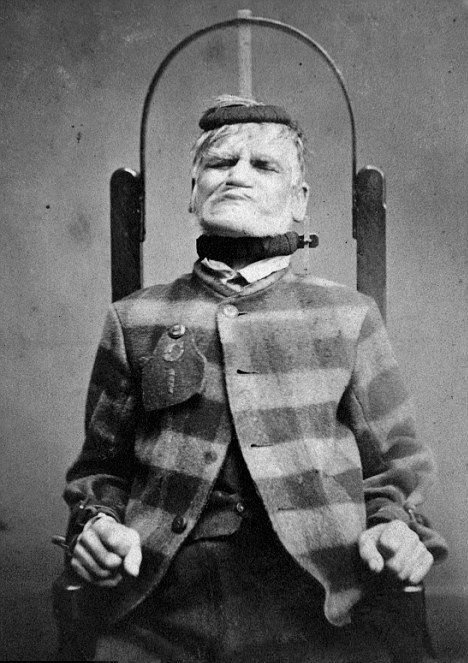
It was not to last. On 4 February of 1891 the police brought him back to the Workhouse. The same issues were mentioned – not working, not washing and eating from the gutter – but this time the police said he had threatened his sister Martha with a knife. His family did not challenge his admission, and 3 days later, on 7 February, 1891 he was transferred to the Jewish wing of the infamous long corridors of the Colony Hatch Asylum for the “pauper insane” in Barnet, North London (above). The paperwork justification for transfer has not survived the century, but we do know Aaron Kosminski arrived with both hands tied behind his back.
Colony Hatch adhered to the Victorian belief that all problems are better with organization – from morning calisthenics to regimented meals. The 2,000 patients were also expected to work, in the tailor shop, the garden or just washing floors. Since most of the patients came from the East End the asylum had a kosher kitchen and a Yiddish interpreter. The records at Colony Hatch have survived and they detail Aaron's 3 year transgression from “apathetic” to "Incoherent, at times excited and violent." The staff noted, “He declares that he is guided and...controlled by an instinct that informs his mind, he says that he knows the movements of all mankind, he refuses food from others because he is told to do so, and he eats out of the gutter for the same reason”
Eventually the violence became predominant, and Aaron's last stop was the complex of buildings at the Levesden Asylum For Imbeciles in Abbots Langley, 20 miles northwest of London (above). 
Aaron survived here for a quarter of a century, having spent most of his life institutionalized. The staff noted, "Patient does not know his age or how long he has been here." 
Aaron Kosminski died of a gangrene infection at the age of 54 years, on Monday, 24 March, 1919. At the time of his death he weighed just 96 pounds. But he lived longer than any of  his victims.
Kosminski did not out-live his would-be nemesis, Detective Inspector Edmund Reid (above). After retiring from the Metropolitan Police in 1896, with over 50 awards and commendations, including being named a Druid of Distinction, Reid moved to Hampton-on-Sea, atop the chalk cliffs of England's east coast. Here he became an English eccentric.
He renamed his home “Reid's Ranch”, and painted the outside walls with castle battlements and cannon aimed at the ocean. He opened a stand in his garden shed (above), from which he sold postcards – mostly featuring himself - and lemon-aide and wrote crank letters to the local newspaper. He died at the age of 61, on 5 December, 1917, the same year he finally married.
Thus I end my version of the story of Jack the Ripper – just another human being,  more unhappy and violent than most, but just another human being.
- 30 -

Blog Archive