August 2025

August  2025
I DON'T NEED A RIDE. I NEED AMMUNITION.

Translate

Showing posts with label Abraham Lincoln. Show all posts

Wednesday, June 25, 2025

THE PROFESSIONAL POLITICIAN


I hate the five dollar bill image of Abraham Lincoln. Our sixteenth President saved the Union and ended slavery not because he was a saint but because he was the greatest politician who has ever occupied the White House. A real professional.
And to those who despise “professional politicians”, my response is they have probably never seen a real professional in action. Such Pols don’t come along often, but when they do, they make the puny impersonations that must usually suffice seem like clowns.

And Lincoln’s professionalism was best displayed in his handling of the biggest clown in his cabinet, a man you have probably never heard of but whose best work you see every day of your life, Salmon Portland Chase (above). If Chase had been half as smart as he was ambitious, he would have been President instead of Lincoln. That to his dying day he continued to believe he deserved to be so, shows what a clown he really was.
Doris Kerns Goodwin has called Lincoln’s cabinet “A Team of Rivals”, but I think of it more as an obtuse triangle. At the apex was Lincoln (above, center). He was the pretty girl at the party. His suitors didn’t really want to know him, but they all wanted to have him. 
On the inside track was the brilliant, obsequious William Seward (above)  - the Secretary of State who thought of himself as Lincoln’s puppet master. 
And the right angle was Salmon Chase (above), Secretary of the Treasury, born to money and brilliant,  but with a stick up his alimentary canal.
And on Tuesday, 16 December, 1862 , the competition between these two paramours of Old Abe's banged heads in the head of Senator Charles Sumner (above), the Chairman of the Senate Foreign Relations Committee and leading Senatorial Cassandra. 
Sumner had come into procession of a letter written by Seward to the American Ambassador to France. In the letter Seward complained that “…the extreme advocates for African slavery and its most vehement opponents are acting in concert together to precipitate a servile war, the former by making the most desperate attempts to overthrow the federal Union; the latter by demanding an edict of universal emancipation as a lawful and necessary if not, as they say, the only legitimate way of saving the Union.” 
It was an old letter, and Seward's position had evolved, but to Sumner this passage was proof that behind the scenes Seward (above) was not fully committed to destroying slavery and the Confederacy. And it confirmed what he already heard from Chase.
Stephen Oates writes in “With Malice Toward None”, “…what bothered Chase the most was the intimacy between Lincoln and Seward…In talks with his liberal Congressional friends, Chase intimated that Seward was a malignant influence on the President...that it was (Seward) who was responsible for the administration’s bungling...Seward became a scapegoat for Republican discontent.” (pp 355-356)
Sumner convened what I call "The Magnificent Seven", the 7 most anti-slavery members of the Republican Senate caucus - called by their opponents and historians "Radical Republicans".  Once the Seward letter was read out loud, Senator Ira Harris (above) from Albany, New York recorded the reaction. 
“Silence ensued for several moments," wrote Harris, "when (Senator Morton Wilkinson of Minnesota (above)) said that in his opinion the country was ruined and the cause was lost…” 
Senator William Fessenden (above) from Maine then added a bit of gossip. He'd been told by an unnamed  member of the cabinet there was “…a secret backstairs influence which often controlled the apparent conclusions of the cabinet itself.  Measures must be taken”, Fessenden concluded, “to make the cabinet a unity and to remove from it anyone who does not coincide heartily with our views in relation to the war.” 
It is sad to say there was not a first rate mind in that room. There might have been, but arrogance drops a person’s I.Q. by forty points or more.  Not one of the seven seems to have suspected they were being manipulated by Chase, that it was Chase who had whispered in Fesseneden's ear, and Wilkinsen' s ear as well, and even Sumner's.  But each was convinced that they and they alone held the solution as to how to conclude the Civil War and end slavery. It is startling to think that men who used an outhouse every day, could be that arrogant.
They skewered up their courage for two days before saddling up and calling on the President at 7 P.M. on Thursday, 19 December, 1862.  For three hours they harangued poor Mr. Lincoln on the dangers of Seward. 
Lincoln remained agreeable but noncommittal, and proposed that they meet again the next night. And the amazing thing was that throughout that meeting Lincoln actually had William Seward’s resignation in his coat pocket.
Understand, Seward had not offered his resignation out of nobility. He was a politician. After hearing of the intentions of the Seven, Seward had a flunky deliver his resignation in private, as a back door demand that Lincoln pick the genial New Yorker over the prig from Ohio. Of course, the loss of support from New York would poke a fatal hole in Lincoln’s ship of state. So Seward was not expecting Lincoln to pick the prig for the poke.
Lincoln’s problem was he also needed the prig. Chase’s handling of the Treasury was brilliant. He was financing the entire war. It was Chase who had begun issuing official U.S. government backed paper currency, greenbacks (above). That had not been done since the American Revolution. It was Chase who had put the words “In God We Trust” on every bill, and it's still there today. Of course, Chase had also put his own face on every $1 bill (above), as a form of political advertising, but Lincoln was willing to tolerate that because Chase was honest in his job, and because without Ohio, the Union would lose the war. 
The other factor was that the whispers about Seward’s “backstairs influence” were false. By December of 1862 it had dawned even on Seward that Lincoln was thinking for himself. When Lincoln had first  read Seward's resignation - delivered by the portly Senator Preston King (above)  - "remarkable for (his) obesity") -  the President had exploded, and demanded to know,  “Why will men believe a lie, an absurd lie, that could not impose upon a child, and cling to it, and repeat it, and cling to it in defiance of all evidence to the contrary?”  Despite his anger, Lincoln knew the question was rhetorical.
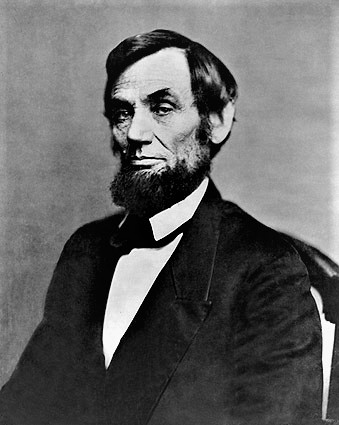
But Lincoln's (above) frustration was understandable. He was beset by arrogance and delusion on all sides. It seemed that everybody in Washington thought they were smarter than Lincoln. But the skinny lawyer from Illinois was about to prove them all wrong.
At ten the next morning Lincoln told his cabinet about the previous night’s meeting. He made no accusations, he mentioned no names. But Chase immediately blubbered that this was the first he had heard about any of this matter.  The President then asked them all, except Seward, to return that night to meet with the Seven. 
Not invited, Seward (above) felt the ground giving way under his feet. He had never expected Lincoln might pick Chase over him. Now, suddenly, he did. 
At the same time, Chase (above) was not entirely certain he had won.
That night the Seven became an audience, along with the cabinet sans Seward,  to a bradavo performance. Gideon Welles (above), the Secretary of the Navy (then a cabinet office) recorded the festivities. 
First, according to Welles, the President (above)  “…spoke of the unity of his Cabinet, and how although they could not be expected to think and speak alike on all subjects, all had acquiesced in measures when once decided." At Lincoln's prompting, each cabinet member agreed with The President, specifically,  "...Secretary Chase endorsed the President's statement fully and entirely…” 
There were hours more of talking but right there, when Chase agreed with Lincoln, that was the end of "Chase's mutiny".  As the Magnificent Seven were leaving the White House a stunned Senator Orville Hickman Browning (above) from Illinois asked how Chase could tell them that the cabinet was harmonious, after all his talk about division and the back stairs influence. 
Charles Sumner(above) 's reply was simple and bitter.  “He lied,” said Sumner. Chase was done as a malignant political influence in the cabinet. No Republican was going to believe anything he ever said again.
The next morning Lincoln called both Seward and Chase to the White House. Welles was again present, I suspect,  as a witness for Lincoln. Wrote Lincoln's "Old Neptune", as he called Welles,   “Chase said he had been painfully affected by the meeting last evening, which was a total surprise to him, and…informed the President he had prepared his resignation…“Where is it?” asked the President quickly, his eye lighting up in a moment." 
“I brought it with me,” said Chase, taking the paper from his pocket…”Let me have it,” said the President, reaching his long arm and fingers towards Chase, who held on, seemingly reluctant…but the President was eager and…took and hastily opened the letter. “This," said he, looking towards me with a triumphal laugh, “cuts the Gordian knot.” An air of satisfaction spread over his countenance such as I have not seen for some time. “You may go to your Departments,” said the President;…(This) “is all I want…I will detain neither of you longer.”  And with that both Chase and Seward left the oval office.
Both Seward and Chase spent a nervous night, not certain as to what Lincoln would do. They had both just been reminded who was in charge of this game. And it was not until a few days later that Lincoln sent a note to both Chase and Seward, saying that the nation could not afford to lose either of their talents. And it did not. 
Seward never tried to pull Lincoln's strings again. But he played a vital part in ensuring passage of the XIII amendment to the constitution ending slavery for ever. 
Seward barely survived an assasian's knife in the plot that murdered Lincoln, but continued to served President Andrew Johnson, even guiding him to acquire the Territory of Alaska (above) - which was labeled at the time "Seward's Folly".  He served as Secretary of State until 8 March, 1869. Seward died in the afternoon of 10 October, 1872. His last words were "Love one another."
Salmon Portland Chase petulantly continued to resign annually until late October of 1864, when Lincoln no longer needed him to hold onto Ohio. But never one to waste talent, Lincoln took advantage of the death of that old racist Chief Justice Roger Taney, to nominate Chase to the Supreme Court. 
Chase (above, center) was easily confirmed and sworn in on the same day as Chief Justice. His ego would not permit him to completely surrender his ambition, trying to achieve that office he was convinced he was so suited for, in 1868 as a Democrat and again in 1872 as a "Liberal Republican"
Chase (above) never resigned his position on the Supreme Court, dying of stroke on 7 May, 1873.  His last vote on the court was in the minority, voting against the government's ability to regulate food safety.
So that is what it looks like when a skilled professional is on the job, using the best the troublesome foolish people who surround him or her have to offer to achieve great ends, like the end of slavery and the end of a civil war.  It often sounds like confusion and pettiness at the time, but as newspaper editor, John McNaught would note of a later American political crises, it is all "...just the American people washing their dirty linen in public." 

                                     - 30 -  

Saturday, November 23, 2024

TO WIT - The Political Insult


I can say without fear of contradiction that Abraham Lincoln was the most hated American politician in history. About one in four Americans spent four years trying to shoot him, for God's sake.
“Honest Abe” was described by one contemporary magazine as a “Filthy story-teller, despot liar, thief, braggart, buffoon, usurper, monster, ignoramus, scoundrel, perjurer, robber, swindler, tyrant, field-butcher, (and) land pirate.” And a Chicago newspaper denounced one Lincoln speech by saying, “We did not conceive it possible that even Mr. Lincoln could produce a paper so slipshod, so loose-joined, so puerile, not alone in literary construction but in its ideas, its sentiments, its grasp. He has outdone himself.” Wow; well at least the paper deigned to call him “Mister Lincoln”. Of course, the needle lost sting when you realize the Chicago Times was reviewing Lincoln’s Gettysburg Address.
But then you come across the criticism of Mr. Lincoln offered by Mr. Peter Muggins, a private citizen from Ohio. He wrote the President the following letter: “God damn you, and your God damned old, hell fired, God damned soul to hell. God damn your God damned families’ God damned souls to hell. And God damn your God damned friends to hell.” After reading an outburst such as that what else is there to say except…everything? I believe that insults without humor are a mere expenditure of air, better used for survival 
It is easy to insult someone if you are willing to be reduced to grass vulgarity  Donald Trump is proof enough of that. But no honest person would ever mistake his vulgarity for wit. The first recorded insult was carved on the walls of an Egyptian tomb 4,300 year ago, when one fisherman ordered a second to, “Come over here, you copulater.” And it probably wasn’t original, even then.  And the twice impeached Donald never rose above that level of venom.
Lincoln occasionally gave as good as he got, of course. He described one opponent as one who could “…compress the most words into the smallest idea of any man I know.” But mostly, his wit was addressed to self depreciating humor. When accused of pandering to voters, Lincoln quickly replied, “If I were two faced, would I be wearing this one?”  But compared to the horrible things others said about him, Lincoln’s venom toward himself couldn’t hold a candle.
General George McClellan, who spent almost two years in close contact with Mr. Lincoln, described him as “…nothing more than a well meaning baboon”, and “An offensive exhibition of boorishness and vulgarity.” Of course history has since judged McClellan to be one of the biggest horse’s behinds in American history, so the source of the insult must have some bearing when judging the quality of the insult. For this reason McClellan loses. Again.
Because the issue here is not accuracy, nor political propriety or even civility; it is to wit, wit.  “The natural ability to perceive and understand – intelligence; keenness and quickness of perception or discernment; ingenuity, as in to live by one’s wits; the ability to perceive and express in an ingeniously humorous manner”; to wit:
In my subjective search for the wittiest political insult I have been disappointed by most modern commentators on George W. Bush, for various reasons. Most fall victim to shooting fish, as Ron Reagan Jr. did when he asked about our former President before he was our President, “What is his accomplishment?" The young Reagan replied, "That he’s no longer an obnoxious drunk.” Mr. Reagan gets points for bitterness and perhaps accuracy (he did know the younger Bush personally) but I must correspond with the adage that “He who has never been an obnoxious drunk at least once in his life, has not lived”.  And the missing element in Mr. Reagan’s observation is that elusive quality of “wit”.  You can't practice what you do not possess. 
I have eliminated most professional commentators from my search because they have staffs who daily submit attempts at wit, which are then weeded through for prized examples, to wit: Jay Leno on Bush being caught by a microphone using an obscenity at an international conference, “It’s not a big deal, President Bush using a four-letter word. Now if Bush used a four-syllable word…that would be unbelievable”; or David Letterman on the results of a poll; “One percent of Americans participating in this poll believe Dick Cheney is the best Vice President ever. Everybody else in the poll believes that one percent should be wearing funny hats”.
The same commentators are eliminated from contention as regards political insults in general, and for the same reason. To wit, Letterman’s riff on one of his favorite targets, Senator John McCain; “He looks like the guy who’s backed over his own mailbox. He looks like the guy at the supermarket who is confused by the automatic doors. He looks like the guy at the movies whose wife has to repeat everything”.
Eventually, I broadened my search to the world stage.   I had brief hopes I had found a choice subject in that indomitable woman, British Prime Minister Margaret Thatcher, known to her fellow sexists politicians as “Attila the Hen” (Clement Freud), “Petain in petticoats” and “La Pasionaria of middle-class privilege” (Denis Healey), “The Immaculate Misconception (Norman St. John-Stevas) or simply “Virago Intacta” (various sources.)
Mrs. Thatcher was described by Lord St. John of Fawsley this way: “When she speaks without thinking, she says what she thinks”. Clive James described her speeches as sounding, “…like the book of Revelations read out over a railway station public address system by a headmistress of a certain age wearing calico knickers.” Johnathan Aiken questioned her grasp of international events. “She probably thinks Sinai is the plural of sinus”.  And Denis Healey compared her rages to “…charging about like a bargain basement Boadicea.” Of course they all lose points for stooping to sexism.
Those sexists depths were surely plumbed however when Tony Banks accused her of behaving “…with all the sensitivity of a sex-starved boa-constrictor.” In fact the only drawback to Mrs. Thatcher as a contender in my search is that she was not as good a wit as the wits she inspired.
The reverse was true of the prince of the British political witticism, legendary Prime Minister Winston Churchill, not for the way he was described but for the way he described others.  He spoke of the man elected to replace him in 1946 this way; “An empty taxi arrived at 10 Downing Street, and when the door was opened, (Clement) Atlee got out. He is a modest man who has much to be modest about”. Of another opponent Churchill said, “I wish Stanley Baldwin no ill, but...He once stumbled over the truth, but hasty picked himself up and hurried on as if nothing had happened.”
Winston described his predecessor, Neville Chamberlain, as looking at foreign affairs “…through the wrong end of a municipal drainpipe.” And he observed that “Harold Wilson is going around the country, stirring up apathy.” And at the award ceremony where Lord Mountbatten was promoted and decorated after his destroyer was sunk in the Mediterranean, “What could you hope to achieve except to be sunk in a bigger and more expensive ship next time?”
An ever dutiful socialite, Churchill once bumped into his hostess, Bessie Braddock, at a party.  He excused himself, but Ms. Braddock scolded, “Winston, you’re drunk!” To which Winston replied, “Bessie, you’re ugly. And tomorrow I shall be sober.”  At another party Lady Astor told him, “Winston, if you were my husband I would flavor your coffee with poison” Churchill responded, “Madam, if I were your husband, I should drink it.”
But Churchill’s best rejoinder may be apocryphal. While he was sitting on the toilet an aide supposedly knocked on the door to remind him that the Lord of the Privy Seal wanted to speak with him. Now, the Lord of the Privy Sea is not a Lord, is privy to nothing, and holds no seal. He is an advisor to the Prime Minister without a cabinet position, and so a person with no real power. This may explain why Churchill responded to the interruption as he supposedly did. Through the closed bathroom door he told the aide to, “Tell the Lord Privy Seal that I am sealed in my privy, and can only deal with one shit at a time.” The story may be myth, but it is clear that Winston stood head and shoulders above his contending wits while on the attack.
The Brits have an advantage in political wit-ery because of the weekly “Question Time” which forces their Prime Ministers to submit to cross examination directly from their  opponents in full public view, requiring both sides of the aisle to live by their wits. This has given rise to such lifelong political duels as the one-sided war between Benjamin Disraeli, who called his great adversary, William Gladstone , “…essentially a prig…All the prigs spoke of him as the coming man”. Disraeli noted that “If Gladstone fell into the Thames, that would be a misfortune. And if anybody pulled him out, that, I suppose, would be a calamity”.
And the best that Gladstone could respond with was to complain that he lost an election because, “We have been borne down in a torrent of gin and beer”.  It’s no wonder then that Queen Victoria complained that Gladstone, in private conversation with her, always spoke to her as if she were a public meeting.
The only nation that comes close to the erudite viciousness of the English are the Australians, and they place heavy emphases on the viciousness. And the Australian  one-man Olympic insult team – one time Labor Party Prime Minister, the right honorable Paul Keating, who once said that most politicians have brains like a sparrow’s nests - “all shit and sticks”.  Clearly he meant to exempt himself.
It was Keating who described an opposition member as “..a shiver waiting for a spine”, and labeled another as “a desiccated coconut”,. Keating described listening to a speech by John Hewson as similar to “…being flogged with a warm lettuce” and Andrew Peacock as “…an intellectual rust bucket.” And when Peacock repeated an old charge against Keating, the P.M. described the attack as “A dog returning to his vomit.”  Keating even described one opponent as “All tip and no iceberg”, and a “pre-Copernican obscurantist”, whatever that is.
But best of all of Paul Keating’s insults is, in my opinion, his comparison of Malcolm Fraser to “…an Easter Island statue with an arse full of razor blades.” Ouch.
Yes, the world is filled with political insults that display wit, verve and élan, as when one British M.P. called another “..a semi-house trained polecat.”, or when Loyd George described Neville Chamberlin as “A retail mind in a wholesale business.”. An Italian politician described Prime Minster Silvio Berlusconi as clinging to data “…the way a drunkard clings to a lampposts, not for illumination but to keep him standing up”. Sam Huston said that Thomas Jefferson processed “…all the characteristics of a dog, except loyalty.”  And when told that Dan Quayle had announced his intention to become George H.. Bush’s “Pit Bull”, Bill Clinton observed that Quail must have “…every fire hydrant in America worried.”
But without a doubt, in my opinion, the supreme American professional political wit (although he never ran for the office) was and always will be H. L. Mencken, the man who described democracy as "...the pathetic belief in the collective wisdom of individual ignorance.”  It was Mencken who said that if Franklin Roosevelt became convinced that supporting cannibalism would help him win an election “he would be fattening a missionary in the White House backyard come Wednesday.”
When describing President Warren G. Harding, Mencken wrote, “He writes the worst English that I have ever encountered. It reminds me of a string of wet sponges; it reminds me of tattered washing on the line; it reminds me of stale bean soup, of college yells, of dogs barking idiotically through endless nights. It is so bad that a sort of grandeur creeps into it. It drags itself out of the dark abyss of pish and crawls insanely up the topmost pinnacle of posh. It is flap and doodle. It is balder and dash.”
It was Mencken who said that “A good politician is quite as unthinkable as an honest burglar”. But Mencken hit his stride when he stooped to describe Calvin Coolidge. “He slept more than any other president, whether by day or night. Nero fiddled, but Coolidge only snored.”
But did Coolidge inspire Mencken to deliver the deftest, wittiest political insult in history? I fear not. Nor was it delivered by Dorothy Parker, the fem-fatalist writer and razor wit, who, on being told that Coolidge was dead, immediately asked, “How can they tell?”
Nor was it the old Frenchman Georges Clemenceau, who sat through a bombastic speech by British Prime Minster Lloyd George, even though Clemenceau understood not a word of English. At the end of the speech the septuagenarian Frenchman shook his head in awe and whispered to an aide, “Oh, if I could only piss the way he speaks”; point taken. But still it falls short, not of venom, but of wit.
No, I believe the best, most accurate, most vicious witticism ever uttered by any politician sprang from the lips of Bob Dole, Republican workhorse and failed American Presidential candidate. Well before his own Presidential campaign, Dole attended a 1980 White House reception for former Presidents Jimmy Carter, Gerald Ford and Richard Nixon, before they flew off to attend Egyptian President Anwar Sadat's funeral. Looking over the White House's Blue Room crowded with ex-Presidents, Dole was heard to comment, “There they are. See no evil, hear no evil and…evil.”
Accurate, biting, funny and inventive; and the very definition of wit.
- 30 -

Blog Archive