August 2025

August  2025
I DON'T NEED A RIDE. I NEED AMMUNITION.

Translate

Showing posts with label Detective Inspector Edmund Reid. Show all posts

Monday, April 28, 2025

BLOODY JACK Chapter Twenty - Six


I suppose the greatest problem with the real Jack the Ripper story is that the ending is unsatisfying. A poet of the age predicted, "They've captured Leather Apron now, if guilty you'll agree; he'll have to meet a murderer's doom, and hang upon a tree" But the Aaron Kominski never stood  trial and was never even publicly identified as the Ripper.

But then, that is the horror of real murder.  The victim cannot be recovered, nor can the victim's loved-ones be made whole. The horror of a real murder usually dies only when the killer, and all those who loved the victim and their friends and family, also die.

Not so with Jack the Ripper. His horror has so far survived 130 years after his last victim bled out in a dark and dirty corner of dark and dirty Whitechapel.  Part of the reason for the longevity of his horror is the photo (above) taken in the tiny sad little room at 13 Miller's Court, Dorset Street. 
Part of the reason is that the newspapers sold 1 million additional papers a day during the “Autumn of Terror”: - August through November of 1888. 
And part of the reason is that the fictional Jack the Ripper has proved too profitable to let him die. But the police in 1888 were dealing with a real killer.
Detective Inspector Edmund Reid (above, front center), one the smartest officers in Whitechapel,  reminded readers in his memoir what the police knew by middle of October, 1888.. “The perpetrator,” he wrote, “...was in the habit of using a certain public-house, and of remaining there until closing time...all of the victims were all of the same class... and living within a quarter of a mile of each other; all were murdered within half a mile area; all were killed in the same manner...he (the killer) lived in the district.” So the police - well at least those below the management level - were not fools. They knew who they were looking for. But publicly identifying and arresting him was not their top priority.
After the Hanbury Street murder of Annie Chapman on 8 September, Whitechapel and Spitafield were flooded with uniformed Constables and plain clothes Detectives, even employing the Whitechapel Vigilantes. As Commissioner Sir Charles Warren had said in his petulant self defense published in the November Murray’s Magazine, “...the primary object of an efficient police is the prevention of crime...” And that was what the police concentrated on – preventing the killer from killing again. And they did.
For 14 days – Friday, 15 September, to Friday, 28 September – Kosminski found the police foiling his searches for another victim, until he was forced outside his hunting grounds to Aldegate, where the public/police net was thinner.
There, in the early hours of Sunday, 30 September,  he murdered Catherine Eddowes in Mitre Square. But even then Warren's plan worked. 
The police were able to focus oAaron Kosminski, living with his brother just down the block from the Goulston Street entryway (above) where Eddowes' bloody apron was found.  Then, during all of October, the “tails” which Chief Inspector Donald Swanson pinned on Kosminski kept him from claiming another victim - 
...at least until 8 November when Kosminski was able to isolate Mary Kelly in her room  – the only murder to take place indoors - and the only murder to have begun earlier in the evening, before the pubs had closed.  And even then he did not kill until closer to dawn, when Kelly's singing, as reported by a neighbor, finally stopped.
The police never had enough evidence to arrest Aaron Kosminski, in much the same way the police were never able to arrest Arthur Leigh Allen of killing at least five victims between December 1967 and October 1969 in California, under the moniker of "Zodiac".   But if, back in 1888, Aaron Kosminski was still alive and no longer killing, why? First there was Abraham, Aaron's older brother. Living with the first paternal role model Aaron had known since his father's death in 1874 would have been a stabilizing influence. 
And second, whoever the Ripper was, he was insane but he wasn't nuts. He did not want to get caught. He had always retained enough control to avoid witnesses and the police, to delay his gratification until the he was certain of his own safety. Even his method of killing was designed to protect himself.
 
And third, accepting Special Agent Douglas' modern profile, the Ripper was extremely passive until the assault. He needed the prostitute to initiate contact. He needed alcohol to lower his own inhibitions. And he needed the victim to be unconscious or dead before he could show the knife and penetrate her with it. To such an individual, being constantly followed by detectives would have fueled a raging  paranoia, as would have his arrest on a Saturday in December of 1889 for walking an unmuzzled dog in Cheapside. 
Cheapside was not in Whitechapel.  Charles Dickens called Cheapside (above)  “...the busiest thoroughfare in the world..." The Cheapside Street market had been in existence for hundreds of years, but during Victorian times, says Dickens, it was “...almost monopolized by men's shops: hosiers and shirt makers, tailors and tobacconists, and above all by jewelers.” 
In fact, says Dickens, “The stranger will be particularly struck with the absence of women...in Cheapside (above)...there is scarcely a woman to be seen to every hundred men.” It would appear an odd place for a homicidal maniac with a particular hatred for women to be walking his dog, muzzled or unmuzzled. What had he been doing to inspire the police to arrest their prime Ripper suspect for such a petty crime?  We will never know.
Having been arrested, the 23 year old Aaron Kosminski made a competent presentation in court. He argued that since he did not own the dog he was not responsible for muzzling it. Like arguing a parking ticket in court, logic was of course no help  But when the magistrate found him guilty and assessed a 10 shilling fine, Aaron was quick enough to argue that it was the Jewish sabbath, and his faith forbid him from handling money. He presented a normal and passive enough image that he was allowed to go free, returning on Monday to pay the fine. 
So this was the man who convinced Mary Jane Kelly to open her door to him, convinced Annie Chapman to go to the back yard with him, and convinced Martha Tabram to lead him up the unlighted stairs in George Yard. Martha's trip to her own death may have been the longest of all the victims, requiring the greatest confidence that the man who was about to murder her, posed no threat whatsoever.
Seven months later after this arrest, on Saturday, 12 July, 1890,  Aaron Kosminski was meekly led by his brother-in-law to the Mile End Workhouse (above), where he was described as having been “insane for the last two years.”  It must have been hard for a Jew to turn their own blood relative over to the charity of Christians, but Arron was hearing voices, had stopped washing and refused food from any person's hand because he feared being poisoned, preferring to eat discards from the gutter. However 3 days later, either because the doctors suspected he was malingering, or because he fooled them, his brother Abraham had to take him home again.
It was not to last. On 4 February of 1891 the police brought  Aaron Kosminski back to the Workhouse. The same issues were mentioned – not working, not washing and eating from the gutter – but this time the police added he had threatened his sister Martha with a knife. Three days later, on 7 February, 1891 Aaron Kominski  was transferred to the Jewish wing of the infamous long corridors of the Colony Hatch Asylum for the “pauper insane” in Barnet, North London (above). The paperwork justification for transfer has not survived the century, but we do know Aaron Kosminski arrived with both hands tied behind his back.
Colony Hatch adhered to the Victorian belief that all problems are better with regimentation - from morning calisthenics to regimented meals. The 2,000 patients were also expected to work, in the tailor shop, the garden or just washing floors. Since most of the patients came from the East End the asylum had a kosher kitchen and a Yiddish interpreter. The records at Colony Hatch have survived and they detail Aaron's 3 year transgression from “apathetic” to "Incoherent, at times excited and violent." The staff noted, “He declares that... he knows the movements of all mankind, he refuses food from others because he is told to do so, and he eats out of the gutter for the same reason”
Eventually the violence became predominant, and Aaron  Kosminski's last stop was the complex of buildings at the Levesden Asylum For Imbeciles in Abbots Langley, 20 miles northwest of London (above). 
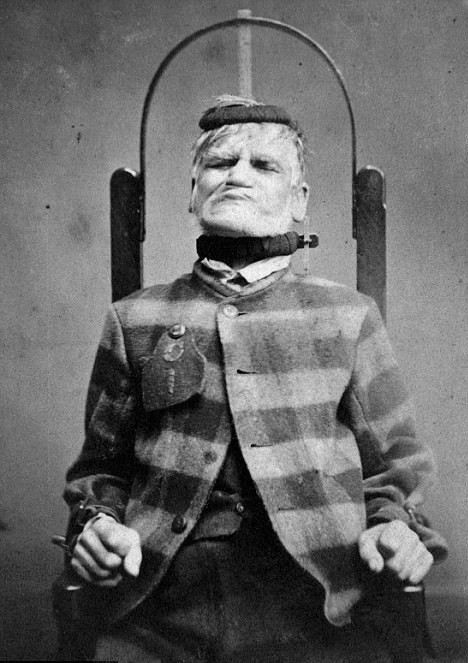
Aaron survived here for a quarter of a century, having spent most of his life institutionalized. Toward the end the staff noted, "Patient does not know his age or how long he has been here." 
Aaron Kosminski died of a gangrene infection at the age of 54 years, on Monday, 24 March, 1919 (above).  At the time of his death he weighed just 96 pounds. But he lived longer than any of  his victims, and even his nemesis.
Detective Inspector Edmund Reid (above) retired from the Metropolitan Police in 1896, with over 50 awards and commendations, including being named a Druid of Distinction, Reid moved to Hampton-on-Sea, atop the chalk cliffs of England's east coast. Here he worked at becoming an English eccentric.
He renamed his home “Reid's Ranch”, and painted the outside walls with castle battlements and cannon aimed at the ocean. He opened a stand in his garden shed (above), from which he sold postcards – mostly featuring himself - sold lemon-aide and wrote crank letters to the local newspaper. He died at the age of 61, on 5 December, 1917, the same year he finally married.
Thus I end my version of the story of Jack the Ripper – just another human being,  more unhappy and violent than most, but just another human being.

- 30 - 

Monday, April 14, 2025

BLOODY JACK Chapter Eighteen


I guess the kindest thing I can say about 36 year old Dr. Fredrick William Blackwell (above), is that he was awakened from a dead sleep by his assistant,  Edward Johnson,  not ten minutes before he examined the body outside the International Workers Educational Institute. By his own watch Dr. Blackwell arrived at the scene at 1:16 a.m., Sunday, 30 September, 1888. And he immediately went to work. But adrenalin can only get you so far, and I fear Dr. Blackwell was pushed faster and farther than he could handle.

He immediately recognized that the victim was dead – her head had been “nearly severed from her body” - and that she had been killed recently – by his first estimate “not more than 20 minutes” earlier, although he gets points for hedging that to up to 30 minutes to match the witness testimony. But that very night Dr. Blackwell also felt compelled to tell The London Star, “...it does not follow that the murderer would be be spattered with blood, for, as he is sufficiently cunning in other things, he could contrive to avoid coming in contact with the blood..."
So, from almost the instant the woman's body on Berner Street was found, it was assumed she was another victim of the clever madman responsible for the escalating murders of Martha Tabem, Polly Nichols and Annie Chapman. But the good doctor assumed a great deal more than that. He also told the Star, “The woman did not appear to be a Jewess, but more like an Irishwoman”  In fact her birth name was Elizabeth Gustafsdotter – she was Swedish – and had been known in London for twenty years as Elizabeth Stride (above). So much for racial profiling.
Dr. Blackwell's description of her wounds was interesting. “In the neck,” he told the inquest on Monday, “there was a long incision...(which) commenced on the left side, 2 inches below the angle of the jaw...nearly severing the vessels on that side, cutting the wind pipe...completely in two, and terminating on the opposite side 1 inch below the angle of the right jaw, but without severing the vessels on that side.” There were no wounds below the shoulders. By separating the windpipe, the killer silenced Elizabeth. By cutting only one side of her jugular veins and arteries he produced unconsciousness in 1- 3 minutes, with death shortly there after.  But even that was longer than the agony of previous victims.
So Liz Stride's neck had been cut from right to left in one stroke – not two - indicating the killer was either right handed or had attacked Elizabeth from behind. All three of those points strongly hint that Liz Stride had not been killed by the same man who had murdered the previous three women, who was probably left handed, and had cut the throat twice.. 
And this murder was committed outside a social club with two dozen people inside, and less than fifty feet from the small “The Lord Nelson” public house at 46 Berner Street, with people still coming and going to and from those two establishments. The victim on the unlit stairwell in Georg's Yard, the victim shielded by the fence of 29 Hanbury Street, and the dead woman left on the dark stretch of Buck's Row were all isolated places. The first goal of con men and premeditated killers is to isolate their victims. Liz Stride was not isolated.
But what truly defines a victim of Jack the Ripper was his method for killing. To quote from the “Case Book” – http://www.casebook.org/intro.html, - “The Whitechapel murderer and his victim stood facing each other. When she lifted her skirts, the...Ripper seized the women by their throats and strangled them until they were unconscious if not dead....The Ripper then lowered his victims...He cut the throats when the women were on the ground...The Ripper then committed the mutilations.” 
The first step, manual strangulation, takes no more than 10 seconds to produce unconsciousness and silence. Without other injury, the victim recovers in a few moments. So the victims were chocked to render them compliant. Once on the ground they were then murdered by having their throat's cut, allowing the killer to feel safe before releasing his pent up rage on the reproductive organs. But, as the casebook points out, “No sign of intercourse was ever detected.”
There should have been lots of questions about who had murdered this woman, Liz Stride.  And about ten minutes after Dr. Blackwell arrived on the scene, there was a brief ray of hope. Detective Inspector Edmund Reid (above), the man who had investigated Martha Tabem's death,  was back from vacation and he arrived on the scene about 1:30 a.m. 
This time the body stayed right where it was, until Dr. George Bagster Phillips (above),  the Whitechapel Division Police Surgeon, arrived 15 minutes later. At last a doctor could compare a previous victim's condition and wounds with the latest victim's.
Inspector Reid was already interviewing the 28 people in the Educational Institute. Each had to give their name and address, a full account of what and who they saw that night, and a rough time line for the evening. And they were all forced to turn out their pockets. Houses on both sides of Berner Street were searched. All the residents were interviewed. This took time, and it was not until about 4:30 a.m. that Inspector Reid returned to the scene of the murder in Duitfield's Yard.
By now a large moribund crowd had gathered outside the closed gates, talking about the murders, inventing and spreading rumors. They were forced to part so the ambulance cart carrying the body could be wheeled away. Dr. Phillips had already left, and about 5:00am, Inspector Reid  returned to the Leman Street station, to begin writing up his report. It was about 5:30 that morning, when PC Collins oversaw the washing down of the murder scene. All the blood spatter was scrubbed off the walls and the pooled blood was washed into the gutter, along with anything the victim and killer might have dropped. So much for hope.
This time the body did not go to the Montague Street mortuary, to be “mishandled” by the Workhouse inmates. Instead the as yet unidentified body was loaded on a police ambulance cart and pushed south to...
...the Ratcliff Street Chapel and Mortuary in the south east corner behind the Baroque St. George in the East Church (above), on Cannon Street south of Cable Street in Wapping   Just two blocks north of the Tobacco Docks, the mortuary was a small utilitarian brick building, built in 1876, to give the working poor a choice over keeping the decaying corpse of a deceased loved one at home - usually in one of those 8' by 8' rooms – until they could afford a grave and funeral.
Because of the public fear of grave-robbers, these chapel mortuaries were under-used. And in truth, before refrigeration, they had no better facilities than the Montague Street mortuary. But the workhouse inmates were convenient scapegoats for the officials' failure to catch the murderer. And the events on that Sunday morning, 30 September, 1888, on Berner Street, and in the dark corners of Mitre Square 45 minutes later, would increase the pressure on the police and the doctors who worked with them.
It was respected Police Constable Edward Watkins who discovered the second horror of that night. He was a 17 year veteran of the London Police Force – separate from the Metropolitan force, so the government would always have direct authority over the governmental and banking centers. The City of London ended where the city walls once stood, and Constable Watkin's beat was near the eastern edge, within sight at Aldgate. 
P.C Watkins started his beat in Duke Street (above, left) where it joined St. James Place, aka Gowers Walk. Walking at the prescribed 2 ½ miles an hour he headed through Heneage Lane to Bury Street, Creechurch Lane, down Leadenhall Street to Mitre Street and Mitre Square, then to King Street to Gowers Street back to Duke Street. Each round was carefully timed out and took 14 to 16 minutes to complete.

Just about 1:45 that chilly Sunday morning, PC Watkins entered the “small and dirty” cobblestone Mitre Square for the 15th time that night. The square had only two gas lights (X's above) -  and one of of those was weak And it had two exits.
 On the north west corner of the square (above), between two Kearley and Tongue warehouses, was  a narrow covered passage to St. James Place and King Street.  
The second exit was Church Lane,  on the northeastern corner of Mitre Square, between the Horner and Company warehouse and a larger K and T warehouse. Church Lane connected with Duke Street, next to the Great Synagogue.. 
Because those two corners had lights, Constable Watkins entered the square (above) and turned right, into the darkest corner of Mitre Square. 
He walked east past the rear of a framing  shop and three abandoned buildings (above)
He was now facing the closed wooden gate of Heydemann & Company warehouse, the darkest corner of the square, and it was here that his bulls eye lantern threw its light upon the body of a woman lying on her back, where the curb met the cobbles. And she had not been there 15 minutes earlier, when Constable Watkins last stood here.
The clothes were pushed up to her breast, and the stomach was laid bare,” Watkins testified, “with a dreadful gash from the pit of the stomach to the breast. 
"On examining the body I found the entrails cut and laid around the throat, which had an awful gash in it, extending ear to ear. In fact the head was nearly severed from the body. Blood was everywhere to be seen." 
And there was something new, a new injury. "It was difficult to discern the injuries to the face for the quantity of blood which covered it...the murderer had inserted the knife just under the left eye, and drawing it under it under the nose, cut the nose completely from the face, at the same time inflicting a dreadful gash down the right cheek to the angle of the jawbone. The nose was laid over on the cheek. A more dreadful sight I never saw. It quite knocked me over.”
And this barbarous murder, together with the earlier murder on Bernier Street,  had the same effect upon the entire city of London.
- 30 -

Blog Archive