August 2025

August  2025
I DON'T NEED A RIDE. I NEED AMMUNITION.

Translate

Wednesday, November 27, 2013

TURKEY WARS

I don’t understand why anyone believes any of the popular myths about Thanksgiving. The truth is our Puritan forefathers were a humorless bunch who showed their devotion to God by going hungry, not by eating. They would have considered our average Thanksgiving dinner an insult to God. Their God was not interested in contentment, just punishment and fasting. And the only feasts they had were in the late  summer, when food was plentiful. By late November they were already deep into their grain stores, and watery stew. They would only say thanks if they were staving to death!
The real mother of Thanksgiving was actually the widow who wrote “Mary Had a Little Lamb” and other innocent poems, Sarah Hale. She was the 19th century version of Martha Stewart. For forty years Sarah was the editor of the prestigious “Godey’s Lady’s Book” magazine. And each November Sarah would bombard her 150,000 subscribers with recipes for Roast Turkey, Turkey stuffing, Turkey gravy, and Turkey stew. Now a lot of selling and some kitchen chemistry was required because 19th century turkeys were scrawny and almost exclusively dark meat. Sarah championed turkey because her middle class homemakers were on tight budgets, and per pound the randy, strutting bird-brain turkey cost less than half what a chicken might.
But the real revolution came when, in 1934, the United States Department of Agriculture discovered the key to making turkeys palatable; artificial insemination. In 1932, before the breeding revolution, the average American ate just two pounds of turkey a year. Today, that amount is closer to twenty pounds. Turkey farmers across America, are very thankful for that big government intervention. So are most turkey eaters, although they don't seem to know it.
But the increased popularity of turkey has come at a price - no sex for the turkey. Today’s buxom white breasted Tom Turkey is too obese to climb atop an equally buxom white breasted hen. Without human intervention, the Thanksgiving turkey would have have gone extinct - Ah, ceste se la guerre. But this brings us to my real topic, which is the year when Thanksgiving became a real de la guerre; 1939
It was the third year of President Franklin Delano Roosevelt’s second term as president. And Republicans were determined (read terrified) that he might want a third term. However they were not in a good position to prevent it, holding only 177 seats in the House of Representatives (to 252 Democrats) and a paltry 23 seats in the Senate (to 69 Democrats). But then in August, Roosevelt handed Republicans an early Christmas present.
In July Franklin had received a visit from Fred Lazarus (above), head of the Federated Department Stores, the single biggest retail chain by volume in America. He controlled Macy’s and Bloomingdales in New York City, Filenes in Boston, and Strauss in Brooklyn. Fred pointed out to the President that in 1939, November would have five Thursdays; the second, the ninth, the sixteenth, the twenty-third and the thirtieth. And Lincoln’s 1863 proclamation calling for a day of Thanksgiving -  first issued after the battles of Gettysburg and Vicksburg, and re-issued by Presidents every year since - specifically designated Thanksgiving as the final Thursday in November. That final Thursday would be, in the case of 1939,  the 30th . The last time Thanksgiving had fallen on the fifth Thursday in November had been 1933. 
That year the Christmas shopping season, which traditionally began the day after Thanksgiving, was just 20 shopping days long, and had proven disastrous for retailers. Of course, there had been the Great Depression that year, but retail business folks are like farmers, they always worry about the rain. Did it come too early, or too late? Is it too much, or too little? Anyway, Lazarus wanted Roosevelt to move the Turkey Day forward one week, to give merchants another week to tempt their customers into spending on Christmas. The President had also heard from lobbyists at the National Retail Dry Goods Association, as well as executives from Gimbels and Lord & Taylor.
Being a long time politician, Roosevelt listened to the business community. And at a Press Conference held August 14th, he said, “I have been hearing from a great many people...complaints that Thanksgiving came too close to Christmas”. Roosevelt reminded the press corps that Thanksgiving was still not an official holiday, and that each year the President picked the date for it. And, since "experts" believed that adding another week to the shopping season would increase sales by 10%, Franklin announced that this year of 1939,  he was moving Thanksgiving to Thursday, November 23rd., the fourth Thursday in November.
The first alarm went off  the very next day, when Fred Lazarus ran into his younger brother Simon. Simon Lazarus was ranting over the change because it had disrupted his Ohio State Universities’ Thanksgiving day football game. “What damn fool got the president to do this?” Simon barked at his brother, who, in fact, was the damn fool himself. But that was just the beginning.
The Republican attorney general for Oregon, turned to poetry. “Thirty days hath September, April, June, and November; All the rest have thirty-one; Until we hear from Washington.”  A shopkeeper in Kokomo, Indiana preferred to protest in prose. He put up a sign in his window which read, “Do your shopping early. Who knows, tomorrow may be Christmas.” 
Republican Senator Styles Bridges of New Hampshire urged the President to simply abolish winter by fiat. And Methodist minister Norman Vincent Peal got very outraged, charging it was  “…contrary to the meaning of Thanksgiving for the president of this great nation to tinker with the sacred religious day with the specious excuse that it will help Christmas sales. The next thing we may expect Christmas to be shifted to May 1st to help the New York World’s Fair of 1940.”  Did anybody point out to Norman, that the bible never mentioned which Thursday Thanksgiving should fall on?
Twenty-three governors went with the President’s switch, and twenty-two did not. Texas and Colorado couldn’t make up their minds and recognized both days as the holiday in question, although the Republican Governor of Colorado, Ralph Carr, announced he would eat no turkey on the 23rd. 
The 30th was labeled as the Republican Thanksgiving, while the 23rd became the Democratic Thanksgiving, or, as "Nucky" Johnson, the recently indicted Republican mayor of Atlantic City called Franklin Roosevelt’s holiday, “Franksgiving”.
There were a few real problems hidden under this haze of invented political outrage. Calendars could not be changed in time for the 1939 switch over. And schools were suddenly uncertain of vacation schedules. Some families found their bosses forced their holiday dinners to be split between the two dates. But it turned out that the real problem had been identified by Simon Lazarus, the angry brother - football.
The headline in the New York Times said it all; “PRESIDENT SHOCKS FOOTBALL COACHES” The coach of Little Ouachita college in Arkansas warned, “We'll vote the Republican ticket if he interferes with our football.'” Chairman of the Athletic Board at New York University wrote to Roosevelt, “…it has become necessary to frame football schedules three to five years in advance, and for both 1939 and 1940 we had arranged to play our annual football game with Fordham on Thanksgiving Day…” And then Roosevelt had changed the date!
A Gallup poll found that 62% of Americans wanted the President’s decision reversed. But it was too late for Roosevelt to change his mind in 1939. And FDR was too stubborn to admit defeat in November 1940, which also had five Thursdays, and was a Presidential election year. Despite the addition of even more politics into the mix, nine states switched from the Republican Thanksgiving (the last Thursday) to the Democratic one (the fourth Thursday) in 1940. 
That left just sixteen celebrating the “old” Thanksgiving. And that seems to have been enough of a victory for Roosevelt, that looking ahead to November 1941 (which surprisingly also had five Thursdays), he asked New York City Mayor Fiorello LaGuardia to study the sales figures. Was that extra week of shopping really helping the economy? In fact it had, but not very much; certainly not enough, considering all the angst and confusion the move had cost.
In early May of 1941, LaGuardia’s report informed the White House that “the early Thanksgiving date has not proved worthwhile".  So on  20 May 1941, Roosevelt set Thanksgiving 1941 back to the last Thursday in November. And in a rational world, that would have settled that. But, of course, politicians are not rational beings.
Being lawmakers the politicians in the House of Representatives decided to get involved by writing a law. House joint resolution 41 justified itself by pointing out that there was nothing to designate the day as a holiday except the annual President's Proclamation (which Roosevelt had mentioned at the start of this mess!). Henceforth, said the Representatives, the last Thursday in November would legally be Thanksgiving. But when HR 41 got to the Senate, those gentlemen felt compelled to improve upon it.  They did this by changing one little word. Thanksgiving would now be not the last Thursday in November as the House had intended, but the fourth Thursday in November. As Connecticut Senator John A. Danaher pointed out, in four out of five years, the last Thursday in November was the fourth Thursday in November, anyway. The House went along and Roosevelt signed the new law into effect on December 26, 1941. And amazingly, since that date, the Republicans had been determined not to notice that Roosevelt and the merchants had won.
No matter what conservative or liberal sympathizers may chortle about on their blog posts, the merchants' got their earlier date for Thanksgiving, and that extra week of Christmas shopping..  They got it by allowing the politicians to choke on their own press releases. Money always wins every political arguement. And most moral arguements, too.  And the great political storm of 1939 - 1940 seems quaint and gentle, in a world where the Christmas shopping season begins shortly after Halloween! .
- 30- 

Sunday, November 24, 2013

ET TU Part Eight A NIGHT AT THE THEATRE


I find it very telling that on March 13, 44 B.C., just two days before the planned assassination of Julius Caesar, the driving force behind the plot, Gaius Cassius Longinus , warned his fellow conspirators that, should Caesar uncover their plans, all of them would have to commit suicide. This was not the advice of a ideological leader. Rather, it indicates conspirators haunted with second thoughts. Simply put, there were too many who knew too much. Estimates of members in the plot range up to 40  And to galvanize the plotters and hold them to their purpose, Cassius did not appeal to their patriotism, but to their sense of class. A serf suffers humiliation every day. It is the staff of their lives. But an aristocrat, faced with loss of privilege, prefers death to humiliation. This was the warning Cassius delivered to his nervous conspirators; we succeed or we die. It never seems to have occurred to the privileged forty, that victory could also be fatal.
The object of Cassius' hatred, Giaus Julius Caesar, elected Roman dictator for life, intended on leaving Rome on the 18th. But even Caesar, at 56, must have been daunted at the prospect of campaigning in the Parthian desert, which 12 years before had consumed his old patron Crassus. Every year for the last five years opposition by the Senate aristocrats, first in Italy, then Spain, Greece, Egypt, Anatola, North Africa, and Spain again had forced Caesar into a military campaign. On this day, the Ides of March, which was until this very year, New Years Day, Caesar had intended on staying close to home. The historian Plutarch says he was not feeling well, and everyone agrees his wife was having nightmares Whichever the excuse he used to dissuade his followers, it seems clear he wanted a little down down time. Someone had to get him out of the house, someone close, someone he could not deny.
The obvious choice was Marcus Junius Brutus, the son of Cesar's long time mistress, and so often forgiven by Caesar that it was rumored he must be Caesar's illegitimate son. But Brutus had a new wife at home, Porcia Catonis. They had been married just the year before, in 45 B.C. Porcia was the daughter of the aristocratic Senator Cato, who hated Cesar so much that when cornered in North Africa in 46 B.C., he had chosen suicide. It must have been her, aided by Crassus, who had stiffened Brutus back, and drove him to murder.  But even Brutus was not willing to lure Caesar to his death. So that job fell to his younger brother, Decimus Brutus.
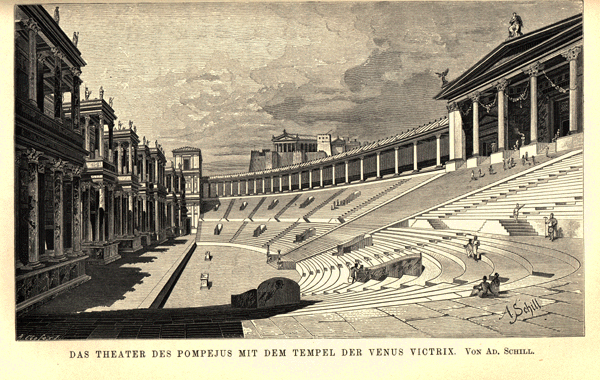
On the morning of March 15, 44 B.C., Decimus was welcomed into Caesar's home, and extended an invitation to a gladiatorial display in one of the larger halls at Pompey's theater It was a subject certain to pique Ceasar's interests. Before crossing the Rubicon, Caesar had been checking up on one of his own gladiatorial schools. He agreed to accompany Decimus to the theatre. He had no intention of attending the Senate, even though they were meeting in the Curia Pompey, part of the same complex.
As the pair entered the complex through a side entrance, crowds pushed toward Caesar, forcing petitions into his hands, comments on government policy and requests for assistance. One of the messages handed to Caesar was from his lieutenant, Mark Anthony, warning of rumors concerning the Senate meeting today. Like the others notes handed to Caesar this morning, it would not be opened until it was too late.
Was there a man in the street warning Caesar to “Beware the Ides of March”? Probably, given the depth of religion in the pagan world, there were people wandering the streets of the largest city outside of China, prophesying doom about every dawn, and in particular about the dawn of an abandoned New Years Day. But Caesar had become Dictator by ignoring such ominous warnings. Today the soothsayer was right. The previous ten thousand mornings he had been wrong.
Once inside the walls of Pompey's Theatre, Caesar and Decimus, made their way along the walks toward the meeting room to inspect the gladiators. But as they passed the Curia they were waylaid by Decimus' older brother, Brutus. He urged Caesar to stop in the Curia,  to allow the Senate to wish him gods' speed on his invasion of Parthia. Exasperated, Caesar acquiesced, and the three men crossed the portico and entered the temporary Senate Chambers.
As he sat down, Caesar could not have missed the electric tension in the room. But what did it mean? Many were avoiding eye contact with him. A few were looking at their feet, or fingering the daggers hidden in their Senatorial robes. But even those Senators who were not in on the plot must have recognized that something was wrong. And when Senator Lucius Tillus Cimber thrust forward a petition asking that Caesar allow his brother to return from exile, Caesar pushed it away, into the hands of an aide. Whereupon Tillus grabbed the hem of Caesar's toga, and pulled. Caesar pulled away, demanding, “Be careful, there is no need to use force!” As Caesar turned to a guard to seek assistance, Senator and Tribume Publius Servilius Casca Longus, slashed forward, stabbing Caesar in the neck, just missing his throat.
Caesar grabbed Casca's arm and stabbed him with a pen. Startled, Casca screamed, “Help, brother!” As he tried to stand, Caesar was stabbed again. He now realized the aristocrats had surrounded him, and they all had knives. He tried to run, but fell, and was brutally stabbed over and over as he lay on the floor. The autopsy would reveal 23 wounds. So many knives were slashing that Brutus was stabbed by one of his allies.
Rather than being proud of their act, the aristocrats fled the scene as quickly as they could, escaping back inside the city walls, where Cesar's soldiers were not allowed to carry arms. And the abandoned body of Julius Caesar lay a crumpled heap on the floor of the Curia Pompey, his robes soaking in his blood, for three hours. Finally three slaves worked up the courage to gather his corpse, load it on a litter, and carry him home to his wife. Thousands stood in shock to see the body pass on the street, one arm hanging off the litter, uncovered , bouncing to the steps of nervous slaves.
The site of Caesar's murder did not become a shrine. It became a public toilet. Pompey's theatre remained in use for almost 1,500 years. Eventually the large latrine which had shared a wall with Curia was enlarged, and engulfed the spot on the floor Caesar had bled upon. Finally it was walled off and forgotten. And when the theatre, and the latrine, fell on hard times midway through the fifteen century A.D., the populace turned it into a quarry, scavenging building stones for their homes and shops. Even today, those who come to look upon the space where Giaus Julius Caesar died, will find only an arch, and an ancient concrete wall
Within two years most of the aristocratic assassins were dead. Cassius, Casca, Cimber, Brutus - all died by their own hands. A few of the forty were killed in battle, and a few even fought for their lives in the courts, and won. They were allowed to return to Rome and live in somewhat reduced privilege Caesar's will left his fortune to his nephew Octavian, and eventually the boy overturned the rotten remains of the Republic and disposed of the tawdry trappings of its dead democracy, killed by the aristocrats. Octavian became Augustus, the first Roman Emperor. Retroactively, he made his uncle divine. The deceased Julius Caesar had become the thing the aristocrats said the feared the most, a god.
But the dream of a representatives government, giving the people a voice in their own governance, had been set back by 2,000 years.
- 30 -

Friday, November 22, 2013

THE FLAMBOYANT JAMOOK

I gotta' tell you, this David Friendland was a real jamook, an empty suit with a very big motor mouth. He could sell life insurance to your dead grandmother, he never shuts up. He's  flamboyant. He's a lawyer for Johnny Dee, that’s Johnny Digilo over in Jersey.   Now, the Genovese have been running the north Jersey unions since forever, and they make Johnny Dee Treasurer of the Longshoreman’s Local 1588 in Bayonne. Johnny is a little crazy sometimes, but he's a big earner, and between the pension skim and the protection, not to mention the loansharking, its a cash cow for the Genovese.  This Friendland is brought in by his old man when the kid graduates law school, back in 1961. Father and son are both Teamster suitcases, so it seems like the perfect deal, one hand watches the other - you know? But Friedland, first he's oobatz – he's crazy – and then he decides to become a politician. VORRE! Ucciderlo ma non voglio il problema
See, in 1966 Johnny Dee approves a one 'G' loan to this car wash goomba named Pereria. The vig is fifty small a week, until Pereria pays the principal. Of course he never pays the principal. And then a year later he borrows another 'G', same terms. Well, when the hundred a week reaches seven “G's', Pereria decides he's paid enough. Hearing this, Johnny Dee calls Pereria and says to pay up or he'll come down there and chop his fucking head off. This goomba Pereria panics and calls the cops. Now he's really in trouble. And when four of Johnny Dee's associates visit the Du-Rite Car wash, Pereria won't come out of the toilet. So the boys leave him a few messages. Pereria must have got them because, he suddenly develops amnesia in court. Case closed, right? Wrong.
The local D.A. has a hard on for Johnny Dee, and calls the goomba in front of a Grand Jury. Safe behind closed doors the goomba remembers again, and Johnny Dee gets indicted for racketeering. This is a problem. And that's where this jamook Freidland comes in. Its 1968 by now, and Friedland is still a suitcase for the Teamsters, but now he's also a state representative from Hudson County and the “quintessential New Jersey politician”. Flamboyant.  He approaches the goomba's suit and tells him, if Pereria doesn't take a $6,500 cash gift from Johnny Dee and drop the whole thing, then Johnny Dee is going to sue him, Pereria, for slander or liable or false arrest or something. Well, the problem is not that Pereria can't be intimidated. He signs the deal. The problem is, he has a record of not staying intimidated. So Friedland shows the cash to Pereria but then he puts it in his desk. He holds onto it until the goomba suffers another memory lapse in front of the new jury, and the charges against Johnny Dee are dropped.
Of course Friedland takes a fee for holding the cash. And the goomba's lawyer takes his cut. By the time the cash gets to Pereria, there's only like $2,500 left. You gotta love suits. What Johnny Dee did was extortion. What Friedland did was an out-of-court settlement. Anyway, the D.A. is so pissed, he brings ethics charges against Fried land and the Jersey Supreme Court suspends Friendland's law license for six months. He doesn't lose his seat in the Jersey House, of course. In Jersey, “Il diavolo protegge idioti e politici”. But Friedland is now on the Fed's radar.
All this is ancient history, before RICO, the Racketeer Influenced and Corrupt Organizations Act, named after some ancient movie gangster. Anyway, After RICO, in 1971,  the feds start prosecuting the family bosses. And knocking them off.   By 1979 they are down to smaller fish, indicting Friedland and his old man for taking a 360 “G” kickback for setting up a $4 million loan from their Teamster's local 701 pension fund. On Wall Street they call that a “finders fee”, business as usual. Across the river in Jersey, that's a RICO violation. In 1980 Friedland and his papa are convicted and the jamook has to resign his Senate Seat. Did I mention that he won a State Senate seat in 1978? Always, a Democrat, of course. This is New Jersey, after all.
Well, this jamook Friedland doesn't want to go to prison. So in 1982 he turns CW, a cooperating witness. He wears a wire. Now this could be a problem, a connected suit with a hard-on wearing a wire? Except everybody knows Friedland is a jamook, and he's facing serious jail time. Nobody is going to talk to him;. What strunz prosecutor signed that deal? So Friedland tells the feds a long and colorful story that leads pretty much no where, while disappearing into witness protection. And they ship him off to Miami, new name, new girl friend, new job. Now he's working for a mortgage company. Like nothing illegal ever happened in that business. Except six months later the same jamook sets up another loan with local 701 Pension fund, back in Jersey. Like he thinks the feds aren't going to be watching it anymore. Two years later he gets indicted again. And in 1986 he gets convicted again. And this time the feds are not interested in a deal. Friedland is going to have to do something really flamboyant to get out of this one.
So, he drowns. While scuba diving, 12 miles off Grand Bahama . And his good friend, skipper Jack Wynn, tells the Coast Guard he saw the jamook take pain killers just before he disappeared beneath the waves, with half an hour of air in his tanks. Of course Wynn does not radio the Coast Guard until the next morning. Il basterd doveva restare morto. You know what I'm saying? The feds are suspicious and don't think Friedland can hold his breath for long. And sure enough, a month after his demise the flamboyant David Friedland, jamook extraordinaire, reappears healthy enough to call his lawyer from beyond his watery grave and insist he is innocent. Which nobody believes that anymore, not even the jamook.
It turns out his timing was really good. Back in Jersey in April of 1988, Friedland's old boss, Johnny Dee, beats a racketeering rap. But his people in charge of the Teamsters local 701 are convicted. Not that the management goes clean, but the Genevese people, like Friedland, are forced out, and replaced by Gambino people. This is a problem for the Genevese bosses because of the loss of income, and they blame Johnny Dee. A month later, in May, they take Johnny Dee for a ride in a Lincoln Continental, where they put five .38 rounds into the back of his head. It made such a mess they had to scrap the freaking car.
Meanwhile, the jamook has picked up a hitch hiker, a smoldering brunette named Colette Golightly, who had previously dumped her cold Indiana optometrist husband for optimistic and sunny Boca Rotan, Florida. She becomes an underwater photographer, which is how she meets David Friedland. She now followed him from Miami, to Bermuda, to Kenya, to Switzerland to France to Venice, Hong Kong, Singapore, and Sri Lanka, with the cops half a step behind. And then for a year, the jamook and Colette disappear almost completely. Clean getaway. Almost because Friedland keeps popping up in various countries, like a whack a mole, just long enough to access bank accounts, before vanishing again. And then the feds get a phone call from a string of coral atolls out in the middle of the Indian Ocean.
The cops in the Republic of the Maldive islands had gotten curious about a flamboyant American resident named Richard Smith Harley. He was an avid scuba diver, and had even bought a half dozen local diving schools. He liked to have his picture taken with his students, feeding sharks, with fish held in his teeth. Flamboyant. He had even started a clinic on tiny Bondos Island, and everybody there called him “Pappa”. But what peaked the Maldive cops interest was that every couple of months Harley would get his American passport stamped when he flew out of the Maldives. But when he flew back a few days later, it was never stamped to show entry into any other country. It was like he was traveling into the Twight Zone. So the cops started comparing Harley's passport photo with the pictures on their alert sheets. And early in December of 1988, they found a match - David Freidland. Same jamook. A couple of days later Frieland was arrested, and at the end of December the feds brought him back to the states.
“Tanned and smiling”, the jamook tells the press, “I had a good time, but I'll tell you it's good to be back in the United States.” Apparently it was not good because he was coming home to his wife Carol, and their daughter, but because the smoldering Colette came back to be with him, if only on visiting days. Awaiting sentencing the jamook announced he had converted to Christianity, and tried to cut another deal with the feds. But nobody was impressed anymore. That's the problem with flamboyant. Over time the bilge tends to fill with water, until its not so buoyant anymore  It's just flam.
In 1989 the bars of the Correcitonal Complex in Coleman, Florida finally slammed shut behind the jamook. And they did not open again until July of 1997, when David Friedland was released from a West Palm Beach halfway house. The jamook told a reporter, “''I can't tell you the nights that I lay awake just crying, because I realize the opportunity I had to do so much good, and how I blew it.”'  He never stopped selling this stuff. He was by then about 60, and after working for a Florida advertising firm, he retired to Boca Roton, with Colette. And he finally learned to shut up.
Maybe the final word on the jamook belongs to Thomas Kean, who became the Republican governor of New Jersey, thanks in part to the deals he cut with the Democrat David Friedland. Kean described him as “He was one of the most brilliant people I ever worked with. He just was a bit crooked.” Just a bit, do you think? Another jamook.
- 30 -

Wednesday, November 20, 2013

A ROMANTIC CHRISTMAS


I find it curious that Ernst Theodore Hoffman (above) is considered a romantic. I think of him as a manic depressive, and justified at that, considering that Napoleon spent most of Ernest’s life turning Europe into a slaughterhouse. As a young man Ernst did fall in love, but the lady was married. And when she turned up pregnant Ernest’s family shipped him off to Poland, where he labored as a petty bureaucrat. But he spent his free time composing classical music and writing vaguely creepy stories. One of his more successful tales was a sort of 19th century “Jaws”, except instead of a 25 foot Great White Shark, Ernest’s villain was a mouse bent on revenge. In it seven year old Maria receives a mechanical doll as a Christmas present, which her older brother Fritz promptly breaks. She sits up late trying to repair the toy, until an army of mice attack her doll. She saves the toy by throwing her shoe at the rodents. Now, maybe I'm just waiting for the other shoe to drop, but I think this idea has ballet written all over it. Interestingly, that idea never occurred to Ernst.
Nor did it occur to Alexander Dumas (above), the vulgar and prolific son of a French nobleman and a Haitian slave woman. See, Alex liked the Parisian good life a lot more than he liked writing. He had at least 40 mistresses, but he made enough to afford his profligate lifestyle by out doing Andy Warhol at marketing his art. Alex kept a warehouse full of writers who ground out stories under his direction, such as “The Count of Monte Cristo” and “The Three Musketeers”, and its sequels. And one of his minor best sellers was a direct steal of Ernst's hallucination, which Dumas changed just enough to avoid a lawsuit – like changing Maria's name to Clara.
Then, seventy years after Ernst died of syphilis (the ultimate romance disease), and 12 years after Alex died of a stroke in 1870, the ballet idea finally did occur to Marius Petpa (above), celebrated head of the Bolshoi Ballet Company in Russia. In 1882 the Imperial Theaters hired Marius and Pyotr Illyich Tchaikovsky to create the “Sleeping Beauty” ballet. This was such a critical success that it established the Bolshoi as the world's premier ballet company, and Marius as a world class genius. And then like a modern Hollywood producer looking for a project to fit the marquee talent, in 1890, the theatre brought the pair together again. But this time, having inflated these two monumental egos, the management merely suggested a sort of theatrical sandwich – one night for both a serious opera and a light ballet.
The one act opera was clearly intended to be the meat in this theatrical happy meal, and being the foremost Russian composer of the day, Pyotr (above) got first choice of subject matter. He decided on a Danish story of a blind princess named Iolanta.. But then, early in February of 1891, in Saint Petersburg, Marius handed Pyotr a detailed synopsis and bar-by-musical bar outline for a two act classical ballet based the story Dumas had filched. Pyotr was appalled. He though it childish and unworthy of serious application. But, if it meant he got paid to write another opera, he would somehow make the silly ballet work. After struggling for a month he tried to remain optimistic. He wrote to one of this brothers, “I am working with all my strength and reconciling myself to the subject of the ballet.” But he also admitted “I am experiencing a kind of crisis.” This was good, since Pyotr had a lot of experience with those.
See, Pyotr had a secret that held the potential to turn every problem in his life into a crises. He was approaching fifty, and had reached an uneasy equilibrium with his homosexuality. He had tried to go straight but his marriage to Antonina Ivanova (above) had blown up after little more than a month. This raised again the threat of exposure by envious and bigoted court and church officials, who at any moment could end his career. Each contract, including this one, could be his last. What little stability existed in his life was supplied by his younger sister Aleksandra and her seven children with Lev Davydov. Pyotr wrote many of his 11 operas, six symphonies and three ballets on their Ukrainian estate near Kamenka. And now, in March, while on his way to a concert tour of America, and still trying to come up with something presentable for Marius's ballet, he learned of Aleksanda's death.
He had just seen Aleksandra (above) over the Christmas holidays, so he must have known how ill she was. Still, Pyotr was hysterical. And then, pausing in Rouen, France, he managed his agony by putting it to work. His genius was always his ability to combine the Russian musical themes with Western ones, and to subjugate his true identity into the restraints of his art. And in the “grand pas de deux” for the lead dance character of Clara, he weaved in threads from the Russian Orthodox funeral service The musical themes of the entire ballet became darker and more nuanced. As one critic has put it, “In Clara, he found a parallel for his sister.” A ballet about wealthy Victorian children, became, with the talent of Pyotr's genius, a work for people of all ages and for all time.
When Pyotr returned from his wildly successful 25 day American tour (he inaugurated Carnegie Hall in Manhattan) he delivered his musical score to Marius in St. Petersburg, to be animated. But as the opportunity approached, the world renown genius, Marius, suffered his own crises of self confidence. The primary symptom of this understandable panic was an attack of Pemphigus vulgaris, a debilitating skin disease, usually afflicting Ashkebazi Jews – of which Marius was one. Scratching his itching skin produced open sours, which made it impossible for Marius to concentrate on the ballet. So his assistant, Lev Ivanov, took over.
Lev (above) had been with the Bolshoi since he was eight, and had a natural talent as a musician, as well as being an excellent dancer. But where Marius was a classical ballet master, Lev was, like poor Ernest, a romantic. He followed Marius's general guidelines. He had to, the music had already been composed. But Lev also arranged his dancers like an impressionist painter, throwing patterns of sugar plumb fairies and swirling lines of snowflakes on point, about the stage. It was the shape and flow of the dance that interested Lev, and somehow the combination of all these hearts and souls, the romantic Ernst and the hedonist Alexander, the classicist Marius and the dark Pyotr, and now that other romantic Lev, they all gave birth, on January 15, 1890, to the premier of “The Nutcracker” ballet at the Mariinsky Theater in St. Petersburg, Russia.
The audiences seem to have been enthusiastic, giving five curtain calls to the Sugar Plum Fairy. The next morning Pyotr wrote to his brother, “The opera in particular was to everyone’s liking ... The productions of both...were superb” But it was a very long evening, with the Nutcracker not ending until well after midnight. 
The weary critics took it out on the dancers, calling the lead ballerina (above) corpulent and pudgy. The battle scene between the mice and the nutcracker confused them: “Disorderly pushing about from corner to corner and running backwards and forwards – quite amateurish.” The Grand Pas de Deux, so inspiring to the composer, was labeled ponderous and “completely insipid”. A week later Pyotr wrote to another brother, “Once again I am not embittered by such criticism. Nevertheless, I have been in a loathsome spirit, as I usually am...in such circumstances.” After 11 performances the double bill was closed.
Less than a year later, in October 1893 Pyotr would die during a cholera outbreak, his secret still secure. Although many have suggested he committed suicide, he did not. Lev Ivanov followed nine years later. Finances forced him to work until his death “in harness”, in December of 1901. About the same time the Bolshoi brought in the upstart Alexander Gorsky to replace the aging Marius (above) as director. While watching his intended replacement rehearsing on his stage, Marius was heard to shout, “Will someone tell that young man that I am not yet dead?!.” Within a year it did not matter; Marius was quietly retired. He did die in 1910, at the age of 92.
A year after its premier the opera Iolanta would be preformed in Hamburg, Germany. But although still performed occasionally, it is now largely forgotten. The Nutcracker, on the other hand, had to wait almost 20 years before it would be performed again, staged this time by the Bolshoi's new director Alexander Gorsky, in Moscow. He saved it. Alexander savaged Marius choices, paring away minor roles, replacing the children cast as Clara and the prince, with adults, thus adding a romantic story line for them. Standing alone, the ballet was now far better received. And after the Second World War, it became the classical Christmas production for every ballet company in the world, responsible for up to 40% of their income.
It just goes to show you – those silly romantics may be naive simpletons, but their ideas grow stronger with time because they are positive and simple, and keep being reinvented. When in doubt, we are always inspired by the romantics among us.
- 30 -

Blog Archive