August 2025

August  2025
I DON'T NEED A RIDE. I NEED AMMUNITION.

Translate

Showing posts with label IDES OF MARCH. Show all posts

Sunday, March 23, 2025

ET TU Part Eight Final cortinam


I find it very telling that as late as 13 March, 44 B.C., just two days before the assassination of Julius Caesar, the driving force behind the plot, Gaius Cassius Longinus,  warned his fellow conspirators that, should Caesar uncover their plans, all of them would have to commit suicide. 
This is the advice of an ideological leader. But behind it is the spirit of a leader haunted by second thoughts. Simply put, Cassius knew there were too many who knew too much. Estimates of members in the plot range up to 40  And to galvanize the plotters and hold them to their purpose and silence, Cassius (above) did not appeal to their patriotism, but to their sense of class. 
A serf suffers humiliation every day. It is the staff of their lives. But an aristocrat, faced with loss of privilege, often prefers death to humiliation. This was the warning Cassius delivered to his nervous conspirators; we succeed or we lose status. It never seems to have occurred to the privileged forty, that victory could also be fatal.
The object of Cassius' hatred, Giaus Julius Caesar, intended on leaving Rome in three short days.  But even Caesar, at 56, must have been daunted at the prospect of campaigning in the Parthian desert, which 12 years before had consumed his old patron Crassus. 
Every year for the last five years opposition by the Senate aristocrats, first in Italy, then Spain, Greece, Egypt, Anatola, North Africa, and Spain again had forced Caesar into a military campaign. 
On this day, the Ides of March, which had been,  until this very year, New Years Day, Caesar intended on staying close to home. The historian Plutarch says he was not feeling well, and everyone agrees his wife was having nightmares  Whichever the excuse he used to dissuade his followers, it seems clear he wanted a little down down time. Someone had to get him out of the house, someone close, someone the untrusting Caesar would trust.
The obvious choice was Marcus Junius Brutus (above), the son of Cesar's long time mistress, and so often forgiven by Caesar that it was rumored he must be Caesar's illegitimate son.  But Brutus had a new wife at home, Porcia Catonis. They had been married just the year before, in 45 B.C. Porcia was the daughter of the aristocratic Senator Cato, who hated Cesar so much that when cornered in North Africa in 46 B.C., he had chosen suicide. It must have been her, aided by Crassus, who had stiffened Brutus back, and drove him to murder.  
But even Brutus was not willing to lure Caesar to his death. So that job fell to his cousin, and one of Caesar's most trusted generals,  Decimus Junius Brutus Albinus (above).
On the morning of 15 March, 44 B.C., Decimus was welcomed into Caesar's home, and extended an invitation to a gladiatorial display in one of the larger halls at Pompey's theater.  It was a subject certain to pique Caesar's interests. Before crossing the Rubicon, Caesar had been checking up on one of his own gladiatorial schools. He agreed to accompany Decimus to the theatre, but he had no intention of attending the Senate, even though they were meeting in the Curia Pompey, part of the same complex.
As the pair entered the complex through a side entrance, crowds pushed toward Caesar, forcing petitions into his hands, comments on government policy and requests for assistance. 
One of the messages handed to Caesar was from his lieutenant, Mark Anthony, warning of rumors concerning the Senate meeting today. Like the others notes handed to Caesar this morning, it would not be opened until it was too late.
Was there a man in the street warning Caesar to “Beware the Ides of March”? Probably, given the depth of religion in Rome, there were people wandering the streets prophesying doom about every dawn, and in particular about the dawn of an abandoned New Years Day.  But Caesar had become Dictator by ignoring such ominous warnings. Today the soothsayer was right. The previous ten thousand mornings, and for the next ten thousand mornings, he would be wrong again.
Once inside the walls of Pompey's Theatre, Caesar and Decimus, made their way along the walks toward the meeting room to inspect the gladiators. But as they passed the Curia they were waylaid by Decimus' older brother, Brutus (above). He urged Caesar to stop in the Curia,  to allow the Senate to wish him gods' speed on his invasion of Parthia. Exasperated, Caesar acquiesced, and the three men crossed the portico and entered the temporary Senate Chambers.
As he sat down, Caesar could not have missed the electric tension in the room. But what did it mean? Many were avoiding eye contact with him.  But even those Senators who were not in on the plot must have recognized that something was different. And when Senator Lucius Tillus Cimber thrust forward a petition asking that Caesar allow his brother to return from exile (above), Caesar pushed it away, into the hands of an aide. Whereupon Tillus grabbed the hem of Caesar's toga, and pulled. Caesar pulled away, demanding, “Be careful, there is no need to use force!” 
As Caesar turned to a guard to seek assistance, Senator and Tribume Publius Servilius Casca Longus, slashed forward, stabbing Caesar in the neck, just missing his throat.
Caesar grabbed Casca's arm and stabbed him with a pen. Startled, Casca screamed, “Help, brother!” As he tried to stand, Caesar was stabbed again. He now realized the aristocrats had surrounded him, and they all had knives. He tried to run, but fell, and was brutally stabbed over and over as he lay on the floor. The autopsy would reveal 23 wounds. So many knives were slashing that Brutus was stabbed by one of his allies.
Rather than being proud of their act, the aristocrats fled the theater as quickly as they could, escaping to their homes beyond the city walls.  And the abandoned body of Julius Caesar lay a crumpled heap on the floor of the Curia Pompey, his robes soaking in his own blood, for three hours. Finally three slaves worked up the courage to gather his corpse, load it on to a litter and carry him home to his wife. Thousands stood in shock to see the body pass on the street, one arm hanging off the litter, uncovered , bouncing to the steps of the nervous slaves.
The site of Caesar's murder did not become a shrine. It became a public toilet. Pompey's theatre remained in use for almost 1,500 years. Eventually the large latrine which had shared a wall with Curia was enlarged, and engulfed the spot on the floor where Caesar had bled out. Finally it was walled off and forgotten. And when the theatre, and the latrine, fell on hard times midway through the fifteen century A.D., the populace turned it into a quarry, scavenging building stones for their homes and shops. Even today, those who come to look upon the space where Giaus Julius Caesar died, will find only an arch, and an ancient concrete wall
Within two years most of the aristocratic assassins were dead. Cassius, Casca, Cimber, Brutus - all died by their own hands. A few of the forty were killed in battle, and a few even fought for their lives in the courts, and won. They were allowed to return to Rome and live in somewhat reduced privilege. 
Caesar's will left his fortune to his nephew Octavian (above), and eventually the boy overturned the rotten remains of the Republic and disposed of the tawdry trappings of its dead democracy, killed by the aristocrats. 
Octavian became Augustus, the first Roman Emperor. Retroactively, he made his uncle divine. The deceased Julius Caesar had become the thing the aristocrats said they feared the most, a god.
But the dream of a representatives government, giving the people a voice in their own governance, had been set back by 2,000 years not by Caesar, but by his murder.
- 30 -

Saturday, March 22, 2025

ET TU - Seven - Matinee


I would like to have attended the Lupercalia, in 44 B.C. Like Halloween, it was the beginning of the Roman holiday season, and the city probably never looked (or smelled) better than it did every Ides (15th) of February. 
In part this ancient festival of cleansing and renewal celebrated Fanus, the Roman incarnation of the Greek god Pan. Young children ran naked around the Palintine Hill, striking married women lightly with palm branches. This was supposed to increase fertility, or, if you were already pregnant, to induce an easy birth. Women lined the hill and offered up their bottoms to be spanked. This was the beginning of our Valentines Day.                                                         
But the festival was named for Lupe, the mythical she-wolf, and that was the major thrust of the official celebrations. Two children were given the honor each year of entering the temple cave on the Palatine Hill where Lupe had supposedly suckled the abandoned human twins Romules and Remes. There the honored boys witnessed the sacrifice of two goats (representing Pan) and a dog (representing Lupe), and their faces were smeared with the animals' still warm blood. 
It was a joyous day, reminding the citizens of their heritage. After killing his brother, Romules had gone on to found the city of Rome. But it also reminded citizens that change was a challenge that made you great, and not something to be feared.
There were several city fathers who feared the future, at this year's Lupercalia. Standing outside the temple, Julius Caesar (above), newly elected dictator for life, was offered a crown three times by his lieutenant Mark Anthony. The crowds cheered every time Caesar rejected the crown, but to a dictator named dictator for life, any crown would have been a meaningless ornament. 
And more than a few of the remaining aristocrats thought they saw the fifty-three year old Caesar, his face caked with the blood from a sacrificed bull,  hesitate a little longer each time the laurel crown was offered, as if hoping the crowds would call for him to accept the title of king.

The last King of Rome, Tarquin the Proud, had been driven from the city by Lucius Junius Brutus, who had then founded the Republic. The mayor of Rome in 44 B.C., Marcus Junius Brutus, liked to claim ancestry from that ancient republican. But that seems to have been just more theatre, politics as usual in the first century B.C., which was also the last century of  B.C. 
Change was coming. And if you were a member of the top 1% of the population of Rome, like Brutus, at the peak of the money pyramid, the peak of the privilege pyramid, the peak of the power pyramid, nothing about change would have been appealing.
Immediately after the festival, Caesar threw himself into preparations for his expedition against the Parthians. He had already sent the first legions marching from Germany toward the Parthian borders, under the command of his young nephew, Octavian. But Caesar himself could not depart Rome until after the festival for the goddess Anna Perenna, on the Ides of March, even though it seems unlikely Caesar was planning on participating in the Anna (annual)  Perrena (perennial) festivities himself.
Under the old Roman calendar the Ides of March  had been the Roman new year's eve. Celebrants pitched tents among a peach tree grove next to the Tiber. Both sexes wore blossoms in their hair and drank and danced into the night. There was an aura of sexuality and licentiousness.  But the holiday crowds were also good cover for secret movements and meetings by the Senate aristocrats. Cassius, Brutus' brother-in-law, had decided that something had to be done before Caesar left Rome.
What Cassius expected to be done was obvious to anyone familiar with Roman politics over the previous century and a half. A hundred forty years before this Ides of March, Tribune Tiberius Gracchus was beaten to death (above) by the Senatorial aristocrats and his body thrown into Tiber.  Three thousand of his supporters were also murdered on the same day.
Gaius Memmius was assassinated just for standing for election as Tribune in 100 B.C. Two of his allies, Lucius Appuleius Saturninu and Gaius Servilius Glaucia, were actually elected Tribunes, but they were arrested on trumped up charges and while in jail a mob hired by the Senate aristocrats had stoned them to death in their cell.  
In 91 B.C. Marcus Livius Drusus was murdered. Tribune Sulpicius Rufus lost his his head in 88 B.C. Then Counsel Marius Gratidianus was literally sacrificed by aristocrats, and thirty-two years before Ceasar's Ides of March, Cnaeus Sicinicus had been murdered. All of these men and thousands of their supporters were killed in the alleys and back streets of Rome, even in the Senate House itself, just to keep money and power in the hands of the rich and powerful.
And now the Senate aristocrats were faced with their greatest enemy, Gaius Julius Caesar. They charged Caesar with wanting to be king, the same charge they had made against Graacchus, against Memmius, against Saturninu, against Drusus, against Rufus, against Marius and against Sicunicus. The aristocrats knew they had to act before Caesar left Rome, because once surrounded by his loyal legionaries, there would be no chance reaching him.
The historian Nicokaus of Damascus described the possible plans of the conspirators. "Some suggested that they should make the attempt along the Sacred Way, which was one of his (Caesar's) favorite walks. Another idea was to do it...(when) he had to cross a bridge...A third plan was to wait for a coming gladiatorial show...because...no suspicion would be aroused if arms were seen. The majority opinion, however, favored killing him while he sat in the Senate. He would be there by himself, since only Senators were admitted, and the conspirators could hide their daggers beneath their togas". 
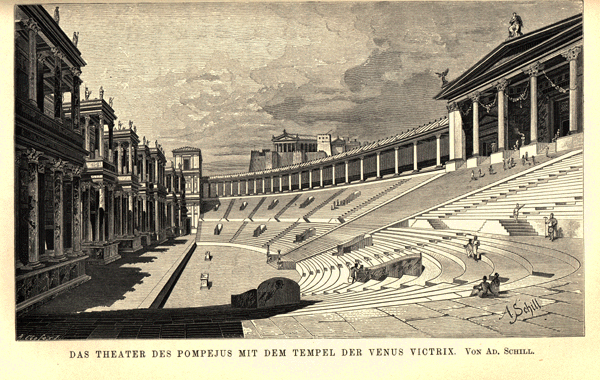
This had the additional, appealing irony that, with the Senate House having been burned down after the murder of Tribune Publious Clodius Pulcher, the Senate was now meeting in the Pompey's Theatre (above, interior).
The building was a massive complex (above), a multi-use facility, like a sports complex in 21st century America, and had been funded by the late Pompey the Great. Besides a magnificent stage for public performances, it also had, behind the stage, a large walled enclosure containing several meeting halls and markets, and beyond that temples, connected by shaded walks and fountains. 
Contained along the surrounding walls were meeting rooms, ringed by a covered portico (above, left, dark green roof). In the largest if these rooms, just behind the stage (above, bottom left) was where the Senate had been meeting since the fire. On stage right of this room stood a statue of Pompey the Great. That room was called the Curia of Pompey.
Curia was an ancient term in ancient Rome, referring to a gathering of the tribes of Rome. The Curia of Pompey was thus the perfect place for the Senate to meet. The only drawback, to the Senate aristocrats, was that the room shared a common wall with what the theatre patrons at the time described as a “monumental public latrine”. And it was in this room next to a toilet, that the Senate would meet with Caesar for the last time.
- 30 -

Sunday, March 24, 2024

ET TU Part Eight Final cortinam


I find it very telling that on 13 March 44 B.C., just two days before the assassination of Julius Caesar, the driving force behind the plot, Gaius Cassius Longinus,  warned his fellow conspirators that, should Caesar uncover their plans, all of them would have to commit suicide. 
This was not the advice of a ideological leader. Rather, it indicates conspirators haunted with second thoughts. Simply put, there were too many who knew too much. Estimates of members in the plot range up to 40  And to galvanize the plotters and hold them to their purpose, Cassius (above) did not appeal to their patriotism, but to their sense of class. 
A serf suffers humiliation every day. It is the staff of their lives. But an aristocrat, faced with loss of privilege, often prefers death to humiliation. This was the warning Cassius delivered to his nervous conspirators; we succeed or we die. It never seems to have occurred to the privileged forty, that victory could also be fatal.
The object of Cassius' hatred, Giaus Julius Caesar, elected Roman dictator for life, intended on leaving Rome three days later.  But even Caesar, at 56, must have been daunted at the prospect of campaigning in the Parthian desert, which 12 years before had consumed his old patron Crassus. 
Every year for the last five years opposition by the Senate aristocrats, first in Italy, then Spain, Greece, Egypt, Anatola, North Africa, and Spain again had forced Caesar into a military campaign. 
On this day, the Ides of March, which had been,  until this very year, New Years Day, Caesar intended on staying close to home. The historian Plutarch says he was not feeling well, and everyone agrees his wife was having nightmares  Whichever the excuse he used to dissuade his followers, it seems clear he wanted a little down down time. Someone had to get him out of the house, someone close, someone the untrusting Caesar would trust.
The obvious choice was Marcus Junius Brutus (above), the son of Cesar's long time mistress, and so often forgiven by Caesar that it was rumored he must be Caesar's illegitimate son.  But Brutus had a new wife at home, Porcia Catonis. They had been married just the year before, in 45 B.C. Porcia was the daughter of the aristocratic Senator Cato, who hated Cesar so much that when cornered in North Africa in 46 B.C., he had chosen suicide. It must have been her, aided by Crassus, who had stiffened Brutus back, and drove him to murder.  
But even Brutus was not willing to lure Caesar to his death. So that job fell to his cousin, and one of Caesar's most trusted generals,  Decimus Junius Brutus Albinus (above).
On the morning of 15 March, 44 B.C., Decimus was welcomed into Caesar's home, and extended an invitation to a gladiatorial display in one of the larger halls at Pompey's theater.  It was a subject certain to pique Caesar's interests. Before crossing the Rubicon, Caesar had been checking up on one of his own gladiatorial schools. He agreed to accompany Decimus to the theatre, but he had no intention of attending the Senate, even though they were meeting in the Curia Pompey, part of the same complex.
As the pair entered the complex through a side entrance, crowds pushed toward Caesar, forcing petitions into his hands, comments on government policy and requests for assistance. 
One of the messages handed to Caesar was from his lieutenant, Mark Anthony, warning of rumors concerning the Senate meeting today. Like the others notes handed to Caesar this morning, it would not be opened until it was too late.
Was there a man in the street warning Caesar to “Beware the Ides of March”? Probably, given the depth of religion in Rome, there were people wandering the streets prophesying doom about every dawn, and in particular about the dawn of an abandoned New Years Day.  But Caesar had become Dictator by ignoring such ominous warnings. Today the soothsayer was right. The previous ten thousand mornings, and for the next ten thousand mornings, he would be wrong again.
Once inside the walls of Pompey's Theatre, Caesar and Decimus, made their way along the walks toward the meeting room to inspect the gladiators. But as they passed the Curia they were waylaid by Decimus' older brother, Brutus (above). He urged Caesar to stop in the Curia,  to allow the Senate to wish him gods' speed on his invasion of Parthia. Exasperated, Caesar acquiesced, and the three men crossed the portico and entered the temporary Senate Chambers.
As he sat down, Caesar could not have missed the electric tension in the room. But what did it mean? Many were avoiding eye contact with him.  But even those Senators who were not in on the plot must have recognized that something was different. And when Senator Lucius Tillus Cimber thrust forward a petition asking that Caesar allow his brother to return from exile (above), Caesar pushed it away, into the hands of an aide. Whereupon Tillus grabbed the hem of Caesar's toga, and pulled. Caesar pulled away, demanding, “Be careful, there is no need to use force!” 
As Caesar turned to a guard to seek assistance, Senator and Tribume Publius Servilius Casca Longus, slashed forward, stabbing Caesar in the neck, just missing his throat.
Caesar grabbed Casca's arm and stabbed him with a pen. Startled, Casca screamed, “Help, brother!” As he tried to stand, Caesar was stabbed again. He now realized the aristocrats had surrounded him, and they all had knives. He tried to run, but fell, and was brutally stabbed over and over as he lay on the floor. The autopsy would reveal 23 wounds. So many knives were slashing that Brutus was stabbed by one of his allies.
Rather than being proud of their act, the aristocrats fled the theater as quickly as they could, escaping to their homes beyond the city walls.  And the abandoned body of Julius Caesar lay a crumpled heap on the floor of the Curia Pompey, his robes soaking in his own blood, for three hours. Finally three slaves worked up the courage to gather his corpse, load it on to a litter and carry him home to his wife. Thousands stood in shock to see the body pass on the street, one arm hanging off the litter, uncovered , bouncing to the steps of the nervous slaves.
The site of Caesar's murder did not become a shrine. It became a public toilet. Pompey's theatre remained in use for almost 1,500 years. Eventually the large latrine which had shared a wall with Curia was enlarged, and engulfed the spot on the floor Caesar had bled out. Finally it was walled off and forgotten. And when the theatre, and the latrine, fell on hard times midway through the fifteen century A.D., the populace turned it into a quarry, scavenging building stones for their homes and shops. Even today, those who come to look upon the space where Giaus Julius Caesar died, will find only an arch, and an ancient concrete wall
Within two years most of the aristocratic assassins were dead. Cassius, Casca, Cimber, Brutus - all died by their own hands. A few of the forty were killed in battle, and a few even fought for their lives in the courts, and won. They were allowed to return to Rome and live in somewhat reduced privilege. 
Caesar's will left his fortune to his nephew Octavian (above), and eventually the boy overturned the rotten remains of the Republic and disposed of the tawdry trappings of its dead democracy, killed by the aristocrats. 
Octavian became Augustus, the first Roman Emperor. Retroactively, he made his uncle divine. The deceased Julius Caesar had become the thing the aristocrats said they feared the most, a god.
But the dream of a representatives government, giving the people a voice in their own governance, had been set back by 2,000 years not by Caesar, but by his murder.
- 30 -

Blog Archive