

I understand why Theodore Roosevelt (above) acted like a jackass on 3 September, 1902. He was in shock. He had received a head injury, and a bad leg wound and come within a hair's breath of being killed. So it was understandable if Roosevelt wanted to punch the man he assumed was responsible.
_LI.jpg)
Except time and distance should have allowed the President to see his mistake, and still he refused to reconsider. So events that afternoon seemed to confirm Republican boss Mark Hanna's assessment of “Teddy” as a “damn cowboy”. Hanna had never intended that Roosevelt should be President, and he would not have been except William McKinley, who was President, had refused to listen to a voice of caution.

See, McKinley (above), who just starting his second term, thought the people loved him, when in fact most of them were just being polite.
.jpg)
His secretary, George Cortelyou (above, right, behind McKinley),knew how many people the Republican's policies had driven to desperation, and had twice removed from the President's schedule the hand shaking receiving line at the Pan-American Exposition. But McKinley kept putting it back.
.jpg)
Thus, maybe only William McKinley was surprised when A poor, mad, unemployed Leon Czolgosz put two bullets point blank into McKinley’s self-satisfied and deluded brisket.
.jpg)
And then, rather than wait for a real surgeon to arrive, the President insisted on being operated on by local doctor, Matthew Mann, who was a gynecologist. When the real surgeon showed up he was at least smart enough to wash his hands of McKinley, who died of infection a week later, 14 September, 1901.

That left the new President (at 42, the youngest President in American history, and richest - worth $200 million-) facing a huge problem. Over May and June of 1902 more than 100,000 coal miners walked off the job, demanding management recognized their union, gave them an eight hour work day, and safer working conditions. The mine owners (the coal trust) would rather pay to have the strikers shot than pay them more to work.
.jpg)
While the "Anthracite Strike" caused some immediate economic “dislocation” (above), it would not create real hardship until winter, when the average American home, heated by coal fires, would be frozen solid. Teddy knew he was going to need the American people to believe he would deal with the strikers and the mine owners fairly and firmly. So in late August of 1902 he took a tour of New England, where the cold would hit the most people first, to lay the foundation for his bargaining position.

First stop was Hartford, Connecticut on 22 August, where Theodore became the first President to publicly ride in an automobile (it was electric!). Then he headed north through Rhode Island to Boston, and up to Maine, speaking several times a day before crowds of 100, 1,000, 5,000, even 10,000 people at a time. Then he swung south again, through central Massachusetts.
.jpg)
For a full week Teddy zig-zagged north and south across New England, weaving the pattern of his case for compromise. “The great corporations,” he said in his stump speech, “...are the creatures of the state, and the state not only has the right to control them, but it is in duty bound to control them....The immediate necessity in dealing with trusts is to place them under the real, not the nominal, control of some sovereign....in whose courts the sovereign’s orders may be enforced.”

And that was why, on the sunny pleasant Sunday morning, the third of September, 1902, President Theodore Roosevelt (he hated being called Teddy) riding in a magnificent black four seat horse drawn landau carriage, arrived in the small industrial town of Pittsfield, in the center of Berkshire County, in far western Massachusetts.
_LI.jpg)
Most of the town's 23,000 residents were on hand at nine that morning in the Commons Park to cheer short speeches by Roosevelt (above, left) and Massachusetts Governor Winthrop Crane (above), and Mayor Hezekiah Russel, a local industrialist. But sitting on the platform beside the mayor were the men who really ran Pittsfield, whose fiefdom actually spread across a huge chunk of New England, the owner and directors of Stanley Electrical Manufacturing Company.

Inside the brick walls of their plant 1,700 men and women toiled twelve hours a day, six days a week, building industrial transformers, which were used as far away as California, and as near as the Berkshire Street Railway Company - owned by most of the same men and the New York New Haven And Hartford Railroad. The corporation had been formed just the year before, with the merger of eight separate urban electric trolley lines, 150 miles of track, power lines, generators and transformers reaching across five states to form a single urban commuter network.
.jpg)
Stanley's workers paid a toll to the factory owners just to reach the factory where they labored without representation. Roosevelt could have ridden that on those rail the sixty miles all the way to Bridgeport, Connecticut, where he was to make his final speech that night to a crowded coliseum. Instead he went by carriage. That choice, while more familiar and a statement of independence, would threaten his life.

Just about ten that morning, after a short speech, the President, his secretary George Cortelyou (still on the job), and Governor Crane, pulled away from the Commons on South Street followed by three or four other carriages. There were even carriages in front of Roosevelt's landau, carrying reporters and staff. They were all heading for Lenox, six miles away, and a scheduled noon speech.
.jpg)
Controlling the four white horse team pulling the landau was the Governor's driver, David Pratt. Riding next to him on the left hand seat was a 6'4” 260 pound Scotsman, Secret Service Agent William “Big Bill” Craig (above). Two days earlier the blond haired, blue eyed Agent Craig had told a reporter for The Worcester Telegram, “Too much caution cannot be taken to keep the crowds back from the (horse) teams and the President.” 

It had been the intention of the directors of the Berkshire Railway and Stanley Electrical to travel along with the President on his journey to Lenox , but there was a delay while Conductor James Kelly did his best to herd his bosses to their seats on the trolley.
.jpg)
So the Presidential Carriage raced past the Country Club trolley (above) and it was not until fifteen minutes later that 32 year old motorman Euclid Madden pushed the control lever to drive the trolley down the rails running in the center of South Street. Almost immediately, the bosses began urging Madden to go faster, to catch up with the President's carriage.

A mile out of town, on South Street, (Above, now called the Pittsfield Road), the Presidential carriage climbed the gentle slope of Howards Hill....

...then down the other side. Crowds were thinner now, but there were still knots of people cheering and applauding as the Presidential party rode by. Then the road curved down and to the right, along the eastern slope of 1,200 foot high South Mountain, to the west of the highway. And the trolley rails slowly shifted from the center of the road toward the right, the better to handle the approaching turn.
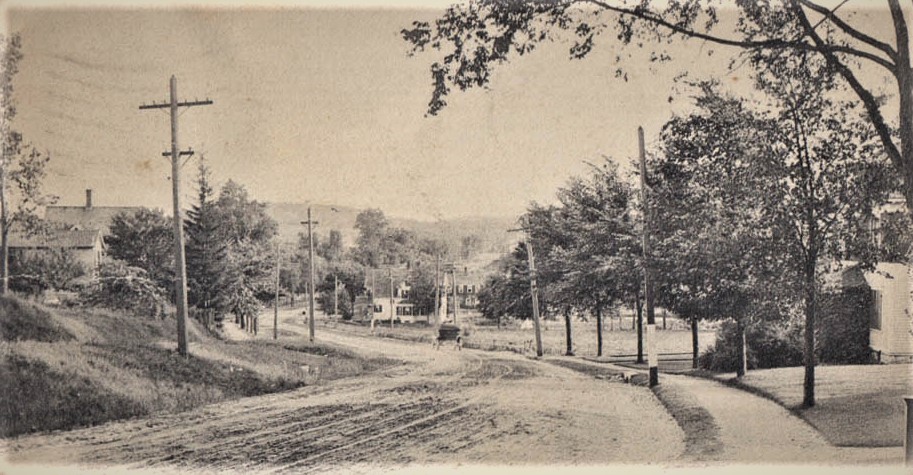
It must have been a relief to be out of the foul smelling industrial town, surrounded by farm land, and fresh air. The only sound would have the rhythmic plop-plop of the horses and the occasional greeting from the thinning throng. As Roosevelt's carriage neared the bottom of the grade (above), the turn tightened, to cross a dry bed of Wampenum Brook. And it was here the dusty Pittsfield Road crossed the trolley track (above, left to center).
.jpg)
_LI.jpg)
Approaching the procession of horse drawn wagons and carriages from the rear, the trolley driver, Euclid Madden did not see the President's carriage until he was just about 100 feet behind, when it suddenly turned to cross the tracks. As the first wheels of the Landau crossed the tracks Agent Craig stood up, shouting, "Look out! Hold fast!", as he tried to wave the trolley off, as if it could change course. Secretary Cortelyou also stood. Massachusetts Governor Crane also tried to urged the electric trolley to stop or swerve, neither of which it could do. It was just about 10:15 a.m.

As the carriage passed over the tracks the trolley car smashed into the left front at a 45 degree angle, shattering the wheel, and hurling the carriage into the air. Closest to the impact, Agent Craig (above) was thrown off his elevated seat, and fell directly under the wheels of the oncoming trolley. Sliding across the the Agent's shoulders and chest, the machine ground him up against the rail. He was killed instantly.
_LI.jpg)
Driver Pratt tumbled into the air, struck the rear of the a horse before landing on the roadway, dislocating his shoulder and bruising his face. The right wheel horse was crushed by the impact and began screaming agony, while the other three, freed from the restraint after Pratt was thrown off, panicked and dragged the wrecked carriage another 30 or 40 feet away from the point of impact

Governor Crane landed some 20 feet from the crash and was relatively uninjured . Secretary Cortelyou struck his head on a rock, opening a bleeding wound which left him barely conscious. President Roosevelt was tossed from the left side of the carriage, landing on his cheek, cutting his lip open, and cutting and bruising his left leg. The President assisted Cortelyou for a few moments. And then he lost his temper

According to eyewitness Frederick Clark, Roosevelt stormed toward Motorman Madden, who was by now standing in front of his trolley. They exchanged what was described as “heated words”. No punches were thrown, and a witness later testified that Madden remained respectful in the face of the infuriated amateur boxer President. Eventually, passengers and bystanders stepped between the two.

They put the injured horse out of its misery. They took the injured humans to a nearby home to tend to their wounds. And then, half an hour late, Roosevelt made it to tiny Lenox (above).
.jpg)
The Washington, D.C. Citizen newspaper reported, “In front of the Curtis Hotel a vast crowd had congregated, and when (Roosevelt) drove up there was the silence of death...Pale, covered with dust, his eye blackened from the bruise, his cheek swelling visibly (above)...“My friends,” he said, “there has been an accident. One of our party has been killed. He was William Craig of the United States Secret Service. I had come to have for this man a genuine admiration, not alone for his rugged honesty and for his loyalty to me, but for the devotion and the love which he showed for my children. I beg of you that there be no cheering and no demonstration of any kind. I thank you from the bottom of my heart for the greeting which you have given me.”
.jpg)
Roosevelt would say later, “If you’re set on risking your life, go to Pittsfield, Mass., and take a trolley ride.”

The national newspapers were calling for Madden and Kelly's heads. On 15 October they were both charged with “unlawful acts” leading to Agent Craig's death. However they were released on bail just two weeks later. It seemed the directors of Berkshire had come to realize the defendant's testimony about hectoring executives and demands for more speed could be damaging to their image, and the company had finally posted the $7,500 bond

Then, according to the National Railway Historical Society newsletter, when, in January of 1903, both defendant's pleaded guilty to manslaughter. Berkshire paid their fines, and continued Madden's salary during his six month sentence (Kelly's sentence was suspended). Immediately upon his release, the father of five was reinstated to his old position. The Rochester Democrat commented, “This seems to be a light punishment for so grave an offense, assuming that Madden was guilty at all.”

William “Big Bill” Craig was the first Secret Service Agent to die while protecting the President, and was buried (above) in Chicago's Oak Woods Cemetery.
.jpg)
Theodore Roosevelt's negotiations to end the coal strike had to done from a wheel chair as bacteria had invaded his inured bone, causing the leg to swell and abscess to form. Still, on 23 October, the strike ended, saving the winter for most families.

A new six man arbitration board allowed the owners to pretend they were not talking with the union, but the ten hour work day became nine, and it seemed progress was possible, maybe even inevitable. The mine owners prediction of doom should the miners win did not come to pass. But for the rest of his life, Theodore Roosevelt suffered from flareups of osteomyelitis, the infection in his leg.
.jpg)
A year after the accident, Stanley Electrical (above) was bought by Westinghouse, which actively discouraged any other companies from settling in Pittsfield. This meant that when the multinational moved most production over seas in the late 20th century, and closed the Pittsfield plant, the community was staggered. Unemployment drove most of the population away. Poverty and drug addition destroyed much of what was left. And the only industry thriving in Pittsfield, today is the environmental cleanup of dioxins used in building the transformers. However, building on the yearly Tanglewood Music Festival, the community has transitioned to a tourist based economy.

Look, I understand why Theodore Roosevelt acted like a jackass that Sunday Afternoon. He needed the emotional release. But there was no real justice in Pittsfield, before or after the accident. There was only life – messy, unresolved and unsatisfying. I think, this that best you can hope for in this world - just small steps of progress, like never mixing horses and mechanical transportation ever again. That is progress.

- 30 -


