August 2025

August  2025
I DON'T NEED A RIDE. I NEED AMMUNITION.

Translate

Showing posts with label Elba. Show all posts

Tuesday, March 01, 2022

COMET - Chapter Four - Denial and Anger


I hope the grieving families of the 15 dead recovered from the ocean found some comfort in knowing that while awaiting burial their loved ones rested in peace in the dark little chapel of the fortress Chiesa di San Giacomo Maggiore, treated with reverence and honor. Except, for the sake of the living,  they were not left at peace. Each evening a handful of bodies were removed and carried to the hospital in Portoferrai on Elba's north shore.
Awaiting them there, scalpel in hand, was Antonio Fornari, the Professor of Pathology at Pisa University. It was Professor Fornari's job to learn from the dead, to discover what exactly had killed those privileged enough to have flown on the wonder of the modern world, the de Havilland Comet.
What Professor Fornari learned from the autopsies was that none of the bodies recovered from the sea had drown. None had either water nor smoke in their lungs. None had suffered shrapnel wounds. All 15 had ruptured lungs. Most also had suffered skull fractures, concurrent with their deaths. Professor Fornari was certain the combination of these two injuries were the primary cause of death in all cases. And he suspected the cause was an explosive decompression. But aviation medicine was beyond his training.
However, he did observe that all the victims had also suffered broken arms and legs. One body even had a leg entirely ripped off. But those injuries had been suffered postmortem. More, all of the victims had their clothing disturbed. Many were almost naked. One had only lost a shoe. And although none showed any signs of having been exposed to a fire, most bore marks similar to scalding on their backs. Three also had scalding marks on their face. One corpse had scalding marks on their chest and abdomen as well. In the end the Professor was unclear what this all meant.  
But after each autopsy, the body was made as presentable as possible and placed in a coffin before being returned to the chapel, for eventual delivery by British Overseas Airways Corporation and then to their families.
The next question was how to get the 70 to 80% of the Comet Yoke Peter, presently sitting on a barge in Porto Azzurro back to the Royal Aircraft Establishment at Farborough - about 40 miles west southwest of London. By ship it might take months. 
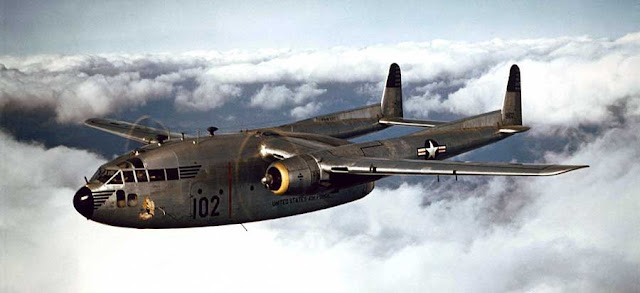
However there was one aircraft in 1954 which was capable of carrying the wreckage from Italy directly to England; the American built Fairchild C-119 (above),  popularly known as the “Flying Box Car”.  It's distinctive twin boom tail allowed easy loading and off loading from its 10 foot by 8 foot cargo hold. And it could carry a ton and a half of weight. The United States Air Force readily agreed to provide a “Box Car” for the transport flights back to England.
In the meantime, Arnold Hall, Director of the Royal Aircraft Establishment, wanted to confirm Professor Fornari's suspicion about the rapid decompression. A model of the Comet's fuselage was constructed at Farnborough. Dummies sat in for the passengers. 
Then, as film camera's rolled, the fuselage was pumped full of air until the container burst. In the explosive decompression the dummies were thrown forward into the back of the seat in front of them, or slammed into the ceiling. This confirmed Professor Fornari 's findings.  First the lungs had ruptured, and then the physical injuries had occured.
As the bits and pieces of Yoke Peter arrived in Farnborough (above), some new discoveries were made. 
Shreds of the cabin carpet were found tangled in the interior of Yoke Peter's tail (above).  A rear fuselage panel bore the distinct imprint of a coin from some passenger's pocket. And paint smears on the rear fuselage had been left by the passenger seats. These were all more evidence of an explosive decompression. But what had caused that? A bomb? Or had one of the Ghost engines exploded, ripping apart the pressurized cabin? 
Clearly the fuselage had come apart in mid-air, but where had the destruction begun? Workers at Farnborough began to reassembled the skin of Yoke Peter on a wire frame. It was a technique which would be used on many future aircraft losses.
Those most closely associated with the Comet were stunned by the accidents, and the groundings – or at least they later claimed to be. With their future careers clearly tied to the success of the Comet, BOAC Captain, R. Clifford “Cliff” Alabaster would later admit, “Initially, we didn’t think it could be mechanical breakup. We had every confidence in the airplane.” And Captain Ernest “Rod” Rodley agreed. “It was a perfect airplane as far as we were concerned. We were absolutely puzzled by the problems.” And a generation of pilots matured in the shadow of RAF Bomber Command, who endured a 46% death rate from 1939 through 1945, would reflexively follow orders even when common sense said to do so was suicide.
The Ministry of Transport and Civil Aviation, Mr A. T. Lennox-Boyd (above, left), had so far resisted pulling the Comet's Air worthiness certificate, in part because de Havilland and BOAC as well as Air France and the South African Air Service ordered all Comets returned to London without passengers, and at reduced speeds and altitudes.  But Lennox-Boyd did seek the opinion of the Air Registration Board. This group had been formed in 1937, and was made up of 4 representatives of the airlines 4 representatives of insurance firms, one professional pilot and a representative of the general public, the last two appointed by the Secretary of State. 
The pilot on the board was Peter Duffrey (above),  and as he recalled, “We had a series of meetings at Heathrow. They were quite sure they'd covered what was going on.”
The board considered the possibility of sabotage, and recommended increasing security around the jets. In case one of the Ghost engine's turbines had exploded, they proposed putting a sheet of steel between it and the pressurized cabin. They recommended installing weather radar in future Comets, so thunderstorms could be avoided. 
They recommended modifications to the wings, to increase lift at low speeds. They even considered the possibility of a failure of the pressurized cabin, but the extensive mathematical calculations by the de Havilland engineers, and the generous margins for safety used, convinced the board to reject this as a possibility. In all, 60 modifications were recommended.
The financial pressures after 10 weeks of grounding were tremendous. Both de Havilland and BOAC were hemorrhaging money. Salaries of pilots, mechanics, ground crews and support staff continued, while payments on loans taken out to build the Comet continued to pile up.  And British technical capabilities were now being openly questioned around the world. Because of the bad publicity, future sales were slipping away. 
As the editor of one British aviation magazine showed, it was a situation ripe for justification. “The positive cause of the accident may never be found," the author reasoned, "though every effort will be made to do so. The results of the public inquiry will undoubtedly be interesting, but they are not likely to be conclusive...To this extent one agrees with the more vigorous shouts from the Press. Now that we have done everything that the technicians consider necessary to forestall trouble in the future – Let us get the Comet flying again!”
Pilot Peter Duffrey (above) explained, “I voted against, because I felt the modifications had not adequately discovered the reason for the explosion.”  It did not matter. By a single vote the board recommend to release the Comets. 
So, on 5 March, 1954 - 54 days after the sudden and violent deaths of the passengers and crew of Yoke Peter - Air Chief Marshal Sir Frederick Bowhill (above), writing as if the board vote had been unanimous, told his Minster that while, “.... no cause has yet been found that would satisfactorily account for the Elba disaster...everything humanly possible has been done to ensure that the desired standard of safety shall be maintained. This being so. the Board....recommends that Comet aircraft should return to normal operational use...”  And so did he.
All recommended modifications were made as quickly as possible. Perhaps too quickly. And three weeks later, on 23 March 1954, the first Comet, with a full load of enthusiastic paying passengers, lifted off from London.  Sir Miles Thomas, Chairman of the British Overseas Airways Corporation, explained, "We obviously wouldn't be flying the Comet with passengers if we weren't satisfied conditions were suitable." 
And two weeks later, on Thursday, 8 April, 1954, Comet Yoke Yoke, carrying 14 passengers and 7 crew members, disappeared 25 minutes after taking off from Rome.  Decades later, Peter Duffrey would admit, “I still do not forgive those who restarted the services...”  The board members had been gambling with the lives of the crew and passengers. And as Duffrey noted, "I was one of the chits" they were gambling with.
- 30 -

Monday, February 28, 2022

COMET - Chapter Three - Spirits Of The Dead


I ask you to witness the sad little fleet dock in the port of Azzuro (above), on Elba's eastern shore. It is some 7 hours since Yoke Peter fell into the cold Tyrryenian Sea - 10 January, 1954. From the trawler Francesco Guiseppe they carry the pale corpse of a 10 or 11 year old boy, strapped atop a wooden plank and covered by a fresh white sheet. The somber fishermen then carry off the body of a 29 year old stewardess, Jean Evelyn Clark.
She is followed by a procession of 12 more shroud draped bodies up the dirt road and into the stone fortress of Chiesa di San Giacomo Maggiore (above). 
In the fort's small, austere, baroque chapel the burdens are laid before the altar. 
Candles are lighted and prayers are intoned. And if the spirits of the dead should have awakened, they must have been surprised to find themselves in such a dark sanctuary, such a long way from the cold thin air so close to heaven.
 Because de Havilland had built Britain's second jet fighter, the single engine Vampire (which went into service in April of 1945), they believed they were uniquely qualified to build the Trans-Atlantic passenger jets envisioned by the Brabazon Committee. However these would require a range of over 3,000 miles. But the second generation Ghost engines burned 3 – 4 times more fuel at 10,000 feet than conventional internal combustion engines, putting New York well beyond their range. So the cautious de Havilland company decided to approach trans-Atlantic flights in stages.
The Comet 1 would establish profitable routes tying the the British empire together, with flights between London and Singapore or South Africa. 
These largely overland routes would allow refueling stops every thousand miles or so, over well established flight paths, using already established ground facilities. Once the Comet was proven and the three times more powerful Rolls-Royce Avon engines had completed their testing, de Havilland would build the larger transcontinental Comet 2, and then the even larger Comet 3. So from the beginning the Comet 1 and it's Ghost engines were envisioned as test beds.
Throughout 1947 and 1948 de Havilland subjected the Comet fuselage and its over-sized square windows (above)  to twice anticipated pressures, through 16,000 cycles from sea level to 36,000 feet and back, simulating over 40,000 service hours. 
Since each rivet holding the Comet's aluminum skin required a hole be punched, the decision was to use the adhesive “Redux”, proven in combat on the plywood fighter/bomber, the Mosquito. It would be used on the Comet primarily “...to affix stiffening...to wing and fuselage panels, the resulting panel being both stronger and lighter than a riveted structure.” After all this was tested and proven, the design was finalized and built.
Not until after three years of testing did the Comet fly. The test pilot John Cunningham described this marvel of modern technology as “Very promising. Very quick.” British Overseas Aircraft Company bought 8 Comet 1's. 
Air France  (above) bought a pair,  South African Airways bought another two, as did Canadian Pacific Airways.  And the American giant, Pan American World Airways, signed up to buy three of the Comet 3s, with an option to buy 7 more the following year. With each Comet sold abroad representing over half a million pounds in badly needed foreign currency, and with “eight BOAC Comets leaving London each week: three to Johannesburg, two to Tokyo, two to Singapore and one to Colombo”, by the summer of 1953 it seemed the Comet was indeed a revolution in passenger travel.
However there were some annoying problems. The vacuum tubes in the navigation system tended to overheat. The cockpit's windows would occasionally fog over. And the seals on the hydraulic control system, which powered the flaps and tail rudder, were faulty on the first four Comets. Crews solved this problem by carry extra cans of fluid, and would top off the system whenever they spotted fluid on the tarmac.
And then there those under powered Ghost engines. In late October 1952 a BOAC Comet taking off from Rome, Yoke Zebra, failed to reach V-2, the speed at which pilots would lift the nose to become airborne. Unable to lift up or stop, Yoke Zebra overran the runway and broke the landing gear (above).  Pilot Peter Duffrey, who had flown the Comet into Rome,  found Yoke Zebra, “... just sitting there hissing – it (had) ripped the belly tank out and there was fuel everywhere.” Luckily there was no fire and no loss of life.  
But Duffrey diagnosed the problem immediately. The pilot had raised the nose too high, and stalled the aircraft. But the pilot was not helped by the hydraulic system. Duffrey noted, “...the lack of feedback on the controls...allowed you to pull-back as much as you wanted.” That made it easy to stall the aircraft.
That mistake was repeated on 3 March 1953 during the delivery flight of a Canadian Pacific Comet, this time just after lifting off from Calcutta. This time all six crew members and the six passengers on board were killed. A week later a Comet test flight out of Karachi, Pakistan, stalled after lift off and slammed into a stone bridge, killing 11 technicians and crew. This crash cost de Havilland the second Comet the Canadians had ordered but now refused to accept. 
Then, in June, it happened again, this time in Dakar, Senegal. Said Duffrey, “As pilots we were becoming very concerned.” In response, new take-off instructions were issued to pilots, and in all future Comets modifications would be made to the wings, and all future Comets would be fitted with weather radars.
Then had come the Yoke Victor tragedy over Jagalgori, India (above). It had been blamed on the weather, but pilot error had not been ruled out. Nor had sabotage. There were a lot of people in Asia and Africa who had an grudge with the British Empire. And a lot of older pilots were suspicious about those new hydraulic controls. And now there was this new disaster over the Tyrryenian Sea. The negative publicity was certain to kill desperately needed sales. 
With 24 hours of prodding from Arnold Alexander Hall (above), Director of the Royal Aircraft Establishment, both de Havilland and BOAC agreed to temporarily ground all Comets. Hall then opened a comprehensive investigation, which began by looking for nefarious causes and actors.
Admiral Louis Francis Mountbatten (above), 1st Earl of Burma and Commander of the British Mediterranean Fleet, was ordered to recover as much of Yoke Peter as possible. 
However the Comet tragedy coincided with a series of devastating 7.0 and above earthquakes in Greece, which followed the ruinous Greek Civil War. Mountbatten was also the NATO commander in the Med and in that role, the fragile state of Greek politics and economics made relief efforts the priority. 
Although he had to continuously shift his resources, Mountbatten still managed to maintain at least one frigate with SONAR and at least one British minesweeper on station in a grid pattern search for debris of Yoke Peter, directing 5 local fishing trawlers dragging the bottom.
It was not easy. One engineer, viewing the search through a primitive video system, described the ocean bottom as looking “as though someone had upended a waste-paper basket”. Still, by 15 March – 65 days after the crash – the Royal Navy had recovered a large section of the front of the fuselage and part of the wings. Four days later they had recovered all 4 Ghost engines. If anyone had noticed the similarity in the way Yoke Peter had broken apart in January and the the pattern Yoke Victor had fallen from the sky 7 months earlier, they were not talking. Not yet.
- 30 -

Wednesday, May 05, 2021

COMET - Chapter Four - Denial and Anger


I hope the grieving families of the 15 dead recovered from the ocean found some comfort in knowing that while awaiting burial their loved ones rested in peace in the dark little chapel of the fortress Chiesa di San Giacomo Maggiore, treated with reverence and honor. Except they were not left at peace. They could not be for the sake of the living. Each evening a handful of bodies were removed and carried to the hospital in Portoferrai on Elba's north shore.
Awaiting them there, scalpel in hand, was Antonio Fornari, the Professor of Pathology at Pisa University. It was Professor Fornari's job to learn from the dead, to discover what exactly had killed those privileged enough to have flown on the wonder of the modern world, the de Havilland Comet.
What Professor Fornari learned from the autopsies was that none of the bodies recovered from the sea had drown. None had either water nor smoke in their lungs. None had suffered shrapnel wounds. All 15 had ruptured lungs. Most also had suffered skull fractures, concurrent with their deaths. Professor Fornari was certain the combination of these two injuries were the primary cause of death in all cases. And he suspected the cause was an explosive decompression. But aviation medicine was beyond his training.
However, he did observe that all the victims had also suffered broken arms and legs. One body even had a leg entirely ripped off. But those injuries had been suffered postmortem. More, all of the victims had their clothing disturbed. Many were almost naked. One had only lost a shoe. And although none showed any signs of having been exposed to a fire, most bore marks similar to scalding on their backs. Three also had scalding marks on their face. One corpse had scalding marks on their chest and abdomen as well. In the end the Professor was unclear what this all meant.  
But after each autopsy, the body was made as presentable as possible and placed in a coffin before being returned to the chapel, for eventual delivery by British Overseas Airways Corporation and then to their families.
The next question was how to get the 70 to 80% of the Comet Yoke Peter, presently sitting on a barge in Porto Azzurro back to the Royal Aircraft Establishment at Farborough - about 40 miles west southwest of London. By ship it might take months. 
However there was one aircraft in 1954 which was capable of carrying the wreckage from Italy directly to England; the American built Fairchild C-119 (above),  popularly known as the “Flying Box Car”.  It's distinctive twin boom tail allowed easy loading and off loading from its 10 foot by 8 foot cargo hold. And it could carry a ton and a half of weight. The United States Air Force readily agreed to provide a “Box Car” for the transport flights back to England.
In the meantime, Arnold Hall, Director of the Royal Aircraft Establishment, wanted to confirm Professor Fornari's suspicion about the rapid decompression. A model of the Comet's fuselage was constructed at Farnborough. Dummies sat in for the passengers. 
Then, as film camera's rolled, the fuselage was pumped full of air until the container burst. In the explosive decompression the dummies were thrown forward into the back of the seat in front of them, or slammed into the ceiling. This confirmed Professor Fornari 's findings.
As the bits and pieces of Yoke Peter arrived in Farnborough (above), some new discoveries were made. 
Shreds of the cabin carpet were found tangled in the interior of Yoke Peter's tail (above).  A rear fuselage panel bore the distinct imprint of a coin from some passenger's pocket. And paint smears on the rear fuselage had been left by the passenger seats. These were all more evidence of an explosive decompression. But what had caused it? A bomb? Or had one of the Ghost engines exploded, ripping apart the pressurized cabin? 
Clearly the fuselage had come apart in mid-air, but where had the destruction begun? Workers at Farnborough began to reassembled the skin of Yoke Peter on a wire frame. It was a technique which would be used on many future aircraft losses.
Those most closely associated with the Comet were stunned by the accidents, and the groundings – or at least they later claimed to be. With their future careers clearly tied to the success of the Comet, BOAC Captain, R. Clifford “Cliff” Alabaster would later admit, “Initially, we didn’t think it could be mechanical breakup. We had every confidence in the airplane.” And Captain Ernest “Rod” Rodley agreed. “It was a perfect airplane as far as we were concerned. We were absolutely puzzled by the problems.” And a generation of pilots matured in the shadow of RAF Bomber Command, who endured a 46% death rate from 1939 through 1945, would reflexively follow orders even when common sense said to do so was suicide.
The Ministry of Transport and Civil Aviation, Mr A. T. Lennox-Boyd (above, left), had so far resisted pulling the Comet's Air worthiness certificate, in part because de Havilland and BOAC as well as Air France and the South African Air Service ordered all Comets returned to London without passengers, and at reduced speeds and altitudes.  But Lennox-Boyd did seek the opinion of the Air Registration Board. This group had been formed in 1937, and was made up of 4 representatives of the airlines 4 representatives of insurance firms, one professional pilot and a representative of the general public, the last two appointed by the Secretary of State. 
The pilot on the board was Peter Duffrey (above),  and as he recalled, “We had a series of meetings at Heathrow. They were quite sure they'd covered what was going on.”
The board considered the possibility of sabotage, and recommended increasing security around the jets. In case one of the Ghost engine's turbines had exploded, they proposed putting a sheet of steel between it and the pressurized cabin. They recommended installing weather radar in future Comets, so thunderstorms could be avoided. 
They recommended modifications to the wings, to increase lift at low speeds. They even considered the possibility of a failure of the pressurized cabin, but the extensive mathematical calculations by the de Havilland engineers, and the generous margins for safety used, convinced the board to reject this as a possibility. In all, 60 modifications were recommended.
The financial pressures after 10 weeks were tremendous. Both de Havilland and BOAC were hemorrhaging money. Salaries of pilots, mechanics, ground crews and support staff continued, while payments on loans taken out to build the Comet continued to pile up.  And British technical capabilities were now being openly questioned around the world. Because of the bad publicity, future sales were slipping away. 
As the editor of one British aviation magazine showed, it was a situation ripe for justification. “The positive cause of the accident may never be found," the author reasoned, "though every effort will be made to do so. The results of the public inquiry will undoubtedly be interesting, but they are not likely to be conclusive...To this extent one agrees with the more vigorous shouts from the Press. Now that we have done everything that the technicians consider necessary to forestall trouble in the future – Let us get the Comet flying again!”
Pilot Peter Duffrey (above) explained, “I voted against, because I felt the modifications had not adequately discovered the reason for the explosion.”  It did not matter. By a single vote the board recommend to release the Comets. 
So, on 5 March, 1954 - 54 days after the sudden and violent deaths of the passengers and crew of Yoke Peter - Air Chief Marshal Sir Frederick Bowhill (above), writing as if the board vote had been unanimous, told his Minster that while, “.... no cause has yet been found that would satisfactorily account for the Elba disaster...everything humanly possible has been done to ensure that the desired standard of safety shall be maintained. This being so. the Board....recommends that Comet aircraft should return to normal operational use...”  And so did he.
All recommended modifications were made as quickly as possible. Perhaps too quickly. And three weeks later, on 23 March 1954, the first Comet, with a full load of enthusiastic paying passengers, lifted off from London.  Sir Miles Thomas, Chairman of the British Overseas Airways Corporation, explained, "We obviously wouldn't be flying the Comet with passengers if we weren't satisfied conditions were suitable." 
And two weeks later, on Thursday, 8 April, 1954, Comet Yoke Yoke, carrying 14 passengers and 7 crew members, disappeared 25 minutes after taking off from Rome.  Decades later, Peter Duffrey would admit, “I still do not forgive those who restarted the services...”  The board members had been gambling with the lives of the crew and passengers. And as Duffrey noted, "I was one of the chits" they were gambling with.
- 30 -

Blog Archive