August 2025

August  2025
I DON'T NEED A RIDE. I NEED AMMUNITION.

Translate

Wednesday, September 09, 2020

Normalization and Climate Change


I can't make up my mind about climate change. Will we adjust our behavior in time, or does the human species lack the intelligence to survive? I hope the answer is yes and no, I worry the answer is no and yes. It seems to come down to how you define “intelligence”, by the smartest of us or the most obstinate and greedy? There are over 7 billion human brains working at this moment, and too many it seems are convinced meteorologists can't accurately predict if it will rain tomorrow, so of course scientists can't predict the average temperature a hundred years from now. But the first is almost impossible to predict, while the second is just extremely difficult.
The National Aeronautics and Space Administration says “The difference between weather and climate is a measure of time”, while the Climate Impacts Group offers a more pragmatic definition; "You pick your vacation destination based on the climate but you pack your suitcase based on the weather." And it all started with a Swedish triple threat – he was an arrogant, racist atheist. But he was a very smart chemist. In fact Svante Arrhenius was so far ahead of his instructors that they gave his PhD dissertation a “C”, and in 1903 that same work won him the Noble Prize in Chemistry.
Growing up with those long cold Swedish winter nights made the racist Svante (above) curious as to why we weren't still having ice ages.  Being a chemist he naturally thought chemistry might provide the answer.  His knew that the sun heated the ground during the day, and  at night reflected most of that energy back into the air as infrared radiation, otherwise known as heat.  He suspected that the more carbon dioxide and water vapor there was in the air, the less of that reflected infrared radiation could escape into space. What he came up with in 1896 was his greenhouse law; “If the quantity of (carbon dioxide) increases in geometric progression, the augmentation of the temperature will increase nearly in arithmetic progression.”   He ran the numbers, and found, as he wrote a decade later, “...any doubling of the percentage of carbon dioxide in the air would raise the temperature of the earth's surface by 4 degrees Celsius; and if the carbon dioxide were increased fourfold, the temperature would rise by 8 degrees C.”   Svante had predicted global warming and climate change, four years before the 20th century had begun.
Poor old Svante. He had to do his calculations the old fashioned way – using unpaid graduate students who labored for hours with pencils and papers and slide rules.  And he made a couple of bad assumptions. He figured clouds were pretty much a wash, since they both reflected sunlight from their tops, and trapped heat under their shadows.  He was right about that, but he missed how sensitive the climate was to carbon dioxide by half.   In other words he saw that burning coal and oil and wood released carbon into the air, but he didn't realize how really bad that was.  In fact, being Swedish, he was looking forward to more beach weather.
It was the geologists who provided what I think is the most convincing piece of the puzzle, they just did not know it for a long time. You see, they were looking for gold and diamonds and copper and coal and oil and even water, which they did by first drilling a lot of holes all over the place. Now, each hole was an experiment, and these rock farmers recorded everything about the holes as they drilled them, including the temperature at various depths. Most of those numbers were kept secret by the companies that collected them. But eventually the more social geologists were able to collect a record of what they called the geothermal gradient world wide. They found that as a general rule at anything less than 200 feet the temperature was about 11 degrees Celsius – or 55 degrees Fahrenheit.  Below that you have to figure in ground water, rock type, how close you are to a volcano - but as a general rule the temperature goes up about 1 degree Celsius for every additional 1,000 feet down the hole you go.  And it wasn't until much later that other graduate students noticed that as a general rule, up close the general rules did not add up.
Plotting out the temperatures in great detail and very exactly, and allowing for volcanoes and such, still produced a steady rising temperature curve as you went down.  But on the other end, at the top of the holes, things were a little odd.  The line there seemed to be steeper than it ought to - not enough that it kept the rock hounds up at night, but it did nag at them.  And then somebody compared the carbon 14 dating of the rocks through which these holes had been bored, at the top.  And suddenly the ages and the temperatures of the upper rocks of the holes started to make sense. The closer you got to the surface, and the younger the rocks got, the higher the temperatures were above that general rule, beginning about 500 years ago, about the start of the industrial revolution, when a growing number of smoke stacks started spewing out all that carbon that Svante had measured.  And in 1998, a century after the chemist Svante started all of this,  three geologists , Henry Pollock, Shapeeng Huang and Po-Yu Shen provided geological confirmation of global warming. “The subsurface temperatures ...indicate that Earth's mean surface temperature has increased by about 1.0° (C) over the past five centuries.”
So two independent fields of science, chemistry and geology, had each independently produced a picture of a warming planet for the previous 500 years, and predicted it would continue to warm. Together they produced a coherent, unified story with an explanation. Glaciologist, the only scientists whose field of study melts if they don't work fast enough, had independently stumbled on a third proof. Snow falling on glaciers today has more carbon in it than water melted out glacier ice formed five hundred years ago, and far more than the snow that fell a thousand years ago. And the amount of carbon in the snow is increasing. And it wasn't until very recently that meteorologists got into this discussion, which was to be expected, since, their field of study is what every other scientist calls “background noise”.
Let me give you an example of that noise; from December 1st , 1801 to January 31st , 1802, only about an inch of snow fell in Albany, New York, a spot which on average gets closer to 32 inches during those two months. The temperature ranged between 4 and 10 degrees Celsius (40 and 50 degrees Fahrenheit), when it is normally around minus 3 Celsius (mid 20's Fahrenheit ). Along the Ohio River, in eastern Ohio, 3 inches of snow fell on November first in 1801, but after that they suffered not even another hard frosts for the rest of the entire winter. In January of 1802 tulips and violets bloomed in New Haven, Connecticut, and on the 28th of that month Salem, Massachusetts saw the thermometer hit 15.5 degrees Celsius (60 Fahrenheit). No less a numbers freak than Thomas Jefferson became convinced that “The change which has taken place in our climate is one of those facts which all men...are sensible of...”  And this was before the industrial revolution!
Less than 20 years later came the other extreme, the summer of 1816. On June 6th, snow fell in Albany, New York. Ice was observed on rivers and lakes in July and August as far south as Pennsylvania. Farmers in Massachusetts got a crop in that summer, but so little that oats were selling for 10 times what they had sold for the previous year. World wide probably 40,000 people died of starvation. It was referred to as “Eighteen Hundred and Froze to Death”, or “The Year Without a Summer”, and it was probably caused by the April 10th , 1815 eruption of Mount Tambora in Indonesia, the largest volcanic eruption in the last ten thousand years. To my mind, that is the real difference between weather and climate – weather is a record of extremes, and climate is a record of the average between them.
Yes, the 700 volcanoes that erupt every year throw about half a million tons of carbon dioxide and sulfur dioxide into the atmosphere, and a super volcano like Tambora may double that amount once or twice a century. But ever day today, humans spew 88 million tons of carbon into the atmosphere. Can there really be any doubt about why old extremes are becoming our new normal, or what is responsible for it?
Every scientific method we use to look at the past 500 years, every experiment we come up with to test what has happened over the last five centuries, tells us that the new normal is climate change, and that our industrial revolution is the one new factor over the last five hundred years that is driving our new normal to new climate extremes.  From this point forward there really is only one question more we have to ask. Does the human species lack the intelligence to survive? And the answer is up to all those idiots who voted for Donald Trump.
- 30 -

Tuesday, September 08, 2020

SOMEBODY SHOOT THAT SON-OF-A-BITCH - Murder of Huey Long

I find it meaningful that Huey Pierce Long was murdered on the ground level 2nd floor of the building he inspired. At 34 stories, the $5 million ($81 million today) limestone clad skyscraper remains, almost a century after its Depression Era construction, the tallest state capital building (above) in the nation.  Along with this singular monument, “The King Fish” also built highways, bridges, charity hospitals, schools, sewers, electrical power grids and housing for the poor. He provided free text books for every child in the state, and dragged Louisiana into the twentieth century -  all in the face of fierce corporate opposition and propaganda.  And if the state's metamorphoses was ruthless and ugly, then Huey's critics must bare part of the blame, because their crimes fueled his. One critic publicly complained, “Good God, I wish somebody would shoot that son-of-a-bitch.”
Standard Oil funded the impeachment of Governor Long back in 1929, after he slapped a five cent a barrel tax on oil profits in Louisiana. The impeachment  failed, but Huey vowed to make his attackers pay, saying, “Now,...I dynamite 'em out of my path.” Even after he was elected to the U.S. Senate in 1933, he imposed himself on state politics with an unrelenting vindictiveness. Typical was his assault on the Pavy family.  Patriarch Benjamin Pavy (above)“a large jovial man with a gray mustache and a full main of silver hair”, had been a district judge in St. Landry Parish for 25 years, and had threatened to arrest Long's poll workers in the election that saw his brother, Dr. Felix Pavy, win the district's seat in the Louisiana House.
In retaliation the Kingfish (above) had Pavy's youngest brother, Paul, fired from his job as the principle of Opelousas High School, and then had Pavy's eldest daughter, Marie, removed from her job as a third grade teacher in Eunice. And when even that failed to convince Benjamin Pavy to fall into line, the first bill Huey shepherded through the special session of Lousiana House that September of 1935, “House Bill Number One”, was to redistrict Judge Pavy out of his judgeship. And to make his defeat certain, Huey even threatened to resurrect an old smear.
Back in 1910, the first time Benjamin Pavy had run for judge, his infamous opponent, the racist Sheriff Marion Swords,  had reminded voters that Pavy's father-in-law, Edward Veazie, had produced several children with a black mistress. Now, according the Huey's close aide Joe Fisher, “Huey had warned Pavy...for six months to lay off or he would say Pavy had “coffee blood”. Huey (above, right)  was like a rattlesnake" said Joe, "He always warned first.”
Since the introduction of black slavery in 17th century America, having a drop of "black blood" terrified most whites.  But “black families”, like Veazie's, were far more common in the “Jim Crow” south than anyone on either side of the racial divide would publicly admit. Pavy had lived half  his life under the threat of being made a social pariah. But just three months earlier his youngest daughter, Yvonne, had given birth to a son. And Pavy's new son-in-law, 29 year old Dr. Carl Weiss (above) -  “unassuming, successful...apolitical” -  was unprepared when this insidious racial smear threatened his innocent son. 
Just after nine that Sunday evening of 8 September, 1935, Huey Long left the House chamber, trailing a small retinue of supporters, reporters and his six state trooper bodyguards.
Huey had been receiving death threats since the impeachment trial, but lately the volume and tenor of the threats had ramped up.  In January some 200 armed “Square Dealers”, an anti-Long militia, had occupied the East Baton Rouge Courthouse. The Louisiana National Guard had been called out. There was an exchange of gunfire and tear gas at the airport. No one had been killed, but clearly tempers were rising.
Halfway down the ornate, ten foot wide hallway (above), Huey stepped into the reception area of Governor Alvin Olin "OK" King's office, (nicknamed “O.K.” because that was invariably his response to instructions from Huey). In twelve hours Senator Long wanted a meeting of “the boys” in O.K.'s office, and the governor's secretary assured him “Yes, they were all informed, and they’ll meet you at 9 o’clock.” Observed another of Huey's aides, the Governor “was in a very good humor that night.” He was, after all, about to decapitate an old enemy. Senator Long then resumed his lopping walk toward the state Senate Chamber further down the hall, where the King Fish intended on pushing his agenda, first thing in the morning. It was just 9:20 pm.
Abruptly, a small bespectacled man stepped out from behind a decorative pillar. Dr. Weiss held a Belgian automatic .32 caliber pistol in his hand, with six rounds in the magazine and one the chamber. At four feet from Senator Long, Weiss fired his first round. It struck Huey in the right side of his abdomen, just below his rib cage, ripping through his intestines, and exited through his back. Huey yelled, and jumped away from the gun. Weiss tried to shoot again, but the empty cartridge from his first shot had jammed in the ejector. A terrified Huey escaped down the hall, running past the entrance to the Senate chamber, and down the stairs.
Behind him, Officer Murphy Roden grabbed at the smoking pistol, and began to wrestle with Weiss. Both men fell, but Roden was up first, stepping back, drawing his own .38 caliber pistol, and firing ten shots into the prone doctor. At the same time three other officers emptied their .45 guns into the assassin.
 Less than ten seconds after firing his only shot at Huey Long, Dr. Carl Weiss was dead, his corpse perforated with some 62 bullets, including a single shot through the forehead and one through the right eye. Weiss probably felt only the first of them, and not even that one, not for very long.
Surprised at seeing Senator Huey Long, alone, staggering off the stairs onto the first floor, Public Service Commissioner James O'Connor rushed to his side. Huey blurted out, "Hell, man, take me to the hospital.” O'Connor led Long out to the rear of the building, where they flagged down a private car.  It sped them north, to “Our Lady of the Lake Sanitarium” (above), just a mile away. The hospital checked the Senator in at 9:30 pm 
Two of the best surgeons in the state were sent for. Speeding to Baton Rouge, they were forced to detour around work on one of Huey's new highways, and had an accident. They never made it to Baton Rouge.
About eleven that night, the still conscious King Fish agreed to undergo the surgery, preformed by Dr. Edgar Hull, a faculty member of the Medical Center of Louisiana at New Orleans. The operation successfully repaired most of the damage to Huey's intestine. 
But in this per-antibiotic age, bacteria from his gut had already infected his other organs. Huey never regained conciseness. He spent the last 29 hours of his life feverish, choking and coughing, until he died at 4:10 am., on Tuesday, 10 September, 1935. He was all of 42 years old. 
The day before Huey died, Dr. Carl Wiess had been buried in Baton Rouge's Roselawn Cemetery. Hundreds attended his funeral, including members and leaders of the “Square Dealers”.  Their numbers made his funeral “the largest ever held for an accused political assassin in the United States”.  Carl's wife and son, his father and mother, also attended. When two press photographers tried to take pictures of the family, they were assaulted, and their cameras were smashed. Carl's father-in-law, Judge Benjamin Pavy was “too sick” to attend.
They buried Huey Long in his tuxedo. As he lay in the rotunda of “his” building, 200,000 people filed past his coffin. Another 100,000 attended his funeral, on 12 September, 1935. 
He was buried in the gardens in front of his statehouse
Initially his grave was marked by a simple stone, but in 1940 the state erected a 35 foot tall memorial to Huey. 
Atop the stone stands an 8 foot bronze version of the King Fish, gazing upon his building. 
On the back is the inscription, “Here Lies Louisiana's Great Son Huey Pierce Long, An Unconquered Friend of the Poor Who Dreamed Of, The Day When the Wealth of the Land, Would Be Spread Among All the People.” 
Huey Long was far from perfect. But then, so were his enemies. And in that regard, at least, it was a fair fight.
- 30 -

Sunday, September 06, 2020

The Curse Of Being Bob


I am tempted  to label the late Robert Lincoln as a "shlimazel", but its a Yiddish term and not generally well known. Most people would probably call him a Jonah – but that would not be entirely accurate. See, according to chapter ten in the Qur'an, God gave Jonah a dangerous job, and to avoid the assignment he jumped ship for someplace else. God sent a terrible storm to swamp the ship, and when Jonah confessed his sin to the the terrified crew, after a few moments of theological discussion, they threw the wayward prophet overboard. That is when, in the words of the Christian hymn “...A whale came up and swallowed him whole.” During the three days Jonah was inside the great fish he prayed for forgiveness, and guided by God, the fish “threw Jonah out on a bar of sand.” Every year on Yom Kippur Jews read the Book of Jonah and ask for God's forgiveness. And now you know why Christians, Jews and Muslims have spent the last 2,000 years slaughtering each other; its because they share so many stories like this one, which differ only in tiny details. But as Hillary Clinton can tell you, it's the details that can cost you an election. But I digress...
Anyway, a Jonah is somebody you don't want on your boat, or babysitting your 401K. A Jonah is cursed, and he drags his curse around with him, rubbing it off on unsuspecting victims who are drowned because God is actually trying to punch the ticket of the guy in next stateroom. And a "shlimazel"  is just like a Jonah, except that God is not involved. Witch is why I think of the very late Robert Lincoln as a "shlimazel". Allow me to explain.
On the day President Abraham Lincoln died, his eldest son, the late Robert Todd Lincoln, (above), called Bob by his father,  had just gotten back from the Confederate surrender at Appomattox Court House. He was late, of course, and when his parents invited Bob to go to the theater with them, Bob begged off and stayed home. He went to bed early and had to be awakened when word arrived that his father had been shot. He made it to the bedside before his father died, but then Bob had to share his private grief with the grief of millions of strangers. And maybe that was what infected Bob, and turned him into a "shlimazel"..
As the son of Abraham, it was inevitable that Bob Lincoln would be drawn into Republican politics, but he resisted as long as he could - late again. He never stood for election, and when President Rutherford B. Hayes offered him the post of Assistant Secretary of State, Bob said “No, thanks”. But, finally in 1881, he accepted the position as Secretary of War under President James Garfield. That job lasted barely six months, because that was only as long as his new boss lasted.
Just after nine on Saturday morning, 2 July, 1881, at the very beginning of another disgusting hot, humid Washington three day holiday weekend, Bob Lincoln was pacing around the central waiting room of the Gothic eyesore that was the Potomac and Baltimore railroad station (above), at the corner of Constitution Avenue and 6th street. The late Bob Lincoln was early this morning, I guess because he himself wasn't going anywhere. He was there to log-in a little suck-up time with his boss, President  Garfield, who was about to leave on the 9:15 train for Baltimore, to begin a two week vacation. 
Yes, Garfield had only been on the job for about three months, and it seemed a little quick to be taking a vacation, but he was the boss and the rules are different for bosses. So here was poor Bob, wandering around this cavernous hothouse, pathetically hoping to make some headway against his biggest rival in the cabinet, the even bigger suck up, Secretary of State James Blaine, known about town as the “monumental liar from the state of Maine”. Blaine at this very moment was walking into the station arm and arm with President Garfield. And that was when Charles Guiteau fired off two rounds of a Bulldog .44 caliber pistol right into Garfield's back.
Bob was not a cop. He did not run to the sound of the gunfire. But when he heard people shouting that the President had been shot, Bob ran toward the Constitution Avenue entrance. Once again he was late. He found Garfield lying on the floor of the “Ladies Waiting Room”. Guiteau had already given himself up, eagerly confessing to everyone and anyone within earshot. Bob and Blaine and Garfield's two sons helped the President to his feet, and escorted him up stairs, away from the lookey-loos. Here he was examined, and since the wounds did not appear to be life threatening – because he was not already dead - it was decided the President should be taken back to the White House. Bob left him there, and returned to his own weekend.
It had all the makings of an obscure footnote in history, until the doctors showed up. There were sixteen of them, and several of them shoved their dirty fingers into the President's wounds, looking for the bullets. They did not find them, but within a few days Garfield found he had a raging infection. What finished the poor schmuck off, on 19 September, 1881, was a heart attack, which is what kills you after two months of fever and diarrhea. Bob Lincoln was not at the death bed. He had already done his part.
Bob left government service after that and went back into private industry, as a lobbyist for the railroads. And it was as President of the Pullman Palace Cars Association that he was invited to a Presidential reception at the Pan American Exposition in Buffalo, New York, on the afternoon of 6 September, 1901. Bob was late again, and as he was just running up the short steps of the Temple of Music Pavilion (above - X marks the spot), he heard two quick gun shots.
William McKinley, the third President of the United States to be assassinated, had just been assassinated. Bob raced into the exhibit, in time to see McKinley drop to the floor. He needed to rush, because thanks to the advances in medicine in the intervening quarter of a century since Garfield's murder, McKinley suffered for only eight days, before the doctors helped him to die on 14 September, 1901. Bob Lincoln slinked out of town, determined to avoid contributing to any further bloody historical events. It would be the last time an American President would be assassinated until 1963, and some have hinted that was because Bob Lincoln chose not to be near another President. When it was suggested Bob might wish to attend another Presidential speech, Bob responded, “No, I'm not going, and they'd better not ask me, because there is a certain fatality about presidential functions when I am present.” But it turned out Bob's affliction not only affected Presidents.
Six years later, on Tuesday. 9 August, 1910, Bob and his family boarded the SS Kaiser Wilhelm der Grosse, in Newark, New Jersey. They were looking forward to a few weeks holiday touring Europe when in the midst of the bon voyage celebrations an angry ex-city worker took a shot at brand new New York City Mayor, William Gaynor – shades of Garfield's shooting!  Gayner was hit in the throat, and in the famous photograph taken just seconds after the shots (above), the old man in the white hat rushing to assist Mayor Gaynor, is none other than the late Bob Lincoln - and thus we  have photographic proof that Bob was a "shlimazel"!  The doctors largely left Mayor Gaynor alone, and he died of his wounds, three years later.
The only other public occasion which involved a living President and Bob Lincoln was on Memorial Day, Tuesday, 30 May, 1922. Bob (above, on the right) was 78 years old by then, when he attended the dedication of his father's memorial in Washington, D.C.  In fact there were three Presidents present at that ceremony. The fat man, (above left) was Chief Justice William Howard Taft, who had been President in 1911 when he signed the bill authorizing the construction of the Lincoln monument. He survived his close encounter with Bob by another eight years. Vice President “Silent Cal” Coolidge was also there (not shown). He would become President, after the death of President William G. Harding (above center), who gave a rousing speech at the dedication. But Harding would not die until August of 1923, fifteen months and a day after rubbing shoulders with Bob – which seems like a rather extended time frame for an effective curse. And Coolidge would last another nine years before he died. The curse, it seemed, had been either broken or maybe it was just exhausted. Bob sure seems to have been. 
In fact, Bob Lincoln himself (above) would die sooner than any of his final potential victims. He suffered a fatal cerebral hemorrhage in the summer of 1926. When he died Bob was the last surviving member of the Garfield cabinet, having outlived his rival James Blaine, who did not even make it out of the nineteenth century (he had died, January 1893) . Bob Lincoln was also the only man in American history to have been present at the murder of two American Presidents, not to mention his relation to a third -  his own farther. Bob  was also the only child of Abraham Lincoln to reach adulthood, and to have children of his own.  But sadly his last heir - and thus Abraham Lincoln's last blood relative - died in 1985.  The line of Lincoln is no more. Bob could not be blamed for any of the unusual coincidences that marred his life, but neither could they be ignored. To call them bad luck seems a pathetic explanation. To call Bob a Jonah seems over-wrought.  I think he was just an innocent "shlimazel".  But I still wouldn't want to have lunch with him.
- 30 -

LABOR DAY CHAPTER FOUR

The engine's stealthy approach to Kennisinton station was unmasked with a deafening burst of steam. The startled crowd shouted obscenities. A fireman leapt from the engine and ran toward the black switching stand between the tracks. Individuals broke from the throng to stop him and he was forced to swing his switching rod to ward them off. Another handful of figures bolted for the engine and mail car.  The railroad agents aboard shouted a muddled threat. And as the host reached for a handhold, shots rang out. The fireman broke free and was pulled aboard as the black beast laboriously retreated whence it had come, leaving two dead and several wounded on the ground.

Also a victim of this brief confused shoot out at Kennisinton station was the American Railroad Union and it's president, Eugene V. Debs. And amazingly, yet another victim, shot in the foot actually, was the Democratic Party and its President of the United States, Stephen Grover Cleveland.

Just after dawn the day before, President Debs had been awakened by Federal Marshals, delivering the injunction issued by Judge Grosscup. The court order said while the owners of the railroad could act in unison, the workers must not. Reluctant to support the strike Debs and the other leaders of the A.R.U. had sent over 4,000 telegrams urging the 125,000 strikers on 29 separate railroads and across the nation, to remain peaceful. Now they were forbidden to speak at all. That afternoon, on 4 July, when the injunction was publicly read out by Federal Marshals, the crowds at the Grand Crossing were unimpressed.

Also on that Wednesday, 2,000 members of the U.S. 15th infantry regiment, with artillery and cavalry support, ...

...all under the command of the vain and ambitious Major General Nelson Appleton Miles. His soldiers first occupied the empty Pullman factory. 

 The soldiers had no training in policing, but that suited General Miles, who saw his mission as a war against unions in defense of western civilization. Miles broke his men into squads and paired them with equal sized posses of railroad agents wearing badges - men the U.S. Marshal for the northern district of Illinois, John W. Arnold, called “worse than useless”.

Just before 4:00pm, Thursday, 5 July, another of Mile's joint posses approached Kennistion station again, this time aboard a Burlington and Ohio train. 

As the engine, tender and mail car approached 47th street and Loomis, they encountered an even larger crowd, angered by the morning's deaths and intent on blocking the tracks with railroad cars, and even a locomotive purposely derailed. Rocks were thrown, immediately, and again the “authorities” joined the violence - the soldiers firing from 2 to 6 rounds apiece while the marshals emptied their revolvers into the the crowd. Six more were killed on the spot.

According the Chicago newspapers, among the 20 or so wounded were “Henry Williams, shot in the left arm, Tony Gajewski, shot in the right arm, John Kornderg, stabbed with a bayonet and not expected to live, an unidentified woman, shot in the right hip, an unidentified man, shot through the liver and not expected to live, and an unidentified 17 year old boy shot in the stomach and expected to die.

Now that blood had been drawn, on Friday, 6 July, General Miles reformed his men into battalions and dispatched one to the 375 acre Chicago Stock yards. Their presence allowed trains, and Pullman Cars to pass. As night approached, a frustrated mob of 6,000 vented their anger instead on the smaller less protected northern extension called the Panhandle Yards. It earned it's nickname because the Pittsburgh, Cincinnati, Chicago and St. Louis Railroad, which owned and operated the property, was based in the southern suburbs of Pittsburgh – in the northern panhandle of West Virginia. 

On this site hundreds of mostly empty cars were resting, guarded by just 12 policemen. The officers were shoved and bullied, but none were seriously injured, and no shots were fired. The rioters systematically set the entire rolling stock ablaze.

Two companies of the 15th Infantry charged into the crowd, firing volley after volley. Several blocks away, saloon owner John Kerr, was wounded while tending to his customers. That bullet had passed through four walls to strike him. Innocent spectator William Anslyn, was over a city block from the confrontation when he was shot in the back. Two days later he died. Another spectator, elderly Charles Klynenberg, was standing in front of his home at 4847 Loomis Street when a soldier charged up the street. He ran toward his front door but was stabbed him three times in the back. He died within minutes. A young woman, standing on her roof was shot and fell dead, into her brother's arms.

Validation for the worker's version of the Pullman shootings of 1894 could be found in the Presidential Commission on the 4 May, 1970 shootings at Kent State University. 

Under similar conditions, 28 members of the Ohio Nation Guard unleashed 67 rounds on about 2,000 protesters. Four were killed on the spot, another 9 were wounded. The closest wounded demonstrator to the soldiers was Joseph Lewis Jr. He was 71 feet away. 

The closest fatality was Jeffrey Miller, who was 265 feet away. The commission concluded, “...the indiscriminate firing of rifles into a crowd...were unnecessary, unwarranted, and inexcusable.” And the same could be said for the official murders committed in the name of protecting railroad property, and crushing workers seeking justice for the fellow workers.

That night, General Miles told the press, “...the injured men are alone to blame....The firing, from what information I have received, was strictly in accordance with orders from this office, was necessary for the public welfare and justified by the circumstances. I think now that the mob knows that the troops will fire without hesitation when ordered. The trouble is nearly over.” And it was, for the railroads.

Said Col Thomas A. Anderson, “The army is not an enemy of Labor nor a friend of Capital. It is simply an instrument of popular power.” But nobody believed that version of reality anymore.

A lot of railroad property was destroyed in those first days of July, but not all of the arson was committed by strikers. Some, perhaps even most of the fires were set by company thugs. And the most notorious fire of 6 July, the burning of the Columbia Exposition's "White City, made of plaster and wood..” was probably set by young boys playing with matches.

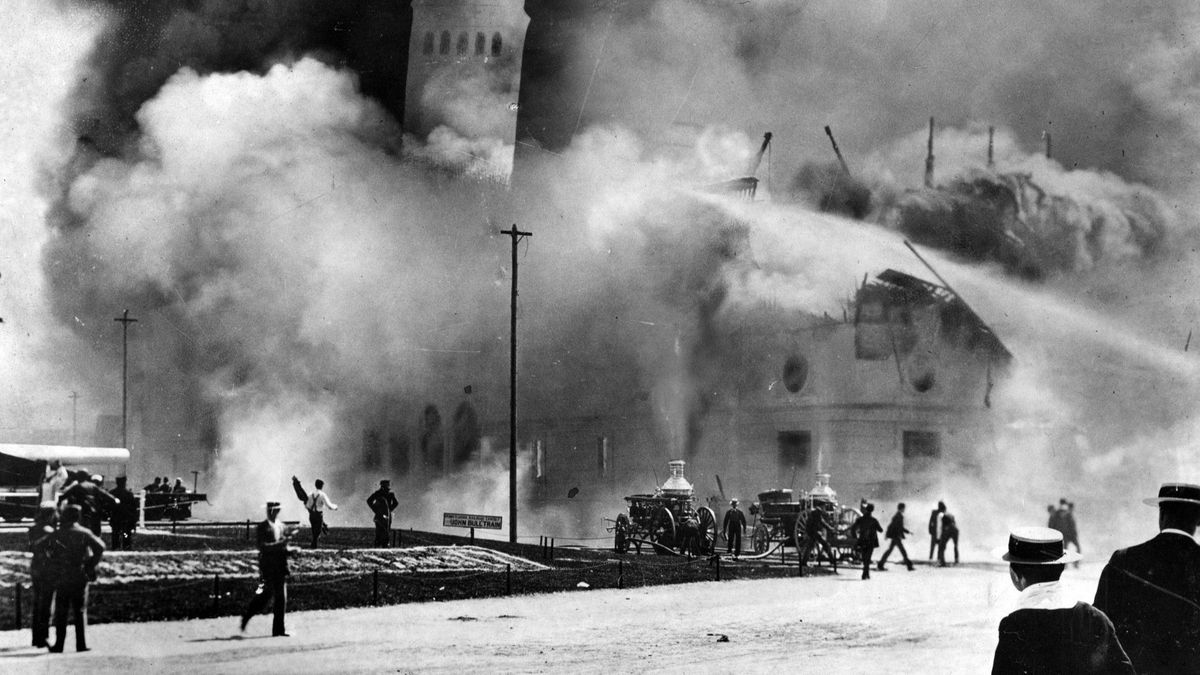
Almost from the day it opened, the fair grounds had suffered numerous fires, including one on 11, July 1893, in which 16 had died. Large sections burned again in January of 1894. Still, without any evidence, the press at the time, and most historians since, have blamed the strikers.

The quality of the deputized “Marshals” would be shown the very next day, Saturday, 7 July, when Deputy Marshal T.J. Ketcham accidentally shot and killed fellow deputy marshal Donald G. Goodwin while in the safety of their offices. But the truth did not matter much anymore.

The General Managers practice of attaching Pullman cars to even coal trains had brought rail traffic to a halt across much of the country. Factories were closing, because of disruptions to the supply chains, putting millions out of work. Seeing public support for the Pullman workers evaporate, Eugene Debs offered a sad compromise, asking only that his A.R.U. members rehired. Instead the G.M.A. hired scabs.

On that Saturday afternoon came yet another bloody confrontation at 49th and Loomis Streets. Hit with rocks the 2nd Regiment of the Illinois National Guard fired a hundred rounds into a mob and followed it up with another bayonet charge. When the mob finally dispersed, they left a hundred dead and wounded on the ground, with an unknown number of wounded carried off.

On Wednesday, 11 July, 1894, Debs and three other A.R. U. officials were jailed, charged with conspiring to “interfere with the transport of the mails, and violation of the Sherman Anti-Trust Act, which had been intended to be used against corporations, like the railroads. They were also charged with violating the injunction. The strike then quickly fell apart, and by the middle of August it was all over. The railroads lost over a million dollars in damages to equipment and another $80 million in lost revenue. But they smashed the A.R.U. and set worker's rights back for another half century. 

Although defended by Clarence Darrow, Debs was sentenced to 6 months in federal prison. He came out a proud socialist, calling not for strikes but revolution.
Grover Cleveland tried to sooth enraged workers with the creation of a worker's holiday, Labor Day. But the memories of murder and betrayal ensured that Cleveland would be last Democratic President until 1912, when Theodore Roosevelt's Bull Moose party split the Republicans and let Woodrow Wilson slip back into the White House. But after that brief aberration, it would take the Great Depression to break the Republican stranglehold on the Presidency,
The man who had started it all, George Pullman, died three years later, on 19 October, 1897. He was so fearful of workers seeking to insult his body it took two days to pour the 18 inches steel reinforced concrete which protected his coffin,

Working conditions on railroads after the strike would be shown by the fate of Howard F. Collins, the youngest son of Grand Crossing Superintendent Thomas Collins, who had tried to talk the switchmen out of striking on 25 June, 1894.  After graduating High School in May of 1896, 12 year old Howard went to work as a conductor.  Westinghouse had patented a pneumatic braking systems back in 1869, but like many railroads, the Illinois Central refused to pay the royalties. So, like all conductors, young Howard was required to clamber from car to car, turn the brake wheel on each car in turn.
But on the Saturday night of 12 September, Howard was applying brakes for a train approaching the Grand Crossing, when,  near 76th Street,  he slipped and fell between the cars. The boy was dragged 36 feet.  His right arm and collar bone were broken, his was spine severed. He died three days later, on 15 September. In gratitude for his father's sacrifice the Illinois Central carried the boy's broken body back to the family plot, in Ontario, Canada. And the Illinois Central did not fully use Westinghouse brakes until the 20th Century.

- 30 -


Blog Archive