August 2025

August  2025
I DON'T NEED A RIDE. I NEED AMMUNITION.

Translate

Wednesday, April 30, 2025

CAPITAL LOSSES


I can't think of a more unlikely sequence of events. First,  there were the astronomical odds against the Susquehanna River surviving for 325 million years - but it did, making it the second oldest river on earth, older than the five rising Appalachian Mountain ridges (above) which grew up, as the river sliced through them.  
And what were the odds that 35 and a half million years ago - over half way back to the demise of the dinosaurs - that a mile wide chunk of the rock traveling at 70,000 miles an hour would slam into the  new born Atlantic Ocean, just off shore from the mouth of that same Susquehanna River?  Well those odds were about one in 182 million.  But they both happened.
And finally there was the rhythmic withdrawal of the Wisconsin Ice Sheet,  which began it's last retreat 11,000 years ago - the end of which released enough fresh water into the now mature Atlantic to flood the lower 200 miles of the Susquehanna River valley, forming the shallow Chesapeake Bay. 

And on the oppressively hot Tuesday, 16 August, 1814,  this unlikely chain of unlikely events allowed  50 British warships to sail through the Chesapeake Channel, created by that ancient crater, and into America's vulnerable interior.
Commanding that fleet from aboard the 74 gun HMS Royal Oak was 56 year old Vice Admiral Sir Alexander Forrester Inglis Cochrane (above). His family had been intimately involved in America for the last half century. In 1776 his brother-in-law, John Pitcairn, had commanded the party that opened fire on the Minute Men on Lexington Green, starting the American Revolution. And coincidentally, six years later, Cochrane's older brother Charles had been killed at the battle of Yorktown, which effectively secured American independence. 
And now, 33 years later, Cochrane scattered his fleet through the bay, shelling American towns and burning American fishing boats. They dispatched their infantry on raids, but never stayed long enough on land to get into trouble.
Six months earlier the 48 year old Brigadier General Roger Ross (above) had been a colonel, leading his brigade in what was to have been the main assault against the little village of St. Boes in southern France. 
Ross captured the town on the first rush (above). But unbeknownst him, his commander, the Duke of Wellington, abruptly shifted his main effort to the other flank. So when the French counterattacked, Ross's men had no support. 
While desperately fighting to hold the church in the village center, shrapnel had slashed open the left side of Ross's jaw. He dismissively refereed to it as a “hit in the chops”, but an inch lower and he would have bleed to death. Ross was driven out of the village, but Wellington won the battle.  As a reward for his devotion the Duke promoted Ross and had gave him command of the 4,500 ground troops in the Chesapeake Bay expedition.
The British were not looking to reconquer America, just convince them to end the stupid war of 1812. Peace talks were already going on back in Europe. All that was needed, both Ross and Cochran felt, was to shove the Americans in the right direction. And surprisingly the best ally the Brits would have in their plan would prove to be the American Secretary of War. That doesn't seem very likely, does it?
It is hard to think of something nice to say about John Armstrong (above). His personality was once described as “obstinacy and self-conceit.” His enemies were not nearly as kind. Armstrong was disliked because he was an arrogant and smug bean counter.  His hubris drove the most successful American general, William Henry Harrison, to resign. And it drove Armstrong's boss, President James Madison, to disaster. 
When Maryland officials begged for help defending their coast against the British incursion into Chesapeake  Bay, Armstrong snapped he could not defend, “every man’s turnip patch”. And when his President asked if it was not at least possible the British might try to capture Washington,  Armstrong had snorted, “What the devil will they do here? No! No! Baltimore is the place, sir. That is of so much more consequence.” In other words, it was unlikely the British would bother to attack Washington, D.C.
He was right, of course. In 1814 Washington (above) was a village of about 8,000 people. It had no industry, no harbor – it wasn't even on a main road. Why bother? 
Well, the British bothered to step ashore 15 miles northeast of Washington on Friday, 19 August , and in 100 degree heat marched on the American capital.  
The plan was for two prongs to meet in Washington. The infantry would march up the Patucent River, while the Navy sailed up the Potomac to Alexandria, Virginia. 
After brushing aside a scratch American force at Bladensburg on Wednesday, 24 August (above)...
....and chasing Dolly Madison out of the White House, General Ross' infantry captured the deserted American capital on Thursday 25 August, 1814, so close behind the retreating Americans that British soldiers ate the meal intended for President Madison and his cabinet before they set fire to the White House. 
They did the same with the Treasury and every other government building in town. They used the 289 foot high Capital Hill as their base, and wanted to burn the capital building (above) as well, but it was still mostly unfinished stone walls. Not enough combustibles to keep a fire going.
So they had to content themselves with piling its fittings and furniture outside and kept those fires burning all night long. 
And then, on next morning, Friday, 25  August,  as the British were finishing up their destructive work, the final unlikely event in our story occurred.
The heavy sweltering surface block of air oppressing Washington had become trapped beneath an advancing cold front . It was a conflict in motion, the humid air rising, cooling on contact with the invading antecedent blowing in from the southwest, the convergence sending everything spinning 
Eighteen year old British Ensign George Rodgers Gleig was there, and he later noted, “towards morning a violent storm of rain, accompanied with thunder and lightning, came on...The flashes of lightning vied in brilliancy with the flames which burst from the roofs of burning houses, whilst the thunder drowned for a time the noise of crumbling walls, and was only interrupted by the occasional roar of cannon, and of large depots of gunpowder, as they one by one exploded.” .
As the invaders formed up for their return to the fleet, the rear of the storm approached, The rain began to pound down even harder. And out of the lowering clouds, a finger of sheer catastrophe touched the surface. First a heavy chain bridge across the Potomac River was buckled and twisted. Then several homes along the tidal basin lost their roofs, or were reduced to kindling. Feather mattresses were sucked out of windows. Trees were torn up by their roots and left scattered. Brick chimneys were shattered and collapsed. And with a “frightening roar”, the twister climbed Capital Hill, and plowed through the center of town.
Soldiers fell flat in the streets or ran for shelter before the monster's sudden advance. Two British 150 pound brass cannon were lifted and tossed like kindling. Invaders and civilians were buried as houses collapsed atop them. One officer and his horse were lifted and slammed down into the mud. And then, just as quickly as it had come, the monster was gone. Like most tornadoes, this one had existed for less than five minutes.
One newspaper crowed afterward that the tornado killed more British than the Americans lost at Bladensburg, and described the storm as divine retribution. But that was probably wishful thinking.
It is probable that some invaders were injured. It is also certain the rain doused most of the fires still burning. But it is unlikely any of that made much difference. Most of the destruction had already been achieved before the storm arrived. But it is also clear that this abrupt assault did quench much of the exhilaration felt by British troops.  And most of the enthusiasm of those Americans who had supported the war.
While the ashes of Washington were still smoldering, President James Madison (above) fired Secretary of War John Armstrong.  Finally.  The conceited fool retired from politics, retreated to his farm in Red Hook, New York and wrote history books until his death in 1843. 
Meanwhile, the shaken British army moved on toward the target Secretary Armstrong had predicted all along - Baltimore. But that was where they were stopped. Their bombardment of the harbor defenses at Fort McHenry only inspired the “Star Spangled Banner”. 
Worse, while scouting the land defenses of Baltimore, General Ross's luck ran out. Rogers was cut down by a bullet, perhaps fired by a sniper, and this time he was killed. Baltimore was deemed too strong, and the British retreated without a ground assault.
The navy stuffed Ross's body into a barrel of Jamaican rum, and shipped it north to Halifax, Nova Scotia, where the General was buried (above) in September of 1814. 
In January of 1815 most of Ross' little army, under another general, was thrown against the defenses of New Orleans, but again they were stopped. 
As hard as it may be to understand, the Duke of Wellington blamed the defeat at New Orleans and the death of General Ross at Baltimore, on Vice Admiral Cochrane.  It did not help that he was later convicted of stock fraud and dismissed from the service. However, after a decade during which he helped Peru to win her independence from Spain, and after Wellington's death, Cochrane was pardon by the crown and died a full Admiral again in 1832, at the age of 73.
Not that the death of Ross and the defeats at Baltimore and New Orleans really mattered, because the burning of Washington had accomplished its goal. A month before the Battle of New Orleans, the Treaty of Ghent had already ended this silly war. 
Just a century later the United States would join the first of two world wars as a British ally, and at every White House visit since, the American President and British Prime Minister (above, 1942) exchange bad jokes about that August day when the British came, bearing torches. Such an alliance must have seemed impossible in 1814.  
It was, of course, not impossible, merely very unlikely. And given enough time it was actually, inevitable. Just something to think about the next time you start thinking the past was logical or the
future can be predicted with any degree of certainty.
- 30 -  

Tuesday, April 29, 2025

THE SPITTING LYON


I can prove the regularity of Senator William Blount's lower intestinal functions, because his enemies in the U.S. Senate depended on them. Their trap was sprung on Monday, 3 July, 1797, while Blount was visiting “The Necessity” behind Philadelphia's “Congress  Hall” (above).  
The arrogant and regular Mister Blount had to go downstairs and out the back of the building to the "Little Shed" in the walled garden (above, far right).  But the Federalists need not  rush because Blount took his time – such things should never be hurried.  By the time he returned to his seat,  the letter had been read and William Blount's political career was in the toilet.  I'll bet even Matthew Lyon, the “Spitting Beast of Vermont”, was pleased with this toilet revolt.
“Dear Cary”, the letter began, “I wished to have seen you before I returned to Philadelphia,...I believe  the plan...will be attempted this fall...(and) in a much larger way then we talked about....I shall probably be at the head of the business on the part of the British...You must take care...not to let the plan be discovered by...any other person in the interest of the United States or Spain.. signed, William Blount.”
The plan was the invention of John Chisholm, who owned a tavern (above) across the street from Senator Blount's Knoxville, Tennessee mansion. Chisholm figured it was only a matter of time before Spain would be forced to sell their American colonies to France. And if France controlled Louisiana and Florida, they might deny American ships access to New Orleans. That would bankrupt all the western farmers in Tennessee and Kentucky.  So Chisholm planned was to use local militia and Creek Indians to capture Pensacola and New Orleans, in the name of the British Empire - who would then promise to allow Americans to use New Orleans as if they owned it.
It was a fantasy of course, but sitting his heavily mortgaged Knoxville mansion (above) Senator Blount thought this was a great idea. And the more he thought, the more he thought it was his idea - particularly after he had improved it by creating a well paid job for himself as the British agent running New Orleans. So Blount wrote this letter to James Cary, who was a translator with the Creek Indian nation in eastern Tennessee.  Senator Blount expected Cary to convince the Creeks to supply most of the manpower for this conspiracy.  
Instead, Cary shared the letter with his bosses in the War Department, who immediately shared it with President John Adams (above).  Now, Adams was a Federalist and he saw a chance to embarrass his own Vice President, Thomas Jefferson, who presided over the Senate and was also the leader of the opposition party, the Democrat-Republicans - of whom Senator William Blount was an important member.
So Adams sent a copy of the "Dear Cary" letter to Federalists in the Senate (above), but insisted it be kept secret until Senator Blount could do nothing to stop the reading of the letter in public. Blount's regular morning toilet trip provided that opportunity.
By noon half of Philadelphia (above) wanted to hang Blount as a traitor, and the other half was trying to deny they had ever met him.  The President's wife even said it was too bad America did not have the guillotine. Senator Blount was arrested trying to slip out of town. Dragged in front of the Senate he denied writing the letter, despite everyone in the room recognizing his handwriting. He was arrested at once, but then allowed to post bail. And once free he hightailed it back to Knoxville – where being part of an anti-government conspiracy had made him something of a hero.  
A week later the Senate voted 25 to 1 to impeach and expel him (above), making him the first politician to be impeached in the new republic.  For the next six months both parties downstairs in the House of Representatives, Federalists and Democrat-Republicans, tried to make the impeachment of Senator Blount work for them in the upcoming 1798 Congressional elections. And that is how our story came to involve an expectorant infused Congressman from the Green Mountain State.
His name was Matthew Lyon, and he had been a Second Lieutenant in the Green Mountain Boys when they captured Fort Ticonderoga in 1776. The next year General Horatio Gates ordered Captain Lyon to take 60 men north to the Onion River, on the Canadian border. And just as they arrived, they heard rumors of  500 Indians coming to attack them. Lyon said later, “The soldiers considered themselves sacrificed”, and they decided to retreat.  Despite Lyon trying to convince his independent minded soldiers to stay, they high tailed it for safer climes. 
The prickly General Gates (above) ordered Lyon arrested and tried before a military court. Convicted of failing to maintain discipline among his men, Matthew lost his command. However he was not reduced in rank. Captain Lyon later fought bravely in the battles of Bennington and at Saratoga, rising to the rank of colonel. After the war the Vermont hero twice ran for election to Congress as a Democratic Republican. Both times the Federalists used the court martial to imply he was a coward. However, third time was the charm, and in 1796 he finally won election.  Two years later he was even re-elected.
And that was how Lyon ended up delivering a speech from the well of the House chamber (above) on Tuesday, 30 January, 1798. In his speech Lyon chastised the Connecticut Federalists for not defending the honor of their citizens by backing the impeachment of Senator Blount. That suggestion brought Federalist Connecticut Congressman Roger Griswald to his feet. As Lyon stepped away from the podium, Griswald, in his best snarky voice, asked if Lyon would be defending the people of Connecticut with his wooden sword.
Now, Lyon never had a wooden sword. Occasionally, an officer convicted of cowardice would be required to wear a wooden sword, as a way of embarrassing him before the army. That had not happened in Lyon's case, because he was not accused of running from the enemy. General Gates' later career provided ample evidence of the General's cowardice and incompetence, as Lyon's later career provided evidence of his courage and brains. But that was reality, and politics is about image - just ask John Kerry who was Swift Boat'ed over 200 years later.
Well, Lyon had been hearing this Federalist taunt for twenty years.  And hit in the back of the head with it, the Green Mountain boy in Lyon reacted instinctively. He spun on Roger Griswald, and spit in his face. We can assume it was pretty disgusting logy. The forty year old Lyon was a tobacco user, and mouth wash and dentistry were still in their infancy.  And then, having expectorated his piece, Lyon turned his back on Griswald again.  In the words of an historian, from that moment “No man in the whole Republican party...(not even) Thomas Jefferson...was so hated and despised (by the Federalists) as Matthew Lyon.”  Griswald went ape and charged at Lyon.
Cooler heads from both sides rushed to separate the two combatants.  And then, this being Congress, the argument about the traitor Senator Blount became about the “spitting Lyon” and the hot head Griswald.  Federalists wanted Lyon impeached for “gross indecency” - for spitting on a college - making him the first Congressman honored with an ethics charge.  Democrat-Republicans wanted Griswald censured for the insult,  making him the second Congressman so honored. In the end, both charges were dropped. So two weeks later, it got worse.
On Thursday 15 February, Roger Griswold entered the house chamber carrying a cane he had been loaned by a friend. He walked directly to Matthew Lyon's desk, and without warning began beating the Democrat-Republican with the stick. Covering his head, Lyon struggled to his feet, and retreated toward the fire pit, meant to take the morning chill off the chamber. He grabbed a pair of tongs from the wood pile, and began an insane fencing duel with his attacker (above). Again, cooler heads separated the two.
The spitting only made the attacks on Matthew Lyon's honor louder. One bad Federalist poet even managed to include the insult into an ode to a theatrical Boston pig. “You boast your little pig can spell the hardest word; But did your little pig ever wear a wooden sword?....Though your piggy screws his snout in such learned grimaces, I defy the squeaking lout to spit in Christians’ faces...,Then tell us no more of your little grunting creature, But confess that the LION is the GREATEST BEAST in nature.”  As I said, he was a bad poet.
The Spitting Lyon so angered the Federalists members of Congress,  it made it easier for them to pass both the Alien and the Sedition Acts, the second of which was signed on 14 July, 1798, six months after the assault by and on the “Spitting Lyon.”  It's actual title was “An Act for the Punishment of Certain Crimes” (above), the crimes being writing or publishing anything false or malicious against members of the government.  It also forbid the defendant from pleading the truth of their writing as a defense. Three months later, on 10 October, The Democratic Republican Matthew Lyons was convicted under the Sedition Act, and sentenced to four months in jail.
But Representative Lyon had the last laugh.  Twice.  First he was re-elected from his jail cell, with 55% of the vote. Then, the Presidential election of 1800 was a tie, and thrown into the House of Representatives. The contest became a 35 ballot knock down drag out between Democratic Republicans Jefferson and Democratic Republican Aron Burr, all engineered by the lame duck Federalist Congressional majority.  The issue was finally settled on the 36th ballot, when the Federalist Representative from Vermont abstained. This allowed Matthew Lyon, the Democrat-Republican from Vermont, to cast the deciding ballot making Thomas Jefferson the third President of the United States.
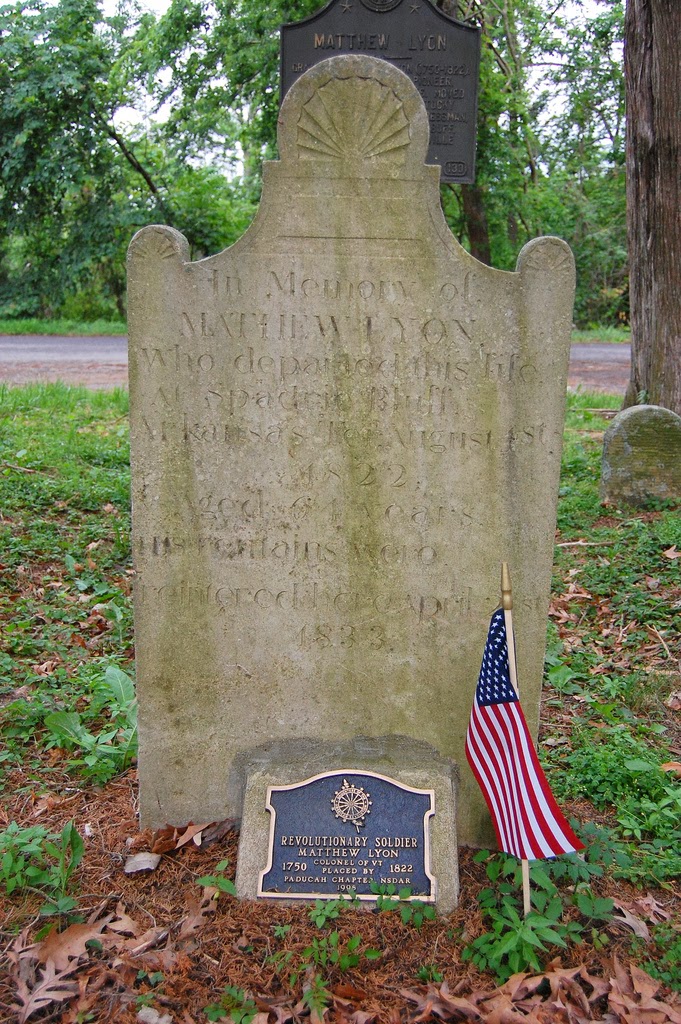
So it turned out, Senator Blount's act of betrayal did not end up preventing Jefferson from winning the White House. The arrogant and ambitious Blount did not witness the victory, having died in his home (above) during an epidemic in March of 1800. The next year Matthew Lyon moved to Kentucky, and won election to Congress from that new state six times, finally retiring in 1811, and dying in 1822. The Spitting Lyon, the Green Mountain Beast, was then buried in the Blue Grass state (below). And what a shame we have allowed his memory to fade, in part because we insist upon neutering our "founding fathers" - denying,  them and us, our shared humanity, warts and all. The valuable lessons are usually in the warts, you know.

- 30 - 

Blog Archive