August 2025

August  2025
I DON'T NEED A RIDE. I NEED AMMUNITION.

Translate

Thursday, August 15, 2024

ETERNAL TRIANGLE Part One

I still wonder why they call it “news”? It is never “new”. As proof I give you the obtuse triangle of “Big” Jim Fisk, Helen Josie Mansfield and Edward Stokes (above); a triangle which would have bemused Sigmund Freud.

Jim Fisk (above)  was born in Vermont on April Fools’ Day in 1835. His father was a traveling “bummer”, selling pots and pans and trifles. When he was 15, "Big" Jim ran away to join " Van Amberg's  Mammoth Circus and Menagerie”, and returned three years later with a splash of color and bombast.  By the age of 36 Fisk had marketed his talents for lying and cheating into a fortune of $70 million - the modern equivalent of one billion, one hundred twenty-nine million, one hundred ninety-eight thousand dollars. 
In the midst of the Civil War, together with the most hated man in New York - his partner Jay Gould (above left) - Big” Jim (above, right) took over and then plundered the Erie Railroad.  
But it was “Big” Jim who decided to move the Erie’s corporate offices into the upper three floors of the Grand Opera House (above), which he also owned. 
For while his partner Jay Gould (above) had no interests outside of making money, Jim Fisk was a man of many prodigious appetites, most involving divas of one kind or another. Jim had been married to his dearest Lucy when he was just 19, but she resided in far off Boston with her own lady love, Fanny Harrod. 
And while Jim kept both ladies in luxury, and even visited them occasionally, he spent most of his free time with “actresses” in New York, and was a regular visitor at the business house of “the notorious Annie Wood”.  And it was in the dim red light of Annie's parlor that Jim was  introduced to his personal Helen of Troy, Helen Josephine Mansfield.
Josie, as she preferred  to be known,  was a beauty in an age when a sexy woman had some "meat on her bones". One admirer noted her “…full, dashing figure". He also noted "Her eyes are large, deep and bright…Her voice is very soft and sweet”.  
It was Josie’s mother who first recognized the girl’s talent as “an incorrigible flirt”, and used her as bait in a badger game played in Stockton, California. A pettifogging local attorney named D.W. Perley , while in a state of undress, was caught "courting" the young Josie.  To cover the scandal Perley wrote at least one check at gunpoint. There was some quarrel over the proceeds of this venture, and shortly thereafter Josie secretly married Frank Lawlor, an actor.  The newlyweds then abandoned her mother, in search of greener fields.
She followed Frank cross-country on the music hall circuit, arriving in New York City in 1864. Here, two years later, Frank came to the shocking discovery that Josie “was going astray” on him. Although why that should have shocked him, seems an open question.  In any case, they divorced, and Josie sought a career more suited to her talents, in the bordello of Annie Wood. There she enticed Annie to introduce her to the genial and jovial and generous Mr. Fisk. He was enchanted. She was enriched.
Over night Josie went from being behind in her rent to the “Cleopatra of West Twenty-third Street”, the owner of record of a four story brownstone (after some $65,000 worth of improvements) - conveniently located just around the corner from "Big" Jim's Opera House – with four servants, a wardrobe filled with dresses, and a jewelry case accented by real jewels.
But having achieved everything she had hungered for, Josie was now bored. And that was when she made the acquaintance of one of “Big” Jim’s business partners, Edward Stokes (above, center), and fell head over heels in love with him.
It was understandable. Where Jim Fisk had few social skills, Edward Stoke (above) had an excess. Where “Big” Jim was physically blunt and crude, Edward was handsome and dashing. He was a privileged, pompous and prideful dandy, with a trophy wife and a 9 year old daughter. 
Josie was experienced enough to recognize that Edward (above) was also a spendthrift and an inveterate gambler, regularly losing small fortunes on race horses. An affair would be dangerous for them both. Josie depended on Jim Fisk for her income. And, in fact, so did Edward. He was a partner with Jim in a Greenpoint, Brooklyn oil refinery.
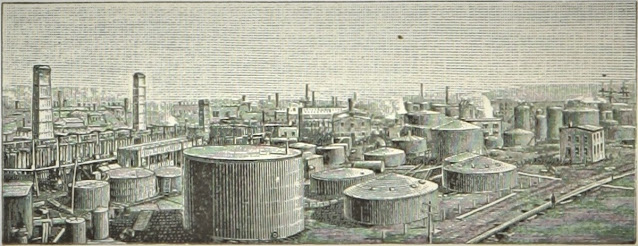
Edward ran the place, and “Big” Jim’s Erie Railroad transported the refineries’ oil at a discount.  It would seem that because of a hunger for self delusion and self destruction in 1869 Edward and Josie began an affair -  they thought behind “Big” Jim’s back.
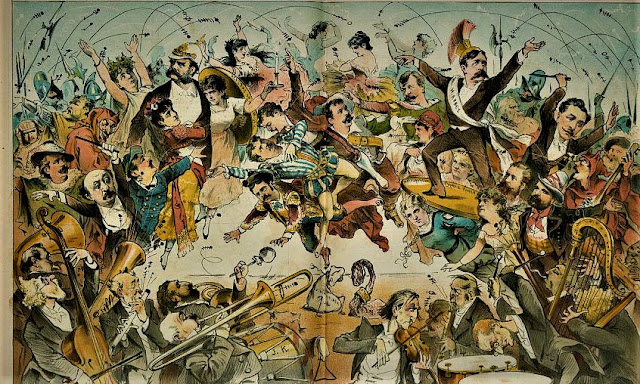
Such a triangle could be maintained only so long as all the parties carefully judged the angles. But algebra was a skill that none of the three possessed in quantity or quality. 
In January 1870 Josie Mansfield announced that she no longer wanted to see “Big” Jim unless he made her financially independent. She reminded him,  “You have told me very often that you held some twenty or twenty-five thousand dollars of mine in your keeping…a part of the amount would place me where I would never have to appeal to you for aught”  And now, she told "Big Jim, she wanted "her" money.
“Big” Jim was hurt. He responded, “Have I not furnished a satisfactory mansion? Have I not fulfilled every promise I have made?” And then he let it be clear that he was fully aware of her affair with Edward. “You may well imagine my surprise at your selection of the ‘element’ you have chosen to fill my place. I was shown today his diamonds, which had been sacrificed ... at one-half their value ….You will, therefore, excuse me if I decline your modest request for a still further disbursement of $25,000” Jim even began calling Josie his Little Miss “Lump-sum”.
Having received a definitive “no” from her sugar daddy,  Josie began shifting her demands. First, she threatened to publish “Big” Jim’s love letters.  Then she said was willing to spend one more romantic evening with him. Then she hinted she would share secret details of his Erie Railroad stock manipulations with the press. 
Through an intermediary “Big” Jim asked Edward directly how much he would require to return those love letters and return Josie as well. Edward asked for $200,000, and that seemed to have hit “Big” Jim’s limit, again.
Of course,  "Big" Jim still sent Josie cash when she asked for it - $500 on 7 November,, $300 more three days later, then another $500 a week later. Now why did he do that? 
He must have known that most of the money was going to Edward's gambling debts.  Of course November was also the month that “Big” Jim cancelled the shipping discount for the refinery he shared with his partner.  Yes, “Big” Jim was hurting his own profit margin, but Edward was being squeezed much harder. And Big Jim could afford it. 
Edward grew so desperate that in January of 1871 he collected a $27,500 debt owed to the refinery, and pocketed it.  Which is just what  “Big” Jim had been waiting for.
Edward was charged with embezzlement and arrested. The Lothario spent a weekend in the notorious New York City jail "The Tombs" (above) before he could raise bail.  Edward swore his revenge for the insult.
Why “Big” Jim had not done this sooner remains a mystery. The man was a Wall Street cut throat, merciless and cruel to his business competitors and partners. Yet he seems to have been sheered of his strength in the face of Josie's demands. 
Josie  now sued "Big" Jim, demanding the pay her $50,000 (the $25,000 she insisted he owed her, plus interest). Edward joined in, suing “Big” Jim,  to force him to buy out Edward’s share of their refinery for $200,000.  And at last the entire mess was out in the open, where the press could profit by it.  And they always love that. This story, they knew,  was just beginning.

                                                  - 30 - 

Wednesday, August 14, 2024

KEEPING TIME


I remember a proverb that says opportunity knocks only once. That may be true, but it is also true that having heard the knock you still have to open the door. And, when the scientists at the Royal Observatory at Greenwich, England heard that knock in 1835 they were mightily annoyed. So they pawned off the job of dealing with the disturbance to one of their servants. He turned that disturbance into a career. In fact he made three life long careers out of simply telling the time.

The Royal Observatory was founded by Charles II  (above) in 1765 as part of his restoration and “re-scientific-ication” of government after the religious fanaticism of that great Puritan hypocrite Oliver Cromwell. The observatory was to use the stars to perfect “the art of navigation.” 

But the builders, despite going over budget by all of twenty pounds, went cheap on the materials, and the observatory, which was to house the most accurate telescopes and clocks of the day, was constructed 13 degrees out of alignment. The Royal astronomers, like the NASA astronomers dealing with the deformed mirrors on the orbiting Hubble telescope, have had to make mathematical adjustments from that day to this.

But besides powerful telescopes, the scientist at the Greenwich observatory also needed accurate clocks. In order to say a particular star was at a particular point in the sky at midnight, they had to know precisely when midnight was. So in the special built Octagon Room were installed two pendulum clocks, (above, center) built by Thomas Tompion, and  by comparing them to each other the time keepers could be accurate to within seven seconds a day.

By 1833 (sixty-four years later) the observatory had done its job so well that ships’ captains and navigators had come to rely on the precise time provided by Greenwich to follow the charts provided by Greenwich. That year the observatory began a practice they follow to this day. 

At exactly 12.55 p.m., (they do it then so as not to interfere with the weather observations made at noon) a large red “time ball” is raised half way to the top of a mast erected atop the observatory.

 At 12.58 the time ball is pulled all the way to the top (above). And then at 1:00 P.M., exactly, the ball is released and quickly falls to the bottom of the mast. If you have ever wondered why they use a ball to mark midnight on New Years Eve in Times Square, New York City, this is it. 

Any ship’s captain waiting in the Thames River to set sail could now synchronize their shipboard watches and clocks with the official time as they set off from the “prime meridian”....

....or “longitude naught” - "0" degrees, "0" minutes and "0" seconds east/west, because Greenwich is where the longitude starts (above, gold line) - as well as time.  

But our story properly begins in 1835, when the observatory got a new boss, George Biddle Airy (above). He figured his primary job was to perfect the astronomical observations for those ships of the British Empire, and he hired human “computers” to do just that.

Now, in the 19th century "computers" were actually men and women who did the dull and boring math required to confirm and correct the stellar charts used to navigate on voyages to the far flung corners of the empire. So, in 1835, when London merchants appealed to Mr. Airy to share in the time service he saw them as an annoyance. But it was not one he could ignore.

He gave that job to his second assistant, John Henry Belville, who had worked at Greenwich as a "Jack-of-all-trades" since he was 13 years old, in 1811.  John Henry dropped his Christian French name after the Napoleonic Wars ended in 1815 to avoid anti-French bigotry. Over the years he had become responsible for maintaining the  “Galvano-Magnetic” clock at Shephard's Gate,  (above,) until 1856, when it was replaced with an electric one, and for raising and lowering the red time ball every day. And to preform his new job of dealing with the merchants, Airy provided John Henry with a very accurate and dependable pocket watch.  

This particular watch  (above) had been originally owned by Prince Augustus Frederick, the Duke of Sussex and by the sixth son of King George III of England. He was the favorite uncle of Queen Victoria and the man who gave her away at her 1840 wedding to Prince Albert.

The watch, number 485/786,  had been assembled by John Arnold & Sons in 1794. It had a spring detent escapement workings, a jeweled movement with a diamond end stone, all enclosed in a silver case (above), with a white enamel dial with gold spade hands and a subsidiary seconds dial.  The mechanics were accurate to within one tenth of second per day.

Each Monday John Henry would present himself and “Faithful Arnold”, the watch, to a clerk at the observatory time desk. The clerk would set the watch and then hand John  a certificate asserting to the watch’s accuracy for that day. 

Then John Henry would make his way by carriage and rail to London, where he would literally deliver the time to some two hundred customers; shops, factories, banks and offices. The fees he charged for the service supplemented his small salary from the observatory.  For most of the people in London, John Henry became the human face of official time, and he was earning four hundred pounds a year doing it when he died in 1856.  

After John’s death  the prigs at the government accounting office refused his widow, Maria, a pension. So she begged the observatory to allow her to continue the time service as a private business, and they agreed. Every Monday Marie strode up the observatory hill, watched while Arnold was synchronized at the "Time Desk (above)" and then went on her rounds by rail and on foot. 
To those who saw her trudging across the streets of London, Maria Bellville became known as the Greenwich Time Lady. 
By 1884 some 25 countries had agreed to set their watches by Greenwich time, and every clock at every railroad station in England was connected directly via telegraph lines with the Royal Observatory. And still, the time delivered by Marie Belville was just as accurate, if slightly less convenient. Maria retired in 1892 (above), and her only daughter Ruth now took over the employment,  carrying the tool of her trade, which she simply called Arnold, in her handbag.

Beginning in 1924 the BBC Radio began broadcasting from the observatory and added the six “pips” on air before each hour announcement. In 1936 the Royal Observatory set up a “talking clock” (above) which anyone with a telephone could dial up at any time to get the correct time to within a hundredth of a second. In most of the rest of the world this technology replaced the quaint "time keepers" of the past. But the English have more respect for keeping what works, particularly if it is a living person. 

A hundred years after her family business had begun,  Ruth Belville (above) was still making her rounds every Monday; having Arnold set by the Royal Greenwich Observatory staff, getting a paper validation of the event, and then serving more than fifty paying customers. 

Finally, in 1940, Ruth celebrated her 86th birthday and decided to retire.  And, since she had no one to pass the task on to, when Ruth retired the Belville family work was finally completed.

Ruth received a pension from  “The Worshipful Company of Clockmakers” guild , where "Faithful Arnold" was also granted a place of rest and honor.  Then on the evening of Tuesday, 7 December, 1943, Ruth left a gas lamp burning in the bedroom of her home in Beddington, Surrey. Sometime during the night the flame sputtered and went out and Ruth suffocated in her sleep, at the age of 89.
In effect, she ran out of time.
- 30 -

Tuesday, August 13, 2024

BLIND AMBITION


I believe that ambitious people tend to be unhappy people. Consider Caesar Augustus, the first Roman Emperor.  He invented the Roman Empire, and he lived a lot longer than all but a couple of the 77 Emperors who followed him. He also had a big funeral in 14 A.D. That's something you get only if you are very ambitious.

Augustus’s last words were, “Did you like the performance?” To which my response is, “In retrospect, it was just okay” because the show ended in a huge bloody confusing mess which I shall now attempt to explain as best I can. Suffice it to say that if Augustus had seen how sorry his empire would end he might have rolled over in his grave, if the barbarians hadn’t scattered his ashes in 420 A.D. as they burned Rome the first time. That is just one of the ways they earned the title of barbarians, from the Romans, of course.   Anyway, the really messy parts start 470 years after Augustus's funeral pyre (above) with the Emperor Julius Nepos. 

Nepos (above) was governor of Dalmatia, across the Adriatic from Italy,  and he got the job as Western Emperor in 474 A.D., because he was married to the niece of Leo I, the Byzantium Emperor, and because he was willing to pay for an army to defeat Glycerius, the guy who had knocked off the previous western Emperor.  In fact Nepos is Latin for nephew, and is also the root of the term “nepotsm”, which tells you almost everything you need to know about this schmuck. 

Nepos was supposed to bring peace and order to the capital of the Western Empire, which was then at Ravenna, Italy, and boy did he ever screw that up. He started out badly by not killing Glycerius.

Instead, after defeating his army and capturing Glyceirus,  Nepos shipped him off to Salona ((above), then the largest port in Dalmatia, where he figured his spies could keep an eye on him. Nepos even made the Glycerius  a Bishop in the Church, assuming, I guess, this act of charity would win Glycerius’ loyalty. But as they say in the Emperor business, no good deed goes unpunished. 

Caesar Augustus (him again) had established the port of Ravenna in the first century B.C. as the primary home for the Roman fleet. By the fourth century of the common era, with the barbarians carrying off half the Roman forum in a fire sale, the capital had been moved first to Milan, and then to the port city because Ravenna (above) was surrounded by swamps and marshes, which offered protection from invading hordes, of which there were plenty around at the time. But so low had Rome fallen by the fourth century the next invading hoards didn’t even have to invade Italy, because they were already there.

Half the army Nepos used to defeat Glyceriys was made up of German barbarians – er, I mean mercenaries, about 30,000 of them, led at this opportune moment by an ambitious German commander, married to a Roman woman. 

His name was Orestes (above, center), and although he had been secretary to Attila the Hun, he does not seem to have been very bright: just ambitious. And that is probably why Nepos figured that Orestes would not catch on when, after overthrowing Glyceriys,  that Nepos as new Emperor ordered Orestes to march off to Gaul with all of his German mercenaries, er, German barbarians.

I suspect it was Orestes wife who explained to him what Nepos was really up to, getting the Germans out of Italy and away from all those rich farms and mines and population centers.  Wives have a way of pointing out when husbands are being particularly dense. Anyway, it was probably she who suggested that Orestes should offer the Germans their own villas and farms right there in Italy, which could be easily stolen from the Roman patricians who owned them. So he did. 

Which is why, on 28 August, 475 A.D. , the Germans marched off not to Gaul but toward Ravenna. Nepos (above) could have stayed and fought, but then he would not have been Nepos. The schmuck jumped ship in the harbor and sailed home for Dalmatia, taking his purple robes with him.

Orestes then walked into Ravenna, where, instead of crowning himself emperor, he put the crown on his son’s head. And again I suspect this was his wife’s idea.

The twelve year old boy was crowned Emperor Romulus Augustus (above), on 31 October,  475 A.D. – what would eventually become Hallow's day, for anybody who enjoys a sense of irony . Of course Orestes was still the power behind the throne (Romulus was only 12 years old), which is why the graffiti artists labeled their new Emperor “Romulus Augustulus”, which is the Latin diminutive version of the name – meaning “Little Romulus”. It was the kind of sly, nasty political joke which graffiti artists had been scrawling on the alley walls of Rome for a thousand years.  

It’s further proof of the old adage that historians spend centuries struggling to learn from dusty records and scratches on walls what they could have discovered in five minutes by talking to the any guy on any street corner in ancient Rome. And one of histories’ greatest mysteries, unexplained by the dusty records, is why, having won such power and wealth so easily, Orestes then went back on the promise to his mercenaries and refused to hand over the patrician’s lands to them. Did he think all 30,000 Germans were not going to notice?

Oh, they noticed. And quickly rose up under their new commander, Odoacer (above). And this time they were joined by a lot of the regular Roman soldiers, and together, in 476, they all marched on Ravenna.  Now, unlike Nepose, the brave, courageous, dull headed, slow thinking Orestes didn’t have the common sense to run. He was captured just outside the city, and duly executed. Thus is the fate of most ambitious dolts in history.

And on September 4, 476 A.D. “Little Romulus” (above, right) handed over his crown to Odoacer (above, center).  Romulus was, according to most historians, the last Roman Emperor, having been emperor for barely 10 months. His puberty lasted longer than his nobility. 

Odoacer was not a stupid man. I think he likely packed up the little-last Emperor (above) and what was left of his family and shipped them off to prison in Campania, in Southern Italy. And I have to say I hope Romulus was contented there. You see, history seems at times to be the story of ambitious people getting everybody else into trouble, and this kid never had a chance to be ambitious, even if he were so inclined.

The truth is, almost nobody got out of this particular story by natural causes. Poor old Nepos was murdered by his own servants, probably in the pay of Glycerius, on 15 April, 480 A.D.  Odoacer rushed in to fill the political vacuum, repaying Glycerius by appointing him Archbishop of Milan. And Odoacer settled down to run his little empire of Italy and Dalmatia, turning the Adriatic into his own lake.

But such land grabs attracted the suspicions of the new Byzantium Emperor, Zeno (above), who, being an Emperor, was suspicious of anybody as ambitious as himself. So he offered a pile of gold to the King of the Ostrogoths, Theodoric, if he would cut Odoacer down to size.

Theodoric laid siege to Ravenna for three long years. Finally, so the story goes, with both armies suffering from hunger and plagues, Theodoric offered Odoacer a truce, which Odoacer agreed to. However, at the celebratory banquet on two February,  493 A.D., Odoacer said something offensive and without warning Theodoric fell on Odoacer and strangled him with his bare hands. Or, maybe, Theodoric  just hired an assassin.  The repetition here is a bit depressing, I agree. 

Little Romulus would outlive most of them, but only because he started younger. Legend says he died about 509 A.D., not yet 35 years old, but still residing in his prison-villa outside of Naples (above). And considering the fate of all the ambitious people in this story, his was a relativity long if not happy, life. Amino Domina, Roman Empire.

- 30 -

Blog Archive