August 2025

August  2025
I DON'T NEED A RIDE. I NEED AMMUNITION.

Translate

Tuesday, May 02, 2023

THE SPITTING LYON


I can prove the regularity of Senator William Blount's lower intestinal functions, because his enemies in the U.S. Senate depended on them. Their trap was sprung on Monday, 3 July, 1797, while Blount was visiting “The Necessity” behind Philadelphia's “Congress  Hall” (above).  
The arrogant and regular Mister Blount had to go downstairs and out the back of the building to the "Little Shed" in the walled garden (above, far right).  But the Federalists need not  rush because Blount took his time – such things should never be hurried.  By the time he returned to his seat,  the letter had been read and William Blount's political career was in the toilet.  I'll bet even Matthew Lyon, the “Spitting Beast of Vermont”, was pleased with this toilet revolt.
“Dear Cary”, the letter began, “I wished to have seen you before I returned to Philadelphia,...I believe  the plan...will be attempted this fall...(and) in a much larger way then we talked about....I shall probably be at the head of the business on the part of the British...You must take care...not to let the plan be discovered by...any other person in the interest of the United States or Spain.. signed, William Blount.”
The plan was the invention of John Chisholm, who owned a tavern (above) across the street from Senator Blount's Knoxville, Tennessee mansion. Chisholm figured it was only a matter of time before Spain would be forced to sell their American colonies to France. And if France controlled Louisiana and Florida, they might deny American ships access to New Orleans. That would bankrupt all the western farmers in Tennessee and Kentucky.  So Chisholm planned was to use local militia and Creek Indians to capture Pensacola and New Orleans, in the name of the British Empire - who would then promise to allow Americans to use New Orleans as if they owned it.
It was a fantasy of course, but sitting his heavily mortgaged Knoxville mansion (above) Senator Blount thought this was a great idea. And the more he thought, the more he thought it was his idea - particularly after he had improved it by creating a well paid job for himself as the British agent running New Orleans. So Blount wrote this letter to James Cary, who was a translator with the Creek Indian nation in eastern Tennessee.  Senator Blount expected Cary to convince the Creeks to supply most of the manpower for this conspiracy.  
Instead, Cary shared the letter with his bosses in the War Department, who immediately shared it with President John Adams (above).  Now, Adams was a Federalist and he saw a chance to embarrass his own Vice President, Thomas Jefferson, who presided over the Senate and was also the leader of the opposition party, the Democrat-Republicans - of whom Senator William Blount was an important member.
So Adams sent a copy of the "Dear Cary" letter to Federalists in the Senate (above), but insisted it be kept secret until Senator Blount could do nothing to stop the reading of the letter in public. Blount's regular morning toilet trip provided that opportunity.
By noon half of Philadelphia (above) wanted to hang Blount as a traitor, and the other half was trying to deny they had ever met him.  The President's wife even said it was too bad America did not have the guillotine. Senator Blount was arrested trying to slip out of town. Dragged in front of the Senate he denied writing the letter, despite everyone in the room recognizing his handwriting. He was arrested at once, but then allowed to post bail. And once free he hightailed it back to Knoxville – where being part of an anti-government conspiracy had made him something of a hero.  
A week later the Senate voted 25 to 1 to impeach and expel him (above), making him the first politician to be impeached in the new republic.  For the next six months both parties downstairs in the House of Representatives, Federalists and Democrat-Republicans, tried to make the impeachment of Senator Blount work for them in the upcoming 1798 Congressional elections. And that is how our story came to involve an expectorant infused Congressman from the Green Mountain State.
His name was Matthew Lyon, and he had been a Second Lieutenant in the Green Mountain Boys when they captured Fort Ticonderoga in 1776. The next year General Horatio Gates ordered Captain Lyon to take 60 men north to the Onion River, on the Canadian border. And just as they arrived, they heard rumors of  500 Indians coming to attack them. Lyon said later, “The soldiers considered themselves sacrificed”, and they decided to retreat.  Despite Lyon trying to convince his independent minded soldiers to stay, they high tailed it for safer climes. 
The prickly General Gates (above) ordered Lyon arrested and tried before a military court. Convicted of failing to maintain discipline among his men, Matthew lost his command. However he was not reduced in rank. Captain Lyon later fought bravely in the battles of Bennington and at Saratoga, rising to the rank of colonel. After the war the Vermont hero twice ran for election to Congress as a Democratic Republican. Both times the Federalists used the court martial to imply he was a coward. However, third time was the charm, and in 1796 he finally won election.  Two years later he was even re-elected.
And that was how Lyon ended up delivering a speech from the well of the House chamber (above) on Tuesday, 30 January, 1798. In his speech Lyon chastised the Connecticut Federalists for not defending the honor of their citizens by backing the impeachment of Senator Blount. That suggestion brought Federalist Connecticut Congressman Roger Griswald to his feet. As Lyon stepped away from the podium, Griswald, in his best snarky voice, asked if Lyon would be defending the people of Connecticut with his wooden sword.
Now, Lyon never had a wooden sword. Occasionally, an officer convicted of cowardice would be required to wear a wooden sword, as a way of embarrassing him before the army. That had not happened in Lyon's case, because he was not accused of running from the enemy. General Gates' later career provided ample evidence of the General's cowardice and incompetence, as Lyon's later career provided evidence of his courage and brains. But that was reality, and politics is about image - just ask John Kerry who was Swift Boat'ed over 200 years later.
Well, Lyon had been hearing this Federalist taunt for twenty years.  And hit in the back of the head with it, the Green Mountain boy in Lyon reacted instinctively. He spun on Roger Griswald, and spit in his face. We can assume it was pretty disgusting logy. The forty year old Lyon was a tobacco user, and mouth wash and dentistry were still in their infancy.  And then, having expectorated his piece, Lyon turned his back on Griswald again.  In the words of an historian, from that moment “No man in the whole Republican party...(not even) Thomas Jefferson...was so hated and despised (by the Federalists) as Matthew Lyon.”  Griswald went ape and charged at Lyon.
Cooler heads from both sides rushed to separate the two combatants.  And then, this being Congress, the argument about the traitor Senator Blount became about the “spitting Lyon” and the hot head Griswald.  Federalists wanted Lyon impeached for “gross indecency” - for spitting on a college - making him the first Congressman honored with an ethics charge.  Democrat-Republicans wanted Griswald censured for the insult,  making him the second Congressman so honored. In the end, both charges were dropped. So two weeks later, it got worse.
On Thursday 15 February, Roger Griswold entered the house chamber carrying a cane he had been loaned by a friend. He walked directly to Matthew Lyon's desk, and without warning began beating the Democrat-Republican with the stick. Covering his head, Lyon struggled to his feet, and retreated toward the fire pit, meant to take the morning chill off the chamber. He grabbed a pair of tongs from the wood pile, and began an insane fencing duel with his attacker (above). Again, cooler heads separated the two.
The spitting only made the attacks on Matthew Lyon's honor louder. One bad Federalist poet even managed to include the insult into an ode to a theatrical Boston pig. “You boast your little pig can spell the hardest word; But did your little pig ever wear a wooden sword?....Though your piggy screws his snout in such learned grimaces, I defy the squeaking lout to spit in Christians’ faces...,Then tell us no more of your little grunting creature, But confess that the LION is the GREATEST BEAST in nature.”  As I said, he was a bad poet.
The Spitting Lyon so angered the Federalists members of Congress,  it made it easier for them to pass both the Alien and the Sedition Acts, the second of which was signed on 14 July, 1798, six months after the assault by and on the “Spitting Lyon.”  It's actual title was “An Act for the Punishment of Certain Crimes” (above), the crimes being writing or publishing anything false or malicious against members of the government.  It also forbid the defendant from pleading the truth of their writing as a defense. Three months later, on 10 October, The Democratic Republican Matthew Lyons was convicted under the Sedition Act, and sentenced to four months in jail.
But Representative Lyon had the last laugh.  Twice.  First he was re-elected from his jail cell, with 55% of the vote. Then, the Presidential election of 1800 was a tie, and thrown into the House of Representatives. The contest became a 35 ballot knock down drag out between Democratic Republicans Jefferson and Democratic Republican Aron Burr, all engineered by the lame duck Federalist Congressional majority.  The issue was finally settled on the 36th ballot, when the Federalist Representative from Vermont abstained. This allowed Matthew Lyon, the Democrat-Republican from Vermont, to cast the deciding ballot making Thomas Jefferson the third President of the United States.
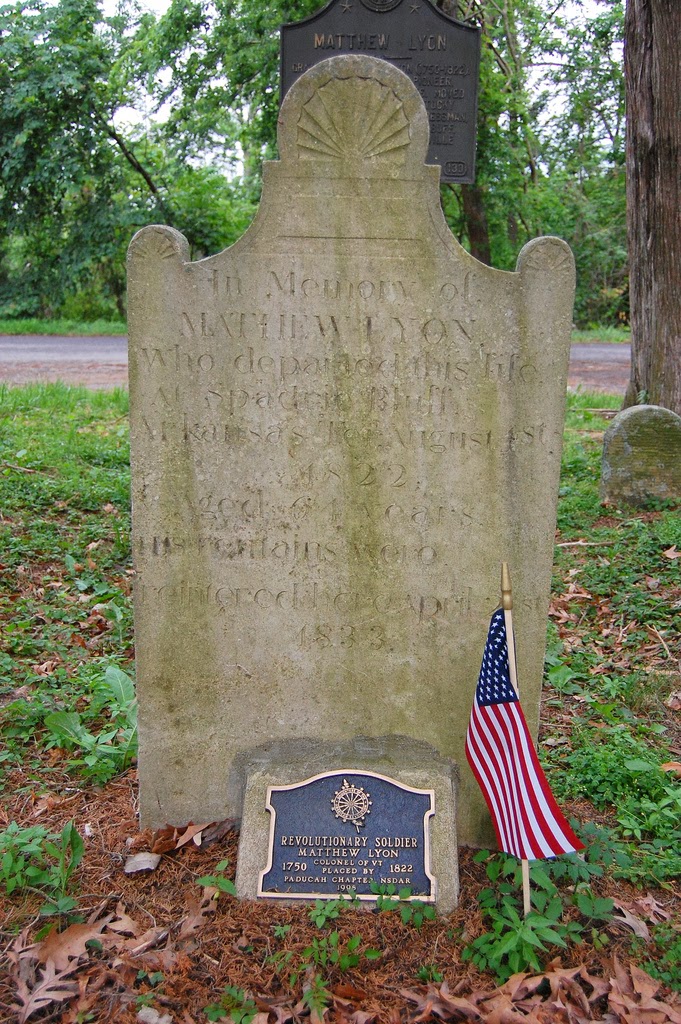
So it turned out, Senator Blount's act of betrayal did not end up preventing Jefferson from winning the White House. The arrogant and ambitious Blount did not witness the victory, having died in his home (above) during an epidemic in March of 1800. The next year Matthew Lyon moved to Kentucky, and won election to Congress from that new state six times, finally retiring in 1811, and dying in 1822. The Spitting Lyon, the Green Mountain Beast, was then buried in the Blue Grass state (below). And what a shame we have allowed his memory to fade, in part because we insist upon neutering our "founding fathers" - denying,  them and us, our shared humanity, warts and all. The valuable lessons are usually in the warts, you know.
- 30 - 

Monday, May 01, 2023

LOOKING FOR THE GREAT ALEXANDER


I suppose you could call it the Melting Monarch's Mummy Trick, or the Ebbing Emperor Illusion – except this was no illusion. On what would be latter be 11 June, 323 B.C.,  Alexander III of Macedonia died in Babylon, probably after being poisoned,  since assassination was the normal recall procedure in Macedonian politics. 

Very long books have been written about who poisoned Alexander and why, and you might find that interesting. I did. But the death of Alexander the Great was just the prologue to the second greatest act of prestidigitation in world history, when the mummy of the most famous man since Adam vanished from the center of one of the largest cities in the civilized world, from one of the most famous and often visited mausoleums in the world. 
One day he was there, and the next – poof - he was gone, never to be seen again. And it wasn't that anybody forgot about him. The day his corpse went walk-about, he was still the best known conquer in history. He was “The Great” with a capital “G”, for heavens sake. And then he was gone. And he is still gone. It must be a mystery; right?
His body lay in his tent for three days, unattended. Sound familiar?  His loyal follows paid no respects to the man they had followed into the mountains of Afghanistan and the plains of India because they were too busy arguing over who should inherit what parts of his empire and his fortune.  Alexander himself thought the best way to enhance his image would have been for his body to be thrown into the Euphrates River, so he would simply disappear- very mysterious. 
Instead, eventually, he was mummified after the Egyptian fashion, and placed in a casket carved to bear his image. This was supposedly then placed inside a gold sarcophagus, which would have made it very, very heavy. The intent was to ship his body back to Macedonia, where he would be buried next to his father.  But somewhere in Syria the procession was waylaid by cavalry under the command of Ptolemy, whom Alexander had assigned to run his province of Egypt.
After slaughtering the funeral procession, Ptolemy hijacked the mummy to the Egyptian holy city of Memphis, about 160 miles south of his new capital which Alexander had ordered built, and had named “Alexandria”. Under Macedonian tradition, by burying Alexander's corpus delicti,  Ptolemy was laying claim to his empire. But after twenty years of fighting, Ptolemy gave up his dreams of world-wide glory and had himself just crowned Pharaoh of Egypt. And the late Alexander the Great took up residence in the temple of Ptah in Memphis.
He stayed there for about fifty years before the son, Ptolemy Soma , had him shipped down river to Alexandria (above), where he was given his own tomb inside the Brucheum, the Greek quarter of the city. Then in about 210 B.C. the grandson, Ptolemy Philopater, built a larger shrine, the Mausoleum of the Ptolemies (later called just The Soma - Greek for "the body"), to house the mummies of his parents, grand and great-grand parents as well as the mummy of Alexander.
The new temple, designed to look as old as the ancient temples still dotting the landscape, stood at the corner of The Street of Soma and Canoptic Street – the 42nd Street and Fifth Avenues of ancient Alexandria. Down the street from this temple of the divine were the Royal Palaces, what was left of the famous Library of Alexandria and the Temple of the Caesar's. 
For the next five hundred years they dragged the corpse out for special occasion, and for viewing by visiting dignitaries, including a Who's Who of classical Rome - Pompey the Great, Julius Caesar, Mark Anthony, Caesar Augustus, and one Roman Emperor after another. This dressed-up desiccated carcass had become an object of veneration, made divine by the faith imparted in the cadaver by the thousands who prayed and offered sacrifice to it. 
To facilitate them, the ninth Pharoh to bear the name Ptolemy - A.K.A. Hook Nose Ptolemy -  had the gold sarcophagus melted down, and Alexander's mummy was then encased in glass - which had been around in Egypt since 3,400B.C.E. -  the better for the tourists to see. The gold, went in the Ptolemy 9's  purse.
But it was not faith alone that persevered Alexander's corpse, it was also the tourist industry, which sprang up to serve the faithful and the curious who visited The Soma. There were hotels, restaurants and souvenir shops - everybody wanted souvenirs. When they caught Caesar Augustus trying to slip Alexander's nose into his pocket, he claimed it broke off by accident. They still made him leave it behind. 
The Emperor Caligula (above) was brazen enough that he broke the glass and walked out with the breastplate ripped right off of Alexander's chest. In the second century A.D., to protect the taxes produced by this industry, the Roman Emperor Septimus Severus closed The Soma to all but the richest visitors. Average folks still came to look at the building, but not as many.
You'd would think it would be easy to locate such a famous spot, even 2,000 years later, but just after daybreak on 21 July, 365 A.D. there was an 8.3 earthquake off Cyprus, 400 miles to the northwest. The shaking and tsunamis slammed into Alexandria, killing about 5,000 people, knocking down 50,000 houses and dropping the level of the entire coast about 20 feet. Needless to say, the morning after that morning, The Soma lost its importance to the city.  Probably Alexander's mummy had slipped into the harbor and most likely the survivors had more important things to worry about other than the dried out carcass of a long dead now heathen monarch.
The only reason to suspect The Soma and the corpse survived this temblor is the reprobate philosopher Libanius. He had resisted conversion to the new political correctness of Christianity.  For committing that sin he had been exiled from Constantinople. Yes, he was a pagan. But the dirty little secret of Christianity is that even pagans were appalled by the sins usually attributed by Christians to the pagans; sins like lust and greed. 
In describing greedy Christians in about 390 A.D. Libanius asked (above), “Who could be the friend of such as these? When they behave like this for money's sake, would they keep their hands off temple offerings or tombs?...And this evil...is universal, whether you mention Paltus or Alexandria where the corpse of Alexander is displayed..”  And that is the only mention of the tomb of Alexander after the earthquake of 365 A.D.   And since there is no record that Libanius ever visited Alexandria after his exile, I find this less than convincing, especially considering that Libanius died not long after writing this passage. Had he lived, maybe he would have corrected it.
There is a theory floating about that, in order to revitalize the local tourist industry the corpse of Alexander was re-named as the corpse of the Christian Saint Mark, and The Soma as the Church of St. Mark.  Why Christians would have done something like that, I have no idea. It just seems to me to be a lot of trouble to go to. 
After 365 A.D. the tourist industry of Alexandria certainly needed a new Alexander The Great, but the two things ancient Alexandria had after the earthquake was dead bodies, and salvaged stones for building new temples. And while it might be emotionally satisfying to blame religious fanatics for the loss of the Alexander's corpse, and it might be appealing to suppose Alexander the Great still exists, buried under St. Mark's square in Venice (above), it is far more likely that he ended up in the harbor of Alexandria, soaking like a packet of old freeze dried coffee, slowly losing his effervescence.
The real magic trick of history is that in the face of overwhelming evidence each generation continues to labor under the delusion that they invented sin and mystery, or at least identified it better.  And this column is certainly proof of  that.
- 30 - 

Sunday, April 30, 2023

VICKSBURG Chapter Thirty - One


As sunlight first touched Chancellorsville, Virginia on Monday, 4 May, 1863, both armies were staggering back from a disaster. The 133,000 man Federal Army of the Potomac under Joe Hooker had literally been worse than decimated, losing some 17,000 men - 1,600 dead, 9,800 wounded and almost 6,000 captured or missing. - almost 13% of their total strength.   But the 60,000 man rebel Army of Northern Virginia under Robert E. Lee had suffered some 13,000 causalities - 1,700 dead, 9,000 wounded and over 2,000 captured or missing – or over 20% of their strength. 
General Joseph "Fighting Joe" Hooker,  although still in command,  rightly bore most of the blame for the Federal failure.  He was mocked in the press both south (above) and north.  However, although few could see it at the time, the tragedy was a tactical victory for the Confederates, but a strategic defeat.
Two advantages helped disguise the scale of the disaster for General Lee's army.  First and foremost, General Longstreet's corps had not been present at Chancellorsville.  Lee (above) had been forced to disperse one third of his army,  some  30,000 men , to southern tidewater Virginia, so they could be fed.  They would now be rejoining Lee -  combat veterans, fresh and not blunted by a wasting battle.   And secondly, Lee had won a clear psychological victory over Hooker.  Lee, it seemed,  always won his battles with the Army of the Potomac. But Lee knew better.
The only shadow which seemed to darken this victory was that Lee's right hand man,  the  religiously fanatical General “Stonewall” Jackson,  had lost his left arm at Chancellorsville.  He was bedridden now, and would not be available to General Lee on his invasion of Pennsylvania. And Lee must invade. His army would never be stronger.  And only in the north would the Confederacy find the surpluses to feed, clothe and arm their soldiers.
Meanwhile, in Mississippi, most of the 42,000 men under Lieutenant General John Pemberton were
marching to realign after Grant's attack around the rebel right flank. There were now about 33,000 men in and around Vicksburg, another 6,000 in and around Jackson, with perhaps 2,000 men in Port Hudson on the Mississippi, just above Baton Rouge, Louisiana.  Pemberton's first impulse had been to abandon Port Hudson and call the garrison back to Vicksburg,  but Confederate President Jefferson Davis had countermanded that order.  In fact, over the next few weeks Davis would feed another 10,000 reinforcements into the isolated post, while commanders elsewhere in the state would be starved for men.
One of the most powerful Confederate regiments was on a forced march to Grand Gulf that morning - the 400 plus men of the 26th Mississippi Infantry.   In April they had repelled the Federals at Fort Pemberton.  Now, they were ordered to Grand Gulf. They might have used the Southern Railroad to save time and energy, but after the raid on Newton Station, that line was no longer available.  The only way to get from the Yazoo delta to Grand Gulf was on foot.  And for two and a half days they had been marching under their colonel, A.E. Reynolds.  But they only got as far as Bayou Pierre before running into the Federals, who were marching north to meet them.
Their commander, the acquisitive Arthur Exum Reynolds,  was a big man in Tishomingo County - he was rich, he was politically powerful and he was fat. The 300 pound lawyer (above, evidently holding in his gut)  had moved to the north eastern corner of Mississippi in the early 1840's, once the Chickasaw native peoples had been forced out.  After the Presidential election of 1860, as a wealthy state representative "A.E." was a natural choice to represent his county at the secession convention. He agreed with the majority that "Our position is thoroughly identified with the institution of slavery",  but like 16 others he voted to wait until other states had joined the rebellion before taking the ultimate step.
When they did, "A.E." raised his own 400 man regiment. He was unanimously elected Colonel of the 26th.  They arrived at Fort Donaldson, Tennessee in February of 1862 (above) - just in time to suffer 12 dead and 69 wounded in their and General Grant's first major battle.  During that engagement, "A.E."'s horse was killed, and the substantial Colonel, while uninjured, lacked the wind to keep up with his unit under his own power. So he led from the rear. The entire regiment, including A.E., were forced to surrender. They were paroled and reformed in September at Jackson, Mississippi. The 46 year old A.E. was again in command as they skirmished with Grant's army during his December 1862 advance to and January 1863 retreat from Grenada, Mississippi.  And now under orders from the profane General Loring, A.E. wisely offered only token resistance to the advancing Yankees.
Captain Patterson's  engineers worked all night to repair the bridge over the North Fork of Bayou Pierre, and at 5:30 the morning of Monday, 4 May, 1863, General Smith's division crossed the bridge and continued up the Port Gibson road toward Willow Springs. As they approached the tiny community a battery of rebel artillery from the Mississippi 26th made a show of firing a few rounds, but retreated before Federal artillery could return the favor. And with that the valuable fresh water of Willow Springs fell into Union hands.
While the Yankees were refilling their canteens a civilian plantation owner appeared riding a mule and demanding to speak with the officer in charge. The General's soldiers, the outraged plantation owner complained, had stolen everything in his larder - pigs and cows and horses. 
The man demanded his property be returned and the thieves punished. The craggy General Smith calmly ask the planter who owned the mule he had arrived upon. It was his mule, responded the planter. Well, said General Smith, the thieves could not have been his men, because his men would not have left the mule behind. And with that the planter was sent on his way, on foot.
Clearly, the troops were already working to stretch their rations beyond the ten days they had been told to make them last. And they were having no trouble doing that.  However General Smith did not allow his men to tarry at the springs or forage too much along their route. That very afternoon Smith pushed his men forward through Rock Springs,  5 miles to Harkinson's Ferry -  the main crossing of the Big Black River by the Port Gibson Road.  They arrived there just as the day was ending, and after a brief exchange of cannon fire the 20th Ohio Infantry stormed across the bridge, forcing the rebels to assume that Grant was going to make a drive directly for Vicksburg, just 20 miles further north.  The Yankees did little more than raid up the road, but if an immediate  assault in Vicksburg was not Grant's intention, what was next for the Army of the Tennessee?
Before he had even crossed the Mississippi  River, Lieutenant General Ulysses Grant (above) understood what he was risking by passing below the still active guns at Vicksburg. He would write later, “To have no communications - to cut loose altogether from my base and move my whole army without a rear link was a tremendous gamble!" Once over the river he could not retreat, there would be no rescue and no resupply. He could not merely stay where he was.  He had to fight and he had to win, every fight and every skirmish. A single reversal could force him to pause and any pause would spell doom.  But fight who, and fight where?
There was still the possibility of joining with Nathaniel Banks( above)  and his 30,000 man Army of the Gulf,  and together crushing Port Hudson and then marching north to Vicksburg with 70,000 men.   But Banks had been tempted to follow a will-o-wisp of easy victories up Bayou Teeche, moving farther away from the key battleground of the Mississippi River.  The Massachusetts political general would not meet his promised return date of 10 May in front of Port Hudson.  And Grant could not wait until Banks returned. Grant had the initiative, and he could not surrender it,  else Pemberton would eventually gather strength against him. He most move forward. And after a bath in the newly liberated fortress of Grand Gulf, Grant rode north to keep a close eye on his most troublesome subordinate, Major General John McClernand.
Grant arrived at Rocky Springs after a daylong ride, "...by a strange and circuitous road." The next morning he might move directly on Vicksburg.  But he had only some 30,000 men in 2 corps drawing up to the Big Black River south of the city.  And Pemberton had about that same number in the new fortifications on the eastern side of Vicksburg.  Isolated as he was , Grant could not afford any battle which offered him less than favorable odds.   Deep in his enemies' rear,  he must keep the Confederates divided and not allow them to concentrate against him. Grant truly had the elephant by the tail.  He needed Sherman to join him, as quickly as possible.
- 30 -

Blog Archive