August 2025

August  2025
I DON'T NEED A RIDE. I NEED AMMUNITION.

Translate

Sunday, May 16, 2021

JUSTICE, Christine Keeler and the Commies


I have given up looking for “justice”. As proof of its nonexistence I offer you the “ostentatiously wealthy” British Labor politician John Lewis (above). Called an evil man and “vindictive” by one of his victims, his allies described the self made rubber millionaire as a "nasty piece of work", “one of the lowest forms of human existence I've ever met...” and “loathsome in every sense”. His “lack of personal...honesty or integrity” made him an “embarrassment to his political party”. In a “just” world John Lewis would have retreated after karma thoroughly kicked his ass in 1951. He did not.

That year,  after four years of her husband's promiscuity and "odd" sexual proclivities,  Lewis' fashion model wife, Joy Fletcher (above, left), left him for a female Swedish beauty queen (above, right).  She later moved on to another male millionaire.  
Shortly thereafter Lewis' (above)  bruised ego was further offended when a traffic cop ordered him to stop at an intersection. Lewis ran his car into the officer's car, three times. His justification was that he was late for a vote. The public chastisement resulted in him losing his seat in October of 1951 . As I said, ot was not a good year for John. 
But Lewis avoided the productive introspection such justice suggested, by inventing a villain to blame for his just deserts. Lewis decided that the Joy (above) in his life had been seduced by the unlucky, undeserving and unrepentant Stephen Ward, because it had been Ward who had introduced Joy to the Swedish Beauty Queen. Lewis swore, “I will get Ward whatever happens”.
The irony was that Stephen Ward (above) did not sleep with Joy Fletcher Lewis. In fact Doctor Ward ( he was an American trained osteopath) was not that interested in sex. We know this because that is the one thing Christine Keeler, one the most inventive, inveterate and inexhaustible liars in 20th century England, never changed her story about. 
The 18 year old show girl always said that although she and Stephen Ward slept in the same bed, it was always “like brother and sister.” She never claimed to have had sex with Stephen Ward. And this is notable because charting the admitted sexual contacts of this beautiful hedonistic exhibitionist narcissist  would have exhausted a team of Public Health epidemiologists.
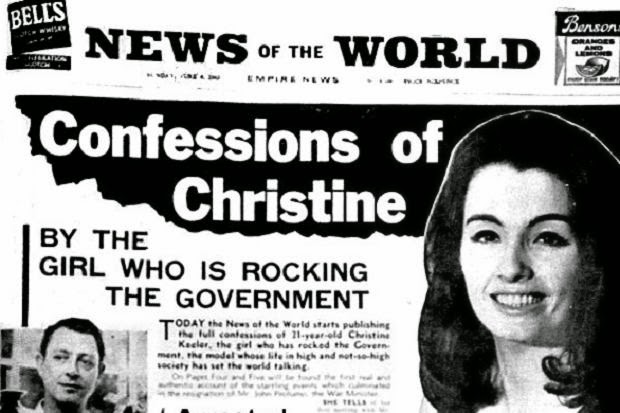
Christine Keeler (above) , in the words of her most famous victim, “seemed to like sexual intercourse”. She was uneducated, and uninterested in much beyond her own vagina. But in her chosen field she was an expert, the epiphany of common carnal knowledge  It seems at times that this high school drop out had sex with every male in mid-century London, including Soviet secret agents, American military officers, London policemen, bankers, drug dealers, musicians, doctors, lawyers, even members of the British Cabinet. And like a single woman Ponzi scheme, Christine's constantly crescive coitus circle eventually brought her into contact with the only male in London who wanted to hear this gorgeous uneducated woman speak. And he was the despised and despicable John Lewis.
Lewis and Christine had a meeting at a 1961 Christmas Eve party. Christine (above)  was, as usual, concerned only with her own problems, which were not insubstantial. Two weeks earlier, a former boyfriend, Lucky Gordon, had fired “several shots” into the front door of the tiny apartment which Christine had once platonically shared with Stephen Ward. 
The publicity generated by that gunfire had killed her affair with British Secretary of State for War, John Profumo (above)...
...as well as scaring off  the other man she was concurrently  sleeping with",  Yevgeny Ivanov (above), a Soviet naval attache.   Christine recalled later that John Lewis “could not have been more helpful....” that Christmas Eve.   But the only five words John Lewis heard in Christine's hour long self absorbed diatribe was “Stephen Ward”, “John Profumo”, and “Soviet”.  It was enough for Ward to promise the young fool £30,000 for names and dates, which Christine was happy to provide. 
Meanwhile, the dreadful Lewis was still trying to get the London press interested in attacking Stephen Ward (above, left). But they were no more interested in Ward than the judge at  Lewis' 1954 divorce case, who had dismissed Lewis' fantasies about Ward being a pimp for his wife, Joy Fletcher. 
 But by adding the name of Profumo to his vendetta, Lewis acquired an ally, in the Conservative Party, Political hatchet man, George Wigg (above). 
Wigg scurried off to repeat Christian’s details to Conservative Party leader, Harold Wilson. And with his okay, Wigg then fed the “News Of The World” the story of a Liberal Party leader who was having an affair with a woman who was also having an affair with a Soviet Spy.
Christine Keeler (above)  met John Profumo while skinny dipping at a 1961 summer night pool party at  Lord Astor's country estate. She had been invited as a guest of Stephen Ward, who was Lord Astor's osteopath and who rented a summer house on Astor's property for one pound a year. Over that weekend, John Profumo got Christian Keeler's phone number, but the lady who was a tramp went home with another party guest, Yevgeny Ivanov, who was in fact a Soviet secret agent.  Monday morning, Stephen Ward felt nervous enough to call his MI 5 contact to report the triangle that had formed in Lord Astor's swimming pool.
The three dominant sections of British Military Intelligence have always been MI 1, code making and breaking, MI 5, counterintelligence, and MI 6, intelligence gathering. In 1960 MI 5 thought they saw a chance to “flip” Yevgeny Ivanov, and they asked Stephen Ward, who knew Ivanov casually,  to befriend him. At their urging, Ward had invited Ivanov to the pool party at the Astor estate. But it was also Ward who warned the government that the Secretary of War might be dipping his wick into Christian Keeler, at the same time she was partying with the Soviet Agent.
Christine (above)  may or may not have slept with Ivanov.  She did sleep with Profumo, but in her own words she saw him merely as “a screw of convenience.”  Ward tried to penetrate her myopia to warn her how deep the water was by joking that she should ask Profumo when NATO was going to share nuclear weapons with the West German government.  Ward knew Christine well enough to doubt the stunning brunette knew what NATO was, or West Germany, or even nuclear bombs. However Ward's little joke would come back to bite his own ass, with teeth that belonged to his sworn enemy, John Lewis. 
During the summer of 1963 the London Press exploded with lurid details of Christine Keeler's sex life, her affair with John Profumo and a Soviet spy,  both of which had been arraigned, said the press, by Stephen Ward.  Christine was having a ball, feeding the press dark and sexy stories depicting Stephen Ward as her pimp and a tool for the Soviets. For an ego maniac, especially one as dim as Christine, it was a joy ride. 
Not everyone was having as much fun. Yevgeny Ivanov was called back to the Soviet Union before the story exploded. Soviet officials usually showed little sympathy for agents who got their pictures on the front pages of London tabloids.  John Profumo first denied his affair with Christine, and then resigned after admitting to it. Stephan Ward (above, left center)  insisted he had been working for British Intelligence, who, of course, denied everything.  The CIA treats their operatives the same way.
 Eventually Stephen Ward was charged with “living off the earnings of an under aged female” - i.e. pimping children.
As Stephen's trial was starting, Christine was in another court room, testifying at Lucky Gordon's trial, charged with shooting Stephen Ward's front door.  Eventually an appeals court would decided her testimony there had been unreliable, and probably perjury. But because the Foreign Office had yet to determine if national security had been breached (it had not), the damage to her reputation - such as it was - were considered proved, and the press lost interest in her. But since left Stephen Ward's jury did not know that, they took her story that Ward had asked her to "to find out, through pillow talk, from Jack Profumo when nuclear warheads were being moved to Germany." as true.  It wasn't. 
Samuel Herbert (above), the Chief Inspector running the investigation broke quite a few rules, including threatening to destroy anyone who testified in support of Stephen Ward.  And then, in his closing, the prosecutor reminded the jury that no one had come forward to defend Stephen.  As if lack of evidence was evidence.
The entire trial was a travesty,  which drove Stephen Ward to take an overdose of sleeping pills. Rushed to the hospital (above) he died two days later. But the jury was still allowed to convict the dead man. 
That conviction helped to bring down the Liberal government, and made Harold Wilson (above) Prime Minister. Three years later 48 year old Inspector Herbert died of a heart attack. His will left only 300 pounds to his family. But his bank account contained 30,000 pounds, well over half a million dollars today.  Where he got that much cash was never explained.
The night that Stephen Ward died, John Lewis celebrated with champagne in a London restaurant. There's political justice for you. Ironically, John Lewis died of a heart-attack on 14 June, 1969. He left just £63,000 in his will.
*
Most of the money Christine Keeler had been paid by the newspapers went to her lawyers. Convicted of perjury in December of 1973,  Christine Keeler served 4 1/2 months in prison. By 1972 she had been married and divorced twice, and given birth to two children, who were largely raised by her mother. She died at 76 years of age, in 5 December, 2017, of  chronic obstructive pulmonary disease, just another victim of John Lewis' hunger for revenge.
- 30 - 

Saturday, May 15, 2021

A WOMAN SCORNED: Kentucky Tragedy.

I don’t know if Solomon Porcius Sharp (above) could have been President. But a man who had the job, John Quincy Adams, described the Kentucky lawyer as, “The brainiest man that ever came over the Allegheny Mountains.” He was not, however, a very nice man. But then nobody in this story were very nice people.  Some were born that way, and some became not very nice with circumstances..

Kentucky became a state in 1792, and, in 1825, was still mostly wilderness,  And yet the 38 year old Sharp had already served two terms as a Congressman for the state, four years as State Attorney General, and was now starting his second term as a state legislator – so the boy was not lacking for ambition, brains or talent. He spent his last day on earth, Sunday, 5 November, 1825, conferring with political allies. Every indication was that come Monday morning, he would easily be elected Speaker of the Kentucky House. It even seemed possible his next stop would be the United States Senate, and then, possibly, the White House; except, an ex-girlfriend of his had other plans. 
Her name was Anna Cooke, and in her youth she had been a real Southern Belle. However Anna was never described as a great beauty. And her family were nearly destitute, having lost both their fortune and their father in the depression of 1819.  Forced to retreat with her mother and five younger brothers to first Bowling Green and then to a small farm in southern Kentucky,  Anna was not likely to make a good match. But she was  "a freethinker, reader of romantic fiction, and a libertine."  Or so said her critics.  I suspect she also had a passion for men and for gambling and for gambling on men. Given her situation and the times, she had little choice if she wanted to get ahead,  But like all gamblers, the more Anna gambled the more she lost. Few suitable men of "good families" (i.e. wealthy,) wanted to be responsible for her debts.  
In 1820, at the age of 35 and still single , Anna had gambled heavily on Solomon P. Sharp.  But when she became pregnant that year, Sharp refused to marry her. The lady was now officially socially ruined. And after her child was still born, the lady had nothing left to lose. In May of 1820, determined to return the pain she had endured, Anna publicly accused Solomon Sharp with being the father.  His political allies responded by claiming the dead child had been born with black skin, and thus could not be the child of a white politician
In a slave state like Kentucky, in a bigoted misogynous nation such as America in 1820, in a land "of the fiddle and whiskey, sweat and prayer, pride and depravity"   it was a truly vicious attack.  With no living male relatives willing to challenge Sharp to a duel, (all three of her  brothers had recently died of fever)  Anna had no way to respond.  In fact, her reputation was left in tatters no matter which side was believed.  And two hundred years later it is impossible to comprehend the depth of her social isolation. But we are certain about what happened next. 
By 1824 Anna Cook was a spinster approaching forty, and her rose had withered.  A critic described her as short, with dark hair and eyes, a few missing teeth, stoop shouldered and  “in no way a handsome or desirable woman.” And yet inside Anna there still burned a passion, which had metamorphosed into a burning fierce hatred of her old boyfriend, Solomon Sharp. 
And just at this opportune moment 22 year old Jereboam Orville Beauchamp (above) appeared and asked for her hand in marriage. He had been a neighbor for some years, and a one time law student in Sharp’s office.  And to hear Jereboam tell it, the hypocrisy of the vicious attack against Anna had awakened an almost religious hunger for justice within him...or so he said.  In response to his proposal, Ann agreed with one stipulation. She would marry the younger Jereboam if he promised to murder Solomon Sharp. Thus, to call their marriage an affair of the heart seems somehow to have missed the point.  And as soon as it was convenient after the 1824 wedding,  Jereboam traveled to the state capital of  Frankfort, looking to fulfill his promise to his new bride.
Of course there might have been another explanation for the timing of Jereboam’s marriage and expedition to Frankfort, besides moral outrage. The week before, on 25 October, 1825,  a warrant for Jereboam’s arrest had been issued by the sheriff in Bowling Green, Kentucky.  It seems a single young woman named Ruth Reed was suing Jereboam for child support.  So the gallant defender of Anna's chaste womanhood might well have been the dead-beat dad of an illegitimate child himself.  Do you get the feeling that the public morality of neither of the times nor Mr. Beauchamp nor Ms. Cook nor Mr. Sharp, were quite what they claimed to be?  Sort of just like today, yes?
Frankfort in November of 1825, when Jereboam arrived,  was a wooden town of just 1,500 souls. It had been established at a ford across the Kentucky River, and was named for Stephen Frank, an early settler. The village became the state capital because local boosters contributed $3,000 in gold to the state treasury, and property for building public buildings. It was not a generous act, as the boosters got rich selling house lots in the new burg. 
But despite the investment, Frankfurt was, in 1825, and remains to this day, one of the smallest state capitals in the Union. There were in 1825, a few brick structures in town, so fire was constantly updating the architecture of all the wooden buildings. Earlier in 1825 Frankfort had burned down its sixth state capital building, and the legislature was currently renting a Methodist Church for its use. 
Directly across Madison Street from that Methodist temporary cathedral of democracy was the rented two story abode of Solomon Sharp, his wife and their 3 children. And around the corner from the front of the mansion  there was a second door (above , right), which opened directly onto the family room.  It was referred to as the side/rear entrance.
Jereboam waited in the shadows of the Methodist church until Sharp returned to his Madison street home, sometime after midnight on 6 November, 1825. Then, as the clock approached two in the morning, he knocked on a side/rear door. 
In the murder's own words, "“I knocked three times loud and quick, Colonel Sharp said; "Who's there" - "Covington I replied," quickly... Colonel Sharp opened the door. I advanced into the room and with my left hand I grasped his right wrist. The violence of the grasp made him spring back and trying to disengage his wrist..."I don't know you," said Colonel Sharp...Mrs. Sharp appeared at the partition door and then disappeared... I said in a persuasive tone of voice, "Come to the light Colonel and you will know me," and pulling him by the arm... " Jereboam then cut the conversation short by thrusting a dagger into Solomon’s neck, severing his aorta. Solomon Sharp was dead shortly after he hit the floor. Jereboam then fled into the night. The first political assignation in American had just been committed.
There were, of course, elaborate conspiracy theories which sprang up around the assignation of Solomon Sharp, spurred on by the victim’s politics and the $4,000 reward offered.  But the police stuck to what they could prove, and four nights after the murder Jereboam was arrested in his home. The cops never found the murder weapon. And although Sharp’s widow eventually identified Jereboam’s voice as the one she heard call out “Covington”,  she had initially identified that voice as belonging to Mr. Patrick Darby, another of her husband’s many political enemies.  But several witnesses testified that Jereboam had repeatedly threatened to kill Solomon, and after a 13 day long trial, the jury had no doubts. On 19 May, 1826, after just one hour of deliberations, they returned with a verdict of guilty.
In his jail cell Jereboam dropped all pretense of innocence and wrote out a lengthy confession (above), filled with all the drama and heroics he clearly wanted people to believe he posessed . The court even delayed his execution so he could finish his diatribe.   According to Jereboam, Solomon had repeatedly admitted his crime against Anna, and had begged for mercy.  
Even if true (and considering his injuries, such a speech would have been physically not possible), how that justified the cold blooded murder of a father of 3 small children (above his grave the word "father" would even be carved in stone),  Jereboam did not attempt to explain.  And in the end it did not matter, because, as one commentator has pointed out,  the entire affair now “went from tragedy to romantic melodrama.”
While he awaited execution, Anna was allowed to share her husband’s cell each night, coming and going during the day.  Into his place of confinement she slipped in a bottle of laudanum, a potent mixture of 89% grain ethanol, 10% opium and 1% morphine. The lovers intended a joint suicide, but instead produced only a double regurgitation marathon.  The absurdity of that sickening episode was matched only by the ineptitude of the jailers, because, just two days later,  these pin-headed penitenciariests allowed Anna to carry a knife into the cell for yet another unregulated visit. Jereboam stabbed himself in the abdomen. Anna then grabbed the knife and stabbed herself in the stomach. If it was a race, she won. She died an hour later. 
Jereboam lived long enough that the jailers had to manhandle the wounded thespian up the thirteen steps of the scaffold, where he died, two hours after his wife.
They were buried together in the same grave, under a lengthy poem, composed by Jereboam (above), and filled with noble words, self pity and maudlin sentiment. So the real cost of Anna Cook’s revenge and Solomon Sharp's ego was three lives; her's  and the lives of two men she professed, at various times, to have loved. And I suspect she thought that was a fair trade. And that is the real tragedy in this so called "Kentucky  Tragedy".
- 30 -


Friday, May 14, 2021

PAY BACK - Martin Van Buren Takes a Dump


I should point out that when Martin Van Buren (above) was dumped into an Indiana hog wallow, ruining a very expensive pair of pearl gray trousers and coating his elegant frock coat with everything a happy swine leaves behind in a porcine sauna, he deserved it.  
Of course “The Red Fox of Kinderhook” was far too crafty a politician to admit he had been humiliated. That would just draw more attention to his humiliation. As the venomous Virginia politician John Randolph observed, Martin Van Buren always “rowed with muffled oars.” But everybody knew this traffic accident had been staged as payback for Van Buren's insult to Hoosiers. What goes around comes around. And it was useless to point out that the insult to Hoosiers had mostly come from Van Buren's predecessor, the still popular Andrew Jackson.
Even the frail shadow of federal authority which existed in 1828 was too much for President Andrew Jackson. Over his two terms, he did his very best to weaken the Federal government, in all its endeavors except the ones he approved of. Jackson vetoed a new charter for the National Bank - precursor of the Federal Reserve - which left the entire banking system unregulated. He streamlined the sale of public lands, which energized the speculators who were overcharging the yeoman farmers. He cut entire programs out of the Federal budget, and insisted the states take over many others. And at the same time he backed the Seminole Indian nation into a war.
But it was not until three months after Van Buren's inauguration in March of 1837 that these pigeons came home to roost. The massive real estate bubble Jackson had inflated, suddenly popped. Over half of the nation's unregulated banks suddenly failed. And by January of 1838 half a million Americans were unemployed. Or to put it more simply, suddenly it was prom night and Martin Van Buren was Carrie. 
And like Carrie, Van Buren then made things worse by slashing out at everything in sight. Oh, he continued the unending and expensive Seminole war. But he insisted on killing Federal funding for the National Road, which had reduced mail time between Washington, D.C.  and Indianapolis from several months to less than a week. Van Buren was so doctrinaire he even sold off the road builders'  picks and shovels. And for frontier farmers trying to get their produce to market, that made any economic recovery that much harder. In fact, the whole economy was falling into a hole.
See, once the National Road across the Ohio border, the $7,000 per mile construction costs were  supposed to be supplied by land sales along the route. But when the real estate bubble popped in 1837, that funding evaporated. Maintenance for the 600 mile road was paid for by the tolls of four to twelve cents (the equivalent of $2.50 today) for each ten mile long section, paid by the 200 wagons, horseback riders, farmers and herds of livestock that used each section of the road every day. But after 1837 that $36,000 a year (almost a million dollars today) had to do double duty, finishing the road and providing maintenance for the road already finished.  And it was not enough money.
In Indiana there were long sections beyond the two urban centers, ((Indianapolis and Richmond, Indiana) where farmers using the road to drive their livestock to market faced forests of 14 inch high tree stumps. These provided clearance for the farmers' and emigrants' high riding Conestoga wagons, but between the stumps, the road bed was in such bad shape that constant repairs to their equipment bankrupted many of the 200 stagecoach lines trying to survive in Indiana. 
And every frontier farmer and businessman knew exactly who was to blame for all of this –“President Martin Van Ruin”.  As a result, in the election of 1840, in Hendricks County, (just southwest of Indianapolis), and along the now almost abandoned National Road, Van Buren received 651 votes, while successful Whig candidate William Henry Harrison received 1,189 votes. Nationwide, Van Buren carried just 7 of the 26 states.  That was how the Wigs won the White House in 1840. 
Normally this Hoosier hostility would not have mattered much, but just six months after taking office, the new President Harrison died of a pneumonia, and all previous assumptions had to be rethought . The Whigs had picked John Tyler as Vice President, mostly to get rid of him. Now, disastrously, he was the head of their party. The overjoyed Democrats began referring to Tyler as “His Accidency.” The dapper Martin Van Buren began thinking he could avenge his defeat and take the road back to the White House in 1844. All he needed was a cunning plan, which he just happened to have.
In February of 1842, Van Buren (above) journeyed to Nashville, Tennessee, for an extended visit with his mentor, Andrew Jackson, hoping some of Old Hickory’s popularity would rub off on him. It did not. Heading north wit the spring, Van Buren then set off for a tour of the frontier states. He was well received in Kentucky, and the pro-slavery areas around Cincinnati, Ohio, but the closer he got to Indiana and the decaying national road, the more reserved the crowds became.
On 9 June, 1842 Van Buren was met at the Indiana border by 200 loyal Democrats. He gave them a speech to a cheerful crowd at  Sloan's Brick Stage House, on the north side of Main Street (the National Road), between 6th and 7th streets,  in Richmond.  But the vast majority of the local Quakers remained skeptical. And while Van Buren was speaking, noted the Richmond Palladium newspaper, “...a mysterious chap partially sawed the underside of the double tree crossbar of the stage(coach)...so that it would snap on the first hard pull…”
The next morning the stagecoach and its distinguished passenger headed toward "The Capital in the Woods" -  Indianapolis.  But just two miles outside of Richmond, while bouncing over ruts and stumps, the carriage splashed into a great deep mud hole. And when the horses were whipped to yank the carriage out, the weakened cross brace snapped. Dressed in his silk finery, Martin Van Buren was forced to disembark into the foul waters and wade to shore.
There was no indication of any further sabotage on Van Buren's 74 mile ride across the mostly open prairie, which took the better part of three days because of the road's condition. And the ex-President and candidate made it to the Hoosier capital in time to keep his appointments and make his speeches over the weekend of June 9-10. He took two more days to make solidify political contacts, shaking hands and trading confidences, before, on Wednesday, 13 June, he boarded yet another mail coach for the 75 mile journey to the Illinois border. But just six miles down the road, Van Buren had to pass through another Quaker bastion, this one called Plainfield, Indiana.
The town earned its name from the “plain folk” who had laid out the grid ten years earlier on the east bank of White Lick Creek (above). This Henricks county town was straddled by the National Road, which provided Plainfield's livelihood. 
Less than a quarter mile east, up Main Street from the ford over the "crick", amidst a stand of Elms, the Quakers had cleared a camp ground and built a meeting house. And here, that Wednesday morning, were gathered several hundred Democrats and Wigs (mostly Quakers in their “Sunday, go to meeting clothes”), to see the once and maybe future President ride past. 
The crowd may have even been increased because the driver of this particular leg of the ex-President's journey was a local boy, twenty-something Mason Wright. Soon, the crowd heard the blast of Mason's  coach horn,  warning of the VIP's bouncing approach down the gentle half mile slope toward White Lick Creek.
The disaster occurred abruptly. The coach rushed into view, with Van Buren's arm waving out of the coach's open window, while Teamster Wright whipped the horses to move faster. Faster? Shouldn't he be slowing down to let people get a view of the President?  And then, just as the carriage came abreast of the center of the campground, the coach was forced to veer to the right to avoid a large "hog waller" mud hole in the very center of the dilapidated National Road. 
And then, as if  it had been planned, the right front wheel bounced over the hard knuckle of an exposed bare elm root. The carriage teetered for an instant until the rear wheel clipped the same root. The teetering coach then careened past the point of no return.  Mason Wright leaped free while the coach crashed heavily onto its side into the very center of the smelly, sticky, hot black hog waller.  Martin Van Buren had been dumped upon. Again.
A Springfield Illinois newspaper would note a few days later, “He was always opposed to that road, but we were not aware that the road held a grudge against him!” Wrote a more bitter Wig newspaper, “the only free soil of which Van Buren had knowledge (of) was the dirt he scraped from his person at Plainfield.”  
The driver and witnesses blamed the elm (above), which could not defend itself. Van Buren was uninjured, but once again had to extricate himself from his injured coach. After pouring the mud and other unidentified muck from his boots, Van Buren made his way on foot further west along the National Road to Fisher’s Tavern, at what is now 106 E. Main Street. There, Mrs. Fisher helped the President clean up his pants and coat, and wash the mud from his expensive wide brimmed hat.
Back at the campground. the honest Quakers helped right the stage, re-attach the horses, and carefully and respectfully delivered the coach to Fishers to collect the President. But it is hard to believe that, as Mr. Van Buren splashed across White Lick "crick" many of those Quakers were not smiling with the sly satisfaction of a job well done.
 A few days later Teamster Mason Wright was awarded a $5 silk hat, although it was never explicitly stated it was for his skill in staging the crash - call it political slapstick. But the tree who's root had provided the fulcrum for the prank would forever more be known as the Van Buren Elm.  In 1916 (above) the Daughters of the American Revolution even gave the tree a wooden plaque of its own. Which, unfortunately,  they nailed to the tree.
Maybe it was the unfortunate nail, but during the hard winter of 1926 cold winds brought the Van Buren Elm down. A local doctor lamented, “The many friends of the old historic tree are loath to have it removed from their midst.”
Van Buren made it safely to Illinois without further accidents. He was  met a few miles outside of the state capital of Springfield by a small delegation of legislators, including the young Abraham Lincoln. But Mr. Van Buren was never elected to public office again. The judgement of Hoosiers stood firm.
The Quakers' Meeting House (above) still stands among the Elms at 256 East Main Street (corner of Vine) in Plainfield, although rebuilt a few times. 
After the original Van Buren Elm fell in 1926, a replacement was planted, and in memorial, the old tree received a bronze plaque (above) embedded this time in a stone.  
The Elm also enabled a local grade school (above) to be named for the dapper Democrat who had stumbled in their town, and a street was named after him as well. 
In Plainfield the National Road (now U.S. Route 40), still slips down the slope toward White Lick Crick (above), and is still called Main Street. That is true of many towns bisected by the old National Road. They truly were America's first Main Street. Both Martin Van Buren and Andrew Jackson were wrong about that. But it was Van Buren who took the fall.

                                      - 30 - 

Blog Archive