August 2025

August  2025
I DON'T NEED A RIDE. I NEED AMMUNITION.

Translate

Friday, November 13, 2020

THE WAR JOKE - Still Funny


I believe this was the first American joke of World War Two: holding up a newspaper headline that read "Japs Bomb Pearl Harbor”, the hung-over volunteer in boot camp sadly announced, “I thought Pearl Harbor was a girl!” It's a good joke, and has been since 1942.  And despite holding a ten year lead, the best Japanese gag of the war has largely been forgotten, because somehow many of the Japanese never got the joke themselves. Typical of the humorless sons of Nippon was Lt. Col. Kingoro Hashimoto, who wore the Japanese neo-con mantle long before such right wing ideologies could have been called “neo”.
Kingoro was known for being “… arrogant and insubordinate,” as well as “…ignorant and dangerous” and “a publicity hound”.  And that was the way a Japanese general described him. Robert Butow pointed out in his 1961 book “Tojo and the Coming of War”, that Kingoro “…seemed to reappear on the national scene - whenever crises threatened – like a jack-in-the-box when the lid is released.” And that is actually my favorite image of this Japanese anti-social psychopath, as a jack-in-the-box, popping up to play martial music to drown out the punch line.
 It was Kingoro who helped plan two attempts to overthrow the elected government in 1931. Both attempts failed, and in response the public elected a moderate Prime Minister. So in 1932 Kingoro supported the assassination of that Prime Minister.  In September of 1933 Kingoro help manufacture the Japanese takeover of Manchuria. And it was Kingoro who, during the 1937 infamous “Rape of Nanking”, in China , ordered the attack on the American gun boat Panay, which killed three American sailors and wounded 48 others. That little joke cost the Japanese $2 million in indemnity paid to the United States. 
However it provided yet more proof that many others in Japan did not favor the lunatics like Kingoro. Public pressure forced Kingoro’s recall and the American ambassador to Japan noted that his embassy was deluged by “…people from all walks of life, from high officials, doctors, professors, businessmen down to school children, trying to express their shame, apologies, and regrets” with the Panay sinking. The Ambassador noted that “never before has the fact that there are 'two Japans' been more clearly emphasized.”  There were two Japans, and as the war with China dragged on year after year, the lunatic one remained not amused and un-amusing.
According to the humorless plan of the Japanese ultranationalists, China was supposed to supply workers for Japanese industry.  But instead of a pool of unlimited manpower, China became a swamp, a drain on Japanese resources, both human and industrial. Could the ultra-nationalists like Kingoro Hashimoto have been wrong? By 1940 there was nobody left alive in a position of authority to suggest so. In September the nationalists doubled-down their bet by invading French Indo-China, looking for rubber and oil to support their war in China, which was supposed to have made Japan industrially independent
The American response to this invasion was to cut off all oil shipments to Japan: just not right away. The isolationist United States was the world’s largest oil exporter.  And the American oil companies fought any crimp in their profits tooth and nail. Congress did not approve the embargo until July of 1941, which gave the Japanese time to plan their response. The Japanese navy was burning 2,900 barrels of oil every hour, 11,600 barrels every day. By September their reserves had dropped to 50 million barrels, just about a six month supply.
The Japanese neo-ultra-nationalists now faced a choice. They could admit they had been mega-stupid. Or they could invade the Dutch West Indies, to capture the oil fields on Borneo. To protect the flank of that massive operation, the Japanese were forced to include the invasion of the American protectorate of the Philippines, and that forced them to create something they called Operation Z.
 While Americans were sitting down to Thanksgiving dinner on 20 November, 1941, six fast Japanese aircraft carriers and their escorts were taking on a full load of fuel oil - bought from the Americans. On 26 November, they steamed for Oahu.  And in the predawn hours of Sunday, 7 December, 1941 they launched almost 400 aircraft in two waves to attack the naval base at Pearl Harbor. The attack sank four battleships, damaged four others, damaged three cruisers, three destroyers and one mine layer, destroyed 188 aircraft, and killed 2,402 and wounded 1,282 American servicemen. It was a brutal wake up call for the Americans.  And for Japan the attack was a complete and total failure.
To quote from Ted Mahar, and his article on the History Net, “The Battle That Ignited America” ; “The attack on Pearl Harbor modernized the U.S. Navy in two hours, neutralizing our battleships and forcing us to use the weapon we should have been stressing all along, our carriers, none of which was even damaged, since none was there.  Political wrangling between carrier admirals and battleship admirals could have slowed our retaliation. The Japanese streamlined the discussions.”
But more specifically, as was pointed out by U.S. Air Force Major Patrick Donovan in his 2001 paper “Oil and Logistics in the Pacific War”, “By far, the more surprising target oversight of the Japanese attack was the oil and gas storage tanks. The entire fuel supply for the Pacific Fleet was stored in above-ground tanks on the eastern side of the naval base. These tanks were perfectly visible to the naked eye and, ergo, perfect targets. These tanks were particularly susceptible to enemy action…Even a few bombs dropped amongst the tanks could have started a raging conflagration.
“The US Navy had just finished restocking Pearl Harbor to its total capacity of 4.5 million barrels of oil. …The Japanese strategic disregard of the fragile U.S. oil infrastructure in the Pacific was an incredible oversight on their part.”
In other words, the entire raid on Pearl Harbor could have been substituted with a dozen strafing attacks over those fuel tanks with incendiary bullets. Without the oil in those tanks the U.S. Pacific Fleet would have been forced to withdraw to California and Washington State. Hawaii would have been indefensible. And, in the words of Admiral Chester Nimitz, the man who won the war in the Pacific, “Had the Japanese destroyed the oil (stored at Pearl Harbor), it would have prolonged the war another two years.”
It displays an underlying truth about the ideological hawks who preach “preemptive strikes” and wars: once the shooting starts they usually prove to be incompetent idiots.  Kingoro Hashimoto was a perfect example. The man who once warned the world, “Watch me, Hashimoto. I am no man to sit still and talk”, was never promoted within the army.  Instead he went into politics. Staying at home after 1941, he survived the war uninjured. He was convicted in 1948 of crimes against humanity, and was sentenced to life in prison.
He thus provided the best Japanese joke of World War Two. Did you hear about the super patriot who sent tens of thousands of young Americans and millions of innocent young Chinese and Japanese to their deaths? He died in his own bed, at 67 years of age, from lung cancer.
- 30 -

Thursday, November 12, 2020

JUSTICE, Christine Keeler and the Commies

I have given up looking for “justice”. As proof of its nonexistence I offer you the “ostentatiously wealthy” British Labor politician John Lewis (above). Called an evil man and “vindictive” by one of his victims, his allies described the self made rubber millionaire as a "nasty piece of work" and “one of the lowest forms of human existence I've ever met...” and “loathsome in every sense”. His “lack of personal...honesty or integrity” made him an “embarrassment to his party”. In a “just” world John Lewis would have retreated after karma thoroughly kicked his ass in 1951. He did not.

That year Lewis' fashion model wife, Joy Fletcher (above, left), grew weary after four years of her husband's promiscuity and odd sexual proclivities, and left him for a lesbian Swedish beauty queen. She later moved on to another male millionaire.  Lewis' bruised ego was further offended when a traffic cop ordered him to stop at an intersection. Lewis ran his car into the officer, three times. His justification was that he was late for a floor vote. The public chastisement resulted in him losing his seat in Parliament. It was not a good year for John. But Lewis avoided the productive introspection such justice suggested, by inventing a villain to blame for his just deserts. Lewis decided that the Joy in his life had been seduced by the unlucky, undeserving and unrepentant Stephen Ward. Lewis swore, “I will get Ward whatever happens”.
The irony was that Stephen Ward (above) did not sleep with Joy Fletcher Lewis. In fact Dr. Ward ( he was an American trained osteopath) was not that interested in sex. We know this because that is the one thing Christine Keeler, one the most inventive, inveterate and inexhaustible liars in the 20th century, never changed her story about. 
The 18 year old topless show girl always said that although she and Stephen Ward slept in the same bed, it was always “like brother and sister.” She never claimed to have had sex with Stephen Ward. And this is notable because charting the admitted sexual contacts of this beautiful hedonistic exhibitionist egomaniac would have exhausted a team of Public Health epidemiologists.
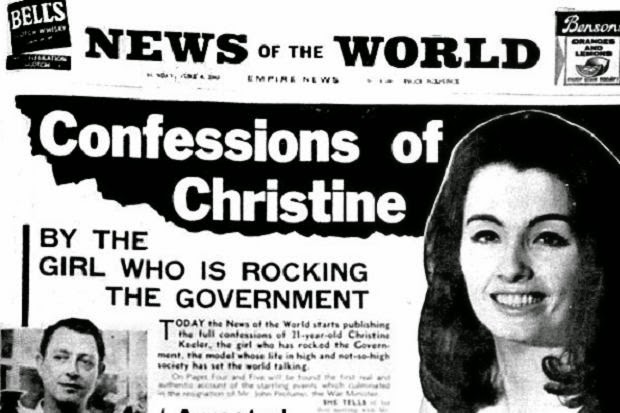
Christine Keeler (above) , in the words of her most famous victim, “seemed to like sexual intercourse”. She was uneducated, and uninterested in much beyond her own vagina. But in her chosen field she was an expert, the epiphany of common carnal knowledge  It seems at times that this high school drop out had sex with every male in mid-century London, including Soviet secret agents, American military officers, London policemen, bankers, drug dealers, musicians, doctors, lawyers, even members of the British Cabinet. And like a single woman Ponzi scheme, Christine's constantly crescive coitus circle eventually brought her into contact with the only male in London who wanted to hear this gorgeous uneducated woman speak. And he was the vile, despised and despicable John Lewis.
Their meeting occurred at a 1961 Christmas Eve party. Christine (above)  was, as usual, concerned only with her own problems, which were not insubstantial. Two weeks earlier, a former boyfriend, Lucky Gordon, had fired “several shots” at the front door of the tiny apartment Christine had once platonically shared with Stephen Ward. 
The publicity generated by that gunfire had killed her affair with British Secretary of State for War, John Profumo (above)...
...as well as scaring off  the other man she was concurrently  dating,  Yevgeny Ivanov (above), a Soviet naval attache  Christine recalled later that John Lewis “could not have been more helpful....” that Christmas Eve.   But the only five words John Lewis heard in Christine's hour long self absorbed diatribe was “Stephen Ward”, “John Profumo”, and “Soviet”.
Lewis had been trying to get the Fleet Street crowd interested in attacking Stephen Ward (above, left)  for a decade, they weren't, and  neither was the judge in Lewis' 1954 divorce case, who had dismissed his fantasies about Ward being a pimp. 
 But by adding the name of Profumo to his vendetta, Lewis acquired an ally, in the Conservative Party hatchet man, George Wigg (above). 
Wigg scurried off to repeat Christian’s rant to Conservative Party leader, Harold Wilson. And with his okay, Wigg then fed the “News Of The World” the story of a Liberal Party leader who was having an affair with a woman who was also having an affair with a Soviet Spy.
Christine Keeler (above)  met John Profumo while skinny dipping at a 1961 summer night pool party at  Lord Astor's country estate. She had been invited as a guest of Stephen Ward, who was Lord Astor's osteopath and who rented a summer house on Astor's property for one pound a year. Over that weekend, John Profumo got Christian Keeler's phone number, but the lady and the tramp went home with another party guest, Yevgeny Ivanov, who was in fact a Soviet secret agent.  Monday morning, Stephen Ward felt nervous enough to call his MI 5 contact to report the triangle that had formed in Lord Astor's swimming pool.
The three dominant sections of British Military Intelligence have always been MI 1, code making and breaking, MI 5, counterintelligence, and MI 6, intelligence gathering. In 1960 MI 5 thought they saw a chance to “flip” Yevgeny Ivanov, and they asked Stephen Ward, who knew Ivanov casually,  to befriend him. At their urging, Ward had invited Ivanov to the pool party at the Astor estate. But it was also Ward who warned the government that the Secretary of War might be dipping his wick into Christian Keeler, at the same time she was partying with the Soviet Agent.
Christine (above)  may or may not have slept with Ivanov.  She did sleep with Profumo, but in her own words she saw him merely as “a screw of convenience.”  Ward tried to penetrate her myopia to warn her how deep the water was by joking that she should ask Profumo when NATO was going to share nuclear weapons with the West German government.  Ward knew Christine well enough to doubt the stunning brunette knew what NATO was, or West Germany, or even nuclear bombs. However Ward's little joke would come back to bite his own ass, with teeth that belonged to John Lewis. 
During the summer of 1963 the London Press exploded with lurid details of Christine Keeler's sex life, her affair with John Profumo and a Soviet spy,  both of which had been arraigned, said the press, by Stephen Ward. Christine was having a ball, feeding the press dark and sexy stories depicting Stephen Ward as her pimp and tool for the Soviets. For an ego maniac, especially one as dim as Christine, it was a joy ride. 
Not everyone was having as much fun. Yevgeny Ivanov was called back to the Soviet Union before the story exploded. John Profumo first denied the affair, and then resigned after admitting to it. Stephan Ward (above, left center)  insisted he had been working for British Intelligence, who, of course, denied everything. Eventually Stephen Ward was charged with “living off the earnings of an under aged female” - i.e. pimping children.
As Stephen's trial was starting, Christine was in another court room, testifying at Lucky Gordon's trial, charged with shooting Stephen Ward's front door.  Eventually an appeals court would decided her testimony there had been unreliable, and probably perjury. But because the Foreign Office had yet to determine if national security had been breached (it had not), the accusations against her integrity were sealed. This left Stephen Ward's jury to take her headline inspired testimony as valid. 
Samuel Herbert (above), the Chief Inspector running the investigation broke quite a few rules, threatening to destroy anyone who testified in support of Stephen Ward.  And then, in his closing, the prosecutor reminded the jury that no one had come forward to defend Stephen. 
The entire trial was a travesty,  which drove Stephen Ward to take an overdose of sleeping pills. Rushed to the hospital (above) he died two days later. But the jury was still allowed to convict the dead man. 
That conviction helped to bring down the Liberal government, and made Harold Wilson (above) Prime Minister. Three years later 48 year old Inspector Herbert died of a heart attack. His will left only 300 pounds to his family. But his bank account contained 30,000 pounds, well over half a million dollars today.
The night Stephen Ward died, John Lewis celebrated with champagne in a London restaurant. There's political justice for you.
- 30 - 

Wednesday, November 11, 2020

UNDER PRESSURE cutting diamonds


I bet the the man who actually found the legendary jewel,was not Frederick Wells. It seems unlikely that in South Africa of 1905 a white man would have been at the dig’s face, where the danger was greatest, and where, in fact, the huge crystal was found. Still, the legend has it that Frederick spotted the rock embedded in the wall just above his head, reached up and pried what he first thought was glass out of the stone with his pen knife. And if that seems as unlikely to you as it does to me, we should both remember that everything about this particular artifact is unlikely.
The nursery where this carbon crystal grew was an odd place. First, the surface above it had to have been stable for 1 to 3 billion years – maybe three fourths of the age of our planet. And for all of that time 90 to 120 miles below this stable surface the temperature had to be a constant 1,000 degrees centigrade, and the pressure about 653,000 pounds per square inch. The longer a carbon crystal remains under that pressure and temperature, the larger the crystal might grow. And this one grew to one and a half pounds. There are only a few spots in the earth where the temperature and pressure has remained consistent for so long; beneath the Canadian Shield, beneath Siberia, beneath the center of the Indian subcontinent, beneath northwest Australia, and beneath South Africa.
The heat allows the molecular bonds of carbon atoms to become plastic, but does not break them down completely, while the immense pressure squeezes them into an eight sided crystalline shape. Over eons such carbon crystals grow slowly and they must be fairly common in these regions of the mantle. But then something unlikely happens. The earth burps.
If one of these carbon crystals rises to the surface slowly, over decades or even years, the atoms binding its carbon molecules together return to their fail-safe state, which is graphite – pencil lead. For carbon to remain a crystal, it must reach the surface in a burst, over no more than a minutes. To travel from the nursery to the surface, then, the stone must reach speeds of several hundred miles an hour. Such a speed can only be reached if the capping pressure is suddenly punctured by a narrow fissure, at which point the temperature and pressure produces a powerful pinpoint volcanic explosion at the surface. For that to happen is unlikely. But over a billion years unlikely becomes inevitable.
The first European who “owned” the surface above this jewel was a Dutch farmer named Cornelis Minnaar. But this was not Holland. It was the southern part of Africa, north of the River Valaal, 25 miles east of the city of Pretoria (Tshwane). The Boers, as these Dutch transplants called them selves, had made the trek to this region to avoid the British, who had stolen their colony. In 1861 Cornelis sold a section of his land to his brother, Roelof , who in 1896, sold an even smaller part to Willem Prinsloo (above) who was just starting a family. The sale price was 570 English pounds, and it was William who owned the land when another Dutchman named Fabricus arrived looking for buried treasure.
Being experienced in this sort of thing, Fabricus first inquired as to where the Minnarrs and Prinsloo households had dug their “sanitary pits”. This was a euphemism for the holes used to bury the products of your outhouse, politely known as “night soil”. Why dig a hole when a hole had already been dug? But since to date nothing unusual had been found in the sanitary pits, Fabricus assumed he would have to look elsewhere. Once he had located some “virgin dirt”, he scrapped away the thin red top soil, and then hacked his way through ten feet of yellow limestone gravel, the bi-product of primordial coral reefs, before reaching a blue slate gravel peppered with tiny red garnets, a rock called Kimberlite. Fabricus had struck pay dirt
Fabricius was working for an Englishman named Henry Ward, who had paid for the option so search on Prisloo’s land. But Ward didn’t have the money to make the buy, and besides Prisloo was not interested in selling at the moment, since it looked like war was about to break out between the Boers and the English. Which it did. After the war was finally settled in 1904 – The British won – Ward now sold out his options to Thomas Major Cullinan (above). By then Willem Prinsloo was dead. So Cullinan made an offer to William’s widow, Maria Prisloo.  Broke and defeated, she sold the farm for 52,000 pounds. Not a bad profit.
Cullinan and partners named their new venture "The Premier Mine". Production started at the end of April 1903, and in a year 2,000 people, mostly local Africans were blasting, chopping, digging and hauling blue Kimberlite out of the open pit. They were looking for diamonds.
Most diamond mines start out as open pits. A Kimberlite Pipe is famously “carrot shaped”, wide at the top, narrow towards the bottom. And after less than a year of digging, on 25 January, 1905, this new mine is credited with producing the largest gem quality diamond ever found.  Diamonds are not rare, but gem quality diamonds are. On average two hundred tons of ore must be culled for every 1 caret of gem diamond, (there are 141.7 carets in every once) and only one out of every five million diamonds weighs two carets or above. The one and one half pound diamond Mr. Wells claimed to have pulled out of the rock face that January afternoon, was rated at 3,106 carets. In the name of good publicity, it was named after Mr, Cullinan.
After a nondescript voyage to England via the royal mail in an unmarked plain brown box, The Cullinan, as it was now known, was presented to King Edward VII. He asked as many experts as he could find - geologists, gemologists and even the physicists Sir William Cookes (above) -  how to cut this hunk of rock.
Cookes noted that around a small black spot in the interior of the stone the colors were very vivid, changing and rotating round the spot as the analyser was turned. These observations indicated internal strain…there was a milky, opaque mass, of a brown color, with pieces of what looked like iron oxide. There were four cleavage planes of great smoothness and regularity.” At issue was how to turn this indescribably rare nondescript lump into something indescribably rare and beautiful.
Diamonds had been known by Europeans since the tenth century, but it was not until the 17th century that they became popular amongst the aristocracy, not until the first “Brilliant Cut” by Italian jeweler Jules Mazarin, really showed the beauty that was hiding inside. His diamonds sparkled with 17 facets, or faces, each one reflecting light back out at the viewer. By 1900 the skill of the diamond cutter had increased the possible reflections to 57 facets.
The general consensuses was that the best cutter for this job was Joseph Asscher, ironically another Dutchman. He studied the Cullinan for six months in his shop in Amsterdam, surrounded by a small crowd of bankers, experts and royal representatives, laying out a plan of attack.
As the London Evening News reported in mid-January, of 1908, “…a special model of the diamond in clay was made…It was cut into pieces to give an idea of what would happen if the genuine stone were treated in the same way. After several experiments a definite plan was arrived at…”
Finally, on Monday, 10 February, 1908, at 2:45 pm, Joseph was ready. Surrounded by a small crowd of anxious interested third parties, Joseph poised his hammer over the chisel, the blade of which was lodged against the precise point which he had calculated the first strike had to be made. If he missed, or struck a glancing blow, the one-of-a-kind diamond worth a million pounds would be rendered damaged and might end up being worth a few thousand. Joseph drew a breath, and sharply struck the chisel….which cracked apart against the diamond.
Immediately Joseph ordered the room cleared, except for the notary republic for the bankers, who were financing this entire thing. Joseph checked the Cullinan and found it, thankfully, undamaged. He checked his tools, re-examined his plans and announced a week's delay while he fashioned a new, larger, chisel.
So it was that on 17 February, 1908, alone in the room with the diamond and the notary, Joseph lined his hammer up for a second time over The Cullinan, and struck the precise strong blow, directly above the dark inclusion...and the diamond fell apart into three perfectly clear pieces. Despite legends to the contrary, Joseph did not faint. He did, however, drink a glass of Champagne.
The Cullinen was cut into nine large stones and 96 smaller diamonds, so many that it took 8 months just to polish them all. And if you ever get to the Tower of London, you might make a note that the Crown Jewels of England on display there, might be literally billions of years old, but they have only been in the royal families’ possession for about a hundred years. And they will always be a testament to the creation of timeless beauty under pressure.
- 30 -

Blog Archive