

I can prove the regularity of Senator William Blount's intestinal functions, because his enemies in the U.S. Senate depended on them. Their trap was sprung on a Tuesday morning, while Blount was visiting “The Necessity” behind Philadelphia's “Congresse Hall”. The Senatorial conspirators gained time because Blount had to go all the way downstairs and out to the little shed, to do his business. But they need not have rushed because he took his time – such things should never be hurried – and by the time Blout and returned from his seat to his seat, the letter had been read and William Blount's political career was toast. It was Monday, 3 July, 1797, and if he were not so arrogant (and regular) Senator Blount (below) might gone on to great things. I'll bet even the “Spitting Beast of Vermont” wished he had.

“Dear Cary”, the letter began, “I wished to have seen you before I returned to Philadelphia,...I believe the plan...will be attempted this fall...(and) in a much larger way then we talked about....I shall probably be at the head of the business on the part of the British...You must take care...not to let the plan be discovered by...any other person in the interest of the United States or Spain..William Blount.”

The plan was the invention of John Chisholm, who owned a tavern (above) across the street from Senator Blount's Knoxville, Tennessee mansion. Chisholm figured it was only a matter of time before Spain would be forced to sell their American colonies to France. And if France controlled Louisiana and Florida, they might deny American ships access to New Orleans. That would bankrupt all the western farmers in Tennessee and Kentucky. So Chisholm planned was to use local militia and Creek Indians to capture Pensacola and New Orleans, in the name of the British Empire - who would then promise to allow Americans to use New Orleans as if they owned it.

It was a fantasy of course, but the more Senator Blount thought about this idea, the more he thought it was his idea - particularly after he had improved it by creating a well paid job for himself as a British agent. So Blount wrote this letter to James Cary, who was a translator with the Creek Indian nation in eastern Tennessee. Senator Blount expected Cary to convince the Creeks to join the conspiracy. Instead, Cary shared the letter with his bosses in the War Department, who immediately shared it with President John Adams. Adams was a Federalist and he saw a chance to embarrass his own Vice President, Thomas Jefferson, who presided over the Senate (above) and was also the leader of the opposition party, the Democrat-Republicans - of whom Senator William Blount was an important member. So Adams sent a copy of the "Dear Cary" letter to Federalists in the Senate, but insisted it be kept secret until Senator Blount could do nothing to stop the public reading of the letter. Blount's toilet trip provided that opportunity.

By noon half of Philadelphia (above) wanted to hang Blount as a traitor, and the other half was trying to deny they had ever met him . The President's wife even said it was too bad America did not have the guillotine. Senator Blount was arrested trying to slip out of town. Dragged in front of the Senate he denied writing the letter. He was arrested anyway and posted bail. And once free he hightailed it back to Knoxville – where being part of an anti-government conspiracy had made him something of a hero. A week later the Senate voted 25 to 1 to expel him. For the next six months both parties downstairs in the House of Representatives, Federalists and Democrat-Republicans, tried to make the impeachment of Senator Blount work for them in the upcoming 1798 Congressional elections. And that is how our story came to involve an expectorant infused Congressman from the Green Mountain State.

His name was Matthew Lyon, and he had been a Second Lieutenant in the Green Mountain Boys when they captured Fort Ticonderoga in 1776. The next year General Horatio Gates ordered Captain Lyon to take 60 men north to the Onion River. And just as they arrived, word came of a party of 500 Indians coming to attack them. Lyon said later, “The soldiers considered themselves sacrificed”, and they decided to retreat. Despite Lyon trying to talk his independent minded soldiers to stay, Gates still ordered Lyon arrested and tried before a military court. Found guilty, Matthew lost his command, but he was not reduced in rank. Captain Lyon later fought bravely in the battles of Bennington and at Saratoga, rising to the rank of colonel. After the war the Vermont hero twice ran for election to Congress, and failed when the court martial was used to smear him. Third time was the charm, however, and in 1796 he finally won election, as a radical Democrat-Republican. Two years later he was even re-elected.

And that was how Lyon ended up delivering a speech from the well of the House chamber (above) on Tuesday, 30 January, 1798. In his speech Lyon chastised the Connecticut Federalists for not defending the honor of their citizens by impeaching Senator William Blount. That suggestion brought Federalist Connecticut Congressman Roger Griswald to his feet. As Lyon stepped away from the podium, Griswald, in his best snarky voice, asked if Lyon would be defending the people of Connecticut with his wooden sword.

Now, Lyon never had a wooden sword. Occasionally, an officer convicted of cowardice would be required to wear a wooden sword, as a way of embarrassing him before the army. That had not happened in Lyon's case, because he was not accused of running from the enemy, but was tried for not maintaining discipline among his men. General Gates' later career provided ample evidence of his cowardice and incompetence, as Lyon's later career provided evidence of the reverse. But that was reality, and politics is about image - just ask John Kerry who was Swift Boat'ed over 200 years later.

Well, Lyon had been hearing this Federalist smear since the war. It had been used to defeat him twice in his congressional campaigns. And hit in the back of the head with it, the Green Mountain boy in Lyon reacted instinctively. He spun on Roger Griswald, and spit in his face. We can assume it was pretty disgusting logy. The forty year old Lyon was a tobacco user, and mouth wash and dentistry were still in their infancy. And then, having expectorated his peace, Lyon turned his back on Griswald again. In the words of an historian, from that moment “No man in the whole Republican party...(not even) Thomas Jefferson...was so hated and despised (by Federalists) as Matthew Lyon.” Griswald went ape and charged at Lyon.

Cooler heads from both sides rushed to separate the two combatants. And then, this being Congress, the argument about the traitor Senator Blount became about the “spitting Lyon” and the hot head Griswald. Federalists wanted Lyon censured for “gross indecency” - for spitting on a college - making him the first Congressman honored with an ethics charge. Democrat-Republicans wanted Griswald censured for the insult, making him the second Congressman so honored. In the end, both charges were dropped. So two weeks later, it got worse.

On Thursday 15 February, Roger Griswold entered the house chamber carrying a cane he had been loaned by a friend. He walked directly to Matthew Lyon's desk, and without warning began beating the Democrat-Republican with the stick. Covering his head, Lyon struggled to his feet, and retreated toward the fire pit, meant to take the morning chill off the chamber. He grabbed a pair of tongs from the wood pile, and began an insane fencing duel with his attacker (above). Again, cooler heads separated the two

The spitting only made the attacks on Matthew Lyon's honor louder. One bad Federalist poet even manged to include the insult into an ode to a theatrical Boston pig. “You boast your little pig can spell the hardest word; But did your little pig ever wear a wooden sword?....Though your piggy screws his snout in such learned grimaces, I defy the squeaking lout to spit in Christians’ faces...,Then tell us no more of your little grunting creature, But confess that the LION is the GREATEST BEAST in nature.” As I said, he was a bad poet.

The Spitting Lyon so angered the Federalists members of Congress, it made it easier for them to pass both the Alien and the Sedition Acts, the second of which was signed on 14 July, 1798, six months after the assault by and on the “Spitting Lyon.” It's actual title was “An Act for the Punishment of Certain Crimes” (above), the crimes being writing or publishing anything false or malicious against members of the government. It also forbid the defendant from pleading the truth of their writing as a defense. Three months later, on 10 October, Matthew Lyons was convicted under the Sedition Act, and sentenced to four months in jail.

But Representative Lyon had the last laugh. Twice. First he was re-elected from his jail cell, with 55% of the vote. Then, the Presidential election of 1800 was a tie, and thrown into the House of Representatives. The contest became a 35 ballot knock down drag out between Democratic Republicans Jefferson and Aron Burr, engineered by the lame duck Federalist majority. The issue was finally settled on the 36th ballot, when the Federalist Representative from Vermont abstained. This allowed Matthew Lyon, the Democrat-Republican from Vermont, to cast the deciding ballot making Thomas Jefferson Third President of the United States.

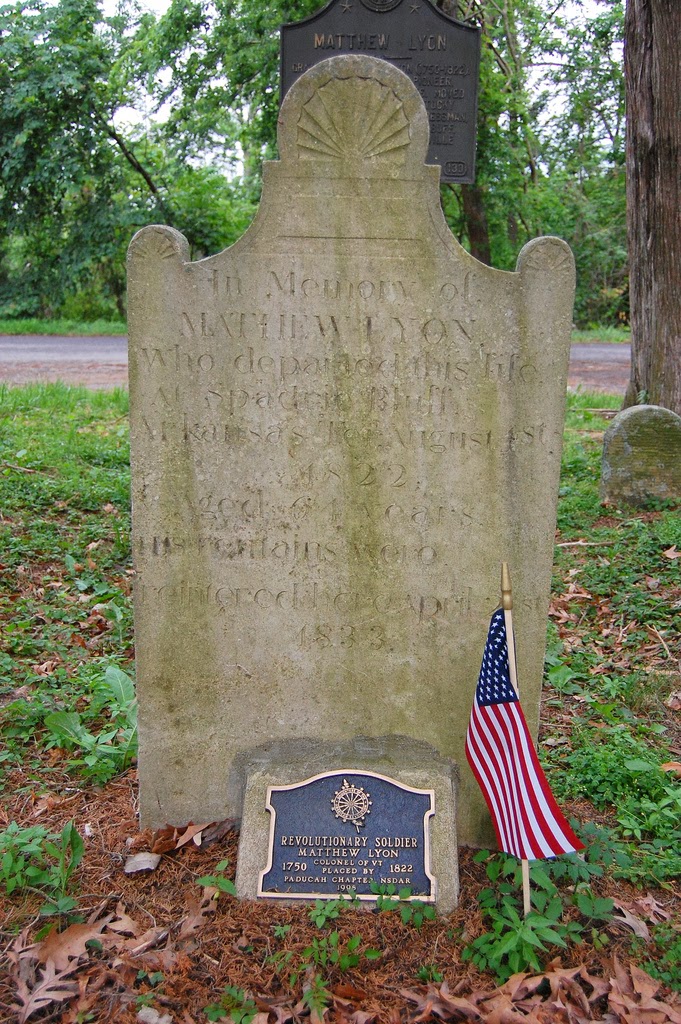
So it turned out, Senator Blount's act of betrayal did not end up preventing Jefferson from winning the White House. The arrogant Blount did not witness the victory, having died in his home (above) during an epidemic in March of 1800. The next year Matthew Lyon moved to Kentucky, and won election to Congress from that new state six times, finally retiring in 1811, and dying in 1822. The Spitting Lyon, the Green Mountain Beast, was then buried in the Blue Grass state (below). And what a shame we have allowed his memory to fade, in part because we insist upon neutering our "founding fathers" - denying them and us both our shared humanity, warts and all. The lessons are usually in the warts, you know.
- 30 -


 The Royal Observatory was founded by Charles II in 1765 as part of his restoration and “re-scientific-ication” of government after the religious fanaticism of that great Puritan villain Oliver Cromwell. The observatory was to use the stars to perfect “the art of navigation.” But the builders, despite going over budget by all of twenty pounds, went cheap on the materials, and the observatory, which was to house the most accurate telescopes of the day, was constructed 13 degrees out of alignment. The Royal astronomers, like the NASA astronomers dealing with the deformed mirrors on the orbiting Hubble telescope, have had to make mathematical adjustments from that day to this.
 But besides powerful telescopes, the scientist at the Greenwich observatory also needed accurate clocks. In order to say a particular star was at a particular point in the sky at midnight, they had to know precisely when midnight was. So they also installed two pendulum clocks, built by Thomas Tompion, each accurate to within seven seconds a day. By 1833 (sixty-four years later) the observatory had done its job so well that ships’ captains and navigators had come to rely on the precise time provided by Greenwich to follow the charts provided by Greenwich. That year the observatory began a practice they follow to this day.
 At exactly 12.55 p.m., (they do it then so as not to interfere with the weather observations made at noon) a large red “time ball” is raised half way to the top of a mast erected atop the observatory. At 12.58 the time ball is pulled all the way to the top. And then at 1:00 P.M., exactly, the ball quickly falls to the bottom of the mast. (If you have ever wondered why they use a ball to mark midnight on New Years Eve in Times Square, New York City, this is it.) Any ship’s captain waiting in the Thames River to set sail could now coordinate their shipboard watches and clocks with the official time as they set off from the “prime meridian” or “longitude naught” - "0" degrees, "0" seconds and "0" minutes east/west, because Greenwich is where longitude starts - and time.
 Two years later, in 1835, the observatory got a new boss, George Biddle Airy. He figured his primary job was to perfect the astronomical observations for those ships, and he hired more “computers”, which in the 19th century were actually men who did the dull and boring math required to confirm and correct the stellar charts used to navigate on voyages to the far flung corners of the empire. So when the London merchants appealed to Mr. Airy to share in the time service he saw them as an annoyance. He asked one of his assistants, a man not qualified to be a “computer”, Mr. John Henry Belville, to handle the problem.
 Airy gave Mr. Belville a pocket watch to use. It had been originally owned by Prince Augustus Frederick, the Duke of Sussex (above), the sixth son of George III, the favorite uncle of Queen Victoria and the man who gave her away at her wedding. The watch had been made by Mr. John Arnold & Sons in 1794 and it was accurate to within one tenth of a second per day. Each Monday John Henry (he rarely used his last name because of the anti-French public bias in post Napoleonic war Britain) would present himself and “Faithful Arnold”, the watch, to a clerk at the observatory time desk. The clerk would set the watch and then hand John a certificate asserting to the watch’s accuracy for that day. Then John Henry would make his way by carriage and rail to London, where he would literally deliver the time to some two hundred customers; shops, factories and offices. He charged for the service, of course. For most of the people in London, John Henry Belville was the face of official time, and he was earning four hundred pounds a year doing it when he died in 1856.
 After John’s death his widow, Maria, still had a daughter to support. She begged the observatory to allow her to continue the time service as a private business, and they agreed. By now (1852) Charles Shepherd had designed and installed a “Galvano-Magnetic” clock (above) at the Observatories’ gate (now called Shepherd’s Gate) where anyone could get the time at any time day or night, for free. But still the London merchants continued to pay for Maria’s direct door service. Every Monday she strode up the observatory hill, watched while Arnold was synchronized with the official time, and then went on her rounds by rail and on foot. To those who saw her trudging across the streets of London, she became known as the Greenwich Time Lady.
 Maria retired in 1892, and her daughter Ruth now took over the employment (above), carrying the tool of her trade, Faithful Arnold, in her handbag. By now (1884) 25 countries had agreed to set their watches by Greenwich time, and every clock at every railroad station in England was connected directly via telegraph lines with the Royal Observatory. And still, the time delivered by Ruth Belville was just as accurate, if slightly less convenient.
 Beginning in 1924 the BBC Radio began broadcasting “pips” before each hour announcement and in 1936 the Royal Observatory set up a “talking clock” which anyone with a telephone could dial at any time to get the correct time to within a hundredth of a second. And still Ruth Belville was making her rounds, still serving more than fifty paying customers over a hundred years after her family business had begun.
 Finally, in 1940, Ruth celebrated her 86th birthday and decided to retire. In America we would have long since replaced her with newer technology. But the English have more respect for keeping what works, particularly if it is a living person. On her retirement, Ruth agreed to pose for a photograph (above), looking a bit like a visitor from another time in 1940's London. And , since she had no one to pass the task on to, when Ruth retired the Belville family work was finally completed.
 In effect, she ran out of time.


