August 2025

August  2025
I DON'T NEED A RIDE. I NEED AMMUNITION.

Translate

Tuesday, September 20, 2016

PAYBACK

I should point out that when Martin Van Buren (above) was dumped into an Indiana hog wallow, ruining a very expensive pair of pearl gray trousers and coating his elegant frock coat with everything a happy swine leaves behind in a porcine sauna, it wasn't entirely fair. Of course “The Red Fox of Kinderhook” was far too crafty a politician to admit he had been humiliated. That would just draw more attention to his humiliation. As the venomous Virginia politician John Randolph observed, Martin Van Buren always “rowed with muffled oars.” But everybody knew this traffic accident had been staged as payback for Van Buren's insult to Hoosiers. What goes around comes around. And it was useless to point out that the insult to Hoosiers had mostly come from Van Buren's predecessor, the still popular Andrew Jackson.
Even the frail shadow of federal authority which existed in 1828 was too much for President Andrew Jackson. Over his two terms, he did his very best to weaken the Federal government, in all its endeavors except the ones he approved of. The ideology that argues against "big government" is still powerful in American politics today. Jackson vetoed a new charter for the National Bank - precursor of the Federal Reserve - which left the entire banking system unregulated. He streamlined the sale of public lands, which energized the speculators who were overcharging the yeoman farmers. He cut entire programs out of the Federal budget, and insisted the states take over many others. And at the same time he backed the Seminole Indian nation into a war.
But it was not until three months after Van Buren's inauguration in March of 1837 that these pigeons came home to roost. The massive real estate bubble suddenly popped. Over half of the nation's unregulated banks suddenly failed. And by January of 1838 half a million Americans were unemployed. Or to put it more simply, suddenly it was prom night and Martin Van Buren was Carrie. And like Carrie, Van Buren then made things worse by slashing out at everything in sight. Oh, he continued the unending expensive Seminole war. But he insisted on killing Federal funding for the National Road, which had reduced mail time between Washington and Indianapolis from several months to less than a week. Van Buren was so doctrinaire he even sold off the construction workers' picks and shovels. And for frontier farmers trying to get their produce to market, that made any economic recovery that much harder.
See, once across the Ohio border, the $7,000 a mile construction costs for the National Road was supposed to be supplied by land sales. But when the real estate bubble popped in 1837, that funding evaporated. Maintenance for the 600 mile road was paid for by the tolls of four to twelve cents (the equivalent of $2.50 today) for each ten mile long section, paid by the 200 wagons, horseback riders, farmers and herds of livestock that used each section of the road every day. But after 1837 that $36,000 a year (almost a million dollars today) had to do double duty, finishing the road and providing maintenance for the road already finished.  And it was not enough money.
Particularly in Indiana, there were long sections beyond the two urban centers, ((Indianapolis and Richmond) where farmers using the road to drive their livestock to market faced forests of 14 inch high tree stumps. These provided clearance for the farmers' and emigrants' high riding Conestoga wagons, but between the stumps, the road bed was in such bad shape that constant repairs to their equipment bankrupted many of the 200 stagecoach lines trying to survive in Indiana. And every frontier farmer and businessman knew exactly who was to blame for all of this –“President Martin Van Ruin”.  As a result, in the election of 1840, in Hendricks County, (just southwest of Indianapolis), and along the National Road, Van Buren received 651 votes, while Whig candidate William Henry Harrison received 1,189 votes. Nationwide, Van Buren carried just 7 of the 26 states.
Normally this Hoosier hostility would not have mattered much, but just six months after taking office, the new President Harrison died of a pneumonia, and all previous assumptions had to be rethought . The Whigs had picked John Tyler as Vice President, mostly to get rid of him. Now, disastrously, he was the head of their party. The overjoyed Democrats began referring to Tyler as “His Accidency.” The adroit and dapper Martin Van Buren began thinking he could avenge his defeat and take the road back to the White House in 1844. All he needed was a cunning plan, which he just happened to have. 
In February of 1842, Van Buren (above) journeyed to Nashville, Tennessee, for an extended visit with his mentor, Andrew Jackson, hoping some of Old Hickory’s popularity would rub off on him. It did not. Heading north, Van Buren then set off for a tour of the frontier states. He was well received in Kentucky, and the pro-slavery areas around Cincinnati, Ohio, but the closer he got to Indiana the more reserved the crowds became.
In early June he was met at the Indiana border by 200 loyal Democrats. Van Buren gave them a speech at Sloan's Brick Stage House on Main Street (the National Road) in Richmond, Indiana. But the vast majority of the local Quakers remained skeptical. And while Van Buren was speaking, noted the Richmond Palladium newspaper, “...a mysterious chap partially sawed the underside of the double tree crossbar of the stage...so that it would snap on the first hard pull…”
The next morning the stagecoach and its distinguished passenger headed for Indianapolis, the “Capital in the Woods”. But just two miles outside of Richmond, while bouncing over ruts and stumps, the carriage splashed into a great deep mud hole. And when the horses were whipped to yank the carriage out, the weakened cross brace snapped. Dressed in his silk finery, Martin Van Buren was forced to disembark into the foul waters and wade to shore.
There was no indication of any further sabotage on Van Buren's 74 mile ride across the mostly open prairie, which took the better part of three days because of the road's condition. And the ex-President and candidate made it to the Hoosier capital in time to keep his appointments and make his speeches over the weekend of June 9-10. He took two more days to make political contacts, shaking hands and trading confidences, before, on Wednesday, June 13, he boarded yet another mail coach for the 75 mile journey to Illinois. But just six miles down the road, Van Buren had to pass through another Quaker bastion, this one called Plainfield, Indiana.
The town earned its name from the “plain folk” who had laid out the town ten years earlier on the east bank of White Lick Creek. This Henricks county town was straddled by the National Road, which provided Plainfield's livelihood. Less than a quarter mile up Main Street from the  ford over the "crick", amidst a stand of Elms, the Quakers had built a camp ground and a meeting house. And here, that Wednesday morning, were gathered several hundred Democrats and Wigs (mostly Quakers in their “Sunday, go to meeting clothes”), to see the once and maybe future President ride past. The crowd may have even been increased because the driver of this particular leg of the President's journey was a local boy, twenty-something Mason Wright. Soon, the crowd heard the blast of the horn from Mason's lips, warning of the VIP's bouncing approach down the gentle half mile slope toward White Lick Creek.
The disaster occurred abruptly. The coach rushed into view, with Van Buren's arm waving out of the coach's open window, while Teamster Wright whipped the horses to move faster. Faster? Shouldn't he be slowing down to let people get a view of the President?  And then, just as the carriage came abreast of the center of the campground, the coach was forced to veer to the right to avoid a large "hog waller" mud hole in the very center of the dilapidated National Road. And as if  it had been planned, the right front wheel bounced over the hard knuckle of an exposed bare elm root. The carriage teetered for an instant until the rear wheel clipped the same root. The teetering coach then careened past the point of no return.  Mason Wright leaped free while the coach crashed heavily onto its side into the very center of the smelly, sticky, hot black hog waller. Martin Van Buren had been dumped upon.
A Springfield Illinois newspaper would note a few days later, “He was always opposed to that road, but we were not aware that the road held a grudge against him!” Wrote a more bitter Wig newspaper, “the only free soil of which Van Buren had knowledge (of) was the dirt he scraped from his person at Plainfield.”  The driver and witnesses blamed the Elm (above), which could not defend itself. Van Buren was uninjured, but once again had to extricate himself from his injured coach. After pouring the mud and other unidentified muck from his boots, Van Buren made his way on foot further west along the National Road to Fisher’s Tavern, at what is now 106 E. Main Street. There, Mrs. Fisher helped the President clean up his pants and coat, and wash the mud from his wide brimmed hat.
Back at the campground. the honest Quakers helped to right the stage, re-attach the horses, and carefully and respectfully deliver the coach to Fishers to collect the President. But it is hard to believe that, as Mr. Van Buren splashed across White Lick "crick" many of those Quakers were not smiling with the sly satisfaction of a job well done. 
A few days later Teamster Mason Wright was awarded a $5 silk hat, although it was never explicitly stated it was for his skill in staging a stage crash - call it political slapstick. But the tree who's root had provided the fulcrum for the prank would forever more be known as the Van Buren Elm.  In 1916 (above) the Daughters of the American Revolution even gave the tree a wooden plaque of its own.
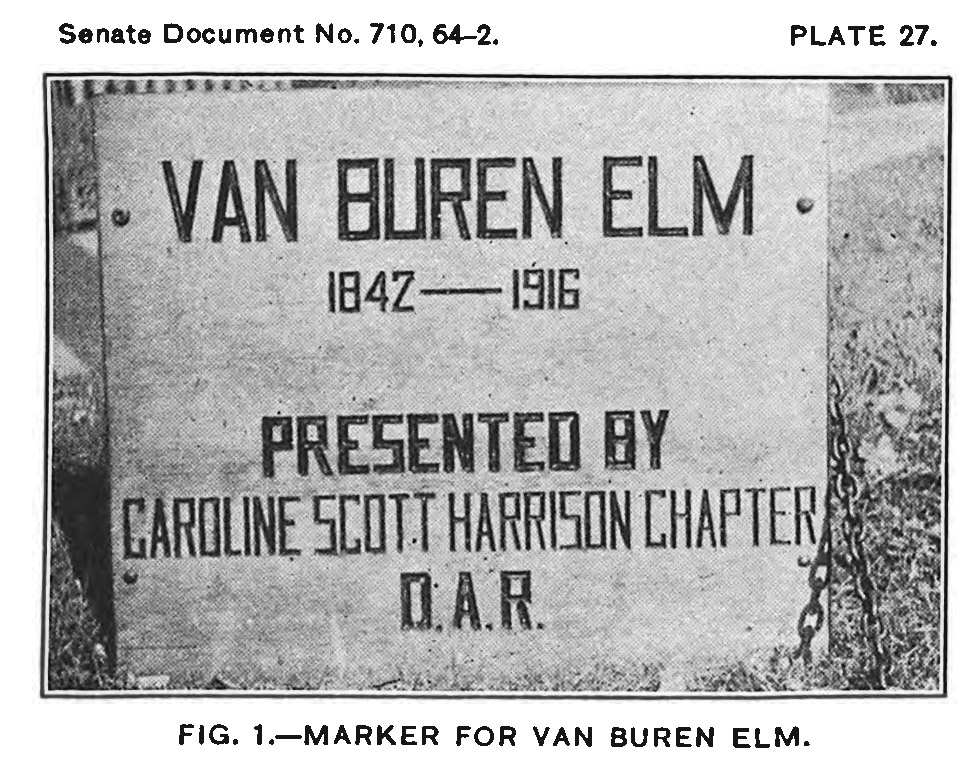
But the hard winter of 1926 brought the Van Buren Elm down, and a local doctor lamented, “The many friends of the old historic tree are loath to have it removed from their midst.”
Van Buren (above) made it safely to Illinois without further accidents. He was  met a few miles outside of Springfield by a small delegation of legislators, including the young Abraham Lincoln. But Mr. Van Buren was never elected to public office again. The judgement of Hoosiers stood firm.
The Quakers' Meeting House still stands among the stand of Elms at 256 East Main Street (corner of Vine) in Plainfield.  After the original Van Buren Elm fell, a replacement was planted, and in memory, the old tree received a bronze plaque (above).  This inspired a local grade school to be named for the dapper Democrat who stumbled in their town, and a street was named after him as well. But in Plainfield the National Road (now U.S. Route 40), is still called Main Street. That is true of many Midwestern towns bisected by the National Road. They truly were America's Main Street. And Martin Van Buren and Andrew Jackson had both been wrong about that. But it was Van Buren who took the fall.
 - 30 -

Monday, September 19, 2016

NO MISTER NICE GUYS

I think everybody liked Robert Williamson Steele. Every one who knew him speaks in glowing terms; he was genial, honest, an entrepreneur, a good neighbor and a true friend. Maybe he was a little distracted by his pursuit of money, but that's no sin in America. Then, in 1860, with the Civil War building to a roiling boil, “J.W.” presented the Federal government with a ready-made, right-out-of-the-box, pro-union local government to smooth passage of the gold rich Colorado territory into the federal union. And his fellow politicians turned him down flat. For some reason they just didn't trust “JW”. And that was only partly because he was a Democrat.
See, in the 1850's there were only two kinds of Democrats, southerners willing to go to war to protect slavery and northerners who were willing to make any compromise to keep southern Democrats happy. The leader of the latter group was Senator Stephen Douglas of Illinois, who shepherded the Compromise of 1850 through Congress - protecting slavery but keeping it south of the Kansas border. And then four years later Douglas flip-flopped with his Kansas-Nebraska act, which let the locals decide the issue of slavery. His spin was “Let the people rule”, but the effect was to allow slavery supporters to drag their grievances north, across the Kansas border, where they barged into abolitionists. This intimate mixing of political ideologies set off “Bleeding Kansas” where neighbors like John Brown began settling political arguments by literally beheading their opponents. That was the real start of the American Civil War; not at Fort Sumter in 1861, but in Kansas in 1855. And, surprisingly, if anybody had taken notice, a practical solution to the political anarchy unleashed by Senator Douglas had appeared in July of 1858.
William Greenberry Russell was a Georgia peach who was a “49'er”. He had been fairly successful in the California gold fields, running other people's claims. But he really struck gold with his in-laws. His wife, Susan Willis Russel, was 1/8 Cherokee, and that side of her family had been forced marched across the Mississippi River in the infamous Trail of Tears, back when Kansas and Nebraska were supposed to be the new “Indian Territory”- like Indiana before them and Oklahoma afterward. Separate but equal has never worked in America, not for Indians, not for blacks, not for women and not for gays.
Anyway, Susan's Cherokee relatives wrote her about rumors of gold in the Rocky Mountain foothills. Looking to make his own fortune, Russel immediately rushed To Denver. One early July day he panned 20 ounces of gold out of Cherry Creek, a tributary of the South Platte River. And news of that one day bonanza was like opening a safety valve on an overheated steam engine. Overnight, violence levels across Kansas dropped as the most adventurous (meaning the most violent) young males packed up all their excess energy and marched 300 miles westward toward the 14,000 foot high Pikes Peak. They weren't actually going to Pike's Peak, but it was the most visible bit of the Rocky mountains as you crossed the rolling prairies; thus “Pike's Peak or Bust”.
Over the first two years of the Pike's Peak gold rush, one hundred thousand abolitionists and pro-slavery men came pouring out of Kansas and Nebraska. You might have expected a repeat of Bleeding Kansas in the gold fields. In 1860 a Kansas newspaper noted that “It is difficult...to walk half a square (mile) in Denver, without meeting some familiar face...” So the “59'ers” were the same folks who had been shooting each other back in Kansas in '58. Oh, they were still shooting each other in the gold fields, just not over slavery. Now it was over failed business deals and cheating at cards. In fact, it seems that all these violent people were suddenly no longer interested in politics. Greed had changed the political ethos.
The two largest towns in the region sat right atop the gold fields. One, Auraria, even adopted the Latin word for gold as its name. But the other was named to curry the favor of the governor of Kansas Territory, James W. Denver. See, the gold fields were part of the huge Arapahoe County, Kansas Territory, and the residents of the town of Denver were hoping for win favorable treatment over Auraria.. But by the time the town of Denver had adopted its new name, Governor Denver was out of office, and the toadying to him did them no good. So Denver the town returned the favor. They kept the name, but when the ex-governor visited his namesake, the residents largely ignored him. And that would prove the new reoccurring theme in Colorado politics.
Being ignored by territorial officials in distant Kansas, on 5 September, 1859, the citizens of Denver and Auraria voted to form their own government, which they labeled the Provisional Government of Jefferson Territory. They laid claim to a huge expanse of plains and mountains, almost as big as California or Texas. The genial Robert Williamson Steele, a lawyer out of Chillicothe, Ohio was elected Governor. Not yet forty, his sole qualification was that he was genial and had served a single term in the Nebraska Territorial legislature before catching gold fever. The prickly Pennsylvanian born lawyer, Lucien W. Bliss, was elected Lieutenant Governor. He had sought his fortune in Leavenworth, Kansas, but had moved on to Denver where he helped start the Rocky Mountain News, and a couple of freight lines. And they were typical of pretty much everybody in the the self proclaimed Territory.
Everybody in Jefferson who wasn't actually mining gold, was trying anything they could to make money off those who were. Governor “J.W.” even started a town in the foothills 12 miles west of Denver, which he called Mount Vernon.(He had a Tea Party 'thing' about the founding fathers). He sold town lots, and built toll roads heading to the new mines further up-slope. Lt. Governor Bliss started a couple of freight lines of his own, hauling equipment, food and fuel into the mines, and carrying the ore out. All of the men elected to the Jefferson Territorial legislature were only part time politicians, often business partners with their political allies and enemies. Even the judges appointed had to fit court sessions into their busy schedules - one of them never did show up for work. And Oscar Totten had been elected clerk of the Supreme Court because nobody else wanted the job.
The whole rickety structure survived for only 16 months. You see, most of the residents of Jefferson Territory, like their political leaders, saw themselves as entrepreneurs first. And being businessmen they hated to pay taxes. So, they supported their new government with a one dollar poll tax. But the natural response from all these entrepreneurs when faced with a tax on voting, was to not vote, and thus not pay the tax. This left the Provisional Government of Jefferson Territory on a very shaky financial and political foundation, made worse by the rickety nature of any business on the frontier.
Of the 100,000 who had joined the Pikes Peak gold rush, seven out of ten went bust and headed back home. The 1860 census of “Jefferson Territory” could find only 25,329, still looking for their Eldorado.  Governor “J.W.” argued that many had gone uncounted because they were working isolated claims up in the hills. But being isolated, said the census takers, meant they were not interested in being counted, and so, they should not count. And the evidence was in the ballot box. The vote to create the Provisional Government of Jefferson Territory had been 1,852 to 280 – barely 2,000 participating citizens out of the supposed 25,000 - not what you would call a “popular” election. Certainly Washington didn't call it that.
After their request for recognition had been rebuffed by Washington, in August of 1860 “J.W.” asked Kansas Territory to absorb Jefferson Territory and its power structure, meaning himself and all those other entrepreneurs. Kansas didn't say no, but they didn't say yes, either. They just waited. In November of 1860, Abraham Lincoln of Illinois won election as President of the United States, sweeping the Republican party into power. They were made stronger when most of the southern Democrats walked out, to form the Confederacy. On 29 January, 1861, the new Republican Congress voted to admit the state of Kansas into the union, as a free state, sans the territory claimed as Jefferson. One month later, on 26 February, 1861, the Republican congress created the Territory of Colorado, ignoring the Provisional Government of Jefferson Territory to death. A month later the rebels in Charleston, South Carolina opened fire on Fort Sumter, and the civil war began in earnest.
On 3 June, 1861, Stephen Douglas died in Chicago, of typhoid fever. Three days later “J.W.” admitted reality, declaring the Provisional Government of Jefferson Territory disbanded. It had lasted barely 16 months. And even before it was gone, nobody missed it, not even its leaders. Lt. Governor Lucien Bliss eventually sold his businesses at a profit, and moved on to Montana, where he repeated his success. But Robert Williamson Steele, like most early entrepreneurs in Colorado, was not quite as successful.
His toll roads closed when the mines they served ran out in the early 1860's. His town of Mount Vernon died shortly thereafter. Today, the only thing to mark its existence is an abandoned cemetery and a roadside plaque. “J.W.” fell back on the law to make a living, but he kept prospecting in his spare time. He lived a long and a productive life, and everybody liked him, right up to his death in Colorado Springs in 1901.
And I suppose if you believed lives can teach lessons, you should remember that genial makes for a good politician, but it ain’t enough to make a viable government - and neither do entrepreneurs. Good government requires shared sacrifice and commitment. And people infected with gold fever aren't interested in sharing anything.
- 30 -

Saturday, September 17, 2016

TEMPEST IN A TEA POT

I am tempted to call his life a tempest in a tea pot. It was a “Tempest” worthy of William Shakespeare only because Albert Bacon Fall (above) was a scoundrel of operatic proportions, a self made legal sorcerer and a bombastic, selfish, fearless and vulgar cowboy Caliban. His villainous reputation was established by a mysterious double murder in the New Mexico desert. But the climax was staged on 9,480 rolling Wyoming acres along Salt Creek and adjacent to a subterranean anticline dome near an odd looking 75 foot tall sandstone butte (below). Some thought the butte resembled a tea pot, which gave its name to the scandal that finally brought our reprobate down. But the true scandal was Albert Fall's entire career.
You taught me language; and my profit on't Is, I know how to curse.”
Caliban - Shakespeare's “The Tempest” Act I, Scene 2
Near the low crest of Chalk Hill (above) the search party found a patch of blood soaked sand and some papers belonging to 57 year old Republican lawyer Albert.J. Fountain. A hundred yards further on, Mescalero Apache scouts found where a man had knelt in ambush, the casings ejected from his rifle, still in the dust. The buggy tracks led eastward 12 miles into the Jarillas Mountains (above, bg), where the search party found Fountain's carriage “plundered and abandoned.” Still in the buggy was a note reading, “If you drop this we will be your friends. If you go on with it you will never reach home alive.” And stuffed under the seat was a kerchief wrapped around some change, belonging to 8 year old Henry Fountain. Neither the father's nor the son's body was ever found.
The clouds methought would open and show riches, Ready to drop upon me that, when I waked, I cried to dream again.”
Caloban - Shakespeare's The Tempest, Act III, Scene 2
When he was accused of masterminding the 1896 Fountain double homicide, Albert Fall said it was just Republicans trying to “crucify innocent Democrats”. The criminal indictments Fountain had just secured against 23 clients and friends of Albert Fall were likewise dismissed as political. In a courthouse jammed with the alleged killer's allies, threatened and intimidated witnesses simply failed to show up. But Albert Fall still managed to be arrogant and offensive in his one sided victory. The Democrats were all found not guilty. And then, two years later, Albert Fall switched parties and became a Republican. And all his friends found it profitable to go with him.
I'll show thee every fertile inch o' th' island; And I will kiss thy foot: I prithee, be my god.”
Caloban - Shakespeare's “The Tempest” Act II, Scene 2
After having fought statehood for years as a Democrat, in 1912  when statehood came, newly minted Republican Albert Fall became one of New Mexico's first elected U.S. Senators.  In Washington, D.C.,  Albert became famous for two things - his alcohol fueled poker parties with Ohio Senator Warren G. Harding, and his unrelenting animosity toward Democratic President Woodrow Wilson. When Wilson suffered a stroke in 1919, Albert alleged he had been rendered mentally incompetent. At their October examination, Senator Fall hypocritically assured the bedridden Wilson, “I have been praying for you, Sir.” Looking up at his torturer, Wilson inquired, “Which way, Senator?” Albert joined in the laughter, but in November of 1920 it was Senator Fall's drinking buddy, Republican Warren G. Harding who was elected President over Wilson.
Ban, 'Ban, Cacaliban, Has a new master: get a new man. Freedom, hey-day! hey-day, freedom!”
Caloban - Shakespeare's “The Tempest” Act II, Scene 2
Harding wanted Albert Fall to be his Secretary of State, but party leaders insisted on someone more trustworthy. Said Harding, “If Albert Fall isn't an honest man, I'm not fit to be President of the United States.” When the party leaders refused to back down Harding named Albert his Secretary of the Department of the Interior, a branch of government Albert had been denouncing for decades. Almost the first thing after taking the oath in the spring of 1921 (above), Secretary Fall cajoled Harding into giving Interior control over the U.S. Naval Oil Reserves in California and Wyoming. Fall then quickly granted a no-bid lease for the two reserves in California to oilman Edward Doheny, and in December Albert did the same for oilman Harry Ford Sinclair, granting him sole access to the Tea Pot Dome field, also known as Naval Reserve Number Three.
Do that good mischief which may make this island Thine own for ever, and I, thy Caliban, For aye thy foot-licker.”
Caloban - Shakespeare's “The Tempest” Act IV, Scene 1
In the spring of 1922, the railroad town of Casper, Wyoming, 35 miles south of the dome, was abuzz with rumors of equipment bearing the name Mammoth Oil Company which had suddenly invaded the naval reserve. Competitors like New Yorker James Darden quickly pierced that deception, and certain the lease granted to Sinclair was not legal, Colonel Darden decided to become Sinclair's unofficial partner by drilling his own well sideways, into the same dome. As Fall himself explained, “Sir, if you have a milkshake and I have a milkshake and my straw reaches across the room, I’ll end up drinking your milkshake."
I will have none on't: we shall lose our time, And all be turn'd to barnacles, or to apes With foreheads villanous low.”
Caloban - Shakespeare's “The Tempest” Act IV Scene 1
The problem for Secretary Fall was the “low down son-of-a-bitch” Darden “was an old friend of President Harding. So on a Saturday afternoon, while the Secretary of the Navy was out of the office, Fall told the the Acting Secretary that Harding wanted “squatters” thrown off the dome. Fall added there was ample legal precedent for using U.S. Marines for this duty. There was none, but Fall never showed reluctance in lying to make a profit. Within the week Captain George K. Shuler and four enlisted marines were slapping “No Trespassing” signs and padlocks on Colonel Darden's well. And because this was done in front of reporters, Albert Fall had finally taken one step too far.
I shall laugh myself to death at this puppy-headed monster. A most scurvy monster! I could find in my heart to beat him
Caloban - Shakespeare's “The Tempest” Act II Scene 2
Long annoyed by Fall's arrogance, the Senate majority Republicans allowed a Democrat from Montana, Senator Thomas Walsh (below), to investigate the oil leases. And when Walsh issued his first subpoena for documents, Fall responded by burying Walsh in a literal truck load of paper. It slowed Walsh, but Darden's complaints finally caused Harding to separate himself from his old drinking buddy. In March of 1923, Albert Fall was forced to resign from the cabinet, first going to work for Harry Sinclair and then returning to his own 750,000 acre southern New Mexico ranch, "Three Rivers".  And then, in August of 1923, President Harding dropped dead of a heart attack. The new President, Calvin Coolidge, decided to treat Albert (below) as the fall guy, sacrificing him to the growing public outcry over fraud in the Harding administration.
How does thy honor? Let me lick thy shoe.”
Caloban - Shakespeare's “The Tempest” Act III Scene 2
The truck load of documents supplied to Senator Walsh provided enough heat to keep the scandal simmering for two years. Called before the committee three times Albert swore under oath - once in writing - that he had done nothing illegal. But late in 1925 questions began to be asked about the number of improvements to Fall's Three Rivers ranch. When put under oath Albert's own son-in-law, M.T. Everhard, was forced to admit he had accepted $198,000 in federal bonds from Harry Sinclair's own hand, and delivered them to Secretary Fall's own hand. There was also a no interest “loan” of $36,000 from Sinclair, and one of $100,000 in cash from Edward Doheny, the little black bag delivered to "Three Rivers Ranch"  by Edward Doheny's son Ned, and his friend and body guard Hugh Plunket. In 1927 the Supreme Court ruled the leases on all three naval oil reserves were invalid, and control went back to the U.S. Navy.
Having first seiz'd his books; or with a log, Batter his skull, or paunch him with a stake, Or cut his wezand with thy knife. Remember, First to possess his books; for without them He's but a sot, as I am, nor hath not One spirit to command: they all do hate him, As rootedly as I — burn but his books.”
Caloban - Shakespeare's “The Tempest” Act III, Scene 2
When the federal case went to trial in Los Angeles in 1930. humorist Will Rodgers cracked that Doney's defense team took up three full Pullman railroad cars. The first car was “Just for the little lawyers...to carry the brief cases.” In the third car, said Rodgers, were “the big ones that were in real touch with Mr. Doheny.”  Harry Sinclair's defense team in his Cheyenne, Wyoming trial, took up at least four Pullman cars, according to Rodgers.
Thou liest, thou jesting monkey, thou: I would my valiant monster would destroy thee: I do not lie.
Caloban - Shakespeare's “The Tempest” Act III Scene 2
Edward Doheny paid a high price for his involvement with Albert Fall. In 1929, under pressure by prosecutors for one of them to turn on their fellow conspirators, Ned Doheny and Hugh Plunket died in what appeared to be a murder/suicide. The next year, Edward was not only found not guilty of bribery, but the jury broke into song after rendering their decision. But the old oil man did not have the heart to celebrate. One disgusted U.S. Senator was prompted to observe, “It is impossible to convict a million dollars in the United States“   Edward Doheny served just 3 months for contempt of Congress, but never recovered from the death of his only son. He died in September of 1935, still one of the richest men in Southern California. The mansion built for the young Doheny and where the murder/suicide occurred, still stands empty in Beverly Hills, often used for filming movies. 
I'll not serve him, he is not valiant.”
Caloban - Shakespeare's “The Tempest” Act III Scene 2
In Wyoming, Harry Sinclair (above) received a mistrial after it was discovered his private detectives had been shadowing members of the jury. He was never retried for the bribery, but he was sentenced to six months for contempt, which he served in the District of Columbia city jail. He also died one of the richest men in Southern California, in January of 1949
What a thrice-double ass Was I, to take this drunkard for a god And worship this dull fool!”
Caloban - Shakespeare's “The Tempest” Act V Scene 1
Albert Bacon Fall was the only member of an administration awash in bribes, arrogant enough and clumsy enough to be convicted of accepting a bribe. He remains the only cabinet member in American History sentenced to prison for crimes committed while in office. He served nine months. When he was released in May of 1932 (above), Doheny repossessed Fall's beloved Three Rivers ranch for not repaying the bribe, for which Doheny had been found “not guilty” of paying him. Fall died a broke, sick old man, at the end of November, 1944, arguing to the last that his conviction was just political payback. I doubt that Albert and Henry Fountain, still lying alone somewhere out there in the New Mexico desert, would agree.
Flout 'em and scout 'em, And scout 'em and flout 'em, Thought is free.”
Caloban - Shakespeare's “The Tempest” Act V Scene 1
- 30 -

Blog Archive