August 2025

August  2025
I DON'T NEED A RIDE. I NEED AMMUNITION.

Translate

Tuesday, May 31, 2016

NOT PERFECT

I was surprised to find , how many of America's 18 million citizens were on the journey to our “more perfect union” on Thursday, 10 September, 1846.  In the pitiless Nevada desert members of the last California emigrant train of the season awoke to see the error of their ways in the snow capped Ruby Mountains. On that same day, out on the Great Plains, exhausted Mormons escaping religious persecution awoke to a violent downpour, and the commandment to rise from their sickbeds and retrace their steps. Sixty miles south of the Rio Grande River, an American invasion force was preparing to fall on the ill prepared Mexican city of Monterrey. While, at the center of this web of worry and hope, susceptible to each distant tug and pull, a 38 year old alcoholic was being chased by the shadows thrown up by a flickering whale oil lamp in a Washington, D.C. hotel room.
On Pennsylvania Avenue, at the foot of Capital Hill,   and a few steps from the fetid Washington Canal, stood the three story wood frame St. Charles Hotel (above) - soon to be renamed the Capital Hotel. The establishment catered to southerners, boasting a basement room where slaves could be restrained so securely the management offered to reimburse masters should their property escape. One of the most popular resident guests was the congressman from Alabama's 7th district, Felix G. McConnell. He was known for his biting humor, his spendthrift ways and his voluminous drinking. And this night he had reached the end of a hundred dollar drunk.
Tales of 38 year old McConnell's impromptu inebriated parties were legendary. During his first term, after inviting the occupants of the bar at the upscale Brown's Hotel to “Come up and licker'”, he was confronted by the scrupulously proper John W. Dade, superintendent of the District's jails. Dade had obviously been drinking for hours, and pompously inquired, “With whom have I the honor of drinking?” McConnell gave his stump speech reply. “"My name is Felix Grundy McConnell, Egad! I am a member of Congress from Alabama. My mother is a justice of the peace, my aunt keeps a livery stable, and my grandmother commanded a company in the Revolution and fit the British, gol darn their souls!” “Old Jack” Dade formally replied “Sir, I am a man of high aspirations and peregrinations and can have nothing to do with such low-down scopangers as yourself. Good morning, sir!” That having been said Dade stayed to drink with McConnell, and the two became fast friends.
But perhaps McConnell's most famous moment of public excess had come at a performance of “The Nordic Paganini”, Old Bull - Ole Bornemann Bull, the Norwegian solo violinists (above) who was on his first American tour. The New York Herald reported, “At the close of some of his wonderful cadences, the very musicians in the orchestra flung down their instruments and stamped and applauded like madmen.” The same critic went on to suggest the “Prince of Violinists” drew up to 4,000 people to his concerts because his “...pyrotechnic style and dramatic manner...captivated the musically uninitiated...”
Ole's bigger than life personality went over well in America.  And he “could talk politics with even more earnestness and force than he could talk music.” All in all he seemed another natural friend for Congressman McConnell, except Ole was a tea totaler.
Ole played four concerts over the holidays in 1843, and in the midst of the Christmas Eve performance in Washington, D.C., a drunken Congressman McConnell suddenly rose and shouted, “None of your high-falutin, but give us ‘Hail Columbia’ and bear hard on the treble’! “ As a music critic noted, people shouted, “"Throw him out!” So they did. But the policemen had their hands full, for McConnell was a husky chap, and full of spirituous encouragement...”, and the officers had to resort to their night sticks. But given that most of the audience was not there for the music but for the show, it was not a significant interruption. Briefly McConnell was charged with “rioting and disturbance”, before his high office and high powered friends saw the charges dismissed.
In his two terms in Congress, McConnell sponsored just two pieces of legislation. In his first term he introduce a bill to annex Ireland. The bill was just a jibe at northern Democrats who insensitively opposed the annexation of Texas, but who were sensitive to the fastest growing immigrant population in America - the Irish.  Having made his joke, Felix McConnell allowed the Ireland annexation bill to quietly die. But at the beginning of his second term, he touched on something much closer to his heart.
On 9 March, 1846, just five days into the 29th Congress, McConnell introduced “A Bill to grant to the Head of a Family, Man, Maid or Widow, a Homestead not exceeding 160 acres of Land”. It was the first “Homestead Bill” introduced in the United States Capital (above). It's purpose was to democratize the frontier.
Since before the revolution money men had been bought up every tract of public land offered for sale, looking to profit by reselling it to other investors, as if it were stocks or stock derivatives.  Land speculation fever was so powerful, most investors eagerly went into debt to obtain as much land as possible, intending to sell it again before their note became due. Like Russian roulette, this game could end in only one of two ways.
Most new naive new owners would discover they  now owned a swamp or a boulder field. This usually led to lawsuits and bankruptcies all around. Or the speculator might do a hasty survey,  subdivide the land and then sell the sub-divisions to poorer speculators, who would subdivide the subdivision, and so on and so on until the most desperate and most financially strapped investors, the actual farmers,  would borrow enough to actually plant crops.
By the time an actual farmer obtained a small tract,  the price was so inflated as to leave him deeply in debt. And the first bad year, the first crop failure, the farmers would be unable to meet their interest payments on the loans. The farmers would then "pull up stakes”, abandon the farm and the loan and move further west to repeat the process. Thus the land would revert to the last owner, who would then resell to the next sucker. It was a very profitable business model, and reminds me of the current student loan system. But like the current for-profit college scams, it did not broaden the tax base, nor fund community improvements, like schools, roads or canals. It only made the wealthy richer still.
McConnell was far from alone even among southern Democrats seeking to break up this monopoly on land and money. Sam Huston from Texas wanted a homestead act. Andrew Johnson from Tennessee introduced his own version the same day as McConnell. But these southern progressives were being replaced by well funded, increasingly rabid pro-slavery politicians, who saw individual homesteaders as a block to the next generation of big slave plantations, and big money land speculators.  Wrote one historian, “In spite of the undoubted earnestness of (McConnell), the bill seems to have been regarded as a jest...(and did not) elicit a respectful hearing from his fellow congressmen.” Andrew Johnson's almost duplicate bill was given a respectful hearing - before it was killed in committee.
It was the disrespect that seems to have broken Congressman McConnell's heart. Despite his reputation as a “dare-devil and a spendthrift”, McConnell was devoted to his job, missing just 8% of his floor votes in 1846, well below the average. Perhaps if he had not left his wife Elizabeth and their three children back in Alabama, he would not have turned to drink in Washington. Perhaps if he had chosen to stay in a less expensive boarding house, where he could share meals and companionship with his colleges, as opposed to a $65 a month room at the St. Charles - perhaps things would have turned out differently. Except his father Perry had died at 52, also addicted to “ardent spirits”. And now it seemed, every one had judged the young lawyer from Talladega as a joke and a drunk.
On the evening of 13 May 1846, the House of Representatives voted to go to war with Mexico – 174 to 14. The war had been sparked by the annexation of Texas by the United States, and was intended to help build a southern slave empire from Virginia, the Carolinas and Georgia through Texas to California. Congressman McConnell voted with the majority for the war, but he knew, as did many other practical southerners, that the Mexican War led the south to further under the control of firebrands and hot heads, determined to extend slavery at all costs.
On Tuesday, 8 September, 1846,  McConnell went to visit the man who had given him his first job, as a Tennessee postmaster. President James K. Polk was surprised to see him, thinking McConnell had gone home to Alabama during the recess. In his meticulous diary Polk noted, “he looked ...as though he had just recovered from a fit of intoxication. He was sober, but was pale, his countenance haggard and his system nervous. He applied to me to borrow one hundred dollars (to clear up his debts) and said he would return it to me in ten days....I had known him in his youth and had not the moral courage to refuse. I gave him the one hundred dollars in gold and took his note. His hand was so tremulous that he could scarcely write his name to the note legibly. I think it probable that he will never pay me.”
Leaving the White House, McConnell settled his bill with the hackman (taxi driver), and disappeared. Where he was Tuesday night and all of Wednesday, no one could say. But early in afternoon of Thursday, 10 September, 1846, McConnell appeared in the bar of the St. Charles, inviting the few patrons to “Come up and licker”. He kept clicking gold coins between his fingers, and telling everyone he had been given them by President Polk. He even loaned the barkeep $35, although the man may have simply been trying to take the money out of McConnell's pocket before he drank himself to death. As evening approached the Congressman asked for a pen and paper, and struggled to compose a note. But after some time he gave up, rose and said he was going to his room.
Once behind his the locked door, McConnell lay upon the bed, and taking a “hawkbill knife” (above), stabbed himself several times in the abdomen. And when that proved ineffective, he slashed his own throat, twice. A short time later, someone was concerned enough to check in on the Congressman. Receiving  no reply to a knock, a pass key opened the room, and Felix Grundy McConnell was discovered atop a blood soaked mattress.
A Washington newspaper said, “No doubt can be entertained that Mr. McConnell committed the act in a state of mental hallucination – most probably under the influence of delirium tremens, brought on by the intemperate course of his life.” According to the Baltimore Sun, “His friends say that for about a week past he had relinquished drinking, owing to indisposition, and that the absence of his usual stimulus caused great despondency...he had his watch and valuable jewelry on his person, besides a sum of money.” President Polk added to his diary, “A jury of inquest was held and found a verdict that he had destroyed himself. It was a melancholy instance of the effects of intemperance...he was a true Democrat and a trusted friend".
Having been thus safely categorized and dismissed as an alcoholic and a jokester, Felix Grundy McConnell was buried in the Congressional Cemetery. Other than an occasional mention of his bill to annex Ireland, he was almost immediately forgotten. It was easier that way, to forget that he and other southerners, had once attempted to change the economics of the nation in a way that might have made the civil war unnecessary, that might have saved both of his sons, one born after his death, from having to fight in a war which cost the state of Alabama almost 40% of its population, men, women and children, black and white, wise, foolish, saint, sinner, alcoholic and tea-totaler.
God bless Felix Grundy McConnell, for his journey. He did his best to guide the people of Alabama and the nation to a “more perfect union”.  He tried to lead them down a path to avoid war.  And if others did not notice his effort, that was their loss. And if he stumbled on the path, that was to be expected. In this journey we all take failure is inevitable. That is what makes success so sweet. That is why the journey must be made every day, to a “more perfect union”. Not perfect, just more perfect. And that was Felix Grundy McConnell – not perfect. Like the rest of us.
- 30 -

Monday, May 30, 2016

ENTREPRENEURS OF DOOM

I have always thought auto racing was analogous to economics. To the spectators a race is a chaotic
rush for victory, and for the racers first place is the only prize that matters. But hidden in the details is the regularity with which racers willingly risk destroying themselves and the race itself. Consider events that began 120 miles southwest of Paris, on Saturday, 11 June, 1955. The 24 hours of Le Mans had been running for just two hours when Pierre Levegh, driving the number 20 Mercedes-Benz 300, “The greatest sports racing car ever built”, was clipped from behind by an Austin Healey, and catapulted into the air at 150 miles an hour by a 3 foot earthen embankment meant to keep the cars on the track.
The 1,900 pound aluminum and magnesium car then went flipping nose over tail down the embankment, and the dynamic physics ripped the engine from its mounts, shredded the fuel tank, spewing the crowd in gasoline and benzine. The wheels and axles, radiator and doors were ripped off the frame. Every loose piece of metal, every screw and bolt, fender and nut was instantly converted into a spinning scythe, killing outright and decapitating 120 spectators and maiming another 300. 
And leaving Pierre Levegh laying half naked, dead on the race course (above). Rescue crews than made matters worse by pouring water on the burning magnesium, intensifying the flames. The horrific death toll caused France, Spain, Switzerland and Germany to ban all racing for a time. And in the United States, the American Auto Club, which had regulated professional auto racing, decided to break all contact with the blood sport.
The only man who could save auto racing in America was Anton “Tony” Hulman (above), a Yale Business School graduate, and heir to a Terre Haute dry goods fortune. 
In November 1945 Huleman had paid $750,000 for the dilapidated almost abandoned 320 acre Indianapolis Motor Speedway (IMS)(above).  Recalled Clarence Cagle, long time Hulman Company employee, “We unlocked the gate, and it fell down. Everything was rotten, there were weeds everywhere. It was a terrible mess.” Hulman rebuilt the grandstands and staged the first post war race on Memorial Day, 1946. The next year Hulman broke a driver's strike and made the Indianapolis 500, the only auto race most Americans ever saw or heard of.
A decade later Huleman dealt with the loss of the Automobile Club sponsorship just as decisively. He formed a new regulating body, hiring technicians and inspectors, copy writers to coordinate advertising and raising purses for dozens of small private tracks and hundreds of midget and sprint car races across the country. Huleman called his new sanctioning body “The United States Auto Club”. At dozens of summer weekend quarter and half mile oval dirt tracks across the Midwest and West, originally built for harness racing, USAC supported a “minor league” for the Indy 500, where younger fans could first encounter the sport, and test their talents as mechanics, drivers and team owners. The vast majority of these USAC events “were not well attended”, but because the 500 was a national event, these tracks survived during the Huleman era. This was the business model for American open wheel, or Indy car,  racing for almost forty years.
Indy cars remained tied to front engine roadsters through the 1950's, but beginning in the 1960's smaller rear engine designs and drivers from Europe came to dominate the Indy 500. 
 American auto racing became a business model divided against itself. The European teams were not interested in supporting the USAC feeder system. And as Tony Huleman aged, so did USAC. Like any bureaucracy, inertia came to dominate. This was understandable as racing was expensive, and innovation only made it more so. What held Indy car racing together through the 1970's was the experience and inertia of Tony Huleman and USAC.  Then in 1977, Tony Huleman died at the age of 76, and the following year, eight key managers and technicians for USAC were killed when their plane went down in an Indiana spring thunderstorm.
It was now that a new generation of entrepreneurs sought to remake American racing, led by the son of an Ohio corporate executive, Roger Penske (above). As a team owner he first competed at Indianapolis in 1968,  winning his first 500 in 1972, with driver Mark Donahue. 
And in 1978 Penske read the “White Letter” written by Formula 1 and USAC driver and All American Racing team owner Dan Gurney (above). Gurney wrote,“We as businessmen should be ashamed of ourselves for being involved in a prestigious sport...as weak and disorganized as it presently is”.  Gurney called for the owners to organize, as then, “USAC will work for us and support our cause and our policies.... Let's call it...Championship Auto Racing Teams.” Gurney closed by identifying CART's primary obstacle. “It appears that a 'show down' with the Indianapolis Motor Speedway is or should be the first target. They are the ones who can afford it...”.
Penske liked what he read, and in 1978, he was bankrolled by an accountant turned oil wildcatter turned USAC team owner and entrepreneur, Ueal Eugene “Pat” Patrick (above)...
Together these three - Gurney, Penske and Patrick -  formed Championship Auto Racing Teams, governed by a CEO and a board of 8 owners, one driver and one mechanic, dividing between them 24 voting shares, with president Patrick and Penske and a few others receiving additional controlling votes. In March of 1979, CART launched their own league with an oval race at Phoenix, Arizona.

USAC and Joe Cloutier, Tony Huleman's right hand man and replacement, struck back one month later, informing Penske, Partick, Gurney and three other CART teams that because their actions were “harmful to racing",  they would not be allowed to compete in the 1979 Indy 500.  On the track's opening day - 5 May, 1979 -  the federal court granted CART an injunction, forcing USAC to admit their entries.
CART, now led by Penske lawyer John Frasco, had won. USAC continued to support dirt tracks, but under the new CART points system, winning the Indy 500 was worth no more than the Ontario, California 500. The vaunted Indianapolis Motor Speedway, and it's USAC creation, had been brought to its knees.
But during the 1980's cracks appeared in CART's veneer. The governing board consistently favored top teams of Penske and Patrick, who could afford innovations like new engines and “ground effects” body designs, while blocking carbon-fiber bodies until Penske designers could develop their own. The board was reconfigured, and almost immediately reconfigured again. Most of the teams, lured by the promise of a more responsive management and bigger purses, instead saw Penske drivers win most of the races and almost every seasonal championship. Also , despite CART's promise to cut costs,  fielding a CART racer was now topping $10 million year, leaving most owners condemned to poverty row and losing seasons
Then in 1989 Joe Clouter died, and was succeeded by 31 year old Tony George, grandson of Tony Huleman. That same year, the CART board voted to fire John Frasco, and replace him with John Caponigro, who promised the old dream of bigger purses and smaller costs. He tried squeezing more money out of of league sponsor PPG.  When PPG complained, the CART board fire Caponigro, and over the next six years CART had three bosses. None could keep the owners satisfied for long, as attendance and television ratings declined for both CART and Tony George's new Indy Racing League, which was fielding cheaper and slower/safer cars.
In March of 1998 CART went public, offering 4,500,000 shares on the New York Stock Exchange. Originally offered at $16 per share the price quickly rose to $35.63 per share. The offering also allowed the entrepreneurs (Penske, Patrick , et al) to convert their 22 voting shares into 400,000 common shares, worth about $100 million. A year later these same men sold most of their stock for less than $25.00 a share, before abandoning CART for the IRL. It smelled of a classic “pump and dump” Wall Street fraud. Except in the new era of "unregulated capitalism", it was just business as usual.
As Gordon Kirby, editor of “Motor Sport” magazine, put it, “Sadly, the influx of money served only to exacerbate the self-interest, egos and greed which had always been at the heart of CART's problems, and in the end most of the team owners wound up selling their shares at a handsome profit and jumping ship. It was an abysmal display of everything the organization theoretically had been founded to prevent. “
In 2004, Roger Penske admitted only, “We've probably lost some of the media, we've lost some of the fans, and we've lost some of the sponsors. Obviously, there's been some damage...” John Menard, another of the original CART entrepreneurs, was a little more honest. “CART has zero market share” he admitted in 2004, “and the IRL has a bit more, but when you combine the two...it kind of doesn't matter.”  As usual, Robin Miller, the opinionated gadfly who covered most of the racing civil war for the Indianapolis Star, was more direct. “The people who used to watch Indy-car racing either got pissed off and quit watching (or) quit going”
Most of the economic damage was out side of the Indianapolis Speedway. Writer Bob Zeller could tell “Car and Driver” magazine, “...more spectators attended the 29th running of the Long Beach Grand Prix than watched it on television” The paid attendance in 2004 was 95,000, while only 60,000 homes tuned in to watch the race on TV.  But even the Indianapolis 500, the goose that each year laid a golden egg for open wheel racing, dropped from a 13 Nielson share in 1979, to a 3.8 share in 2014. There were still half a million people at the Speedway on race day, but the television audience was under 6 million  CART had decimated open wheel racing in America, from top to bottom, exactly as the entrepreneurs on Wall Street decimated the general economy in 2007. And CART had proved to be a preview.
By 2007, with the stock price below $0.25 a share, CART declared bankruptcy, and disappeared, leaving behind a few wealthy entrepreneurs who had grown even more wealthy, thousands of stock holders who had lost from a few hundred to a few thousands of dollars, millions of fans with a foul taste in their mouths, and open wheel racing all but dead on the track. Mike Tanier, racing author, has compared American open wheel racing after CART to “ a once-divorced couple (that) survives amidst the wreckage of a pair of shattered lives...It lurches from race to race and season to season, donning its Sunday best for Memorial Day weekend but grimly battling through most of the year.” Just another example of the dubious benefits of amoral capitalism, and the cost of supporting the lifestyles of the rich and greedy..
- 30 -

Sunday, May 29, 2016

THE FIRST DAY Chapter Nineteen

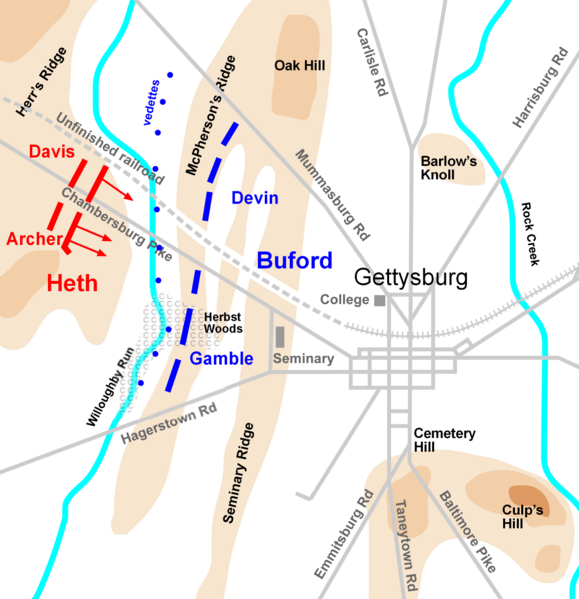
I believe of the two people with the clearest idea of what was happening at Gettysburg, one was Brigadier General John Buford. Elements of his cavalry division - 3,000 troopers and a single battery of 6, 3-inch rifled cannon - was blocking the advance into Gettysburg of Henry Heth's division of 7,000 infantry and 15 cannon, and was about to be outflanked by the converging Rhodes division of almost 7,000 rebel infantry and 16 cannon coming down from Carlisle, and Early's division approaching from York with another 5,400 rebel infantrymen and 16 cannon – almost 20,000 men and 47 cannon about to crush Buford's tiny command.
At 10:30p.m. on Tuesday, 30 June, 1863 Buford (above) sent his cold and emotionless appraisal of the situation to three men - General Pleasanton, commander of the Federal Cavalry Corps and Buford's boss, and General Meade, newly named commander of the entire army. But the first recipient was the most important - commander of the only troops close enough the help Buford's men, commander of the First Corps of the Army of the Potomac - 11,000 men and 28 cannon – and the other person who fully comprehended the strategic and tactical situation in Gettysburg at that moment - Major General John Fulton Reynolds.
His older brother had gone into the navy, and risen to captain. John Reynolds (above) had become a soldier, enduring the lonely life serving on the western frontier, negotiating and fighting the native peoples of the Great Plains and in the 1859 part of the almost war with Britain over an island between Canada and Washington Territory. His devotion to the Union was unquestioned. His bravery undoubted. His mind sharp and clear. His subtly not present. 
General Reynolds had spent the last part of that brief night between June and July of 1863, 5 miles north of Emmitsburg,Maryland, wrapped in a blanket and sleeping on the floor of the empty Mortiz tavern (above) on Marsh Creek, about 7 miles south of Gettysburg, Pennsylvania. It is amazing how little sleep the officers on both sides of any war get while on campaign, which may explain many of the mistakes and oversights that cost so many lives. On this night, after receiving Buford's message, and moving closer to Gettysburg, Reynolds was awakened again at 4:00a.m. by his aide Major William Riddle.
Riddle had to read the day's marching orders from General Meade several times while the sleep deprived Reynolds tried to process them. He was in charge of the left wing of the army, and there was little doubt in any one's mind that his was the force that was going to contact Robert E. Lee's rebels first. Buford’s late night missive made it clear to Reynolds, that this would be the day. Three hours later  Reynolds effective second in command, Brigadier General Abner Doubleday, would arrive for his instructions. While they were talking, the first shot would be fired from Herr Ridge, opening the battle. And at about 8:00a.m. Reynolds and his staff would mount up and head for Gettysburg.
Awakening that morning just 6 miles south of Gettysburg were the 3,800 men of the 1st division, commanded by “the richest brigadier in this army”, 55 year old white haired politician and philanthropist, James Samuel Wadsworth (above) of  New York. His men loved the hesitant Republican, and during the march to Gettysburg, Wadsworth was reputed to have commandeered shoes off the feet of cheering civilians, to replace the worn out souls of his men. Unlike Heth, Wadsworth had his strength in front, the 1,800 men of the famous Iron Brigade, under Brigadier General Solomon Meredith.
The Iron Brigade was composed of five western regiments - the 2nd , 6th and 7th Wisconsin, the 19th Indiana and the 24th Michigan - which had fought as a unit in every major battle since Bull Run. Under their second commander, General John Gibbon, the brigade had converted their dress broad brimmed soft black hats into their standard dress. Gibbon had also given them their legendary discipline. One private remembered, “There were early morning drills, before breakfast drills, forenoon drills, afternoon drills, evening and night drills...” Another soldier observed that “Probably no brigade commander was more cordially hated by his men.” 
But witnessing Gibbon's troops under fire at the 1862 battle of South Mountain, first commander of the Army of the Potomac, General George McClellan, had said, “They must be made of iron.” The label stuck, but it cost. After 2 years of war, of the 1,000 men who had joined the 2nd Wisconsin volunteer regiment in 1861, by 1 July 1863, there were only 300 men left.
Meredith's brigade was followed by the 2,000 members of the 2nd Brigade – the 7th Indiana, the 56th Pennsylvania, and the 76th, 84th, 95th and 147th New York regiments - under 56 year old Hoosier Brigadier General Lysander Cutler (above). He was a real self made man. Born in North Carolina, Cutler had walked to Indiana and climbed from store clerk to State Representative. He was maybe the poorest officer in the army. They were on the road by 6;00a.m. that morning, and would be in Gettysburg in about 3 hours.
Leaving after his infantry, Reynolds quickly outdistanced them, riding to the sound of the guns, through waves of refugees. Shortly after 9:30a.m. he reached the Lutheran Seminary (above)  and greeted Buford with the question, “What's the matter, John?” Buford replied, “The devil's to pay.” 
The 2 men talked in the cool mist for a few moments, before General Reynolds' sent a messenger back to General Wentworth. His division was advance at the double-quick and relieve the cavalrymen on McPherson's Ridge, west of Gettysburg. 
Reynolds also sent a messenger to General Howard in Emmitsburg, telling him to bring the Eleventh Corps forward to Gettysburg at once. A message was also sent to General Sickles, ordering the Third Corps to move to Gettysburg via Emmitsburg. A fourth message went back to General Meade, saying, “...we will hold the heights to the south of the town, and...I will barricade the streets...if necessary.”
Reynolds was not protecting Seminary Ridge, nor even the town of Gettysburg itself, but the high ground south of the town, Cemetery Ridge, Culps Hill and the Round Tops, Big and Little (below). He and Buford had drawn their defense of that McPearson's Ridge four miles to their front, intending on trading space for time, and delaying the rebel army. 
Had Lee been at the front, he would have seen the strategy for what it was, and probably broken contact and withdrawn back to the Cashtown Gap.  But Lee was 10 miles back, just reaching Cashtown by mid-day. While Reynolds was at the the front, and clearly the strategic superior of Henry Heth.
Marching at the double -quick across McPherson's ridge, the 2nd Wisconsin did not have time to load their muskets before Reynolds himself threw them into the 5 acre stand of trees known as Herbst's Woods. This stand topped the crest of the ridge, protecting the advancing regiments of Archer's 1,200 men as they came to the crest. Reynolds was determined they must not win that crest – at lest not yet. They rebels had to be thrown back, or not enough of the Federal army would have time to arrive to hold the round tops.
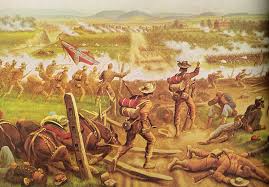
Under Reynolds orders, the Wisconsin boys fixed their bayonets at the run. Reynolds urged them into the stand of trees adjacent to a field of corn, shouting, “Forward men! Forward for God’s sake, and drive those fellows out of those woods!” Seeing the Federals approaching through the trees, Archer halted his 1,200 rebels and unleashed a murderous volley of musket fire. A third of the 2nd Wisconsin regiment went down, dead and wounded. Every man in the color guard was out of action. But the remaining 200 men showed their iron, pressing forward. One of the rebels about to receive the fierce charge supposedly remarked, “Those are those damned black hat fellows again. Tain't no militia. That's Army of the Potomac!” Archer's men then continued their own charge, and the Tennessee and Alabama rebels engulfed the outnumbered Wisconsin boys. But as they did, without intending to, they turned their own flanks, to swallow the Yankees in a sea of gray and butternut brown.
Just as this catastrophe was occurring for the Federals, Generals Doubleday and Williams led the rest of the Iron Brigade in a more organized charge, and the fresh Federal troops fell upon the rear of Archer's turned flanks. In the shock and noise and violence, Archer's brigade was broken, smashed, its individuals falling back across Willoughby Run. 
In the assault, 200 rebels found themselves surrounded in a group of willows on the west bank of the creek, and were taken prisoner – including the “Little Game Cock” who had tried to warn Henry Heth of the dangers of such an assault - General James Archer (above). As he was being led to the rear, General Doubleday saw his old army comrade and greeted him, “Good morning, Archer. How are you? I'm glad to see you, Archer.” To which the bitter Archer replied, “Well, I'm not glad to see you, by a damn sight.”
At that moment, adrenaline rushing through his blood, Doubleday was unaware of the catastrophe which had just befallen the Federal Army. In that volley let loose from Archer's brigade against the 2nd Wisconsin, General Reynolds and several members of his staff had also been hit.  Reynolds slumped in the saddle. 
Suddenly free from the pressure control of its rider, and perhaps hit itself, the General's horse trotted out of the line of attack, bearing Major-General John Fulton Reynolds a few yards into an open stand of trees (above, left). There, his surviving staff gathered the reins, calmed the horse and lowered their commander to the ground. They loosened his uniform, looking for the wound. By the time they found it, he was dead.
This was no sharpshooters work. A single Minnie ball had entered behind Reynolds right ear, and burrowed its way through his brain. He was effectively dead before the horse could be stopped. 
What killed John Reynolds was a random shot, a death by the anarchy, the unmitigated insanity of combat. It may even have been fired from a union musket. Like all war, this single shot had no meaning in and of itself. It was given meaning afterward to satisfy the humans who had to live with the consequences of their arrogance and stupidity. 
One of his aides, Major Joseph Rosengarten, tried to understand the grief a decade and a half later. “...Reynolds, in the full flush of life and health," marveled Rosengarten,  "....a glorious picture of the best type of military leader, superbly mounted, and horse and man sharing in the excitement of the shock of battle.”
They carried his body off the field and into the town, leaving him in a house while the battle continued around it. That night they crept into the no man's land of Gettysburg to retrieve his cold corpse, and sent it home to his family. His sisters would bury him in their home town of Lancaster, Pennsylvania, on 4 July. I prefer to think of John Fulton Reynolds' sacrifice as a monument to the courage and the stupidity of the entire war. And every monument to every war in the all of human history, including the battle of Gettysburg, and that memorial, and all memorial to the heroes and victims of every war, should all bear the same inscription: "What A Waste."
- 30 -

Blog Archive