August 2025

August  2025
I DON'T NEED A RIDE. I NEED AMMUNITION.

Translate

Sunday, November 23, 2014

MOB HIT, THREE

I believe the best evidence is that Joseph Stalin had his own father murdered, and watched it done. The cobbler Besarion Vanovis was a known violent drunk who for years beat both his wife and son, before abandoning them. And when, in March of 1906, he was found dead on a back street in Tifil, Georgia, there were few tears shed for his demise, and police wrote it down to just another drunken brawl. But his wound, a huge hole smashed into his skull, was just the sort of injury Stalin now insisted on inflicting on his other old enemy, Leon Trotsky - a single blow delivered with an ax, wrapped in a heavy coat.  Stalin was very specific about the method.  In fact, contemplating such acts of terror were Stalin's favorite pastime, as the drunken ruler shared with comrades in 1923: “To choose the victim,” he told them, “to prepare the blow with care, to slake an implacable vengeance, and then to go to bed....there is nothing sweeter in life.”.
After the raid of 24 May, the American Socialist Workers Party tried to raise funds to improve the defenses at 19 Avenida Viena (above), but were only able collect $2,250. Trotsky had previously been approached by Harvard University to donate his papers. And he now had two reasons to close the deal quickly, to protect his own life, and to move his papers to where Stalin could not destroy them. In exchange for his communications and notes between 1917 and 1937, Trotsky was paid $6,000 cash.
The money went to see that all windows facing Morelos Street (above) were bricked up, as were the doors in the portico which opened on Viena Street. The windows that remained were now guarded by iron bars. Wooden interior doors, which had proved easily smashed, were replaced with steel.
On 18 June, 1940, , the Mexican Police arrested two dozen members of the Mexican Communist Party, and charged them with taking part in the raid. The leader, David Alaro Siqueiros (above), escaped at first, releasing editorials insisting he was innocent and being framed.  But as more and more members of the raid confessed and named him as the leader, the tone of his press releases changed. Now he claimed he was not trying to kill Trotsky, but just to get him expelled from Mexico. Four months later Sisqueiros was finally captured in Jalisco. A judge was bribed to release the painter on bail, unheard of in an attempted murder case, and within 24 hours Siqueiros was in first Ecuador, and then Cuba, and then central America. Most of the other members of the raid were not so lucky, and ended up serving years in jail.
It was during the confusion and trauma immediately following the 24 May attack that a old friend appeared at the Viena Streeet villa, a young blond named Slyvia Ageloff.  Her sister, Ruth, had once worked for Trotsky as a typist, and the sisters had met the Old Man and Natalia during his Paris exile.  Trotsky had taken an interest in the young socialists because he was,   in the words of a close family friend,  an “experienced philanderer”,  but Natalia also found the girls a pleasant diversion, and now Slyvia was doubly so .
Slyvia  (above left) explained she had come to Mexico to visit her mysterious Canadian boyfriend, Frank Jackson (above right), who had recently started a new job in Mexico. She was welcomed to tea with the Trotskies, although Frank's schedule prevented him from joining them, which added to his mystery. The only time members of the household saw him at first was when his Buick sedan pulled to the curb to pick her up. Eventually Frank became familiar with the guards, and even agreeing to drive the house-bound Leon and Natalia on an outing to Vera Cruz. That kindness, and a gift of chocolates for Natalia,  made it easier when Sylvia asked if Trotsky could offer some advice on a political article Frank was writing
The article which Jackson wanted Trotsky to read was titled “The Third Camp and the Popular Front”, referring to Trotsky's argument that workers must reject both capitalism and the gangster state Stalin had created.  But as he read it in his study,  Trotsky grew uneasy.  Frank Jackson was sitting too close, right behind him, on the edge of his desk, with his coat folded across his lap.  Since the 24 May attack, Trotsky kept a .25 caliber pistol within reach on the desk top. But an alarm switch was blocked by Jackson. Trotsky found the article obvious and dull, and after he had made comments and sent Jackson on his way, The Old Man told Natalia he did not want to see the Canadian again.
But Sylvia begged, and Trotsky agreed to read the rewrites Jackson had made. So about 5:20, on Tuesday afternoon, 20 August, 1940,  Jackson pulled up again in front of the villa. Getting out of his Buick he called up to the guard shack above the foray (above),  asking if Sylvia had arrived yet.  The guards answered no, but opened the front door without question  Again they noted he carried a raincoat. Trotsky was in the garden, feeding his rabbits, so Jackson stepped back to the kitchen, to tell Natalia that he and Sylvia would be leaving Mexico the next day.  But she had grown suspicious of the Canadian, and asked him why he was wearing a hat and coat on such a hot day. Jackson answered, “It might rain.”  Abruptly, Trotsky appeared and invited Jackson back to his study to read the rewrites.
He waited only a few moments, before drawing a cut-down climbers pick ax hanging off the rear of his belt, hidden beneath his jacket.  Nervously, he wrapped his raincoat around it, and raising it over his head, drove it with all his might into the very top of Leon Trotsky's head. 
The steel point smashed through the top of the Old Man's skull, tore through the living soft layer beneath, and was driven three inches into his brain. 
Jackson said in his confession, “I shut my eyes and struck with all my strength ... As long as I live I can never forget his cry ...he screamed very long, infinitely long,” Jackson had expected the man to die instantly. But the sound of his cry terrorized the murderer, and everybody else in the villa.
As Jackson pulled the ax back out, to raise it again, Trotsky stood and turned on his assassin. They struggled over the ax, destroying much of the furniture, and spilling Trotsky's blood (above)   The younger man managed to slice Trotsky's cheek, before the 60 year old Russian pulled the ax out of his hands. 
As Natalia and a bodyguard rushed into the room they discovered Trotsky standing over his attacker, the ax in his hand, blood pouring over his eyes. Trotsky said to his wife, “Look what they've done to me!” He told the guard he'd been shot. Then Natalia guided him out to the garden.
The guards fell upon Jackson (above),  beating him while he cried, “They made me do it. They're holding my mother. They have put my mother in jail”  When he tried to pull a pistol out of his pocket, they beat him again. Again he cried out, “They have imprisoned my mother”  Then he added, “Sylvia Ageloff had nothing to do with this.”   Then he insisted “it” was not the NKVD, he had nothing to do with the Soviet secret police.” No one ever believed him.
Trotsky was driven to two miles to Cruz Verde Hospital in Mexico City. A team of neurosurgeons operated to release pressure on his brain. His last words were, “I think Stalin has finished the job he started.” Suffering from shock and blood loss, and severe brain damage, Leon Trotsky never woke up from the surgery, and died half past seven the next evening.  He was buried on the villa's grounds, which have become a museum, dedicated to his memory.
Later, the police, who had arrested Sylvia,  led the bewildered and terrified woman into a hotel room crowded with reporters, where she was surprised to confront Jackson (above). He began yelling, telling her to go away.  
Jackson (above, right)  later re-enacted his crime, and even admitted to being Jacques Mornard. And under that name he was convicted of murder, and sentenced to twenty years in prison. He served every day of it,  if under luxurious conditions, with female companionship, and servants, all paid for by the NKVD.
We know now that Leonid Ettingon told Ramon Mercader just before his final meeting with Trotsky, that if he failed to murder the Old Man, his mother Caridad Mercader (above) , would be sent to a gulag in Siberia.  After Trotsky was dead, Caridad was ordered back to Moscow, where Stalin himself gave her a medal, the Order of Lenin.  The honor was tainted when she realized she would never be free again. Twelve years after the murder, Mexican police finally pierced Ramon's disguises, and his true identity was finally revealed.  Caridad knew that not only  had she turned her own son into a murderer, she would have been arrested and likely executed by Soviet NKVD if he ever talked. She became a drug addict, her heroin supplied by the NKVD.
Joseph Stalin, perhaps the greatest thug of all time,  died in his own bed on 5 March, 1953,  likely poisoned by the head of his NKVD, Lavrentiy Beria.  Beria was arrested and executed on 23 December, 1953,  just another gangster rubbed out.  That left only the flotsam floating behind to record the damage the gangster had done.
Ramon was released from prison in May of 1960, and traveled immediately to the Soviet Union where he was honored and rewarded for his loyalty and silence. He would never reconcile with his mother (above), who said she was “only good for destroying capitalism, but no good for building Communism.”  She hated living in the Soviet Union,  and died in Paris in 1975.   Her son, Ramon, died three years later, in Havana, Cuba.  And Seva, Trotsky's grandson, going by the name Esteban Volkov,  still lives as of 2014, with only an occasional nightmare of the attacks, and his grandfather's brutal murder.
- 30 -    

Friday, November 21, 2014

JUSTICE

I have given up looking for “justice”. As proof of its nonexistence I offer you the “ostentatiously wealthy” British Labor politician John Lewis (above). Called an evil man and “vindictive” by one of his victims, his allies described the self made rubber millionaire as a "nasty piece of work" and “one of the lowest forms of human existence I've ever met...” and “loathsome in every sense”. His “lack of personal...honesty or integrity” made him an “embarrassment to his party”. In a “just” world John Lewis would have retreated after karma thoroughly kicked his ass in 1951. He did not.
That year Lewis' fashion model wife, Joy Fletcher (above, left), grew weary after four years of her husband's promiscuity and odd sexual proclivities, and left him for a lesbian Swedish beauty queen. She later moved on to another male millionaire.  Lewis' bruised ego was further offended when a traffic cop ordered him to stop at an intersection. Lewis ran his car into the officer, three times. His justification was that he was late for a floor vote. The public chastisement resulted in him losing his seat in Parliament. It was not a good year for John. But Lewis avoided the productive introspection such justice suggested, by inventing a villain to blame for his just deserts. Lewis decided that the Joy in his life had been seduced by the unlucky, undeserving and unrepentant Stephen Ward. Lewis swore, “I will get Ward whatever happens”.
The irony was that Stephen Ward (above) did not sleep with Joy Fletcher Lewis. In fact Dr. Ward ( he was an American trained osteopath) was not that interested in sex. We know this because that is the one thing Christine Keeler, one the most inventive, inveterate and inexhaustible liars in the 20th century, never changed her story about. 
The 18 year old topless show girl always said that although she and Stephen Ward slept in the same bed, it was always “like brother and sister.” She never claimed to have had sex with Stephen Ward. And this is notable because charting the admitted sexual contacts of this beautiful hedonistic exhibitionist egomaniac would have exhausted a team of Public Health epidemiologists.
Christine Keeler (above) , in the words of her most famous victim, “seemed to like sexual intercourse”. She was uneducated, and uninterested in much beyond her own vagina. But in her chosen field she was an expert, the epiphany of common carnal knowledge  It seems at times that this school drop out had sex with every male in mid-century London, including Soviet secret agents, American military officers, London policemen, bankers, drug dealers, musicians, doctors, lawyers, even members of the British Cabinet. And like a single woman Ponzi scheme, Christine's constantly crescive coitus circle eventually brought her into contact with the only male in London who wanted to hear this gorgeous uneducated slut speak. And he was the vile, despised and despicable John Lewis.
Their meeting occurred at a 1961 Christmas Eve party. Christine (above)  was, as usual, concerned only with her own problems, which were not insubstantial. Two weeks earlier, a former boyfriend, Lucky Gordon, had fired “several shots” at the front door of the tiny apartment Christine had once platonically shared with Stephen Ward. 
The publicity generated by that gunfire had killed her affair with British Secretary of State for War, John Profumo (above)...
...as well as scaring off  the other man she was concurrently  dating,  Yevgeny Ivanov (above), a Soviet naval attache  Christine recalled later that John Lewis “could not have been more helpful....” that Christmas Eve.   But the only five words John Lewis heard in Christine's hour long self absorbed diatribe was “Stephen Ward”, “John Profumo”, and “Soviet”.
Lewis had been trying to get the Fleet Street crowd interested in attacking Stephen Ward (above, left)  for a decade, but even the judge in Lewis' 1954 divorce case had dismissed his fantasies about Ward being a pimp. 
 But by adding the name of Profumo to his vendetta, Lewis acquired an ally, in the Conservative Party hatchet man, George Wigg (above). 
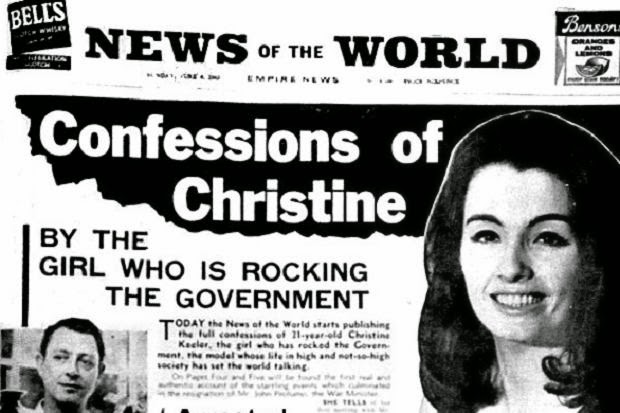
Wigg scurried off to repeat Christian’s rant to Conservative Party leader, Harold Wilson. And with his okay, Wigg then fed the “News Of The World” the story of a Liberal Party leader who was having an affair with a woman who was also having an affair with a Soviet Spy.
Christine Keeler (above)  met John Profumo while skinny dipping at a 1961 summer night pool party at  Lord Astor's country estate. She had been invited as a guest of Stephen Ward, who was Lord Astor's osteopath and who rented a summer house on Astor's property for one pound a year. Over that weekend, John Profumo got Christian Keeler's phone number, but the tramp went home with another party guest, Yevgeny Ivanov, who was in fact a Soviet secret agent.  Monday morning, Stephen Ward felt nervous enough to call his MI 5 contact to report the triangle that had formed in Lord Astor's swimming pool.
The three dominant sections of British Military Intelligence have always been MI 1, code making and breaking, MI 5, counterintelligence, and MI 6, intelligence gathering. In 1960 MI 5 thought they saw a chance to “flip” Yevgeny Ivanov, and they asked Stephen Ward, who knew Ivanov casually,  to befriend him. At their urging, Ward had invited Ivanov to the pool party at the Astor estate. But it was also Ward who warned the government that the Secretary of War might be dipping his wick into Christian Keeler, at the same time she was partying with the Soviet Agent.
Christine (above)  may or may not have slept with Ivanov.  She did sleep with Profumo, but in her own words she saw him merely as “a screw of convenience.”  Ward tried to penetrate her myopia to warn her how deep the water was by joking that she should ask Profumo when NATO was going to share nuclear weapons with the West German government.  Ward knew Christine well enough to doubt the stunning brunette knew what NATO was, or West Germany, or even nuclear bombs. However Ward's little joke would come back to bite his own ass, with teeth that belonged to John Lewis. 
During the summer of 1963 the London Press exploded with lurid details of Christine Keeler's sex life, her affair with John Profumo and a Soviet spy,  both of which had been arraigned, said the press, by Stephen Ward. Christine was having a ball, feeding the press dark and sexy stories depicting Stephen Ward as her pimp and tool for the Soviets. For an ego maniac, even one dim as Christine, it was a joy ride. 
Not everyone was having as much fun. Yevgeny Ivanov was called back to the Soviet Union before the story exploded. John Profumo first denied the affair, and then resigned after admitting to it. Stephan Ward (above, left center)  insisted he had been working for British Intelligence, who, of course, denied everything. Eventually Stephen Ward was charged with “living off the earnings of an under aged female” - pimping young girls.
As Stephen's trial was starting, Christine was in another court room, testifying at Lucky Gordon's trial. Eventually an appeals court would decided her testimony there had been unreliable, and probably perjury. But because the Foreign Office had yet to determine if national security had been breached (it had not), the accusations against her integrity were sealed. This left Stephen Ward's jury to take her headline inspired testimony as valid. 
Samuel Herbert (above), the Chief Inspector running the investigation broke quite a few rules, threatening to destroy anyone who testified in support of Stephen Ward.  And then, in his closing, the prosecutor reminded the jury that no one had come forward to defend Stephen. 
The entire trial was a travesty,  which drove Stephen Ward to take an overdose of sleeping pills. Rushed to the hospital (above) he died two days later. But the jury was still allowed to convict a dead man. 
That conviction helped to bring down the Liberal government, and made Harold Wilson (above) Prime Minister. Three years later 48 year old Inspector Herbert died of a heart attack. His will left only 300 pounds to his family. But his bank account contained 30,000 pounds, well over half a million dollars today.
The night Stephen Ward died, John Lewis celebrated with champagne in a London restaurant. There's justice for you.
- 30 - 

Wednesday, November 19, 2014

OFF TO THE RACES

I have no doubt that Clailborne Fox Jackson (above) believed he had been chosen by God to be rich and powerful. A natural born gambler, after marrying into a patent medicine fortune (“Dr. Sappington's Anti-Fever Pills”), the son-in-law helped turn the doctor's little sassafras flavored lozenges into antebellum America's most popular pharmaceutical. And when the Lord twice took Claiborne's wife, and then his second wife – both Doctor Sappington's daughters, to heaven, Claiborne simply married the next lucky Sappington girl in line. Claiborne's assurance in God's favoritism explains why he felt justified in lying to win election as Missouri Governor in 1860.
With war clouds gathering, Claiborne assured voters he favored neutrality between union and rebels, but in his January 4, 1861 inaugural address he “came out”, insisting Missouri must “stand by the South.” He then called a state convention to authorize secession. But on March 4th that convention voted 89-1 to remain in the union, at least for the time being. A week later seven states met in Montgomery, Alabama to form the Confederate States of America. Frustrated he could not lead Missouri to join them, Governor Claiborne wrote to the provisional President of the new Confederacy, Jefferson Davis, asking for artillery to knock down the stout walls of the St. Louis federal arsenal.
Occupying 22 buildings on bluffs along the Mississippi River (above), The St. Louis Arsenal was the fourth largest arsenal in the United States, and the largest in a slave holding state. It was a tempting target, containing 60,000 muskets, 9,000 pounds of gunpowder, 1 ½ million cartridges and dozens of cannon, guarded by just 40 personnel. Davis immediately ordered artillery seized earlier from the federal arsenal in Baton Rouge, shipped to St. Louis, to knock down those walls (above, right edge). The rush was vital, because at 4:30 on the morning of Friday, April 12, 1861, Confederate gunners in Charleston, South Carolina opened fire on Fort Sumter. The civil war had started, but many in Missouri, on both sides, thought they had more time.
Then on Sunday April 14th , Governor Claiborne did what he really did best – something arrogant and stupid. He ordered the St. Louis Police to selectively enforce the “blue laws” against drinking alcohol on the sabbath. Dozens of beer gardens were shut down, the patrons, emigrant German Catholics, enjoying a Sunday afternoon family tradition, were humiliated and roughed up. The male only taverns frequented by Protestants were not harassed. The next day, Monday April 15th, the governor announced an “English Only” policy for state government. Wrote one St. Lewis German language newspaper, “Every question, every doubt has been swept away. The Fatherland calls us—we stand at its disposal.”
By Friday, 4,200 German volunteers (many veterans of the 1848 revolution) and Republican Wide Awake members, were camped in the arsenal's grounds, now well armed and eager, wrote one member, “to teach the German-haters a never-to-be-forgotten lesson.”  On the evening of Friday, April 26th,  25,000 muskets and several cannon not required by the volunteers were shipped to safety, across the Mississippi to Alton, Illinois, then loaded on a train for Springfield. 
This was the work of a five foot five inch tall, sugar addicted, mustard sandwich loving 42 year old red headed, hot head from Connecticut named Nathaniel Lyon (above). A West Point graduate, Lyon was smart and ruthless. He had served with distinction in the Mexican War and then spent a few years slaughtering innocent Indian women and children in California. In the spring of 1860 President Lincoln gave him command of the St. Louis arsenal, with a battalion of U.S. Army regulars. And when German longshoremen reported to Lyon on May 8th of the arrival of the steamship “J.C. Swon”, flying the Confederate flag and carrying a cargo of heavy crates labeled “Tamaroa Marble”, Colonel Lyon knew the time to act had arrived.
Despite civilian authorities urging caution, on Friday, May 10th, Lyon lead his 6,000 men and artillery against the pro-slavery Missouri militia gathered at “Camp Jackson”, 4 miles away. Future architect of the union victory, Ulysses Simpson Grant, watched the regulars and German Home Guard from in front of the Anheuser-Busch brewery. And future burner of Atlanta, William Tecumseh Sherman, saw the columns from his office at the St. Louis Railroad street car company, and headed for home to make certain his young son was not following the drums.
Methodically Lyon surrounded the Missouri militia, and outnumbered four to one, they surrendered without a shot being fired. But as the prisoners were being marched back to the armory between columns of regulars, angry crowds formed, taunting the “Damn Dutch men”.  Sherman saw a drunk try to cross the street through a company of the “Home Guard”. Constantin Blandowski, an exiled Polish nobleman serving as a pro-union officer, pushed him to ground. The drunk pulled a pistol and fired, giving Consantin a mortal wound in the leg. The German volunteers opened fire. The random death toll was 28, “ a middle-aged street vendor, a teenage girl, a young German laborer...and several soldiers...A wounded woman sat keening on the ground, the body of her dead child clasped in her arms”. Fifty more were wounded.
Like everything Lyon did, the bloody riot forced moderates to choose sides, and it gave Lincoln second thoughts. A few days later, Federal Brigadier General William Shelby Harney, a southern sympathizer whom Lyon had replaced, was ordered back to St. Louis. Harney was a Tennessean by birth, and on May 12th he signed an agreement that federal troops would remain in St. Louis, and the Missouri Militia would maintain order in the rest of the state. It was “secession in all but name.” But Colonel Lyon had not been relieved, merely outranked, and Missouri Republican Congressman Frank Blair was given secrete orders to relieve Harney again, if need be. At the end of May, Blair did just that.  Lyon was promoted to Brigadier General of Volunteers, making him the ranking military officer west of the Appalachians. . At a meeting in the Plantation Hotel, intended to seek a compromise, Jackson offered up his usual mixture of half truths and threats. Lyon responded that rather than surrender federal authority to the Governor, he would “see you...and every man, woman, and child in the state dead and buried."
Governor Jackson retreated to the state capital of Jefferson City (above), 144 miles up the Missouri River. It was in the center of the state's “Little Dixie” region. 
“On average Missouri’s slave population was only 10 percent, but in Little Dixie (Red, above)...slave populations ranged from 20 to 50 percent” Jackson felt safe here, with the apparatus of political power in his hands – tax and voter rolls, official seals and keys to the treasury. He was certain he could slow or even prevent Lyon from marching on the capital. 
Putting the reforming state militia under the command of his cousin, army veteran Meredith Miles Marmaduke, Jackson ordered him to assemble the new army fifty miles further up the river, at Boonville - “ where the Ozark uplands meet the western prairies”. This was the western edge “Little Dixie”, and had to be held.   
But Lyon had no intention of giving Jackson time to regain his balance. Rather than marching overland, and being forced to protect the railroad behind him, on Sunday, June 12th, the general loaded 1,400 men onto steam boats and headed up the Missouri.
Again Lyon's audacity had caught Jackson off guard.   The Governor barely had time to get out of the capital before Lyon landed his men, on Wednesday, June 15th. He captured the machinery of state government without firing a shot. Lyon did not pause to celebrate. Leaving just 300 men to hold the capital, he headed further up the river with 1,200 men, intent on crushing the rebellion.
At Boonville,  Marmaducke commanded just 600 men, most armed with flintlock muskets or shotguns. They had no training, and the little army had not yet even learned how to feed or clothe itself. The rational choice was to retreat. But Jackson was convinced that if he abandoned “Little Dixie” he would never be able to return. So he ordered Marmaduke to defend Boonville. The reluctant commander had no time to prepare. Late in the day of June 16th, Lyon's troops landed eight miles south of Boonville.
At 7 a.m. Lyon put his men on the Rocheport Road. He had landed so far south out of concern about rebel artillery on a ridge just south of Boonville. But at about 8 a.m.,as his regulars unlimbered their own cannon to drive away rebel skirmishers, there were no answering blasts from the Missouri State Guard's lines. Jackson had dispatched his few artillery guns a few miles south,  and Lyon's rapid advance had not given him time to bring them back. And as the German volunteers and Federal regulars advanced up the ridge at the rebels, Jackson was observing from a mile away, protected by the most reliable company in the rebel force.
Private J. C. Walden, of the Missouri Guards described the battle, such as it was. “As the enemy went by us on the road below us, we...fired. The Federal column paid little attention and didn't even break ranks. We fired a second volley, when someone yelled retreat. I don't know whether it was the captain -- but we retreated. I started for the camp... where we had left our knapsacks. I found our things taken by the enemy.” In fact, they had probably been stolen by their own men, who had started running first.
The federal troops called it “The Boonville Races”, and "The Great Missouri Lion Hunt".  By 11 a.m. General Lyon had accepted the surrender of the village from the mayor of Boonville. The fight cost the federals five dead and five wounded. Best estimates are that the Missouri State Guard lost five dead, ten wounded and 70 prisoners. A month later most of the same politicians who had voted against secession in March, met again in Jefferson City as a “rump” state legislature, and declared the Governor's office vacant. Missouri would now stay in the union, and Lyon would forever be known as the savior of union.
He did not live to enjoy it. In August, in the far southern edge of Missouri, at the bloody battle of Wilson's Creek, General Nathaniel Lyon would be shot through the heart, and his army defeated. The rebels would advance back into Missouri, but they would never have as good a chance at dragging the state into the Confederacy, as they did that spring and summer of 1861, when Governor Claiborne Jackson's arrogance threw victory away.
The great writer and historian Bruce Catton described the battle at Boonville as “the slightest of skirmishes by later standards”. But he added that after it, “the chance that Missouri could be carried bodily into the Southern Confederacy had gone glimmering. Jackson’s administration was now, in effect, a government-in-exile, fleeing down the roads toward the Arkansas border, a disorganized body that would need a great deal of help from Jefferson Davis’s government before it could give any substantial help in return.” In truth it never did.
Claiborne Jackson never saw his Little Dixie tobacco plantation again, and would die of stomach cancer on December 6, 1862, still in exile, in a Little Rock, Arkansas rooming house. He was just 56 years old. In the end, it seemed that God had not favored the man who lived off the slavery of others, or profited by lies to those who trusted him.
- 30 -

Blog Archive