August 2025

August  2025
I DON'T NEED A RIDE. I NEED AMMUNITION.

Translate

Wednesday, January 01, 2025

AIR HEADS Part One


I don't think anybody stood a chance of winning the $50,000 first place prize money.  It was 1911. Flying was still brand new and the world’s first two pilots - Wilbur and Orville Wright - were still learning how to fly.
The world's third pilot was U.S. Army Lieutenant Thomas Selfridge. He died (above) in an air plane crash on 17 September, 1908. 
In that same crash Orville Wright was also badly injured. He would never fly again.
The second famous pilot to die in that first generation of pilots, in 1910, was Charles Stewart Rolls (of Rolls-Royce fame) (above).  Considering there were only about 100 men (and one woman) with flying licenses in America in 1911, two percent was an appalling death rate, bad enough to make you wonder why anybody even wanted to even try flying -  let alone try flying from coast to coast across the United States.
The world’s 49th licensed pilot was a shy, cocky, 6’4” thirty-something, cigar smoking, playboy and adrenaline junkie with a hearing loss and a speech impediment named Calbraith Perry Rogers (above -right). He was a romantic who favored action over words, as proven by the way he met his wife, 20 something Mabel Groves (above, left).  He saw her slip off a dock and fall into the water.  So assuming she was drowning,  he jumped in and pulled her to safety. Within a few months he married her, despite the hat.   Cal approached flying with the same spontaneity as his love life,  but it was a passion which quickly developed into a mission..
Having seen his first airplane on a visit to Dayton, Ohio, in June of 1911,  Cal took the full Wright Brother’s flight course (above),  all 90 minutes of it.  Mabel explained that flying filled the hole in his life left by his deafness which had excluded a military career.  It was, she said "the last piece of a jigsaw puzzle". 
Then Cal talked his mother, Maria, into loaning him $5,000 so he could buy a Wright Model B Flyer “E-X”. The "X" was for experimental – which was a joke because in 1911 every “airplane” was experimental.  But Cal may also have been the origin of the phrase to “take a flyer”,  because just two months later, in August, he entered his new Wright Flyer in an air show in Chicago and took home third prize, worth $11, 285.   Not bad: Cal had been a pilot for 60 days and already he had made six grand profit.  He suspected there might be money in this flying thing.
And this was confirmed in October of 1910 when the Hearst newspaper chain had offered $50,000 to the first pilot to make it across the continent in 30 days or less.  The offer was set to expire on 10 October, 1911.  Orville Wright tried to warn Cal. "There isn't a machine in existence that can be relied upon for 1,000 miles,  and here you want to go over 4,000.  It will vibrate itself to death before you get to Chicago."   But Cal refused to give up the idea.  He explained, "It's important because everything else I've done was unimportant."  Faced with that level of stubbornness,  Orville tried to look at the bright side. At least the Wright B Flyer was so light, said Orville "six good men could carry it across the country."
 What Cal needed, as any NASCAR driver can tell you, was a sponsor.  He found his ‘sticker sucker’ in  Mr. J. Odgen Armour, owner of Armour Meat Packing Company, and his new soft drink called “VIN FIZ”.   Allegedly it was grape favored soda water, but one critic thought it tasted more like  “a fine blend of river sludge and horse slop”   With a product like that Mr. Amour was going to need a heck of an advertising campaign. Enter Cal and his flying bill board.
With a guarantee of $23,000 from Amour, and a bonus of $5 per mile east of the Mississippi River, and $4 per mile to the west of the "big muddy",  and a corporate three rail car support train complete with a reservoir of spare parts, fuel and mechanics, and sleeping car accommodations for Mable, Cal’s mother Maria,  his cousin, his head mechanic Charlie Taylor, two other mechanics, two general assistants and assorted reporters from the Hearst news service, the flight was starting to look possible.
Armour even threw in an automobile (above) to track down Cal whenever he crash landed . With that much corporate funding behind him, Cal figured he had it all figured out. The first problem was that, before Cal even got airborne, his "Vin Fiz" was already in third place.
First off, from Golden Gate Park in San Francisco, was motorcycle racer Bob Fowler (above). 
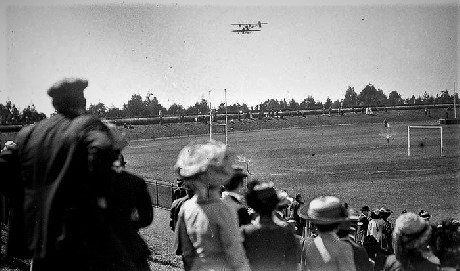
There were 10,000 cheering people there at 1:35 P.M., on Monday, 11 September,  1911 to see Bob take off (above).  
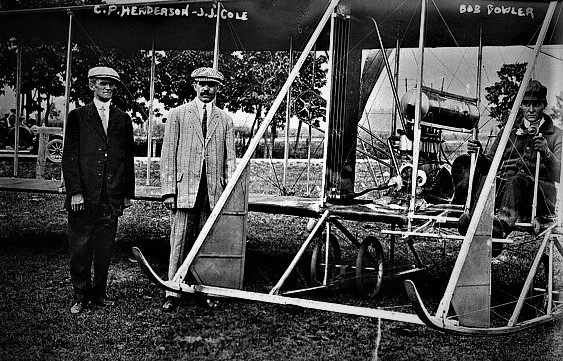
Like Cal, Bob was piloting a Wright “B” Flyer, except his sponsor was Joseph J. Cole (above, middle, with mustache) , founder and owner of the Cole Motor Company, of Indianapolis, Indiana.  Cole supplied Bob with his automobile engines and $7,500 in financial support.  
The Cole engine was more powerful than the Wright engine, but it was also 200 lbs heavier. J.J. also gave Bob a support train, with spare parts. His mother, Ethel Fowler (above), went along and repaired the fabric of his plane during the flight.  But "The Cole Flyer" lacked the publicity Hearst supplied to support the "Vin Fizz  Flyer".
Making an average speed of about 55 miles an hour, Bob Fowler reached Sacramento in just under 2 hours, and after schmoozing with California Governor Hiram Johnson, Bob flew on to the foothill town of Auburn, for a total distance on the first day of 126 miles. Impressive. And on a Monday.
On Tuesday, 12 September,  Bob had reached Alta, California, where he crashed into some trees.  Bob was now out of the race until repairs could be made.
Second to start was James J. (Jimmy) Ward (above),  pilot's license #52, and previously a jockey, and another motorcycle racer.
Jimmy was flying a Curtis Model D. and he had the full support of designer Glenn Curtiss, including the de rigueur train with a hanger car filled with spare parts, 
Traveling with Jimmy was his second wife, Maude May Mauger - seen here strapped in for her first (and only) flight, with her husband at the controls. 
 Jimmy took off from Governor’s Island in New York harbor on Wednesday, 13 September, 1911. He preformed a loop around the Statue of Liberty (above left, BG) and then immediately got lost over New Jersey.  
He made only twenty miles before crash landing (above). Then he too had to wait for repairs. The basic tempo of the race had thus been set right from the start; take off, crash, wait for repairs, take off, crash, wait for repairs, and repeat as necessary for 4,000 miles. It was going to be very hard to finish this race, let alone win it.
Before starting himself, Cal Rogers tied a bottle Vin Fiz to one of his wing struts (white circle on the left), “for luck”.  For reality, he tied a pair of crutches to another strut, in case he needed them later. He would.
Before a paying crowd of 2,000, a chorus girl poured a bottle of grape soda over the landing skids and proclaimed, “I dub thee “Vin Fiz Flyer””. Cal actually called his plane “Betsy” but he recognized the value of naming fees even back then.
Cal took off from the race course at Sheepshead Bay, Long Island at 4:30 p.m. on Sunday, 17 September. And if anybody noticed that it was the third anniversary of the crash that had killed Lieutenant Selfridge, they were polite enough to keep it to themselves.
After take off, Cal buzzed Coney Island and dropped coupons for free Vin Fiz soda (above). Then as the breathless reporters breathlessly reported, he flew over Manhattan “…with its death-trap of tall buildings, ragged roofs and narrow streets”.  Cal landed safely in Middleton, New York that night to a cheering crowd reported as 10,000 – not to be bettered by San Francisco. He had made all of 84 miles that first day. His plan was to average 250 miles a day.
That night the reporters wrote that Cal claimed he would be in Chicago in four days. But Cal  rarely talked to reporters because he barely heard their questions, the byproduct of a scarlet fever attack in his childhood.  And he spoke in the clumsy monotone of someone who never clearly heard a human voice.   So it was easier if the the reporters just made up heroic quotes for Cal. And they did.
They invented more heroic quotes for him the next morning when, on take off,  the "Vin Fiz" hit a tree and ended up in a chicken coop (above).  The bottle of Vin Fiz was "miraculously" undamaged, as proved because it would have been impossible to find another bottle of Vin Fizz aboard a train car named "The Vin Fiz Special".   But now it was Cal’s turn to wait for repairs.  The race was on!  It just wasn't going anywhere very quickly.
- 30 -

Tuesday, December 31, 2024

CHRISTMAS -TAKE TWO


I'll bet few of you know that this year Christmas comes on Tuesday, 7 January.  This is good news if you can't wait for Thursday, 25 December 2025. I am, of course, speaking of the  “original" Christmas, the one 200 million Greek and Russian Orthodox Christians celebrate, 13 days after Catholics and Protestants make merry. Now, as to why there are two Christmases, well, that has to do with the way theology seems to have been invented specifically to start arguments.
The first successful calendar that we know of was adopted over 6,500 ago by the 18 amalgamated city-states we know as the Sumerians. Being farmers they started their year in the spring, with each of their months beginning with sunset on the night of the new moon. This lunar calendar proved so popular it was adopted with slight modifications by everybody, including a small group of highland Semitic sheep herders known to themselves as the Yehudi – modern English translation being “the Jews”.
The Jewish spring was marked by the birthing of their sheep, what they called the Pesach. Fourteen days into the first Hebrew month of Nisan, at the full moon, they drained the blood of one of their first born kids. That's a baby sheep. The body was then burned, the rising smoke being offered up as a sacrifice to their god Elohim or Yahweh, to ensure he would keep them in milk, wool and lamb chops for the coming year. But, just about the same time as the invention of the calendar, the flocks of many of these Hebrews started dying.
Maybe it was disease and maybe a drought, but these Jewish bands were reduced to seeking work around the Egyptian settlements in the Nile river delta, where they were forced to exchange their Sumerian lunar calendar for an Egyptian solar one, and their mutton for bread. And the first Egyptian bread grain which ripened each spring, about the Nisan full moon, was barley. Now, barley doesn't rise well with yeast. This meant that every spring, when the stockpiles of wheat and rye grains ran short, the Jews were reduced to eating the hard, flat, unleavened barley bread. After leaving Egypt, or, as the religious fanatics described it, “escaping”, the spring Pesach was relabeled the Passover Festival.
Over the next  couple of millennial the Jews established a homeland called Israel, where they were  attacked by the Philistines, the Babylonians, the Egyptians, the Akkadians, the Hittites, and eventually the Romans. Every new conqueror forced the Hebrews to adopt some of their culture and calendar. 
And as is common with occupied people, the common folk dreamed of a messiah or Christ, who would save them from their oppressors, foreign and Jewish. Over time this produced a seemingly endless stream of messiah candidates. Most were loonies, but a few were dangerous enough that the upper crust Jewish Pharisees felt forced to eliminate them. And it was because of those few that before we got two Christmases, we got two Pesach-es – later renamed Easter.
See, the Romans, who were occupying Israel in the first century, had just stitched together a combination solar and lunar calendar championed by Julius Caesar and enacted on The Kalend, or the first morning of the new month of January, 47 B.C.E.  By Roman law all debts and taxes were paid on the Kalends of each month, including the Temple Tax the Jews paid so they would be excused from sacrificing to the Roman gods.
This Temple Tax was paid to the Roman Governor in the capital of Jerusalem, a city of between 60 and 70,000 people. During Passover, the city had to accommodate another 5 to 10,000 pilgrims in town to sacrifice at their temple. This produced a lot of taxable income for everybody, but with a crowd that large, you were guaranteed at least one Christ-wanna-be a year. 
Which is why, the Christian holy book could be very specific about the date when the most successful Christ, Jesus ben Joseph of Nazareth, was nailed to a cross. He was killed, theologians now figure, about 3:00pm on Friday in the 33rd year of the common era,   or about 3 hours before the start of Passover that year.  Except killing this Christ only added to the Pharisse's problems.
These Christians kept insisting their dead guy was The Christ sent to reform Judaism which pissed off the Pharisee, who  saw no reason to reform a religion they were running.   Also, all reformers made the Romans nervous, which pissed off the Pharisee even more. A decade after Jesus' crucifixion, the Jewish King Agrippa beheaded the cult's new leader, Jesus' brother, James. 
The next leader, also named James but called "The Just" to separate him from James the dead,  tried to avoid giving the Pharisee any reason to cut off any more heads by strictly obeying Mosaic law for 20 years. However, the Pharisee eventually decided to kill James the Just anyway. So they threw him off the Temple roof. And when that didn't kill him, they had him beaten to death.
But there were other, even more disruptive zealots around, and in the year 66 C.E., bad Roman government and all these revolutionaries set off the First Jewish war, which lead to the Kitos War and then the Bar Kokhba revolt, which ended in 136 C.E. 
This 80 years of violence so pissed off the Romans they destroyed the Jewish temple, then burned and sacked the entire city of Jerusalem, and then outlawed Judaism entirely. The only way for Christianity to survive this Roman repression was to form their own religion, adopting the Julian calendar and inventing a new theology they called Christianity as they went along.
As figured by Professor Rodney Stark, of Baylor College, devotees of Christianity surpassed the “symbolically weighty figure” of 100,000 worshipers attending a hundred or so churches about the year 200 C.E., or 70 years after the last Jewish revolt. And yet, already, their new theology was starting to encounter problems. 
In the year 189 C.E., Rome, received a new bishop, or elder of this new quasi-Jewish church. We know him only by the name of Victor, and that he came from North Africa -  perhaps he was a Berber. We can assume Victor was devout, but we know he also was combative and arrogant. First, he had started calling himself “the Pope”. And secondly, was the way he tried to handle the Quarterdecimani debate.
In plain English, it was “The 14” - as in the 14th day of Nissan, i.e. the date of Passover. Less than fifty years after the death of Jesus, Polycarp, the Bishop of Smyrna, reminded his fellow Christians that the Paesch was a life giving festival well before it became the Jewish Passover. 
This made 16 Nisson - the second day after Passover – the perfect day to celebrate the resurrection of Jesus Christ. Which meant the common folk still had to know when Passover started. And Polycarp had been personally trained by the Apostle John, who had personally known both the living and the resurrected Jesus.  So, he ought to know when Jesus died and rose from the dead -at least to within a day or two.
But Victor and most western Bishops wanted to disconnect Christianity from Passover. Too Jewish, you know. That meant converting Jesus ben Joseph into a gentile, like the majority of the new Christian recruits. This was why the Sabbath was moved from the Jewish Friday at sunset and all day Saturday – the end of the week – to Sunday – the beginning of the week. And by using the Julian calendar, which most gentiles were familiar with, they could reenact the mystical Good Friday to Resurrection Sunday, every year. And that was something the “floating” Jewish Passover, which could come on any day of the week, and was favored by the eastern Christians, could not do.
So far, settling such theological issues had followed the example of the Pauline Epistles. The bishops exchanged letters arguing their case, until they were close to agreement. They then held conferences, called synods, which endorsed the new dogma. But bishops still within the Byzantine Empire, who spoke and read Greek, felt as qualified to determine dogma as the upstart Latin speakers from Rome. 
But Pope Victor, a Latin speaker,  now abruptly warned that any Christians who did not sever the direct connection between Passover and Easter would be excommunicated - thrown out of the church and denied Jesus' forgiveness.
Immediately a missive arrived from the proud Bishop of Ephesus. This was a large, wealthy city, so when Bishop Polycrates spoke, other Christians paid attention. He reminded Victor that many respected church leaders celebrated Easter on 16 Nisson, like, “...Philip, one of the twelve apostles....(and) John, who was both a witness and a teacher...and Polycarp in Smyrna...” and the seven bishops in his own family. Polycrates warned Victor. “ I...am not frightened by terrifying words.”  In other words, don't even think about excommunicating me.
Another dissent arrived from the Bishop of Lyon, France. Irenaeus was a Greek who had a strong record opposing “Judaizing” the new faith, which gave him street cred in this argument. Irenaeus cautioned Victor against asserting dominance, because that might start a civil war within the Church. Finally, Victor backed down. 
So,  for the next 800 years, everybody agreed to disagree on the date for Easter and about the power of one Bishop, whatever he called himself, to dictate to other Bishops. The eastern church read their liturgy in Greek, the Romans in Latin. And this divided church survived the fall of the western Roman empire and the rise of Islam, until 1053 C.E., when another hot head was elevated to Pope.
In that year, “Pope” Leo IX went nuclear on a small group of Greek Orthodox churches in southern Italy. Leo ordered them to either “conform” to the Latin Easter or close their doors. 
In Constantinople, the Ecumenical Patriarch, head of the local churches, Micheal I Cerularius, retaliated by dropping the same bomb on the Latin churches in his city.  And his city was far bigger than Rome.
The following year, 1054, Cardinal Humbert, led a Papal delegation to Constantinople to insist that Micheal reopen the Latin churches and acknowledge Leo IV as the supreme leader of the “Catholic”, meaning unified, church.
Oddly enough, Micheal said no.  Whereupon, everybody in sight excommunicated everybody else in sight. This exchange of “Ex” bombs escalated until it widened into the Great Schism, which has divided Christianity ever since. The two sides stopped talking to each other. The Latin churches continue to celebrate Easter on the first Sunday after the Paesch full moon, while the Greek Churches mark Christ's rising from the dead three days after Passover, whatever the day of the week that fell on.
A final bit of confusion was added in 1582, when Pope Gregory XIII introduced a new and refined calendar, which cut that year by 10 days. Initially it was recognized only in Catholic states. Protestant Britain did not make the switch until 1752, by which time the difference between the Julian and the newer Gregorian calendars had grown to 11 days. Russian, being Eastern Orthodox  did not accept the change until the revolution, in 1918, by which time the shift was 13 days. They were followed later by most secular governments.
But the Greek Orthodox Church, still pissed off about the Great Schism, have remained on the Julian calendar. Which is why we have two Easters, and why the Eastern Orthodox Christmas comes on  25 December, Julian Calendar, but also falls on 6 January, under the Gregorian calendar – 13 days later. Which gives us two Christmases.  Just remember that St. Nicolas, the inspiration for Santa Claus,  was a Bishop in the Eastern Orthodox Church. 
The Jews, of course, have stubbornly stuck to their own clock, insisting the year 2024 is actually the year 5785.  But that....is a story for another time.

- 30 -

Blog Archive