August 2025

August  2025
I DON'T NEED A RIDE. I NEED AMMUNITION.

Translate

Monday, March 16, 2020

FROM HERE TO TIMBUKTU - When the Price of Gold Dropped

I have to say that Mansa Musa made quite an entrance. He materialized out of the Sahara desert heat shimmers like a mirage in 1324. His unexpected arrival stunned the Islamic potentates of Cairo and Mecca out of their smug self assurance, and shocked the European Christians out of their complacency. Because when Mansa paused in Cairo to stock up on souvenirs, he paid in gold. And he bought a lot of souvenirs. Mansa was leading 80 camels just to carry his gold. He came from a land whose ancient name was Kaya Magha, which meant “King of Gold”.  And Mansa was certainly that.
Mansa spent so much gold on his Hajji, his religious visit to Mecca,  that for the only time in all of recorded history, the price of gold in all of Europe and Africa and the Middle East was determined by one single man. And no one had ever heard of Mansa before, nor of his kingdom of Mali, nor of the city he claimed to have come from, the mysterious and mythical, Timbuktu. In the Berber language of the desert tribes, the name means “the well at the end of the world”.
The river Niger begins as a tiny spring in the West African highlands of Ghana, just 150 miles from the Atlantic. But the Niger immediately turns its back on the ocean and instead flows eastward. As it does the river collects vast amounts of gold, which could easily be extracted from it's waters.
Dugout canoes then carried the gold downstream, following the river’s arc to the north, penetrating the desert. At the northern peak of that arc, in Timbuktu, slabs of salt, mined from the blistering floor of the heart of the Sahara, and carried 500 miles south across the sands on camel back, were exchanged for the gold.
The salt was then transferred to other canoes for distribution a thousand miles further south in the equatorial heart of black Africa. There, the final commodity, slaves, were  exchanged for the salt and then marched, locked in shackles, back upstream.
And it was at the point of contact between the two worlds, the Arab north and the African south, that the economic ties were joined. And at about the same time that William the Conquer was winning the battle of Hastings, the village of Timbuktu was founded.
What made this trade possible, what made the city of Timbuktu possible, was the Niger River and an extraordinary pack animal, the Arabian camel (Camelus dromedarius). This ungulate with three stomachs evolved in North America, but went extinct there about 1 million years ago, at the start of the ice ages. By the end of the last ice age, about 10,000 years ago, its new home range was the arid and unforgiving Arabian Peninsula.
This amazing beast can lose up to 40% of its body weight in water, and can gulp down  21 gallons of salt laden brackish water within 10 minutes to refresh itself. Either behavior would kill a lesser creature. Its mouth and throat are so soft that it can ingest thorns and bare branches without injury. Its huge soft padded feet allow it to climb sand dunes with ease. Its long eyelashes and double eyelids allow it to survive the most fierce sand storms on earth. Known in Arabic as a Jamal, the camel can easily carry 200 pounds of cargo for twenty miles a day through blistering heat. And it can do it for fifty years.
The camel was first domesticated in Arabia about 3.500 years ago, and by the time they were introduced into the Sahara by Arab traders about the second century C.E., there were few wild dromedaries left. It was these ships of the desert, combined with the great Niger river, which built the greatest of West African kingdom, Mali.
Mansa was the second Musa (or “King of Kings”) from Mali to go on Hajji. His predecessor, Kankan Musa, had appointed Mansa as his Deputy King when he began his pilgrimage. But the desert had swallowed Kankan and his party without a trace, and after a year of silence, in 1307, Mansa had been crowned Musa of Mali, Emir of Melle, Lord of the Mines of Wangara, conqueror of Ghanata and Futa-Jallon, and quite possibly the richest man in the world. Only Genghis Khan ruled a larger empire.
Mali was a multi ethnic and multi-religious kingdom larger than Western Europe, and containing some 400 cities and uncounted villages. Timbuktu was the gateway for Islam into Mali. There it thrived alongside shrines to Sango, the thunder God, and Legba, messenger to all the African gods. A devout Muslim, Mansa felt no need to convert his subjects. Instead, when he returned to Mali in about 1325, he was inspired to rebuild Timbuktu, already a mud brick metropolis of 100,000 people.
Mansa brought an architect from Muslim Spain to design his new palace, as well as the mud brick Djinguereber Mosque , (above), where 2,000 people still take their daily prayers. The cities’ University of Sankoré began attracting world class astronomers and mathematicians and Islamic scholars. A Mali proverb observed, “Salt comes from the north, gold from the south…but the word of God and the treasures of wisdom are only to be found in Timbuktu.”
The city was famous for its libraries. Leo Africanus, an Islamic historian, wrote that in Timbuktu, “There is a great demand for books, and more profit is made from the trade in books than from any other line of business.” The scholar Ahmad Baba claimed that his personal library was one the smaller ones in the city, containing only 1,600 books. The entire city and its environs was said to hold during the golden age of Mali perhaps 10,000 ancient, pre-Islamic manuscripts, more than any other library in the world.  Book copying was a big business in Timbuktu.
Musa ruled his kingdom for perhaps 25 years. He died about the year 1337. The city of Timbuktu was ruled by his descendents for another century, until the empire of Mali was replaced by the Sunni empire, which was more African than Muslim. But the stories of so much gold attracted the interest of European monarchs, and in the sixteenth century Portuguese “explorers”, pushing down the coast, reached out and destroyed Timbuktu without ever seeing the city.  First contact diseases killed thousands. Armies from Morocco then killed more when they captured the weakened city in 1591.
But although the Moroccan leader Ahmad I al-Mansur hungered for the wealth of Timbuktu, he had no conception on what that wealth was based. In 1593 he began to dismantle the economic engine by first exiling the scholars, men like Ahmad Baba, because he considered them “disloyal”. For the first time it its history ignorance reigned in Timbuktu. The economic engine had lost its spark, and slowly died.
When Europeans finally arrived in the early nineteenth century they were shocked to discover the mysterious and romantic city of Timbuktu was a dusty backwater, little more than a local market town, slowly being reclaimed by the desert from which it had mysteriously sprung.
- 30 -

Sunday, March 15, 2020

A PLATE OF HUBBLE PI

I suspect the problem begins with the oft quoted but not well understood phrase, “pi are squared.” In the first place, it’s not. It is a fact that you cannot square a circle, and yet it is done everyday, out of sight for those of use who are math-impaired. This is so because of  pi - the relationship between the length of the line forming a circle, divided by the distance across that same circle. And this relationship, no matter how large or small the circle,  always works out to be 3.141592653589793238…etcetera, etcetera, ad infinitas, add infelicitous, and never ever repeating. This makes Pi an irrational number, which is confusing again because I find all numbers irrational, even on Pi day (3/15).
To find the area of a living room you simply ask a realtor, and then Subtract 10%. But to find the area of a circle you must  measure the radius of a circle and then square it -  or to put it another way, the radius of the circle times the radius of the circle times the radius of the circle - three times.  In the shorthand of math-speak that becomes, A(rea)= pi Radius squared.  Or PiR3. This is true math-media.     
What this mystery formula really means is that you can never turn a circle into a square of the exact same size: close, but never exactly. And it doesn’t matter if it is a great big circle or an itty-bitty one. Pi is always 3.141 etcetera, etcetera, etcetera, but never ending.
If you are a math freak this is obvious, while the rest of us have to be satisfied with accepting that Pi is an irrational number and live with it. But I ask you, what is the value of knowing pi? 
I had a fourth grade teacher who was so obsessed with having her students memorize the value of Pi to twenty decimal places that she had us memorize the following poem: “Sir, I send a rhyme excelling, In sacred truth and rigid spelling, Numerical sprites elucidate, For me the lexicon’s full weight”. Each of the 20 words of that poem has the number of letters required to read out the first twenty digits of pi, in order.  I had to memorized that poem again in my thirties because as a ten year old I couldn’t spell the word Nantucket, and as a sixty year old I rely upon a spell checker to detail any word long enough to rhyme with  “elucidate”. So this poem was as much a mystery to me then as the number Pi remained for years.
But I am older now and I have grown so used to making mistakes in public that I hardly notice the embarrassment anymore. So I openly admit that I still find pi a puzzle. Besides, every time I make a mistake, I learn something new. Things my mistakes have taught me so far include, never turn down a chance to use the bathroom, never loan money to attractive women, never invest in Nigerian lottery tickets, never give out my social security number over the net, and never question the value of pi. But, why pi?
Legend has it that the great Greek mathematician Archimedes of Syracuse was struggling over the solution to pi when a Roman soldier blundered into his garden. The old man supposedly snapped, “Don’t touch my circles!”, whereupon the chastised legionary pulled his Gladius and separated Archimedes’ head from his face. I suppose that if Archimedes had been sitting in his bathtub, as he allegedly was when he discovered that displaced water could be used to measure density (Eureka!), something else might have been separated. But, suffice it to say that before computers, finding pi was a great big pain in the Archimedes. He managed to figure out that pi was somewhere between 3 10/71 and 3 1/7. He might have done better if he had invented the decimal point, first. But...
About the year 480 CE the Chinese mathematician Zu Chongzhi figured out that pi was a little more than 3.1415926 and a little less than 3.1415927. After that the decimal point zealots took over. The German mathematician and fencing instructor Ludolf van Ceulen worked out pi to 35 decimal places. And in 1873 the amateur geek, William Shanks, worked it out to 707 decimal places. But William made one tiny little mistake in the 528th number and that threw everything else off. But it was such a good try that nobody noticed his screw up until 1944. Today computers have figured pi out to one trillion digits to the right of the decimal point and still no repeatable pattern has been detected, and still it never quite reaches zero.  It is still a little bit less than 3.15 and a little bit more than 3.14. All that has changed is the definition of “a little bit”. It keeps getting smaller and smaller -  but it will never be zero.
But what does that mean? What does Pi mean, beyond its face value? Well, it turns you can find it in the  curve of the double helix of a DNA molecule, the chemical code of all living plants, animals and bacteria, and the behavior of light coming from distant galaxies, or out of our sun.  Einstein himself realized that if you want to describe why and how a river "meanders"  to the sea, you need to use Pi , because the actual length of a stream, with twists and bends is usually between 1.3 and 1.4 times the straight line distance - called the "meander ratio".  All the geologists have to do is plug in the variables for soil type, and angle of slope and latitude and drawing rivers on a map becomes predictable. Pi is why why so many rivers look the same when seen from space or on a map. Pi is what all rivers have in common with DNA. And airplane wings. And sewer pipes. And eye balls, human and otherwise. 
Pi reveals the underlying structure of the universe, the lines of force - magnetic,  gravity, chemical or electrical.  Even atomic. Pi is like a master key, that with a little jiggling, can be made to open just about any door. The mere fact that such a key exists, tells you that everything we can see, hear and feel is connected to everything else, even the stuff we can't see. Pi tells you the chaos inside an exploding super nova is governed by the same laws that control the budding of a flower. It is the mathematical proof that there is a logic to the entire universe, and that logic is 3.141592653589793238...etcetera, etcetera.        
Thus pi is the “admirable number” according to the devilish little Polish poetess Wislawa Szmborska. While being infinitely long it includes “…my phone number, your shirt size, the year nineteen hundred and seventy-three, sixth floor number of inhabitants, sixty-five cents, hip measurement, two fingers, a charade and a code, in which we find how blithe the trostle sings!” (…and no, I have no idea what or who the hell a trostle is or what makes it blithe or unblithe. Do you?)
Daniel Rockmore, in the pages of "The Chronicle of High Education" for 12 March 1999, wrote that Pi was "Foreign, unpredictable, otherworldly, yet as common as a circle...it's easy to find, but hard to know. Among mathematicians there still rages a fierce, unsettled debate about whether pi is a "normal" number--that is, whether each of the digits 0 through 9 each occur on average one-tenth of the time in the never-ending decimal expansion of pi...making...Pis...a veritable poster number for the fashion world's ambiguous and androgynous advertising campaigns."  And you thought mathematics had no sex appeal  Why, if Pi was plain old 3 or dull old 4, there would be no sex. Sex is made possible by being 3.14159265358979.... etceteraetcetera.. And it cannot be and will not be controlled. And certainly not owned.
A physician and a crackpot amateur mathematician from Solitude, Indiana named Dr. Edwin J. Goodwin,  thought that he had “solved” pi to the last digit - and none of this irrational numerical horse feathers for him!  He decided to make Pi his own personal private property by copyrighting it. But in order to profit from his discovery (you know how wealthy the Pythagoras estate is) Dr. Goodwin needed a legal endorsement. And rather than subject his brainchild to the vagaries of the copyright peer review, the good doctor instead offered his theory as an accomplished fact to the local politicians. 
The proposal, Indiana House Bill 246, sponsored by Representative T.J.Record of Posey, Indiana “…an act introducing a new mathematical truth and offered…to be used only by the State of Indiana free of cost…provided it is accepted and adopted by the official action of the Legislature…”. This insanity actually made it through the Committee on Canals and Swamps (Perfect place for it!) in record time, and was passed by the full Indiana house on 5 February, 1897, by a vote of 67 to 0.  Who says politicians don't spend time on important issues?
Unfortunately, in the Indiana Senate some wiseacre showed the bill to a visiting Purdue party- pooper, Professor of Mathematics C.A. Waldo. And now we at last know where Waldo was, at least was in 1897.  The lawmaker asked if the professor would like the honor of meeting the amazing Dr. Goodwin, and Professor Waldo replied that he already knew all the lunatics he cared to know, thank you very much. And with that comment Dr. Goodwin’s brief bubble of fame was burst. On 12 February, 1897 any further vote on the bill to copywrite the perfect definitive solution to Pi was postponed indefinitely.  Hoosier lunatics have since moved on to more productive fields.
It was not a victory for logic so much as an avoidance of a victory for ignorance, which is pretty much the same thing that happened in Tennessee about 30 years later when they tried to make evolution illegal. Don't tell the whales. They'll have to go back to being dogs. 
Still pi remains one of the most popular mathematical equations, if mostly poorly appreciated by those of us who aren’t trying to generate a random number or navigate a jet plane across the North Pole, or predict the next stock market bubble, or launch a satellite, run a radio station, process an X-ray or a Cat-scan, drive a submarine, drill for oil, purify gold or etcetera, etcetera, ad infinitas, add infelicity.
Just trust me, and always trust pi. It lifts your spirit, gives you a sense of security and keeps your circles on the square. To share it just try singing..."Pi, Pi, Me oh my, Nothing tastes sweet, wet, salty and dry, all at once, ...oh my, I love pi!
- 30 -

Saturday, March 14, 2020

ET TU Part Eight CLIMAX


I find it very telling that on 13 March, 44 B.C.E, just two days before the planned assassination of .Julius Caesar, one of the driving forces behind the plot, Gaius Cassius Longinus , warned his fellow conspirators that, should Caesar uncover their plans, all of them would have to commit suicide. This was not the advice of a ideological leader. Rather, it indicates conspirators haunted with second thoughts. Simply put, there were too many who knew too much, estimates of members in the plot range up to 40  And to galvanize the plotters and hold them to their purpose, Cassius did not appeal to their patriotism, but to their sense of class. A serf suffers humiliation every day. It is the staff of their lives. But an aristocrat, faced with loss of privilege, prefers death to humiliation. This was the warning Cassius delivered to his nervous conspirators; we succeed or we die. It never seems to have occurred to the privileged forty, that victory could also be fatal.
The object of Cassius' hatred, Giaus Julius Caesar, elected Roman dictator for life, intended on leaving Rome on the 18th. But even Caesar, at 56, must have been daunted at the prospect of campaigning in the Parthian desert, which 12 years before had consumed his old patron Crassus. Every year for the last five years opposition by the Senate aristocrats, first in Italy, then Spain, Greece, Egypt, Anatola, North Africa, and Spain again had forced Caesar onto campaign. On this day, the Ides of March, which was until this year, New Years Day, Caesar had intended on staying close to home. The historian Plutarch says he was not feeling well, and everyone agrees his wife was having nightmares Whichever the excuse he used to dissuade his followers, it seems clear he wanted a little down down time. Someone had to get him out of the house, someone close, someone he could not deny.
The obvious choice was Marcus Junius Brutus, the son of Cesar's long time mistress, and so often forgiven by Caesar that it was rumored he must be Caesar's illegitimate son. But Brutus had a new wife at home, Porcia Catonis. They had been married just the year before, in 45 B.C. Porcia was the daughter of the aristocratic Senator Cato, who hated Cesar so much that when cornered in North Africa in 46 B.C., he had chosen suicide. It must have been her, aided by Crassus, who had stiffened Brutus back, and driven him to murder. But even Brutus was not willing to lure Caesar to his death. So that job fell to his younger brother, Decimus Brutus.
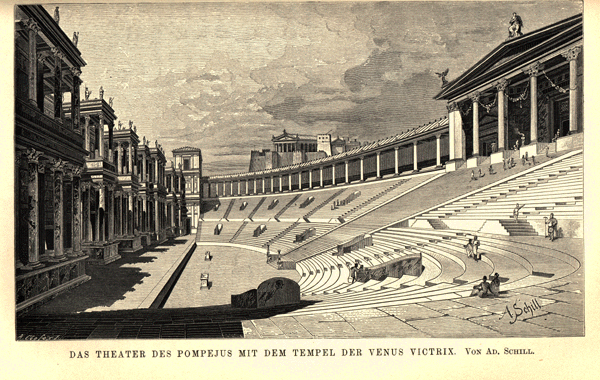
On the morning of 15 March, 44 B.C., Decimus was welcomed into Caesar's home, where he  extended an invitation to a gladiatorial display in one of the larger halls at Pompey's theater.  It was a subject certain to pique Caesar's interests. Before crossing the Rubicon, Caesar had been checking up on one of his own gladiatorial schools. He now agreed to accompany Decimus to the theatre. He had no intention in attending the Senate, which was meeting in the Curia Pompey, part of the same complex.
As the pair entered the complex through a side entrance, crowds pushed toward Caesar, forcing petitions into his hands, comments on government policy and requests for assistance. One of the messages handed to Caesar was from his lieutenant, Mark Anthony, warning of rumors concerning the Senate meeting today. Like the others notes handed to Caesar this morning, it would not be opened until it was too late.
Was there a man in the street warning Caesar to “Beware the Ides of March”? Probably, given the depth of religion in the pagan world, there were people wandering the streets of the largest city outside of China, prophesying doom about every dawn, and in particular about the dawn of an abandoned New Years Day. But Caesar had become Dictator by ignoring such ominous warnings. Today the soothsayer was right. The previous ten thousand mornings he had been wrong.
Once inside the walls of Pompey's Theatre, Caesar and Decimus, made their way along the walks toward the meeting room to inspect the gladiators. But as they passed the Curia they were waylaid by Decimus' older brother, Brutus. He urged Caesar to stop in the Curia,  to allow the Senate to wish him gods' speed on his invasion of Parthia. Exasperated, Caesar acquiesced, and the three men crossed the portico and entered the temporary Senate Chambers.
As he sat down, Caesar could not have missed the electric tension in the room. But what did it mean? Many were avoiding eye contact with him. A few were looking at their feet, or fingering the daggers hidden in their Senatorial robes. But even those Senators who were not in on the plot must have recognized that something was wrong. And when Senator Lucius Tillus Cimber thrust forward a petition asking that Caesar allow his brother to return from exile, Caesar pushed it away, into the hands of an aide. Where upon Tillus grabbed the hem of Caesar's toga, and pulled. Caesar pulled away, demanding, “Be careful, there is no need to use force!” As Caesar turned to a guard to seek assistance, Senator and Tribume Publius Servilius Casca Longus, slashed forward, stabbing Caesar in the neck, just missing his throat.
Caesar grabbed Casca's arm and stabbed him with a pen. Startled, Casca screamed, “Help, brother!” As he tried to stand, Caesar was stabbed again. He now realized the aristocrats had surrounded him, and they all had knives. He tried to run, but fell, and was brutally stabbed over and over as he lay on the floor. The autopsy would reveal 23 wounds. So many knives were slashing that Brutus was stabbed by one of his allies.
Rather than being proud of their act, the aristocrats fled the scene as quickly as they could, escaping back inside the city walls, where Cesar's soldiers were not allowed to carry arms. And the abandoned body of Julius Caesar lay a crumpled heap on the floor of the Curia Pompey, his robes soaking in his blood, for three hours. Finally three slaves worked up the courage to gather his corpse, load it on a litter, and carry him home to his wife. Thousands stood in shock to see the body pass on the street, one arm hanging off the litter, uncovered , bouncing to the steps of nervous slaves.
The site of Caesar's murder did not become a shrine. It became a public toilet. Pompey's theatre remained in use for almost 1,500 years. Eventually the large latrine which had shared a wall with Curia was enlarged, and engulfed the spot on the floor Caesar had bled upon. Finally it was walled off and forgotten. And when the theatre, and the latrine, fell on hard times midway through the fifteenth century A.D., the populace turned it into a quarry, scavenging building stones for their homes and shops. Even today, those who come to look upon the space where Giaus Julius Caesar died, will find only an arch, and an ancient concrete wall
Within two years most of the aristocratic assassins were dead. Cassius, Casca, Cimber, Brutus - all died by their own hands. A few of the forty were killed in battle, and a few even fought for their lives in the courts, and won. They were allowed to return to Rome and live in somewhat reduced privilege. Caesar's will left his fortune to his nephew Octavian, and eventually the boy overturned the rotten remains of the Republic and disposed of the tawdry trappings of its dead democracy, which had really been killed by the aristocrats.  Octavian became Augustus, the first Roman Emperor. Retroactively, he made his uncle divine. The deceased Julius Caesar had become the thing the aristocrats said they  feared he wanted to become, a god.
But the dream of a representatives government, giving the people a voice in their own governance, had been set back by 2,000 years.
- 30 -

Blog Archive