August 2025

August  2025
I DON'T NEED A RIDE. I NEED AMMUNITION.

Translate

Showing posts with label D.C.. Show all posts

Thursday, February 20, 2025

COXEY'S ARMY - AT THE GATES


I suppose, in the category of those seeing Coxey's Army as a relief from oppression,  we must include 14 year old Albert Hicks, of East 83rd street in Manhattan. According to the Brooklyn Eagle, Albert had a fight with his mother and ran away from home, saying he was going to join Coxey’s Army.  
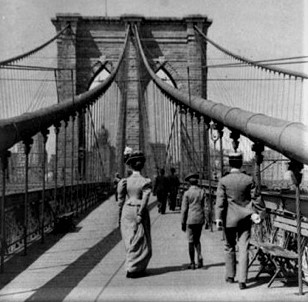
According to the Eagle, Albert made it no farther than the ten year old Brooklyn Bridge, where a police officer took him into custody, and called his father to come to collect the boy. It was a common story, an angry fourteen year old running away from home, not worth repeating on the front page of a large newspaper, except for the dubious connection to “Coxey’s Army”. 
Which may explain why the hero of this story bore the same name as the last pirate hung in New York City, back on Friday, 13 July, 1861.
Pirates were self employed sailors,  committing robbery without government sanction.  And in that spring of 1892, the Congressmen, members of the cabinet and lobbyist for the wealthy, considered the Commonweal Army as pirates, practicing the dangerously romantic concept that government can be petitioned directly by its citizens. It had not really been tried in America since the civil war.  And consider what that experiment had cost. 
So working class Americans came out to have a look at Coxey’s Army, which was doing this odd thing. And the vast majority were not frightened by what they saw.   The mixing of whites and blacks did cause some unease, but not enough to deny the logic of joining people looking for work with work that ought to be done, such as building roads. 
But the stories of Coxey's Army did scare Congressmen and the President, and infuriated the wealthy and powerful who were not interested in sharing "their" money. 
"Once, indeed, the Tin Woodman stepped upon a beetle that was crawling along the road, and killed the poor little thing. This made the Tin Woodman very unhappy, for he was always careful not to hurt any living creature; and as he walked along he wept several tears of sorrow and regret."
1900  L. Frank Baum "The Wonderful Wizard of Oz"
On Sunday, 22 April, 1892 , the Philadelphia recruits, under the top hat wearing Christopher Columbus Jones, arrived in Hagerstown. They army had been waiting for them, but the reinforcements numbered  just 18 .  Similar reinforcements coming from Chicago, Kansas and Georgia were being cut off by local authorities and jailed or broken up. Clearly the wealthy in America were not going to surrender addiction without a fight. 
This day, too, William G. Moore, Chief of the District of Columbia Metropolitan Police , publicly announced that if the Commonweal Army entered the Federal City, he would enforce an 1830 regulation making it illegal for anyone to enter the District who would likely become a “public charge’.  It was an absurdly pompous threat on the face of it, since being arrested for violating the 60 year old ordinance would achieve the very object the ordinance was designed to discourage. Prisoners were by definition, in the public charge. There is a reason criminalizing poverty has been discarded. But, it seems, every generation must relearn that reason on their own.

But the commission that ran the District of Columbia went even further. Knowing that Coxey's soldiers sought donations of food and money, Moore announced that hence forth it would be illegal to solicit funds without a license, even though no licenses yet existed and no requirements had yet been written for such a license.

In addition it would now be illegal for there to be any assembly on public property without a license., despite no such license being in existence, and no procedure for obtaining such a nonexistent license was yet in existence.  And no obstruction of public roads would be permitted, either, said the commission, such as pedestrians walking down a public street.  If these regulations were meant to discourage Coxey’s Army, they failed.  In fact, the confrontational approach probably added to the Army’s numbers, as the unemployed, who before had just been desperate and rejected, now began to get angry.
Bright and early on 23 April the 300 plus members of Coxey’s Army marched (above) out of the Hagerstown camp, with flags and banners flying. They only made about six miles that day, stopping for the night at the little community of Hyattstown, where some of the men were provided with home cooked meals by locals, and the rest were welcomed to camp along Little Bennett Creek. Thousands of people turned out for speeches and general festivities in the Army’s camp that night.

One of the reasons Hyattstown was so welcoming was that for over a century, locals had been struggling with a “...deficient link of the Great National Western Road.”  The section between Rockville and Gaithersburg, Maryland, had heavy rain. Often it was nearly impassable, and its dismal condition was disparaged and deplored by the local press and public.”  
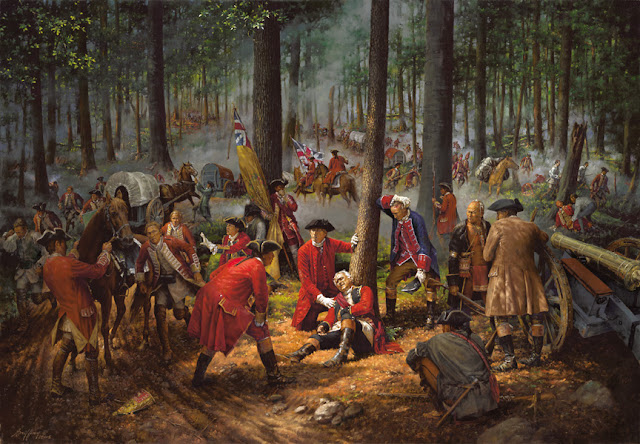
A generation before the American Revolution - in 1755 - , the English General Braddock had almost been defeated by this very stretch of road a year before he was killed on his way to Pittsburg (above). A generation after that war, Thomas Jefferson’s road improvements bill had failed to fix the problem. Now, four generations later, the problem persisted. In fact, this section would not be really fixed until 1925, when it was finally paved over, once the automobile became as powerful a lobby as the railroads.
The mayor of Frederick, Maryland (above), John E. Fleming,  lowered the old toll road barrier and boasted that Coxey's Army would never set foot in his town.  Forty additional deputies were sworn in to keep them out.  However, on 24 April , Coxey’s Army, now 340 strong, marched into town, escorted by the deputies. And the world did not end. That night the press reported a “drunken brawl”, but the details were never confirmed. And the next day, when the Army marched out, their numbers were now 400 strong. 
It was on Saturday, 28 April 1892  that Coxey’s Army reached the doorstep of their goal, Brightwood Riding Park – now the Brightwood Recreation Area - along Rock Creek, just outside the District of Columbia. Here they established what they called Camp Stevens. They were greeted by a crowd of 10,000 curious, friendly people. Also on hand were 1,500 federal troops (3 soldiers for every member of the Army), with more soldiers waiting in Baltimore, Annapolis, and Philadelphia, ready to rush to the capital to put down the first signs of any violence. There was none.
Instead, over Saturday and Sunday, an estimated 6,000 unarmed curious citizens visited the encampment in peace. Coxey was quoted in the papers as explaining the march this way; “Congress takes two years to vote on anything…Twenty-millions of people are hungry and cannot wait two years to eat.”
On Tuesday, May 1st, 1892  perhaps 15,000 people crowded around as the Army of 500 left camp (above) for their final seven mile march on the Capital. The Baltimore Herald said “Such a fantastic aggregation (had) never paraded itself in seriousness before the public.” 
First came Mrs. Annie L. Diggs, carrying the American flag. She was followed by Jacob Coxey’s 17 year old daughter on horseback, representing the goddess of Peace. Then came Carl Browne, dressed in his buckskin fringe (above).
Then came Jacob Coxey in his carriage (above, left), riding with his second wife and their infant child, “Legal Tender Coxey”.  They were followed by an actress on horseback, Ms. Virginia Le Valette.  She carried an umbrella (above, left center) and was draped in an American flag. And only behind this final exhibit of female pulchritude, did the public at last get a view of the object of the entire discussion, the army of the unemployed, totting banners and signs. It must have been the most bizarre procession that ever walked down Washington's 16th street, not excepting the parade formed by Dolly Madison as she fled the White House in 1813, with wagons piled high with silverware and paintings, just ahead of the British arsonists.
As they had formed up for the final march, Carl Browne told the men, “The greatest ordeal of the march is at hand. The eyes of the world are upon you, and you must conduct yourselves accordingly.” And they did.
Ahh, if they only knew the high drama and low comedy that was about to descend upon their heads.
"The Tin Woodman knew very well he had no heart, and therefore he took great care never to be cruel or unkind to anything. "You people with hearts," he said, "have something to guide you, and need never do wrong; but I have no heart, and so I must be very careful."
1900  L. Frank Baum  "The Wonderful Wizard of Oz" 
- 30 -

Sunday, November 10, 2024

K STREET Chapter Seven


I guess it must have been like awaking from a dream. With the bombing of Pearl Harbor, the economic revolution demanded by the Great Depression was finally unleashed. 
Federal spending rose from $9.4 billion in 1940, to $13 billion in 1941, to $30 billion in 1942, and $65 billion by 1943, and from just 9% of the total Gross Domestic Product in 1940, to almost 50%.
Unemployment was still at almost 10% in 1941, but by 1943 it had dropped to less then 2%. And the Federal District had gone from less than 1 million residents in 1940 to 2,100,000 in 1943. 
The dreamer awakened to discover the America of 1929 had been the dream.
"Lobbying is part of a larger process of social and legislative change. To be successful, it should be just one part of a strategic campaign that includes working with the press, grassroots activism, letter writing, and litigation. Each of these elements should be integrated with direct conversations with legislator."
Milo Public Affairs LLC
Emblematic of this change was the Pentagon, which was built in only 15 months (on land once occupied by  the Bonus Marchers' shantytown), was officially opened on January 15, 1943. It was the largest office building in the world (at the time) with some 6 ½ million square feet of space, but only four stories tall,  to save on steel. 
One joke was that the Pentagon was so big that a teenage Western Union Messenger got lost among the endless corridors and by the time he made it out, he was a Lt. Colonel. 
Early on, a member of the 42,000 army of clerks, the vast majority of whom were women, went into labor. As he dialed for an ambulance the guard chastised the woman for even coming to work in her condition. She explained, “When I came in here, I wasn't in this condition.”
“Fifteen million people in the United States are represented by lobbyists. The other 150 million have only one man who is elected at large to represent them – that is the President of the United States”
Harry Truman 1947
In comparison, the Thomas Jefferson Memorial (above) was begun in November of 1938 and  took  3 ½ years to complete. And upon its opening, on April 13, 1943, the centerpiece statue was painted plaster. The intended bronze likeness of Jefferson would not be cast and put in place until in 1948, when bronze was no longer a vital war commodity. Later that same year of 1943, the new 11 story office building at 1625 K street, built on the site of the Little Green House, would be also be completed.
The little Green house had been demolished in May of 1941, after the lot was purchased by developers. The firm of Singletary Rueda designed an 11 story, 108,000 square feet of floor space, 1,260,000 cubic square feet of “living” space, building. It also opened in 1943.  It cost $500,000 ($6.5 million today). The developers got a building fronted with a limestone and with a polished granite lobby. The less visible side and rear of the building showed a cheaper brick veneer. They named it the Commonwealth Building. And although it was described as a general use Office building, because of its location, just three blocks from the White House and the Executive Office Building, it was a prime location for lobbyists.
“You know, the only trouble with capitalism is capitalists, they're too damn greedy.”
Herbert Hoover - March 1934
In 1950 the British Medical Journal – The Lancet – published a study indicating a close link between drawing cigarette smoke into your lungs and and cancer. In 1954 a 20 year study of 40,000 smoking English doctors was published, which confirmed that relationship. It was estimated that between 1930 and 1959 11 million smokers worldwide would die of smoking related cancers and strokes. The British government issued advice that people should stop smoking.
Meanwhile the United States Tobacco industry managed to deny reality for another seven years. In the spring of 1963 the big six tobacco companies - R. J. Reynolds, American Tobacco, Brown & Williamson, Liggett & Myers, P. Lorillard, and Philip Morris - hired as their chief lobbyist ex- Kentucky Governor, ex-Senator and ex-majority Whip of the House of Representatives -  and close personal friend of President Lyndon Johnson -  Earl C. Clements (above).
“Lobbying, like all persuasion, is story telling....When you lobby, tell a good story. Put a face on the issue, preferably a face from the legislator's home district. Also put the story in a larger context - your example is but one story among many. Talk about a world in which your problem doesn't exist, lay out the existence of your problem, and why the target is the key to the solution.”
Milo Public Affairs. LLC
On Saturday, January 11, 1964 the Surgeon General's report was released to 200 reporters. The ten doctor panel was unanimous in finding a direct link between smoking and lung cancer, chronic bronchitis, emphysema, cardiovascular diseases and cancer of the larynx. Within three months consumption of cigarettes dropped 20%. And then Clements swung into operation.
“I earn a living fronting an organization that kills 1200 people a day. Twelve hundred people. We're talking two jumbo jet plane loads of men, women and children. I mean, there's Attila, Genghis... and me, Nick Naylor. The face of cigarettes, the Colonel Sanders of nicotine.” 
“Thank You For Smoking”. Fox Searchlight Pictures. 2006
Tobacco in 1962 was a $7 billion industry. That year Americans smoked on average 4,300 cigarettes apiece. The industry paid $3 billion in taxes and spent $250 million in advertising. What is amazing is that with this much at stake, Clement convinced the Big Six not to deny the dangers of smoking. Rather, he urged them to not only accept warning labels on each pack, but to insist that they should write the labels.  
In fact, suggested Earl Clement, those labels could be a powerful defense against wrongful death lawsuits. His strategy worked so well that tobacco use actually increased, as did the cost of smoking - almost $100 billion in lost productivity each year and $22,000 in additional medical cost over the shortened lifetime of every smoker, after the warning labels went on. Even into the next century, smoking "weed" would get you jail time, smoking tobacco was still legal. 
“Nick: Okay, let's say that you're defending chocolate and I'm defending vanilla. Now, if I were to say to you, "Vanilla's the best flavor ice cream", you'd say …?
Joey: "No, chocolate is."
Nick: Well, I need more than chocolate. And for that matter, I need more than vanilla. I believe what we need is freedom and choice when it comes to our ice cream, and that...is the definition of liberty.
Joey: But that's not what we're talking about.
Nick: Ah, but that's what I'm talking about.”
Thank You For Smoking. Fox Searchlight Pictures. 20006
For his amazing work, in 1966, Clements was named to the well paid position of President of the Tobacco Institute He died in 1985 and was buried in his hometown cemetery, in Morganfield, Kentucky. His cause of death is, oddly, given  nowhere in his obituaries.
- 30 -

Tuesday, November 05, 2024

K STREET Chapter Two

I have to tell you that the American Constitution says many magnificent things and some really dumb things. An example of the latter is hidden in the very first amendment, which insist, amongst other items, that “Congress shall make no law....abridging the...right to petition the government for redress of grievances.” The problem is the founding fathers never actually defined what a grievance was. 
The original justification for the revolution - no taxation without representation – was corrected by the establishment of the Constitution itself.  But once corrected that complaint morphed into the petty jeremiad , “No taxation if I can afford to buy my Representation.” In such a situation the middle man, the facilitator, the go between between you and your representative is called a lobbyist. And while making you richer, they also make themselves rich..
“William Irving, who as chairman of the ward meeting in New York, denounces De Witt Clinton for visiting Albany - (he) has forgotten, perhaps, that three years ago he visited Albany nearly a whole winter as a lobby member, to procure a charter for the City Bank.”
The Albany Register, March 25, 1817
Under that new flawed Constitution, William Hull was hired in 1792 to convince the first Congress to cough up the benefits owed to veterans. He quickly realized he was outnumbered. 
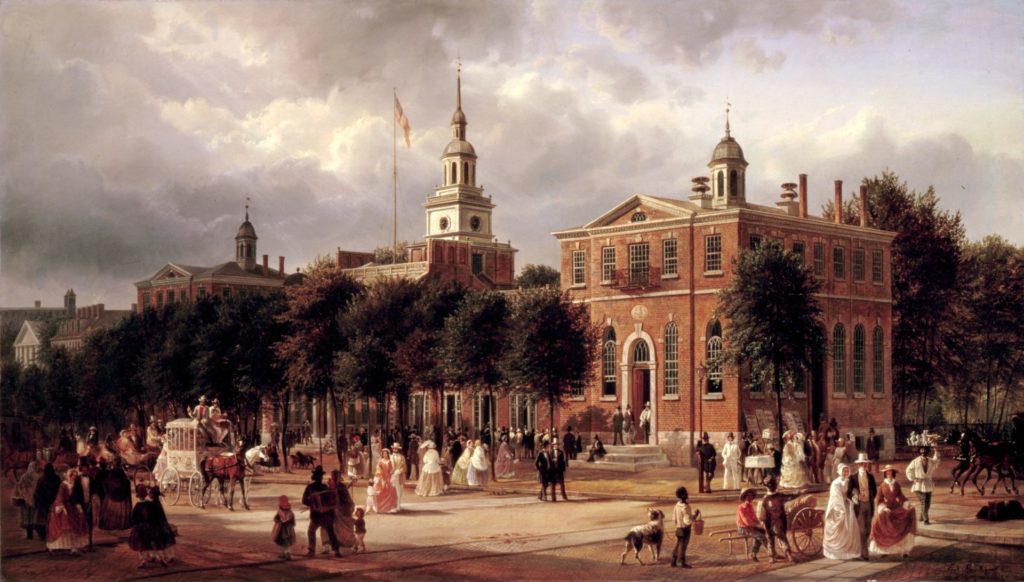
All about Independence Hall swarmed a great cloud of lobbyists, for shipwrights and New England merchants seeking to stop a tariff bill (delayed but passed), merchants seeking an end to the tax on molasses (passed), a pay raise for Federal clerks (denied), military officers seeking repayment of personal moneys (passed) and even states themselves, who sought a louder voice in the federal government than the one already provided for them by the Constitution. 
The Senate was even forced to block the pitiless lobbyists from their own chamber. In desperation William Hull called for reinforcements. He urged veterans' groups to send supporters to Philadelphia so those who had served their country could be heard above the din. The veterans' bill still died. And eventually so did the veterans, which ended the problem as far as Congress was concerned.
“In the legislature of New York, some years ago, “lobbying” was reduced to a system. The agents for the various private bills...met in a tavern, and took the “yeas and nays” on every bill in which they were interested...So complete was this machinery, and so perfect the sagacity with which the opinions of the independent members were guessed at, that the decisions of the chambers became ludicrous echoes of those of the “lobby!”
Notes on the United States...by George Combe. 1841
In the 1850's Samuel Colt found his original patents were running out, and he launched a campaign to have Congress extend them. The profits he hopped to gain were so great, and the funds he expended to achieve that end were so manifest, that Congress launched an investigation. 
It recorded that the Connecticut arms maker had supplied women, company stock, Parisian gloves, dinner parties, theater tickets and a great many pistols, even giving one to a congressman's “little son, only eleven or twelve years of age.” Said the chief lobbyist for Colt, “To reach the heart or get the vote, The surest way is down the throat.” Presumably he was referring to food, but the ultimate inheritor of Mr. Colt's tactics, the National Rifle Association, has never been shy about shooting off its own mouth.
“...Then there are the lobby-members, a race very little if any inferior to the real members...It is the business of a lobby member to bribe the real members, in any way that seemeth to them best.”.
The United States of North America as They Are.... By Thomas Brothers. London. 1840 
Jay Gould was the head of the Union Pacific Railroad and the clever mastermind behind the Credit Moblier, in which congress paid $145 million ($2.5 billion today) for a transcontinental railroad that actually cost only about $50 million. 
But to listen to Gould tell it, he was getting shafted by his Washington lobbyist, William Eaton Chandler. Chandler pocketed $10,000 from Gould, and equal amounts from the other members of the scam. 
Gould's co-conspirator, Collis Huntington, owner of the Southern Pacific Railroad, complained that the lobbyists “are very quick and hungry in Washington this winter.”  Still, as Huntington admitted, “We must take care of our friends”: just not like they were family. The friendly members of Congress, who approved the skyrocketing bills for the construction, had been gifted stacks of railroad stock. But the day the railroad was completed, their stock almost worthless. All the profits had channeled through a different company, Credit Moblier, which had been held by Gould and Huntington and a few partners so close they were like family. 
(If you wish to see but a sliver of the fortunes that were stolen from the American taxpayers in the Credit Moblier scam, please visit the Huntington Library, art galleries and botanical gardens in Pasadena, California. Just tell the guards that your great-great-grandfather paid for the Gainsborough, or the Japanese Tea Garden, and you've come to pick it up.)
"This business of lobbying, so called, is as precarious as fishing in the Hebrides. You get all ready, your boats go out--suddenly there comes a storm, and away you are driven.... Everybody who knows anything about Washington, knows that ten times, aye, fifty times, more measures are lost than are carried; but once in a while a pleasant little windfall of this kind recompenses us, who are always toiling here, for the disappointments. I am not ashamed--I do not say I am proud, but I am not ashamed--of the occupation."
Samuel Ward. Congressional Testimony. 1875
Samuel Ward liked to be known as the King of the Lobbyists - quite an ego. And there was no doubt, he was one of the most fascinating men in the Gilded Age. He'd been educated at the best schools in Europe. He had made and lost half a dozen fortunes. His best friend was Henry Wadsworth Longfellow and his sister wrote the “Battle Hymn of the Republic”, for heaven's sake. 
He was a poet, and perhaps the anonymous author of “Diary of a Common Man.” It seemed he had only become a lobbyist because it allowed him to dine like a king on the client's dime. And his clients included insurance and telegraph companies, steamship and railroad lines, bankers, mining conglomerates, manufacturers, investors, the nation of Paraguay, among others, and whichever private citizens had enough money to afford government protection against their business competitors. To all comers, Sam Ward was living proof that the American government thinks with its stomach.
 "To introduce a bill properly, to have it referred to the proper committee...to attend to it, to watch it, to have a counsel to go and advocate it before the committee, to see that members of the committee do not oversleep on the mornings of important meetings, to watch for the coming in of the bill to Congress day after day, week after week, to have your men on hand a dozen times, and to have them as often disappointed; to have one of those storms which spring up in the Adriatic of Congress, until your men are worried, and worn, and tired, and until they say to themselves that they will not go up to the Capitol today--and then to have the bird suddenly flushed, and all your preparations brought to naught,  these, these are some of the experiences of the lobby."
Samuel Ward. Congressional Testimony  1875
At a time (the 1870's) when Washington was infamous for its dearth of quality restaurants and serving horribly bad food, Samuel Ward was a gourmet, a bon vivant and cognoscente of fine wine and conversation. A meal at his table was seasoned with witty stories of the famous, and his guests were a happy mix of the powerful and the wealthy. An evening at his tables was described by one guest as “The climax of civilization”, at least in Washington, D.C.. One year his clients reimbursed Sam $12,000 just for “Dinner Expenses” - over $200,000 today. 
It was Sam who inspired Historian Vernon Parrington to define the age as “The Great Barbeque., and Mark Twain as "The Guilded Age".  Sam's “ambrosia nights” inspired imitators but no real competitors. The only drawback to such a life as that lived by Samuel Ward is that he was honest. He died broke, in Naples, in 1889. 
The New York Times was rapt in its praise – once he was dead. “He never resorted to vulgar bribery; he excelled rather in composing the enmities and cementing the rickety friendships which play so large a part in political affairs, and he tempted men not with the purse, but with banquets, graced by vivacious company, and the conversation of wits and people of the world.” They had to invent a phrase for what Samuel Ward did. They called it “The Social Lobby”.  Future generations would broaden the definition of the practice.
“Wife of Washington Lobbyist Uses Money as Wrapping Paper"
"The wife of Washington lobbyist Ed Rogers gets the money sheets from the United States Bureau of Engraving and then slices and dices as you would any wrapping paper to best fit the gift and get the best pattern on the front of the package (in this case it's lining up Washington's face just right). No matter that she regularly cuts several bills in half in the process, to be frugal she sticks to the dollar paper and only uses it to wrap "small" gifts. A sheet of money paper consisting of 32 $1 bills and sells for $55. “
Luxist. (“a web site dedicated to covering the best the world has to offer.”) September 8, 2008
- 30 -


Blog Archive