
I assume you have heard of the most famous work by Dr. Laurence Peter, who created "The Peter Principle.” It states that in any hierarchy “every employee tends to rise to their level of incompetence”. Well, I have observed a related behavior in human males which I call “The Peter Pan Principle”.
Peter Pan was the theatrical character, the boy who never grew up, and my theory postulates that some males emotionally stagnate in adolescence. And my example is the life long adolescent, Arthur Brown , second cousin to Calvin Coolidge, and a man whose dramatic life reached its pinnacle on the floor of the U.S. Senate, and its nadir ten years later and a block away, on the floor of a hotel bedroom. To put it another way - Arthur Brown slept his way to the bottom.
Arthur (above) grew in up in the 1840's on a Michigan farm, with two older sisters - he was a baby Moses floating on the estrogen Nile. Family friends generously described him as possessing a “keen intellect” but less perceptive on “moral issues”.
When Arthur was 13 his progressive minded parents dragged him to the center of Ohio so that his older sisters could attend the Unitarian funded Antioch College (above). And Arthur eventually entered that institution as well. As was to be expected given its progressive coeducational provenance, the academic standards at this institute of higher learning were high, while the standards of discipline were a bit fuzzy.
The students did not pass or fail, they instead received a “narrative evaluation” for each class. It was the perfect environment for Arthur, giving him easy access to mother figures and women he could manipulate. In short he seems to have been confused as to the advice of the school's first President, Horace Mann; “Be ashamed to die until you have won some victory for humanity.”
After graduating from Antioch, Arthur earned a law degree and spent the Civil War years back in Kalamazoo Michigan, building a successful criminal law practice, marrying, and fathering a daughter. And when his mid-life crises came, Arthur's response was almost pre-ordained.
He fell in love with a younger woman - Ms. Isabel Cameron (above), daughter of the powerful Republican State Senator, David “The Don” Cameron, and wife of a clerk. Arthur bought his new mistress a horse and buggy, and rented her a house.
Now, no rational person would have expected to keep such a high profile romance secret in a town of just 20,000. And one night in 1876 Arthur's offended spouse surprised the loving couple in his law offices. Mrs. Brown was armed with a loaded revolver, but luckily she proved a poor marks-woman. The entire town sided with the wife when she threw Arthur out on his ear. The man-child Casanova now moved to Salt Lake City, Utah Territory, evidently under the mistaken impression that Mormons were open to open marriages.
Arthur was expecting to be appointed the U.S. District Attorney for Utah, but the pall of smoke from the Republican bridges he had burned in Kalamazoo obscured his prospects. So he opened a law office at 212 South Main Street in Salt Lake City (above), where he quickly duplicated his Michigan success. The local newspaper judged Arthur to be “a good hater,.” and described him as “Gentile in faith, but a Mormon in practice.” Little did they know.
By 1879, when he was rejoined by the still smitten Isabel, Arthur (above) was a millionaire. And the instant his Michigan divorce was finalized, Isabel became the second Mrs. Brown. Arthur bought a fine house in the fashionable section of South Temple Street, and, in time produced a son - his second - whom they named Max.
In 1894 Arthur was sent to Washington as one of Utah's first two senators. The New York Times described him as “an intense, bitter partisan...Always pugnacious...” His honorary post ended after only one year, and he did not run for election. He returned to his profitable law practice and his family, in that order. In 1896 Arthur was a delegate to the Republican National Convention held in St. Louis.
And it was there he met his next mistress (that we know of), secretary for the local Republican party, Mrs. Anne Maddison Bradley (above). He was 53, and she was 23. It became apparent that Arthur had a type - younger.
Annie was the editor of the Salt Lake City Woman's Club magazine, a member of the Woman’s Press Club and the Poet's Roundtable. She was also a charter member of the Salt Lake City Unitarian Church. She was everything a rich Unitarian might seek in a mistress, if you overlooked her clerk husband, Clearance A. "Ned" Bradley and their two children. But wouldn't that just make her more likely to be discreet?
The convention (above) nominated William McKinley on the first ballot, allowing Arthur and Anne to consummated their affair so quickly that Arthur overlooked yet another impediment to his new mistress - a vine of insanity intertwining several roots of Madison family tree.
Back in booming Salt Lake City (above), Annie at once separated from her husband, Clarence. He started drinking to excess, and then gambling to excess. A couple of years later Clarence conveniently ended up in jail. Anne testified later that Arthur then “...began coming to my house at very unseemly hours, and I told him it must stop, but he answered. 'Darling, we will go through life together. I want you to have a son' and after several months we did.”
Arthur Brown Bradley (above) was born 7 February, 1902. Shortly thereafter Arthur took a suite at the Independence Hotel. He informed Isabel - remember wife number 2? - that he was going to file for divorce. He even took Annie with him on a trip to Washington, D.C, staying in adjoining rooms at the Raleigh Hotel, just behind the Capital, at the corner of Pennsylvania Avenue and 12th street.
When the divorce papers arrived back in Utah, Isabel was finally spurred to action. When hitting Arthur with a horse whip did not dissuade him from seeing his mistress, Isabel had both Arthur and Annie arrested and charged with adultery - four times in six months. The Salt Lake City “Desert News" was present at the last arraignment. Said the News, “Arthur Brown On the Rampage...Says He Was Knocked Down By an Officer.”
Arthur accused the police of notifying the newspapers in advance of his arrest - it was probably Isabel - and denounced the arrest of Annie - in a very loud voice. “They dragged her through the streets", he shouted, "One on each side of her. Armed to the teeth. Cowards! Cowards! Cowards!”
Judge Christopher Diehl asked Arthur, “How do you expect to keep such things out of the papers when you yell so you can be heard for two blocks?” Eventually the headlines would read, “Arthur Brown Goes Scot Free.” But all the dramatics took a toll on Arthur's reputation and his income.
His last arrest forced some reflection and re-evaluation upon Arthur. He moved back into the house on South Temple (above) with Isabel. Annie was offered a house of her own and $100 a month to stay away from Arthur. To Arthur's great surprise, she turned it down.
And a few months later Arthur slipped away to meet Annie in room 11 of the Pacific Hotel in Pocatello, Idaho. Their passionate reunion was interrupted by Isabel banging on the door. Arthur admitted his wife, at the same time asking his law partner - what the hell was he doing there? - to please, “Come in, I don't want to be left alone here with them.”
Annie, the mistress, began civilly enough. “How do you do, Mrs. Bradley? I have wanted to talk to you.” But Isabel's first instinct was not for conversation. She clamped her hands around Annie's throat and began throttling her.
The men separated the combatants, and the women spent the next several hours screaming accusations at each other, while Arthur cringed in the corner, if not in the center of the room, then still the center of attention. Come the dawn, Isabel returned home and Arthur Brown stupidly gave Annie a .32 caliber revolver, should Isabel seek a second confrontation. It seemed Annie had won.
But upon Annie's return to Salt Lake City, Arthur's law partner informed her that Isabel and Arthur had “reconciled”. The offer of a house and weekly stipend was renewed, and Arthur now pointedly denied his paternity of Annie's son, Arthur Brown Bradley. And being three months pregnant with yet another gift from Arthur, Annie reluctantly agreed to cease and desist any contact with the adolescent lawyer. She gave birth to her second child by Arthur, on 24 November, 1903. But to prove she had not given up on her obsession, she named the new child Martin Montgomery Brown Bradly.
Despite promises to his wife, Arthur maintained a discreet contact with Annie, at least until August of 1905, when Isabel died of cancer. Abruptly the path seemed cleared for Annie and Arthur to marry. But they did not... that is, Arthur did not make any offer of marriage.
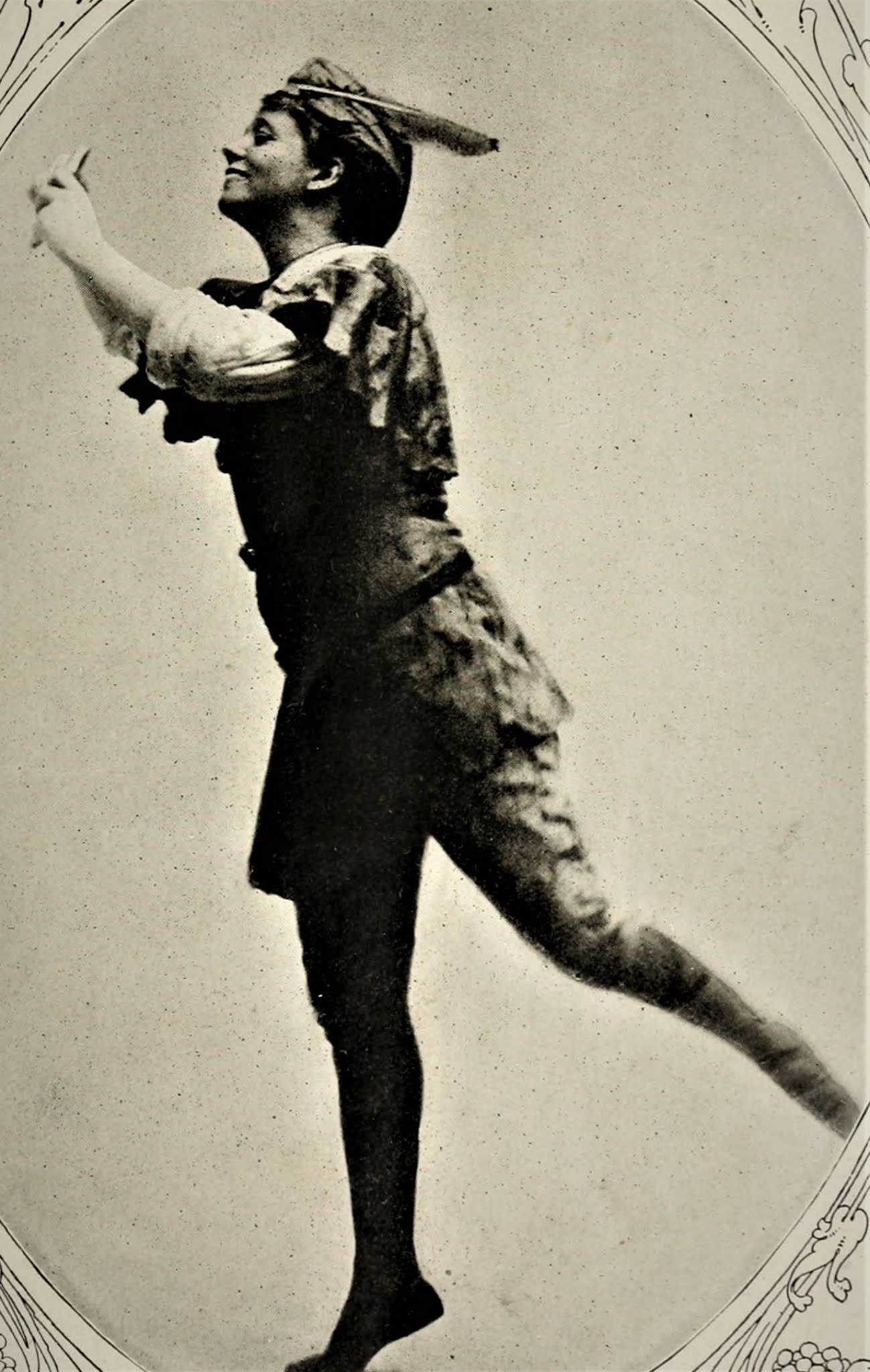
He was 63 years old now, and already had another mistress, someone closer to his own age for a change, She was Ms. Annie Adams Kiskadden (above, left). She was the mother of Maude Adams (above, right), Utah's famed actress, best known for originating the stage role of Peter Pan.
If she did not know about the past mistress, Annie Bradley must have suspected this one. She was now 33 years old herself, divorced, the mother of four, and had no income. Swallowing a little more pride she asked her millionaire boyfriend for $2,000 to start a new life. Arthur Brown ignored that request, but did present her with a one way train ticket to California for herself and the children. Then he left for Washington, D.C.
This slap in the face finally snapped something in Annie, just the way something had snapped in the two previous Mrs. Browns, one after the other, before her. Annie traded in her ticket for herself and her sons to California for a one way trip for herself only to Washington, D.C.
Annie arrived in town on Saturday, 8 December, 1906. As she expected, Arthur was registered again at the Raleigh Hotel (above). Annie registered as Mrs. A. Brown, and took the room next to Arthur's.
Conning the maid into opening the connecting door, Annie searched Arthur's room until she found letters from Annie Adams Kiskadden, which discussed marriage plans. No one should be surprised that after waiting for Arthur's return, Annie shot him with the very gun he had given her for self defense. I guess you could say that's what she used it for.
What can you say about a man who keeps inspiring the women in his life to shoot at him? Once might be an accident,. twice might be an unlikely coincidence - but three times? And the last time, he supplied the gun! When the hotel manager bent down over Arthur (above), he said only, “She shot me.” As if he was surprised.
Indeed, she had. Judging by the powder burns on his hands the Unitarian gigolo was reaching for the gun when Annie pulled the trigger. And six days later the gentile polygamist died - 13 December, 1906. His obituary in the New York Times noted with faint praise, that Arthur had been “intensely loyal to his male friends.”
As final proof of his childish character, Arthur's will renounced both of his sons by Annie. “I expressly provide that neither or any of them shall receive anything from my estate.” It almost makes you wish he had lived, so somebody could have shot the S.O.B a fourth time.
A jury agreed. Annie had entered a plea of “temporary insanity” but almost on the first anniversary of the shooting, and after just nine hours of deliberations, the jury instead found Annie simply not guilty. The misdirected Juliet walked out of the court room a free woman.
Annie returned to Salt Lake City (above) and opened an antique store called “My Shop” And she made a success of it, running her own business, raising her two sons by Arthur on her own, until her death on 11 November, 1950.
Thus the life of Arthur Brown, who never seemed to get any older than he was at the age of twelve. And don't we all know at least one like guy like that?
- 30 -






 The ceilings in the parent's bedroom (above) and the children's room upstairs showed gouge marks, apparently made by the upswing of the ax blade


 He had been assigned as a visiting minister to several small communities north of Villisca, where he developed a reputation for odd behavior; late night walks, rumors that he was a peeping tom and unconfirmed stories that he had tried to convince young girls to undress for him. In 1914, while preaching in South Dakota, he had advertised (above) for a private secretary. One young woman who responded was informed by return post that Kelly wanted her to type in the nude . He was convicted of sending obscene material through the mail, and spent more time in a mental hospital. While there he wrote to the Montgomery County D.A. that he expected at any moment to be arrested for the


 A second jury was immediately empaneled, and in November the Reverend Kelly was acquitted by all 12 jurors. No one else was ever tried for the murders. And the crime remains one of the most horrific, unsolved mass murders in American history, known simply as
  Did he do it? I don't know. The passengers on the number 5 train that Monday morning in 1912, were pretty certain in 1917 that the Reverend Kelly had confessed to them, three hours before the bodies were discovered. But did they really remember the confession, five years later? Was it really the morning of the murders? Or had it happened two weeks later, when Reverend Kelly had impersonated a detective, and returned to the scene of the crime, and then boarded the same Number 5 train ? It is enough to shake your faith in any certainty in this world. (


