August 2025

August  2025
I DON'T NEED A RIDE. I NEED AMMUNITION.

Translate

Showing posts with label 49 B.C.E.. Show all posts

Thursday, February 17, 2022

ET TU Part Two GAMBLING


I have no doubt there were spies in Ravenna (above) on 11 January, 49 B.C.E. There are always spies in border towns, and heading north into Cis-Alpine Gaul (Northern Italy)  the first town you reached  was the  fishing port of Ravenna. (above)  By virtue of his own ego and talent to garner loyalty, a man could be a general here, even a dictator.
But just fifteen miles to the south in the port of Ariminum, he would be answerable to the politicians 200 miles further to the southwest, in the self described center of the civilized world; Rome. And the man the spies from Rome were watching this short winter day was the governor of Cis-Alpine Gaul and the conqueror of  Trans-Alpine Gaul - Julius Caesar.
Caesar's stated reason for being in Ravenna was to check on his investments. The tens of thousands of slaves Caesar had captured in his conquest of  Trans Alpine Gaul (i.e. France) and during his recent invasion of Britain, had be converted into cash. Laborers and house servants could quickly be sold, but gladiators required training. The reward was gladiators could always be sold at a premium, so, of course, Caesar was here to inspect the construction of his gladiator school, and to witness a display of his gladiators in training. 

Then, after a light lunch, Caesar went to the baths, another public appearance for a Roman politician. And in the evening he sat down for a banquet (above), the kind of thing politicians are still expected to do. And as the sun set, according to Plutarch, “...he left the company, having desired them to make merry till his return, which (he assured them) they would not have long to wait for." It was enough to lull most spies to sleep. But the Romans were about to learn what the Gauls had learned before them - if you want to know what Caesar is about to do, you did not watch Caesar. You watch his legions.
When Caesar marched off to Gaul in 58 B.C. the tribune he left guarding his interests was the
flamboyant Publius Clodius Plucher (above).  Over the next five years with his help Roman politics devolved into something akin to the Chicago gang wars of the 1920's. Then  on 18 January, 53 B.C,  100 miles south of Rome, in the little farming village of  Bovilla,  Plucher and his band of thugs ran into thugs under Pompey's leading tribune, Titus Annius Milo. 
During the ensuing brawl -  something which had become common in the dying Roman Republic -  Plucher was stabbed in the back with a spear. He was taken into a tavern to be tended to, but Milo's men dragged him back into the street (above) where he was murdered.  There were two immediate results of this escalation of violence. 
First, Plucher's thugs brought the tribune's body 100 miles back to Rome, where they built his funeral pyre in the middle of Senate House (above), burning the entire building down.  Milo was then convicted of murder. The tribune's lands and businesses were seized, and he was exiled from Rome.  
This had only happened because Pompey had withdrawn his support from Milo, supposedly appalled by his own tribune's actions. So naturally the Senate turned to Pompey to restore law and order, naming him as sole consul, with powers to put down what was described as an insurrection. 
Four years later, with Julius Caesar's (above) ten year term as Governor of both Gauls about to run out, and with him returning in triumph, Pompey was worried about Caesar's ability to sway the populace. When his nervous allies hinted there were few soldiers in Rome to protect the Senate, Pompey reassured them, “I have only to stomp my foot to raise an army”  
Thus it was Pompey as Counsel who suggested on 7 January, 49 B.C, the Senate order Caesar to disband his legions and return to Rome for trial for excesses in his governance of Gaul. 
That action was vetoed by the two Tribunes who were were still loyal to Caesar, Mark Antony and Quintus Cassius Longinus (above). They were promptly driven out of the Rome at sword point. And that left the government entirely in Pompey's hands.
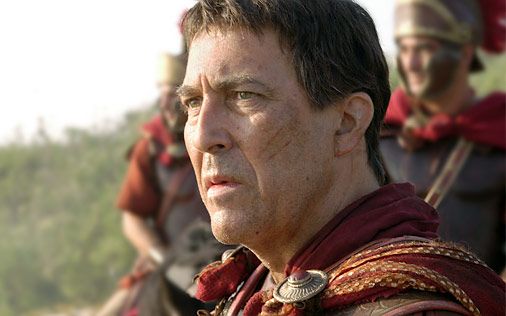
Caesar (above), offered a compromise. He would surrender command of his legions IF Pompey surrendered his post as Sole Counsel. Then both Caesar and Pompey would stand for (and certainly win) election as Co-Counsels., IF Caesar could remain safely in Cis-Alpine Gaul until the results were confirmed. Elected counsels were immune from prosecution. Then Caesar could safely return and both men would rule in Rome for a year. 
Pompey could have accepted the deal simply by resigning. But neither he nor the conservatives in the Senate trusted  Caesar enough to take the offer. When Caesar's ten year term as Governor of both Gauls ran out he would no longer command his 8 legions. And without their swords, the Senate could deal with him. So the Senate and Pompey could afford to wait and watch
Caesar had never expected Pompey would accept the compromise. He had only the XIII Legion (100 cohorts of 360 men each)  with him in Ravenna. 
But before he had even offered the compromise he had ordered the 6,000 veterans of his XII Legion, wintering in the port of Trieste (above), some 140 kilometers to the east at the head of the Adriatic, to join him in Ravenna. His six remaining legions, across the Alps in TransAlpine Gaul, were all similarly ordered to join him in Italy, as soon as possible. This before the compromise was even offered.  
The advance elements of the 12th arrived at the little fishing village a week later.  But long before then, on the afternoon of the 11 January, while Caesar was visiting the baths, his 5,000 infantry and 300 cavalry of the 11th Legion marched out of the “Rimi” gate, headed south.
After dusk, having slipped out on his dinner party,  Caesar made his way on foot to a mill on the outskirts of the Ravinna. 
Here his aides had a carriage pulled by four mules,  waiting. To discourage any spies, Caesar's wagon followed a back road through the surrounding marshes. But they got lost in the dark, and the carriage got stuck in mud.  Dawn found the great Caesar on foot, asking for help from a lowly farmer. 
By mid morning he had finally joined his men, on the banks of the Rubicon (or red) River. The veterans of the XII legion  had followed Caesar from conquest to triumph across Gaul, had even crossed the Rhine and invaded Germania. 
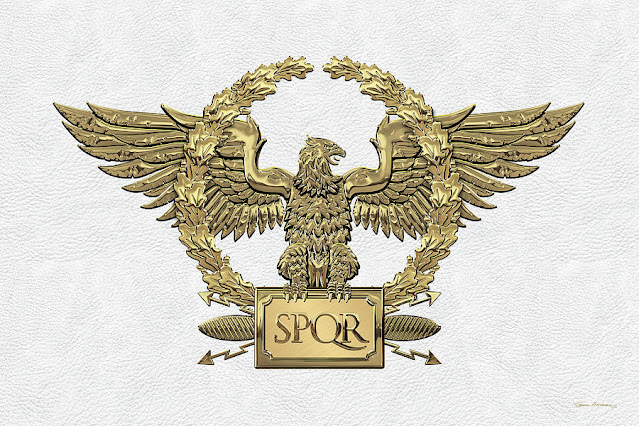
But this was something different, this was an assault on the Senatus, Populusque, Romanus - the Senate and the People of Rome, symbolized by the S-P-Q-R atop every eagle and banner the soldiers followed. It was stamped on the very coins with which they were paid. Nervously the legionaries awaited the stirring speech they expected Caesar to give before asking them to become traitors and outlaws.
Instead, one man suddenly grabbed a trumpet from one of the musicians, raced across the shallow stream blowing “the advance”. Only then did Caesar turn to his officers, and say, “We can still retreat. But once we pass this little stream, there is nothing left but to fight..” Then he called out, “Let us go where the omens of the Gods and the crimes of our enemies summon us” 
As he crossed he is supposed to have said, almost to himself, “ Alea iacta est”, the Latin phrase usually translated as “The die is now cast!”
Across the river Mark Anthony and Cassius Longinus waited, physical evidence of the arrogance of the Senate. Here Caesar drew the XII Legion into a square, tore his robes in a show of humility, and led the soldiers in a personal pledge of fidelity to himself, to Julius Caesar. The Roman Republic was now dead. All that had yet to be done was to bury it. According to Suetonius, his legion now “marched so fast the rest of the way that he reached Ariminum before morning and took it.”
A week later, when word of Caesar's advance arrived in Rome the city was electrified and terrified. Pompey immediately declared martial law in the city.  The Senate voted to replace Caesar as governor of Gaul, with the competent Lucius Domitius Ahenobarbus.  Lucius immediately rushed 30 cohorts to the hilltop town of Corninium, south of Rome.
Senator Favonius suggested it was high time that Pompey (above, left) stomped his foot. His problem was Pompey's own legions were in Spain. The city had raised two legions and was assembling a third, but Pompey was not interested in testing them against Caesar's veterans.  And Pompey did not increase his popularity when he informed the aristocratic members of the Senate that they should get out of town. Many denounced Pompey as a coward. But they still followed Pompey and their fellow aristocrats when they grabbed their wealth, and ran.
In their haste the Senators failed to collect the treasury of Rome with them. So the horde of gold and silver looted from Carthage, stolen from Egypt, taxed from Spain and Maccidonia was left waiting when Caesar arrived a the head of a flying column, followed by the VIII Legion.   
They couldn't find the keys to the vaults, so Caesar sent for locksmiths. A Tribune reminded Caesar he was violating the law (above) by breaking into the vaults. Caesar suggested, “If what I do displeases you, leave.” The doors were forced open, and Caesar had enough money to pay his soldiers. But his own murder stepped through that vault door, right next to him.
Meanwhile Caesar kept his men moving southward along the Adriatic coast, capturing additional troops as they marched out to oppose him.  Finally, on 15 February his XII Legion arrived outside of Corfinium, where it was quickly reinforced by XIII Legion. 
Lucius Ahenobarbus had urged Pompey to join him at Corfinium , but instead Pompey replied he was conceding Italy to Caesar.  Finding himself thus out on a limb, Lucius continued to assure his men that Pompey was coming, while he plotted his own escape.  And he might have made it except his troops learned the truth , had their commander drugged, and handed him over to Caesar. Along with some 6 million sestertii.  Thus, instead of being delayed by a bloody battle, Julius Caesar left Corfinium after little more than a week with more men and more money than when he had arrived.      
By the time early March, when Caesar arrived outside of the port of Brundisium, he had six legions. Still Pompey was able to ward off any attack while he loaded his own men on  transports and slipped across the Adriatic to land in Greece, where he could find even more soldiers.  Caesar may have won the battle of Italy, but he had not won the war.
- 30 - 

Sunday, October 13, 2013

ET TU Part Two GAMBLING

I have no doubt there were spies in Ravenna on January 11th. There are always spies in border towns, and traveling north out of Roman territory, the first town you reached in Cisalpine Gau (northern Italy)  was the little fishing village of Ravenna. A man could be a governor here, even a dictator. But just fifteen miles to the south in Ariminum, he would command no soldiers, no bureaucrats, he would be not the governor but governed by the politicians 200 miles to the southwest, the self described center of the civilized world; Rome. And the man the spies from Rome were watching this winter day in 49 B.C. E., was the governor of both CisAlpine and TransAlpine Gaul - Julius Caesar.
Caesar's stated reason for being in Ravenna was to check up on his investment in a gladiator's school. That was logical - given that the tens of thousands of slaves Caesar had captured in his conquest of Trans Alpine Gaul (i.e. France) and during his recent invasion of Britain, had be converted into cash. Laborers and house servants could quickly be sold, but gladiators required training. The reward was they could always be sold at a premium, so, of course, Caesar was here to inspect the construction of his school, and to witness a display of his gladiators in training. Then, after a light lunch, Caesar went to the baths, another public appearance for a Roman politician. And in the evening he sat down for a banquet, the kind of thing public officials are still expected to do almost daily. And as the sun set, according to Plutarch, “...he left the company, having desired them to make merry till his return, which (he assured them) they would not have long to wait for." It was enough to lull most spies to sleep. But the Romans were about to learn what the Gauls had learned before them - if you want to know what Caesar is about to do, you did not watch Caesar. You watch his troops.
Three years earlier, in December of 53 B.C., a member of the ruling First Triumvirate, and the primary ally of Caesar, Crassus, a had been killed in Parthia. At about the same time another Caesar supporter, Tribune Publious Clodius Pulcher, had been killed in a staged brawl – something which had become common in the dieing Roman Republic. The Tribune's angry supporters had built Plucher's funeral pyre in the Senate House, which had resulted in the Senate House burning down. The Senate aristocrats used this act of vandalism as justification to elect the second member of the Triumvirate, Gnaeus Pompeius Magnus, as Sole Consul, with powers to put down what was described as an insurrection. When some nervous Senators hinted that there were few soldiers in Rome to protect them, Pompey reassured them, “I have only to stomp my foot to raise an army” And while he began to arrest Caesar's supporters, on January 7th 49 B.C, the Senate voted to order Caesar to disband his own legions and return to Rome for trial. That law was vetoed by the two Tribunes who were were still loyal to Caesar, Mark Antony and Quintus Cassius Longinus. They were promptly driven out of the Rome at sword point.
Caesar (above), the third member of the Triumvirate, was still in Trans Alpine Gaul. And he offered a compromise. He was willing to give up his army and return to Rome, if Pompey gave up his new post as Sole Counsel. And, Caesar also requested the Senate allow him to stand for election as Counsel while he was still in Trans Alpine Gaul, with, presumably, Pompey standing for re-election as co-Counsel at the same time. It seemed a fair compromise. If elected (which was assured) both men would have immunity from prosecution in the courts, and would jointly rule the city of Rome for a year. Pompey could have accepted the deal simply by resigning. But he did not trust Caesar enough to take the offer. And the aristocrats in the Senate rejected out of hand their half of the compromise. Caesar's ten year term as Governor of both Gauls was about to run out, and as soon as he was no longer legally protected by his legions, the Senate could deal with him. So the Senate could afford to wait and watch
Caesar could not, and did not. His 6,000 veterans of the 12th legion were in winter barracks near the present day port of Trieste, Serbia, at the head of the Adriatic. Early in January, expecting the Senate would reject his compromise, Caesar had ordered these men to sail for Ravenna. The advance elements had arrived at the little fishing village a week later. And on the afternoon of the January 11th,  5,000 infantry and 300 cavalry marched out of the “Rimi” gate, headed south.
After dusk, having slipped out on his dinner party,  Caesar made his way on foot to a mill on the outskirts of the Ravinna. Here his aides had a hired carriage pulled by four mules,  waiting. Caesar's wagon followed a back road across the surrounding marshes. But they got lost in the dark, and the carriage got stuck in the mud.  Dawn found the great Caesar on foot, asking for help from a lowly farmer. By mid morning he had finally joined his men, on the banks of the River Rubicon (or the red river).
This was the traditional border of Rome. Beyond, in the village of Rimi, was the end of the 200 year old great “Northern Road”, the Via Flaminia (above), which wound its way across the Apennines, the central mountain spine of Italy, through narrow gouges and bridging rushing torrents, to the Field of Mars, through the Flaminia gate in the city's walls, right to the base of Capitoline Hill, the central citadel of Rome itself. Crossing this border at the head of an army had been forbidden for a Roman general for two hundred years. Crossing this border would brand Caesar and his soldiers as outlaws, subject to execution by any citizen at any time. So this called for a bit of theater.
The veterans of the 12th    legion  had followed Caesar from conquest to triumph across Gaul, had even crossed the Rhine and invaded Germania. But this was something different, this was an assault on the Senatus, Populusque, Romanus - the Senate and the People of Rome, symbolized by the S-P-Q-R atop every banner the soldiers followed, on the very coins they were paid with. Nervously the legionaries awaited the stirring speech they expected Caesar to give before asking them to become traitors and outlaws.
Instead, a man suddenly grabbed a trumpet from one of the musicians, raced across the shallow stream blowing “the advance”. Caesar turned to his officers, and said, “We can still retreat. But once we pass this little bridge, there is nothing left but to fight..” Then he turned toward the bridge, and called out, “Let us go where the omens of the Gods and the crimes of our enemies summon us” As he crossed the bridge himself, he is supposed to have said, almost to himself, “ Alea iacta est”, the Latin phrase usually translated as “The die is now cast!”
Across the river Mark Anthony and Cassius Longinus waited, physical evidence of the arrogance of the Senate. Here Caesar drew the troops into a square, tore his robes in a show of humility, and led the soldiers in a personal pledge of fidelity to himself, to Caesar. The Roman Republic was now dead. All that had yet to be done was to bury it. According to Suetonius, his legion now “marched so fast the rest of the way that he reached Ariminum before morning and took it.”
Rome was electrified and terrified by the news. Caesar began his desperate march down the Via Flaminia, and it quickly became clear that the Senate's previous arrogance had turned it a triumphal parade. So great was the frustration with the Senate that city after city threw their gates open to Caesar. Forces sent to stop him, went over to him. '
Senator Favonius suggested it was high time that Pompey (above) stomped his foot. Pompey's own legions were in Spain. The city had raised two legions and was assembling a third, but they were new recruits, and Pompey was not interested in matching them against Caesar's veterans from Gaul.  Pompey did not increase his popularity when he informed the aristocratic members of the Senate that they should get out of town. Many denounced Pompey as a coward. But they still followed Pompey and their fellow aristocrats when they grabbed their wealth, and ran for Brundisium, the traditional port at the heel of the Italian boot. In their haste they left behind the treasury of Rome, the horde of gold and silver looted from Carthage, stolen from Egypt, taxed from Spain and Maccidonia. It was the first place Caesar went, when he got to town.
They couldn't find the keys to the vaults. So Caesar sent for locksmiths. A Tribune reminded Caesar he was violating the law. Caesar suggested, “If what I do displeases you, leave.” The doors were forced open, and Caesar had enough money to pay his soldiers, and build his empire. But his own murder stepped through that vault door, right next to him.
- 30 -

Blog Archive