


He might have been a gentleman by act of Congress, but in 1985, according to Byron, in his third year at the United States Military Academy at West Point (above), he was thrown from a horse and so badly injured his knee, he was given an honorable discharge. West Point has a "no comment" on the details of his release.

He finished his education at the University of Georgia, majoring in Political Science. Then he might have been a Democrat, thanks to his uncle Max Roach Looper, a state Representative from tiny Dawsonville, Georgia. But Byron lost his first election there in 1987, and after three years as a legislative aide, legend has it, that he went to Preto Rico

He claimed to have worked there as the sober assistant to a university president. But the university does not seem to have existed, nor did the president. So what was he doing on The Island of Enchantment", and did he really go there? It remains a mystery, which doesn't actually interest many people.

According to Miss Modesta Blansett, who dated him for awhile, Byron was a real charmer and a political junkie. Except when he drank, which was often. On those occasions he “exhibited a dark, angry temper”. Byron had two traffic tickets for drunk driving in Hall County, Georgia, and in March of 1986 he pleaded “no contest” to a third. In 1987 he picked up another DUI conviction in Atlanta. Then, like many people approaching thirty, Byron felt the need to re-invent himself. So in 1993 he returned home, one hundred miles north as the crow flies, to the 931 area code, to the Cumberland Plateau of central Tennessee.

As a small boy Byron had left Cookeville, the farming and industrial community bisected by Interstate 40, 80 miles east of Nashville and 100 west of Knoxville. But times and circumstances had changed Byron. His “pinstriped oxford cloth and double-breasted suits” and power ties no longer fit in among the 24,000 overhaul wearing farmers in the Putnam County capital, nor even with the 11,000 students attending Tennessee Tech, nestled in the center of town.

Still, shortly after his arrival, Byron decided to register to run as a Republican against the popular local Democratic state Representative Jere Hargrove (above). Mr. Hargrove remembered being puzzled just a few days after Byron had filed paperwork to run against him when he received a letter from "Low Tax", seeking help in getting a job with the Farmers Home Administration. Hargrove says he never responded “because I thought it was crazy.” He remembered the campaign which followed as “dirty”. And for Byron it was unproductive. He lost. Again.

Still, Byron refused to give up. As the Republican county Chairman Scott Ebersole remembered, “He was playing politics all the time.” Byron even took out an ad in the political magazine, “Campaigns & Elections”, seeking the help of a consultant.

Consultant William Lindsay Adams, based in Louisiana, answered that ad, but found his interview with Byron made him “uncomfortable”. “Byron told him that if a candidate wasn't in the race at the end, it wouldn't cost him very much to win”. Adams quoted Looper as saying it would just be “about 35 cents” – the price of a bullet. After that conversation, Adams stopped answering Bryon's calls.
Then in 1996, Byron found Republican backing for a run against the 14 year Putnam County Tax Assessor, Bill Rippetoe. Their support was understandable, since if elected, Byron would be the first Republican to hold a county wide office since the civil war. Byron took part in no debates, and made no public appearances. But he did run a lot of negative radio ads, claiming that Rippetoe had fixed tax assessments for his friends. There was no evidence for this, of course, so Rippetoe was not prepared to respond.

And to prove his philosophy on property taxes, Byron invested $4.95 to legally change his middle name from Anthony to “(Low Tax)” - parentheses included. He did run one positive ad, promising he was “a new kind of leader”, and introducing his wife Terry to the voters. However, Terry Guess was not his wife, but merely his girlfriend, who was also his landlady. He was renting a room in her house. But by the time the truth had come out, Bryon had finally achieved his dream – he won the election by 1,100 votes. Sound familiar?

A week after taking the oath of office, on Thursday, 12 September, 1996, "Low Tax" (above) called a press conference to announce he had discovered $100 million worth of property taxes had not been paid. But before the reverberations from that headline had reached the farthest corners of Putnam county, from Hanging Limb to Muddy Pond, the County Commission, to which Byron reported, responded that $100 million was the “normal backlog” for property taxes at that time of year. They also suggested that Bryon should just do his job and stop holding press conferences. After further checking, Byron held a press conference to announce they were right. Then he left town – for Puerto Rico. Or so he said.

This time Byron was gone three weeks, which in a town the size of Cookeville did not go un-noticed. When he returned he cleaned house, firing dozens of staffers, and hiring a “Security Chief”, who swept the office for listening devices. None were found.

"Low Tax" also assigned three employees to photocopy more then 5,000 pages of County Commission records. When this expense was questioned, he held a press conference to announce he had uncovered “a good ol' boy network” and was suing to make the documents public. In response the County Commission revealed that the documents already were public. This time “Low Tax” was forced to issue a written apology. Said County Executive Doug McBroom, “His attitude was that we're all dumb, and he was here to save us...but he kept getting caught.”

At one of his many press conferences, Byron was faced with an allegation that he had fired staffers because they were Democrats. But Byron had a ready answer for that charge. It was preposterous, he said, since he was secretly a Democrat, too. A quick look at the records revealed that for once Byron was telling the truth. He was a registered Democrat. Still. Whereupon, the Democratic Party had him purged from their rolls. The Republicans were perfectly happy to have him as a member since, in heavily Democratic Putnam County, beggars couldn't be choosers.

Meanwhile, the work in the Tax Assessor's office became increasingly chaotic. Byron would disappear from the office for days at a time, and when he did show up, he spent his time trying to transfer properties to the tax rolls of neighboring counties – specifically properties owned by members of the County Commission who were giving him such a hard time. His new Security Chief got into a fist fight with a voter. Some property owners charged Byron had “shaken them down” for political contributions. And when they did not contribute, Bryon increased their property tax assessments. Under Byron's stewardship, records went missing, and his remaining employees had spent 90 hours working on his next campaign, for the congressional seat held by Democrat Bart Gordon.

His congressional campaign had barley gotten off the ground when in March of 1998, the Tennessee Bureau of Investigation hit Byron with a 14 count indictment for official misconduct, theft of services, misuse of county property and misuse of county employees. In the primary Bryon came in third in a field of four Republicans.

But the resourceful young man had an ace in the hole. In the same election, he was the only Republican who had filed to run against the popular five term Democratic State Senator, Tommy Burks (above) . By default Byron thus qualified for the general election in November.

Nobody expected Byron to win, evidently not even Byron. But Tommy Burks (above) had been a politician to long to ever be over confident. He told a friend, “This Looper boy is absolutely crazy. I believe he's capable of doing anything.” And then in August, another lawsuit was filed against Byron, from an unexpected source.

It was filed by Byron's former girlfriend and landlady, Terry Guess. She alleged that in December of 1997, after they had broken up, Byron had assaulted and raped her. And when she thereupon ordered him out of her house, he had filed a false transfer of ownership, putting her home in his name. But Terry's breaking point came when she discovered she was pregnant. Now, with the baby due in a few weeks, she sued Bryron, asking for $1.3 million in damages and child support.

Byron did his best to “handle” the suit. He held a press conference. He referred to Terry as “a former stripper”, and complained “She left me with heart palpitations, a small box of memorabilia, and a red G-string.” It was a good line, but it did not help his career.

But Byron had uncovered a “quirk” in the election laws of Tennessee which he felt certain would bring him victory. Early on the morning of 9 October, 1998, Byron (Low Tax) Looper drove a black sedan onto a pig and tobacco farm, and stopped next to a pumpkin patch, along side of a pick up truck. Then he fired one 9mm round into the skull of State Senator Tommy Burks, killing him instantly.

According to Tennessee law, a candidate who dies within 30 days of an election, must have his name removed from the ballot. Byron figured he would win by default - emphases on "fault". Because Byron had not counted on his clever cover up dissolving like salt in a Tennessee thunderstorm.

In a matter of hours the cops had discovered that Byron had bought the sedan in Georgia, resold it there to a different Georgia car dealer a few hours after the murder. And worse, Byron had been recognized at the scene by two of Tommy Burk's farmhands.

Plus there was his confession to a childhood friend (above) a few hours later after the murder.
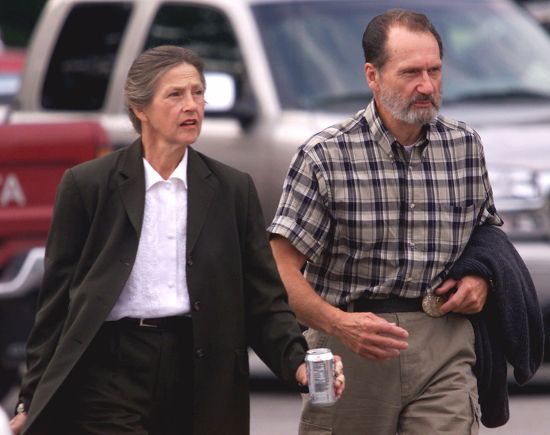
On election day Byron was in jail, and although he was still the only living candidate on the ballot, and although his radio ads continued to be aired, Charlotte Burks (above. left), Tommy's widow, received 30,252 write in votes against Byron (Low Tax) Looper's 1,531 votes. The lady finally retired from politics in 2014, after 4 terms in the state senate.

Yup, that Byron (Low Tax) Looper (above) sure knew how to lose an election. And a court case. He changed lawyers eight times, but in August of 2000, Byron was finally convicted of first degree murder. Even after his conviction he tried to run for another term as assessor from jail, until the State Attorney General removed him from office.

Eventually he was sentenced to life without the possibility of parole in the Morgan County Correctional Complex (above). And that was when he got yet another name change, becoming inmate #323358 . That name stuck until 26 June, 2013, when a female counselor informed Byron that he was losing his private cell and being transferred to the prison's general population. Byron slapped her face, and was subdued by a guard. Later that day he was found dead in his isolation cell.
.jpg)
A pair of autopsies revealed he died of a combination of high levels of antidepressant and "deterioration of his heart muscle". Just as if he ever had one. His unofficial epitaph was provided by his last (of 8) attorney, McCracken Poston. He called Byron " a colorful character in both Georgia and Tennessee politics" . But Poston was forced to add, "The fact that Byron was an unusual, if often difficult, client is well documented." Again, sound familiar?

- 30 -


