August 2025

August  2025
I DON'T NEED A RIDE. I NEED AMMUNITION.

Translate

Wednesday, September 07, 2022

JAY GOULD, The Libertarian Dream


I wish modern libertarians could meet Jay Gould. Because Jay Gould was unfettered capitalism in the flesh, “the human incarnation of avarice,” as one minister described him, the Mephistopheles of Wall Street, the robber baron par excellence, “prince of the railroad schemers”, and the man within whom all the theories of the libertarians about capitalism and freedom met the reality of human nature, and got the living tar beat out of it.
He (above) was a “…short, thin man with cold black eyes, a narrow face and, in his maturity, a “full black beard”. Born into poverty, his mother was active in the Methodist Church until her death, when Jay was 10 years old. When he was seventeen, Jay apprenticed himself to a surveyor, Mr. Oliver Diston, at the salary of $10 a month. When Jay started issuing his own maps for sale, Diston sued his apprentice. Jay’s attorney, Mr T. R. Westbrook,  managed to have the lawsuit dismissed. But, as one biographer noted, from that day forward, “…there was scarcely a day during his whole life that (Jay Gould) did not have some litigation on his hands.”
His map business made Jay $5, 000, which he invested with Zadock Pratt, a Manhattan leather merchant. Smothering Mr. Pratt in adoration, the 21 year old Jay proposed to write the older man’s biography. That project drew the pair into a partnership in a new leather tannery south of Scranton, Pennsylvania.  Using  Pratt’s money, Jay built an entire company town, which he named “Gouldborough”. He wrote Pratt sycophantic letters, in one describing the organizing meeting for the new community. “Three hearty cheers were proposed for the Hon(erable) Zadock Pratt…This is certainly a memorandum worthy of note in your biography, of the gratitude and esteem which Americans hold your enterprising history.”  However Mr. Pratt, who knew a lot more about the tanning business than did the young Jay Gould, had begun to see through the fog of compliments.
Pratt (above) showed up at the plant unannounced in the summer of 1858, to go over the books.  He quickly discovered them to be a confusing mess, showing unauthorized risky investments, including in a private bank which Jay had established in Stroudsburg, Pennsylvania.  But the company did not share in the bank's profits. Those went only to Jay Gould. Pratt decided to fire his erstwhile friend and sue him to take ownership of the bank.  However, Jay had anticipated this, and had already lined up a richer and more docile partner.  In August,  when confronted by Pratt, Gould stunned the man by offering to buy him out for $60,000.  Pratt quickly accepted.  The cash for the buyout had come from Jay’s new partner, Charles Lessup.
But it wasn’t long before even the somnolent Lessup began to suspect he was being had. By the fall of 1859 Lessup was panicked by the commitments Jay had made, using his good name. But it was too late.  On 6 October, 1859, facing financial disaster, Charles Lessup shot himself.  Lessup’s daughters bitterly demanded Jay repay them for their father’s lost investment, and Jay countered with an offer of a payment of $10,000 a year for six years.  He had, of course, neglected to include any interest during the five year delay.  Unfortunately for Jay, the Lessup families’ lawyers caught the omission.  Still, in the early months of 1860, it became clear that Jay was hiding huge assets from the family.
Lawyers and 40 deputized men were dispatched to the tannery on Tuesday morning, 13 March, 1860. They flashed the legal papers, ushered the workers out and padlocked the doors. They held the place for a little over six hours, until Jay returned from New York.  Just past noon some 200 men stormed the building with axes, muskets and rifles.  Four men were shot, others were badly beaten, and according to the New York Herald, “…those who did not escape were violently flung from the windows and doors…”  As Jay Gould would later boast, “I can hire one-half of the working class to kill the other half.”  The courts would eventually throw Jay Gould out of the tannery, but by then he had shifted his operations to a place more suited to his nature; the unregulated economic free-for-all that was Wall Street.
While North and South battled over slavery, Jay Gould battled over wealth. He formed his own brokerage firm -  Smith, Gould and Martin.  Like all of Gould's  partners, Smith and Martin  were soon left behind, broken and broke.  Gould  then made the acquaintance of James “Big Jim” Fisk, who made a fortune smuggling southern cotton through the Federal armies, and selling Confederate War Bonds. And even while brave men died in their tens of thousands,  Gould and Fisk joined with Daniel Drew, director of the Erie Railroad, in their own, private war.
Their enemy was Cornelius Vanderbilt (above), who owned every railroad in the east except the Erie. Naturally, “The Commodore”, as Vanderbilt liked to be called, was seeking a monopoly, so he could charge whatever freight rates he wanted, and he began to buy stock in the Erie. Sensing blood in the water, Jay and friends printed up 100,000 new shares of Erie stock, which The Commodore promptly bought, and which the board of the Erie – Drew, Fisk and Jay Gould – immediately declared to be worthless.
Bilked out of $7 million, Vanderbilt filed legal papers to examine the Erie’s books.  Jay and friends grabbed the company records and retreated to New Jersey, where they re-incorporated.  Vanderbilt then had arrest warrants issued for all three men, but since New York law could not touch them in New Jersey, the Commodore began to assemble ships and men to invade that state,  all by himself. While the Erie Board prepared to receive the invaders, Jay managed to slide a bill through the New York State assembly making the issuing of worthless stock, perfectly legal, retroactively, of course.
This trick was managed by the simple expedient of giving William “Boss” Tweed (above), the head of political graft in New York, a seat on the Erie board.  That brought the Erie War to a temporary pause.  And if you are feeling sorry for the Commodore, remember that Cornelius himself once said, “Law, what do I care about the law? Ain't I got the power?" -  another libertarian hero.  The entire bunch were so busy cheating and stealing they barely noticed the end of the Civil War.
With the Commodore’s cash, and further fortified by looting the Erie’s assets, Jay, Fisk and Drew began their own complicated scheme to raise freight rates on the Erie Railroad. Using the profits from that scheme, in 1869 they began to buy and hoard gold, because raising the price of gold would raise the price of wheat, which would allow them to raise the freight rates they charged farmers for shipping the wheat.  As insurance the trio took on another partner, Abel R. Corbin, who happened to be President Grant’s brother-in law.  The new partner gave the appearance that “the fix” was in, and other investors jumped on the bandwagon. The price of gold skyrocketed.
When President Grant learned about the manipulations, he immediately ordered the U.S. Treasury to sell $4 million in gold. On 24 September, 1869, the sudden influx hit the market like a bomb, and gold dropped 30% in a day.  The date would henceforth be known as “Black Friday” - at least until October of 1929. Thousands of investors were wiped out, including Abel Corbin. An angry mob swarmed the Gould’s brokerage offices, smashing the furnishings and chanting “Who killed Charles Lessup?” Of course the trio of Gould, Fisk and Drew, walked away from the wreckage with an $11 million profit.
Gould's own partner Daniel Drew was to be his next victim.  In 1870 Fisk and Gould sold their shares in the Erie to their one time enemy the Commodore, for $5 million. The deal gave Vanderbilt his monopoly, but it also revealed that the Erie was bankrupt.  And it left Daniel Drew, abandoned by his partners, out $1.5 million. He would die flat broke nine years later, just one more partner and one more victim of Jay Gould.
Big Jim Fisk was saved from a similar fate when, in 1871, a competitor for a woman shot him to death in a New York Hotel. After that Jay was reduced to stealing from lesser partners, such as Major Abin A. Selover, who actually considered himself a friend of Gould’s.  It was Selover who introduced Jay to a California friend of his, James R. Keene.  After Keene and Selover had both been battered by Gould in a contest for control of the telegraph company, Western Union,  Jay and Selover happened to meet on the street one day. Jay tried to walk past, but for once in his life, Jay Gould had been caught out in the open.
Selover grabbed Jay be the collar and shouted, “I’ll teach you to tell me lies!” The six foot tall Selover then threw Jay to the ground, and then yanked him up again by one hand, dangling him above the stairwell of a below-street level barbershop. With his free arm Selover began slapping the Mephistopheles of Wall Street and shouting, “Gould, you are a damn liar!” Nobody who witnessed the event interrupted to disagree. When Selover finally let go, Gould dropped 8 feet to the stairs. A stock broker the next day quipped, “It was characteristic of Mr. Gould that he landed on his feet.”
Overnight, Abin Selover became the most popular man in New York City. Jay Gould was smart enough not to press charges, since no jury could be expected to convict anyone of assaulting Jay Gould. Henceforth, Jay never went out without a body guard. He began to describe himself as the “most hated man in New York”, but there was a touch of pride in his voice when he said it. Selover eventually went broke, as did Keene. However, when he finally died in 1892, Jay Gould was the ninth richest man in America, worth about $77 million. He died a hero only to those who never did business with him. Gould scoffed at the idea that Wall Street should be regulated. “People will deal in chance….Would you not, if you stopped it, promote gambling?”
It was and is a philosophy which fails to see an advantage to drawing a line between gambling and investing. It is the philosophy of libertarianism. It is the philosophy of unmitigated greed. It was the philosophy of Jay Gould.  And people had lots of reasons to hate him. Not a very healthy hero.
- 30 -

Tuesday, September 06, 2022

THE SPITTING LYON


I can prove the regularity of Senator William Blount's intestinal functions, because his enemies in the U.S. Senate depended on them. Their trap was sprung on Monday, 3 July, 1797, while Blount was visiting “The Necessity” behind Philadelphia's “Congress  Hall” (above).  
The arrogant and regular Mister Blount had to go downstairs and out the back of the building to the "Little Shed" in the walled garden (above, far right).  But the Federalists need not  rush because Blount took his time – such things should never be hurried.  By the time he returned to his seat,  the letter had been read and William Blount's political career was in the toilet.  I'll bet even Matthew Lyon, the “Spitting Beast of Vermont”, was pleased with this toilet revolt.
“Dear Cary”, the letter began, “I wished to have seen you before I returned to Philadelphia,...I believe  the plan...will be attempted this fall...(and) in a much larger way then we talked about....I shall probably be at the head of the business on the part of the British...You must take care...not to let the plan be discovered by...any other person in the interest of the United States or Spain.. signed, William Blount.”
The plan was the invention of John Chisholm, who owned a tavern (above) across the street from Senator Blount's Knoxville, Tennessee mansion. Chisholm figured it was only a matter of time before Spain would be forced to sell their American colonies to France. And if France controlled Louisiana and Florida, they might deny American ships access to New Orleans. That would bankrupt all the western farmers in Tennessee and Kentucky.  So Chisholm planned was to use local militia and Creek Indians to capture Pensacola and New Orleans, in the name of the British Empire - who would then promise to allow Americans to use New Orleans as if they owned it.
It was a fantasy of course, but sitting his heavily mortgaged Knoxville mansion (above) Senator Blount thought this was a great idea. And the more he thought, the more he thought it was his idea - particularly after he had improved it by creating a well paid job for himself as the British agent running New Orleans. So Blount wrote this letter to James Cary, who was a translator with the Creek Indian nation in eastern Tennessee.  Senator Blount expected Cary to convince the Creeks to supply most of the manpower for this conspiracy.  
Instead, Cary shared the letter with his bosses in the War Department, who immediately shared it with President John Adams (above).  Now, Adams was a Federalist and he saw a chance to embarrass his own Vice President, Thomas Jefferson, who presided over the Senate and was also the leader of the opposition party, the Democrat-Republicans - of whom Senator William Blount was an important member.
So Adams sent a copy of the "Dear Cary" letter to Federalists in the Senate (above), but insisted it be kept secret until Senator Blount could do nothing to stop the reading of the letter in public. Blount's regular morning toilet trip provided that opportunity.
By noon half of Philadelphia (above) wanted to hang Blount as a traitor, and the other half was trying to deny they had ever met him.  The President's wife even said it was too bad America did not have the guillotine. Senator Blount was arrested trying to slip out of town. Dragged in front of the Senate he denied writing the letter, despite everyone in the room recognizing his handwriting. He was arrested at once, but then allowed to post bail. And once free he hightailed it back to Knoxville – where being part of an anti-government conspiracy had made him something of a hero.  
A week later the Senate voted 25 to 1 to impeach and expel him (above), making him the first politician to be impeached in the new republic.  For the next six months both parties downstairs in the House of Representatives, Federalists and Democrat-Republicans, tried to make the impeachment of Senator Blount work for them in the upcoming 1798 Congressional elections. And that is how our story came to involve an expectorant infused Congressman from the Green Mountain State.
His name was Matthew Lyon, and he had been a Second Lieutenant in the Green Mountain Boys when they captured Fort Ticonderoga in 1776. The next year General Horatio Gates ordered Captain Lyon to take 60 men north to the Onion River, on the Canadian border. And just as they arrived, they heard rumors of  500 Indians coming to attack them. Lyon said later, “The soldiers considered themselves sacrificed”, and they decided to retreat.  Despite Lyon trying to convince his independent minded soldiers to stay, they high tailed it for safer climes. 
The prickly General Gates (above) ordered Lyon arrested and tried before a military court. Convicted of failing to maintain discipline among his men, Matthew lost his command. However he was not reduced in rank. Captain Lyon later fought bravely in the battles of Bennington and at Saratoga, rising to the rank of colonel. After the war the Vermont hero twice ran for election to Congress as a Democratic Republican. Both times the Federalists used the court martial to imply he was a coward. However, third time was the charm, and in 1796 he finally won election.  Two years later he was even re-elected.
And that was how Lyon ended up delivering a speech from the well of the House chamber (above) on Tuesday, 30 January, 1798. In his speech Lyon chastised the Connecticut Federalists for not defending the honor of their citizens by backing the impeachment of Senator Blount. That suggestion brought Federalist Connecticut Congressman Roger Griswald to his feet. As Lyon stepped away from the podium, Griswald, in his best snarky voice, asked if Lyon would be defending the people of Connecticut with his wooden sword.
Now, Lyon never had a wooden sword. Occasionally, an officer convicted of cowardice would be required to wear a wooden sword, as a way of embarrassing him before the army. That had not happened in Lyon's case, because he was not accused of running from the enemy. General Gates' later career provided ample evidence of the General's cowardice and incompetence, as Lyon's later career provided evidence of his courage and brains. But that was reality, and politics is about image - just ask John Kerry who was Swift Boat'ed over 200 years later.
Well, Lyon had been hearing this Federalist taunt for twenty years.  And hit in the back of the head with it, the Green Mountain boy in Lyon reacted instinctively. He spun on Roger Griswald, and spit in his face. We can assume it was pretty disgusting logy. The forty year old Lyon was a tobacco user, and mouth wash and dentistry were still in their infancy.  And then, having expectorated his piece, Lyon turned his back on Griswald again.  In the words of an historian, from that moment “No man in the whole Republican party...(not even) Thomas Jefferson...was so hated and despised (by the Federalists) as Matthew Lyon.”  Griswald went ape and charged at Lyon.
Cooler heads from both sides rushed to separate the two combatants.  And then, this being Congress, the argument about the traitor Senator Blount became about the “spitting Lyon” and the hot head Griswald.  Federalists wanted Lyon impeached for “gross indecency” - for spitting on a college - making him the first Congressman honored with an ethics charge.  Democrat-Republicans wanted Griswald censured for the insult,  making him the second Congressman so honored. In the end, both charges were dropped. So two weeks later, it got worse.
On Thursday 15 February, Roger Griswold entered the house chamber carrying a cane he had been loaned by a friend. He walked directly to Matthew Lyon's desk, and without warning began beating the Democrat-Republican with the stick. Covering his head, Lyon struggled to his feet, and retreated toward the fire pit, meant to take the morning chill off the chamber. He grabbed a pair of tongs from the wood pile, and began an insane fencing duel with his attacker (above). Again, cooler heads separated the two.
The spitting only made the attacks on Matthew Lyon's honor louder. One bad Federalist poet even managed to include the insult into an ode to a theatrical Boston pig. “You boast your little pig can spell the hardest word; But did your little pig ever wear a wooden sword?....Though your piggy screws his snout in such learned grimaces, I defy the squeaking lout to spit in Christians’ faces...,Then tell us no more of your little grunting creature, But confess that the LION is the GREATEST BEAST in nature.”  As I said, he was a bad poet.
The Spitting Lyon so angered the Federalists members of Congress,  it made it easier for them to pass both the Alien and the Sedition Acts, the second of which was signed on 14 July, 1798, six months after the assault by and on the “Spitting Lyon.”  It's actual title was “An Act for the Punishment of Certain Crimes” (above), the crimes being writing or publishing anything false or malicious against members of the government.  It also forbid the defendant from pleading the truth of their writing as a defense. Three months later, on 10 October, The Democratic Republican Matthew Lyons was convicted under the Sedition Act, and sentenced to four months in jail.
But Representative Lyon had the last laugh.  Twice.  First he was re-elected from his jail cell, with 55% of the vote. Then, the Presidential election of 1800 was a tie, and thrown into the House of Representatives. The contest became a 35 ballot knock down drag out between Democratic Republicans Jefferson and Democratic Republican Aron Burr, all engineered by the lame duck Federalist Congressional majority.  The issue was finally settled on the 36th ballot, when the Federalist Representative from Vermont abstained. This allowed Matthew Lyon, the Democrat-Republican from Vermont, to cast the deciding ballot making Thomas Jefferson the third President of the United States.
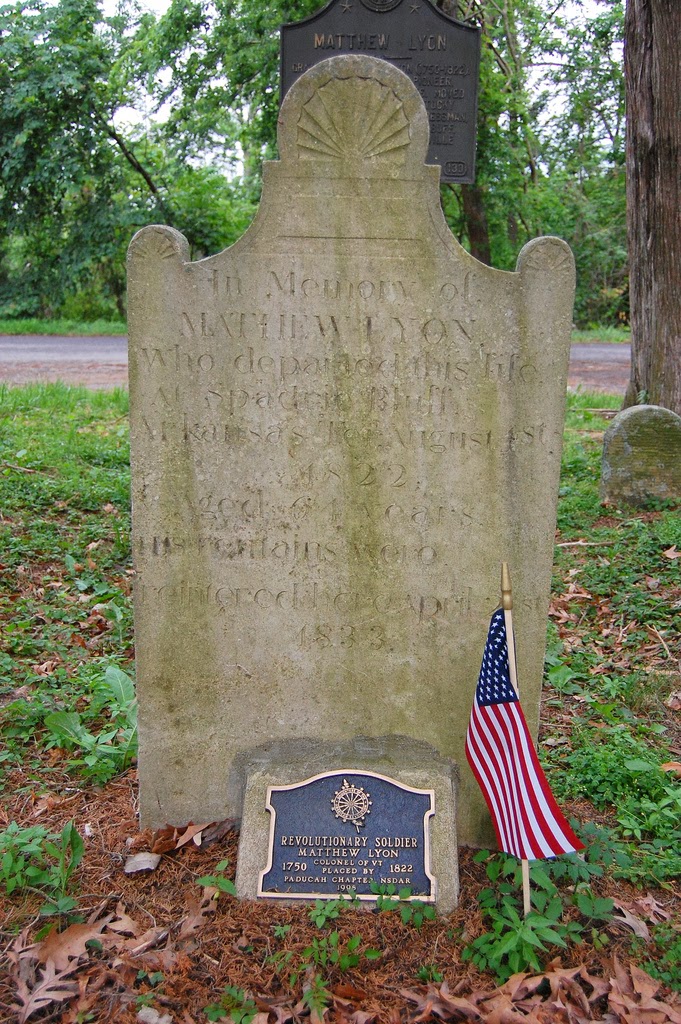
So it turned out, Senator Blount's act of betrayal did not end up preventing Jefferson from winning the White House. The arrogant and ambitious Blount did not witness the victory, having died in his home (above) during an epidemic in March of 1800. The next year Matthew Lyon moved to Kentucky, and won election to Congress from that new state six times, finally retiring in 1811, and dying in 1822. The Spitting Lyon, the Green Mountain Beast, was then buried in the Blue Grass state (below). And what a shame we have allowed his memory to fade, in part because we insist upon neutering our "founding fathers" - denying,  them and us, our shared humanity, warts and all. The valuable lessons are usually in the warts, you know.

- 30 - 

Monday, September 05, 2022

AMERICAN NARCISSIST


I can see Andrew Phillip Kehoe (above) clearly, as if he was standing next to me at this moment. And yet his image remains hazy. According to his drivers' license, he was five feet, nine inches tall, weighed 150 pounds and had gray hair.  He was also described as “ ...a slight, hollow-chested man”, of 46, with thin lips. And yet he remains an enigma. A neighbor, when shown several photographs of him, said, “ "I knew him well and he never looked like that.” And he was not just a physical enigma. 
Howard Kittle, the Clinton County agent and Farm Bureau manager, received a letter from Andrew, and admitted that if anyone else had written it “I would have thought sure he was insane.'” But that was before - when he was a community leader, a trusted guardian of the township's wealth and its future. Afterward the local newspaper - the Clinton County Republican-News - was forced to wonder, “Is the building of a modern institution which equips children to meet the problems of the world a burden - or is it a privilege?” You see, the man at issue was a anti-tax warrior and an American narcissist who murdered 34 children and 8 adults.
Bath in 1927 was a little farm town of about 300 people 10 miles northeast of Lansing, Michigan. “(It) had a ( grain) elevator, a little drugstore, and you knew everybody within 20 miles” said a life long resident.  Which means pretty much everyone knew Phillip Kehoe.
In 1922 rural Clinton County closed its scattered one room school houses. They used $8,000 of their own hard earned money to buy five acres of ground just south of Bath. They borrowed $35,000 to build a two story Consolidated School building. 
Here, classes would be divided by age,  to protect the younger, smaller children from older bullies. With fewer teachers, higher standards could be required of the instructors -  even a college teaching degree. And amenities such as a library, lunch programs, athletics, music and art were added. Buses now picked children up at their front doors and returned them safely home each night. It was the foundation for a secure world that future generations would grown up in. And it was not cheap for the older generations.
The future always costs. You either invest in it now, or it proves much more expensive.  In 1922 property taxes in Clinton county were $12.26 per thousand dollars of valuation ($160 today, or over $16%). In 1923 those taxes had gone up by half to $18.80 ($235 today). This was not the decision of a few liberals. This was debated for years within the community. And over time the decision was made to invest in the future of Clinton County,  in the counties' children, and to spend the money on their  future. 
Three years later, eager to eliminate the debt quickly, the elected leaders of Clinton County paid off $7,200 of their obligation, and taxes topped out at one dollar higher (to $240 per thousand of valuation in today's dollars). It was expected taxes would now start to drop, but that did not take into account the rising inflation of the 1920's, and the selfishness of one egomaniac who chose - chose -  not to have a future, and to steal the counties'.
Let me tell you about Andrew Phillip Kehoe, the way most Americans learned of him by sharing a headline from the New York Times, dated Wednesday, 18 May, 1927; “Maniac blows up school, kills 42, mostly children; Had protested high taxes...Children Pinned in Debris. Others hurled against walls or out windows – Searchers still hunt for missing. Agonizing scenes in yard. Distraught parents find little ones dead beneath blankets...”. 
The early numbers were wrong, of course. The maniac killed eight adults and 34 children at the school, that day. The last little victim, nine year old Richard Fitz (above), would die of an infection caused by his injuries, a week short of a year after the explosion that killed him. 
Just before he murdered 34 children, the maniac had bludgeoned his wife one last time - this time to death. 
He had tired his two horses' legs together and left them in the barn stacked with all his farming equipment. Then he set the barn on fire. Before that he had poisoned and killed every fruit tree on his farm. Interestingly, it was figured by the cleanup crews, that he could have paid off his mortgage and his property taxes by selling most of his well maintained farm equipment, which, according to his neighbors, he rarely used.  
Neighbor M.J. “Monty” Ellsworth wrote later, “He was at the height of his glory when fixing machinery or tinkering...He spent so much time tinkering that he didn't prosper.”  The maniac also stood out, as a farmer, for his meticulous appearance. He changed his shirt quickly should a spot of dirt appear on it and was often seen sitting on his front porch (above), in a smoking jacket,  puffing on a cigar.  But his primary interest, his obsession, was in reducing his taxes.
The maniac had been elected to the school board in 1924, two years after the new school had opened and the first election after the new higher tax rate had been announced. His platform was to cut the cost of the new school. In 1925, after the death of Maude Detluff, the school board's treasurer, he had been appointed to fill that position. His book keeping was, like his appearance, meticulous. After his suicide, his books showed  “a long and detailed explanation” of a 22 cent discrepancy.  But in the spring of 1926, when he ran for election to officially take on that job, the voters had rejected him. Once again, the majority approved investment in the future  He stopped paying his mortgage and the insurance on his farm. Eventually, the previous owners - his wife's relatives - began foreclosure proceedings.
Early Tuesday morning, 18 May 1927, after killing his long suffering wife, and every other living thing on his property, Phillip Kehoe set his house on fire (above) and drove off to carry out the rest of his plan for revenge,
Decades earlier, Phillip's promising career as an electrical engineer in St. Louis had been cut short by a fall and a serious head injury.  So farming was the his second career choice. He married and moved to Clinton county, Michigan,  right after the First World War. He might have over paid for his farm, because land prices were inflated at time. And his wife was afflicted with tuberculosis, a wasting disease before antibiotics. But he still assaulted her, every time he felt the need to feel superior.
The Klu Klux Klan paid for and staged a funeral for Phillip. They expected to garner support by blaming his Catholicism for encouraging him to destroy the school because it was not a Catholic school. But even if all of that were true, none of it would justify the cold blooded murder of 34 innocent children, and nine adults, and the farm animals. He was probably a racist by modern standards, but all Phillip Kehoe could focus on was HIS taxes.
Before the school was built, he had opposed it. Once it was decided to build it, he insisted it should be a 10 grade institution, instead of 12 grades. He opposed the inclusion of a library, or athletic programs or a music department.  And he lost every argument. 
Once the building was constructed, the tax increase gave him enough supporters to win election to the school board, where his obstinacy continued. He even opposed giving the superintendent a paid vacation each year, and then argued it should only be one week, not two. And as he lost each of these arguments, his obsession grew, day by day. 
Words used to describe him during this time were “surly”, “obstinate”, “impatient” and “arrogant”.  Eventually he began to invest his money not in his farm, or his wife,  but in World War surplus explosives. He slipped the explosives into the basement of the new school, and rigged  them with a timer and set them to explode early on a Wednesday morning,  just after classes had begun. And just before that bomb went off, Kehoe set off the last bomb, packed into his car, killing himself , the school principle and others.  
The day after the bombing,  while still in shock and grief,  the Clinton Country Republican ran an editorial, which explains, far better than I ever could, the connection between the maniac's crime and his anti-tax fever. “That he was insane there is little doubt", wrote the editors of the paper. " But he was not always insane. To start with he was merely antagonistic. Then he became radical.. He was the victim of the progress of his own lack of balance...
"What a terrible price to pay for narrow-mindedness", continued the editorial. "What an awful calamity for one peaceful little community to bear for one man's lack of ordinary American ideals...Never before have we known of aversion of the cost of education taking such terrible form. There are, however, many people who unthinkingly hamper and discourage the progress of good schools and other institutions for the welfare and happiness of the public. What are we going to do about it?”
It is almost a century later, and the question begs to be asked again, this time of a nation which elected an admitted rapist as President, supported by the power hungry unChristian unRight, - those who object to investing in the future because they choose not to believe we have one. And what are the majority of us going to do about it?  The answer after the 6 January 2021 U.S. Capital assault and the poison of the Trump Presidency is...not yet answered,
- 30 -

Blog Archive