August 2025

August  2025
I DON'T NEED A RIDE. I NEED AMMUNITION.

Translate

Wednesday, March 23, 2022

ETERNAL TRIANGLE Part One

I still wonder why they call it “news”?  It is never “new”.  As proof I give you the obtuse triangle of “Big” Jim Fisk, Helen Josie Mansfield and Edward Stokes (above); a triangle which would have been familiar to Pythagoras and would have bemused Sigmund Freud, and might have warned Senator John Edwards and Governor Mark Sanford - among others - if they had only been willing to consider themselves as not unique.

Jim Fisk (above)  was born in Vermont on April Fools’ Day in 1835. His father was a traveling “bummer”, selling pots and pans and trifles. When he was 15, "Big" Jim ran away to join " Van Amberg's  Mammoth Circus and Menagerie”, and returned three years later with a splash of color and bombast.  By the age of 36 Fisk had marketed his talents for lying and cheating into a fortune of $70 million - the modern equivalent of one billion, one hundred twenty-nine million, one hundred ninety-eight thousand dollars. 
In the midst of the Civil War, together with the most hated man in New York - his partner Jay Gould (above left) - Big” Jim (above, right) took over and then plundered the Erie Railroad.  
But it was “Big” Jim who decided to move the Erie’s corporate offices into the upper three floors of the Grand Opera House (above), which he owned. 
For while his partner Jay Gould (above) had no interests outside of making money, Jim Fisk was a man of many prodigious appetites, most involving divas of one kind or another. Jim had been married to his dearest Lucy when he was just 19, but she resided in far off Boston with her own lady love, Fanny Harrod. 
And while Jim kept both ladies in luxury, and even visited them occasionally, he spent most of his free time with “actresses” in New York, and was a regular visitor at the business house of “the notorious Annie Wood”.  And it was in the dim red light of Annie's parlor that Jim was  introduced to his personal Helen of Troy, Helen Josephine Mansfield.
Josie, as she preferred  to be known,  was a beauty in an age when a sexy woman had some "meat on her bones". One admirer noted her “…full, dashing figure". He also noted "Her eyes are large, deep and bright…Her voice is very soft and sweet”.  
It was Josie’s mother who first recognized the girl’s talent as “an incorrigible flirt”, and used her as bait in a badger game played in Stockton, California. A pettifogging local attorney named D.W. Perley , while in a state of undress, was caught "courting" the young Josie.  To cover the scandal Perley wrote at least one check at gunpoint. There was some quarrel over the proceeds of this venture, and shortly thereafter Josie secretly married Frank Lawlor, an actor.  The newlyweds then abandoned her mother, in search of greener fields.
She followed Frank cross-country on the music hall circuit, arriving in New York City in 1864. Here, two years later, Frank came to the shocking discovery that Josie “was going astray” on him. Although why that should have shocked him, seems an open question.  In any case, they divorced, and Josie sought a career more suited to her talents, in the bordello of Annie Wood. There she enticed Annie to introduce her to the genial and jovial and generous Mr. Fisk. He was enchanted. She was enriched.
Over night Josie went from being behind in her rent to the “Cleopatra of West Twenty-third Street”, the owner of record of a four story brownstone (after some $65,000 worth of improvements) - conveniently located just around the corner from "Big" Jim's Opera House – with four servants, a wardrobe filled with dresses, and a jewelry case accented by real jewels.
But having achieved everything she had hungered for, Josie was now bored. And that was when she made the acquaintance of one of “Big” Jim’s business partners, Edward Stokes (above, center), and fell head over heels in love for him.
It was understandable. Where Jim Fisk had few social skills, Edward Stoke (above) had an excess. Where “Big” Jim was physically blunt and crude, Edward was handsome and dashing. He was a privileged, pompous and prideful dandy, with a trophy wife and a 9 year old daughter. 
Josie was experienced enough to recognize that Edward (above) was also a spendthrift and an inveterate gambler, regularly losing small fortunes on race horses. An affair would be dangerous for them both. Josie depended on Jim Fisk for her income. And, in fact, so did Edward. He was a partner with Jim in a Greenpoint, Brooklyn oil refinery.
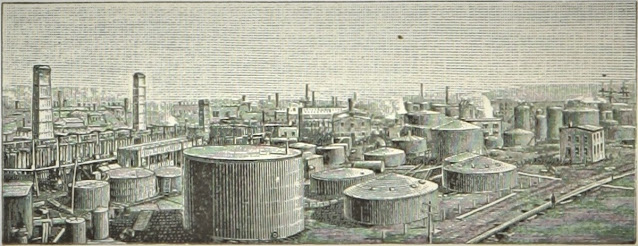
Edward ran the place, and “Big” Jim’s Erie Railroad transported the refineries’ oil at a discount.  It would seem that because of a hunger for self delusion and self destruction in 1869 Edward and Josie began an affair -  they thought behind “Big” Jim’s back.
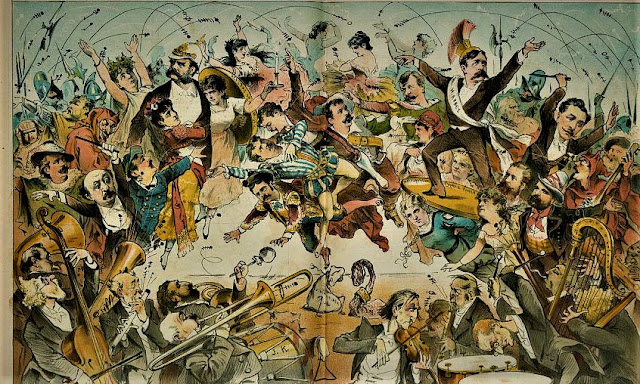
Such a triangle could be maintained only so long as all the parties carefully judged the angles. But algebra was a skill that none of the three possessed in quantity or quality. 
In January 1870 Josie Mansfield announced that she no longer wanted to see “Big” Jim unless he made her financially independent. She reminded him,  “You have told me very often that you held some twenty or twenty-five thousand dollars of mine in your keeping…a part of the amount would place me where I would never have to appeal to you for aught”  And now, she told "Big Jim, she wanted "her" money.
“Big” Jim was hurt. He responded, “Have I not furnished a satisfactory mansion? Have I not fulfilled every promise I have made?” And then he let it be clear that he was fully aware of her affair with Edward. “You may well imagine my surprise at your selection of the ‘element’ you have chosen to fill my place. I was shown today his diamonds, which had been sacrificed ... at one-half their value ….You will, therefore, excuse me if I decline your modest request for a still further disbursement of $25,000” Jim even began calling Josie his Little Miss “Lump-sum”.
Having received a definitive “no” from her sugar daddy,  Josie began shifting her demands. First, she threatened to publish “Big” Jim’s love letters.  Then she said was willing to spend an evening with him. Then she hinted she would share secret details of his Erie Railroad stock manipulations. 
Through an intermediary “Big” Jim asked Edward directly how much he would require to return those love letters and return Josie as well. Edward asked for $200,000, and that seemed to have hit “Big” Jim’s limit, again.
Of course,  "Big" Jim still sent Josie cash when she asked for it - $500 on 7 November,, $300 more three days later, then another $500 a week later. Now why did he do that? 
He must have known that most of the money was going to Edward's gambling debts.  Of course November was also the month that “Big” Jim cancelled the shipping discount for the refinery he shared with his partner.  Yes, “Big” Jim was hurting his own profit margin, but Edward was being squeezed much harder. And Big Jim could afford it. 
Edward grew so desperate that in January of 1871 he collected a $27,500 debt owed to the refinery, and pocketed it.  Which is just what  “Big” Jim had been waiting for.
Edward charged with embezzlement and arrested. The Lothario spent a weekend in the notorious New York City jail "The Tombs" (above) before he could raise bail.  Edward swore his revenge for the insult.
Why “Big” Jim had not done this sooner remains a mystery. The man was a Wall Street cut throat, merciless and cruel to his business competitors and partners. Yet he seems to have been sheered of his strength in the face of Josie's demands. 
Josie  now sued "Big" Jim, demanding the pay her $50,000 (the $25,000 she insisted he owed her, plus interest). Edward joined in, suing “Big” Jim,  to force him to buy out Edward’s share of their refinery for $200,000.  And at last the entire mess was out in the open, where the press could profit by it.  And they always love that. This story, they knew,  was just beginning.
- 30 -

Tuesday, March 22, 2022

TOTALLY INSANE Dan Sickles Pleads


I do not agree that Senator Daniel Sickles was temporarily insane when he murdered his good friend, Phillip Key. But then his jury were never told what a whoring booze-hound Sickles was. They were only told what a whoring booze-hound Phillip Key was. In the vernacular, Dan Sickles wasn't crazy, he was just an arrogant jackass.
Before he was even twenty, Daniel Sickles (above) had been indicted for fraud. Still, his criminal career didn't really get started until he was 26 and passed the New York State bar exam. He served a one year term in the State Assembly, when he joined a N.Y. delegation tour of London, where he introduced his mistress, Miss Fanny White (under an assumed name) to the King of England. Back in the United States, in 1852, Daniel met his legal lady fair, his personal Alice Alquist from “Gaslight”, Teressa Da Ponte Bagiolo.
Teressa Sickles (above) was the perfect political wife. She was beautiful,  sophisticated and charming. She had very wealthy parents. She spoke five languages. However, all this merely proves that a smart woman is just as likely to have terrible a taste in men as a dumb woman. Terresa’s only excuse in marrying Daniel (against her parent’s wishes) was that the poor child was just 15, when the 34 year old Daniel seduced and married her. She was three months pregnant when, in 1853, she and Daniel were married a second time, at her parent’s insistence, by the archbishop of New York.  As if organized religion was going to fix this disaster of a pairing.
One contemporary compared Daniel's morals to a rotten egg.  In 1856 Daniel was elected to the New York State Senate, which shortly thereafter censured him for giving a tour of those august chambers to Miss White, who was at this time identified as the operator of a popular N.Y.C. bordello. And when Daniel was elected to the U.S. House of Representatives in November 1857, and he and Teressa  moved to Washington, D.C.  At the same time he  maintained a suite at a Baltimore Hotel for his assignations with Fanny White, and  "soiled doves" in her employ.  You see, Congressman Sickles was Miss White's primary financial backer and partner.
Shortly after the legal couple moved, Daniel was introduced to Phillip Barton Key, and the two struck up a friendship of kindred spirits. Key was living proof of the old adage about fruit never falling very far from the sapling. Phillip’s father, Frances Scott Key, had been so familiar with a certain popular drinking ditty (so difficult to sing that it was used as an 18th century sobriety test), that on the fly he converted it into our national anthem, translating “And swear by old Styx, that we long shall entwine, the myrtle of Venus and Bacchus’ vine” into “Oh, say, does that star spangled banner yet wave, Ore the land of the free and the home of the brave.”
Phillip was forty-two year old widower at the time, with six children, and “the handsomest man in all Washington society”, according to Mrs. Clement Clay, the biggest gossip in a town that still lives on gossip. At six feet tall, Phillip had “sad eyes and a languid charm” (according to Edward Pinchon who wrote a bio of Dan Sickles), and his “…fine figure, fashionable air, and agreeable address, rendered him extremely popular among the gentler sex”, according to Felix G. Fontaine, who wrote “The Washington Tragedy”. Key was also the Federal District Attorney for Washington, and thus a good man to know for anyone who might anticipate developing legal problems. Daniel had so far made a career out of developing legal problems, so he decided that Phillip Key was the perfect man to escort Teressa to Washington social functions while Daniel was “relaxing” in Baltimore with Fanny White.
Friends tried to warn Daniel about Phillip’s reputation, and in March of 1858 Daniel had a confrontation with Phillip concerning accusations that were already bubbling up about his intentions toward Teressa. But Daniel came away from that meeting convinced that Phillip could be trusted. Evidently, Daniel assumed that Teressa could also be trusted.
Maybe the twenty year old girl was just fed up with Daniel’s philandering, and maybe it was payback. But whatever her motivation, according to Terressa’s own confession, “I did not think it safe to meet (Phillip) in this house, because there are servants who might suspect something….He then told me he had hired (a) house as a place where he and I could meet. I agreed to it.” The assignations took place at 888 Fifteenth Street in Washington, between K and L streets, in a run-down racially mixed neighborhood just around the corner from the Sickles’ rented home. “There was a bed in the second story…. The room is warmed by a wood fire. Mr. Key generally goes first… I went there alone.” And there, confessed Teressa, “I did what is usual for a wicked woman to do” Occasionally they also took carriage rides to various cemeteries, where, according to the coachman, “They would walk down the grounds out of my sight, and be away an hour or an hour-and-a-half.” Whatever they were doing out of sight, it was not enough, evidently, to wake the dead, or Daniel.
The torrid affair between Teressa and Phillip was one of the best known secrets in Washington, which has always been, at heart, the provincial Southern village it started out as. And it was only a matter of time before some moralizing busybody felt the need to drop Daniel an anonymous letter telling the whole sordid truth.. The dreaded day came on Thursday, 24 February, 1859. Daniel showed the note to a another friend, George Wooldridge, and then “put his hands to his head and sobbed in the lobby of the House of Representatives.”
On Saturday night, 26 February, 1859, Daniel confronted Teressa in her bedroom (they had separate sleeping arraignments, on different floors, even when he was sleeping at home),  and he forced her to write her confession in her own hand. This would later be reprinted on the front page of Harper's Weekly, a national newspaper. At about two the following afternoon, as Daniel was being comforted by another drinking buddy, Samuel Butterworth, in his own parlor, he spotted Phillip Key walking slowly back and forth on the street in front of his house on Madison Place, waving a white handkerchief in the general direction of Terressa’s bedroom window.
Daniel took the time to put on an overcoat, dropped a revolver and two derringers in the pockets, and went charging out of his Madison Place townhouse. He caught up with Phillip at the corner of Madison Place and Pennsylvania Avenue, just across the street from the White House. Daniel bellowed, “Key, you scoundrel, you have dishonored my bed. You must die!” Thereupon Daniel pulled a derringer and fired. Not surprisingly he missed. 
Phillip, who until that instant was unaware the affair had been discovered, grabbed for the gun, which was pointless since it was a single shot weapon, and the two men struggled for a moment while a dozen witnesses gasped in amazement. Phillip finally broke free and ran across the street, throwing a pair of opera classes to cover his retreat, and hid behind a tree.
Daniel followed, and produced a second derringer. This second shot hit Key in the thigh. The playboy dropped to the ground, begging, “Don’t shoot me”, and shouting, “Murder.”
Daniel finally pulled his revolver, and his third shot hit the tree. But the fourth shot, delivered point blank over the prone Phillip, blasted a hole in his chest as big as a silver dollar. The fifth shot misfired, and witnesses managed to restrain Daniel from delivering a ‘coup de grace.’ Not that it mattered; Phillip Key would soon be dead. Explained Daniel, when he was arrested, “He deserved it.”
It was the trial of the century! The prosecutor spoke of the “echoes of the church bells” still lingering in the air” while Daniel pulled the trigger over and over. The eight defense lawyers reminded the jurors that Daniel was “…in a state of white heat, (which) was too great a state of passion for a man to be in, who saw before him the hardened, the unrelenting seducer of his wife”.  After a twenty day trial the jury was out for only an hour. A hundred fifty people attended Daniel’s victory celebration. He had been declared, officially, temporarily insane.  The first such plea successfully delivered in an American court, and one of the few times it has ever worked.
The only hiccup occurred after the trial when Daniel publicly forgave Teressa. The public, which had supported the heel, now suddenly turned on theirs and attacked Sickles.  Americans were not offended at the murder, but at the show of marital compassion. Washington and New York society cut him dead.  Daniel would have been condemned to die in obscurity, remembered only as the first defendant to use the temporarily insanity defense in America, but the outbreak of the civil war saved his reputation.
Being a Union supporting Democrat, Sickles was too valuable to be shunned, and he was used to enlist German American soldiers, and even rose to command one third of the Union Army at the Battle of Gettysburg. It was there that Sickles almost cost the Federals the war, and had his right leg (above) shattered by a Confederate cannon ball. Being a general's leg, the limb was held in the national archives, where Sickles came to visit it every year on the anniversary of it's loss.   
Poor Teressa (Above, post trial, and looking very unhappy)  barely survived that war , succumbing to tuberculosis on 5 February, 1867, at the age of thirty-one. She was buried with her parents, back in New York; free at last from her insensitive and violent husband.
The old reprobate was then appointed ambassador to Spain, where and when it was rumored he seduced María Isabel Luisa de Borbón y Borbón-Dos Sicilias, also known as Isabella II, Queen of Spain - deposed (above). 
At the age of 50 Sickles did remarry, again to another  deeply religious girl - this time to the orphaned 23 year old Carmina Creagh (above). She quickly produced two children for Sickles and then dutifully settled into her new cloister.
Back in New York, Sickles (above, with Carmina walking behind) occupied himself by raising money for a Gettysburg memorial for his New York troops. But after a few years it was evident he had pilfered $27,000 from the funds. There was talk of having the old reprobate arrested over the theft, which would have been a public relations nightmare for his fellow crooks at Tammany Hall, and cooler heads prevailed. He was merely removed as head of the fund raising committie.
In March of 1914, there were rumors that Daniel had finally died. A reporter for the New York Times placed a telephone call to his mansion on Fifth Avenue. Daniel answered the phone himself. He had never felt better, he told the reporter, and denounced the rumors as a “damn lie.” 
Two months later Daniel Sickles suffered a stroke and really died. He was buried with all honors he did not deserve. All past indiscretions were forgotten, if not forgiven. And I believe that for every second of his 91 years of life , Daniel Sickles was totally and completely insane. There was absolutely nothing temporary about his mental condition, no matter what the jury said.
- 30 -

Blog Archive