August 2025

August  2025
I DON'T NEED A RIDE. I NEED AMMUNITION.

Translate

Wednesday, March 10, 2021

AMERICAN NARCISSIST - Bath, Michigan Bombing


I can see him clearly, as if he was standing next to me at this moment. And yet his image remains hazy. According to his drivers' license, he was five feet, nine inches tall, weighed 150 pounds and had gray hair. He was also described as “ ...a slight hollow-chested man”, of 46, with thin lips. And yet he remains an enigma. A neighbor, when shown several photographs of him, said, “ "I knew him well and he never looked like that.” And he was not just a physical enigma. Howard Kittle, the Clinton County agent and Farm Bureau manager, received a letter from him, and admitted that if anyone else had written it “I would have thought sure he was insane.'” But that was before - when he was an elected community leader, a trusted guardian of the communities' wealth and its future. Afterward the local newspaper - the Clinton County Republican-News - was forced to wonder, “Is the building of a modern institution which equips children to meet the problems of the world a burden - or is it a privilege?” You see, the man at issue was a anti-tax warrior and an American narcissist.
Bath in 1927 was a little farm town of about 300 people 10 miles northeast of Lansing, Michigan. “(It) had a ( grain) elevator, a little drugstore, and you knew everybody within 20 miles” said a life long resident. In 1922 rural Clinton County closed its scattered one room school houses. They used $8,000 of their own hard earned money to buy five acres of ground just south of Bath. They borrowed $35,000 to build a two story Consolidated School building. Here, classes would be divided by ages, to protect the younger children from older bullies. With fewer teachers, higher standards could be required of the instructors, even a college teaching degree. And amenities such as a library, lunch programs, athletics, music and art were added. And buses picked children up at their front doors and returned them safely home each night. It was the foundation for the secure world future generations grew up in. And it was not cheap for the older generations.
The future always costs. You either invest in it now, or, if you refuse, it proves much more expensive trying to catch up.  In 1922 property taxes in Clinton county were $12.26 per thousand dollars of valuation ($160 today, or over $16%). In 1923 those taxes had gone up by half to $18.80 ($235 today). This was not the decision of a few liberals. This was debated for years within the community. And over time the decision was made to invest in the future of Clinton County,  in the counties' children, and to spend the money on that future.  Three years later, eager to eliminate the debt quickly, the elected leaders of Clinton County paid off $7,200 of their obligation, and taxes topped out at one dollar higher (to $240 per thousand in today's dollars). It was expected taxes would now start to drop, but that did not take into account the rising inflation of the late 1920's, and the selfishness of one egomaniac who chose - chose -  not to have a future.
I shall not use his name because of something Neil Kaye, forensic psychiatrist at Jefferson Medical College told Time Magazine in April of 2007.  He said, “We glorify and revere these seemingly powerful people who take life. Meanwhile, I bet you couldn't tell me the name of even one of (serial killer) Ted Bundy's victims.” So let me just share a headline from the New York Times, dated Wednesday, 18 May, 1927, to explain who this man was, by what this man did.  “Maniac blows up school, kills 42, mostly children; Had protested high taxes...Children Pinned in Debris. Others hurled against walls or out windows – Searchers still hunt for missing. Agonizing scenes in yard. Distraught parents find little ones dead beneath blankets...”. The early numbers were wrong, of course. The maniac killed eight adults and 34 children at the school, that day. The last little victim, nine year old Richard Fitz, would die of an infection caused by his injuries, a week short of a year after the Bath School Disaster. And that was the name of one of this selfish bastard's victims.
Just before he murdered 34 children, the maniac had bludgeoned his wife to death, restrained all his animals in a burning barn, killed every fruit tree on his farm, and burned all his expensive farm equipment. Interestingly, it was figured by the cleanup crews, that he could have paid off his mortgage and his property taxes by selling most of his well maintained farm equipment, which, according to his neighbors, he rarely used.  Neighbor M.J. “Monty” Ellsworth wrote later, “He was at the height of his glory when fixing machinery or tinkering...He spent so much time tinkering that he didn't prosper.”  The maniac also stood out, as a farmer, for his meticulous appearance. He changed his shirt quickly should a spot of dirt appear on it and was often seen sitting on his front porch, in a smoking jacket,  puffing on a cigar.  But his primary interest, his obsession, was in reducing his taxes.
The maniac had been elected to the school board in 1924, two years after the new school had opened and the first election after the new higher tax rate had been announced. His platform was to cut the cost of the new school. In 1925, after the death of Maude Detluff, the school board's treasure, he had been appointed to fill that position. His book keeping was, like his appearance, meticulous. After his suicide, his books showed  “a long and detailed explanation” of a 22 cent discrepancy.  But in the spring of 1926, when he ran for election to officially take on that job, the voters had rejected him. Once again, the majority approved investment in the future  That rejection appears to have sparked the fuse. The maniac stopped paying both the mortgage and the  insurance on his own farm. The previous owner, his wife's relatives, eventually began foreclosure proceedings  His crops began to rot in the fields.
There is a story that decades earlier, a promising career as an electrician in St. Louis had been cut short by a fall and a serious head injury.  So farming was the maniac's second career choice. He married and moved to Clinton county right after the First World War. He might have over paid for his farm, because land prices were inflated at time. And his wife was afflicted with tuberculosis, a wasting disease before antibiotics. The Klu Klux Klan would even alleged his Catholicism encouraged him to destroy the school because it was not a Catholic school. But even if all of that were true, none of it would justify the cold blooded murder of 34 innocent children, and nine adults, and the farm animals. All the maniac could focus on was HIS taxes.
Before the school was built, he had opposed it. Once it was decided to build it, he insisted it should be a 10 grade institution, instead of 12 grades. He opposed the inclusion of a library, or athletic programs or a music department.  And he lost every argument. Once the building was constructed, the tax increase gave him enough supporters to win election to the school board, where his obstinacy continued. He even opposed giving the superintendent a paid vacation each year, and then argued it should only be one week, not two. And as he lost each of these arguments, his obsession grew, day by day. Words used to describe him during this time were “surly”, “obstinate”, “impatient” and “arrogant”.  Eventually he began to invest his money not in his farm, or his wife,  but in World War surplus explosives, and to sneak them into the basement of the new school house, rig them with a timer and set them to explode early on a Wednesday morning,  just after classes had begun.
The day after the bombing,  while still in shock and grief,  the Clinton Country Republican ran an editorial, which explains, far better than I ever could, the connection between the maniac's crime and his anti-tax fever. “That he was insane there is little doubt", wrote the editors of the paper. " But he was not always insane. To start with he was merely antagonistic. Then he became radical.. He was the victim of the progress of his own lack of balance...What a terrible price to pay for narrow-mindedness. What an awful calamity for one peaceful little community to bear for one man's lack of ordinary American ideals...Never before have we known of aversion of the cost of education taking such terrible form. There are, however, many people who unthinkingly hamper and discourage the progress of good schools and other institutions for the welfare and happiness of the public. What are we going to do about it?”
It is almost a century later, and the question begs to be asked again, this time of a nation which elected an admitted rapist as President, supported by the power hungry unChristian unRight, - those who object to investing in the future because they choose not to believe we have one. And what are the majority of us going to do about it?  The answer after the 6 January 2021 U.S. Capital assault and the poison of the Trump Presidency is...not yet answered,
- 30 -

Tuesday, March 09, 2021

ET TU Part Eight CLIMAX


I find it very telling that on 13 March, 44 B.C.E, just two days before the planned assassination of .Julius Caesar, the driving forces behind the plot, Gaius Cassius Longinus , warned his fellow conspirators that, should Caesar uncover their plans, all of them would have to commit suicide. 
This was not the advice of a ideological leader. Rather, it indicates conspirators haunted with second thoughts. Simply put, there were too many who knew too much. Estimates of members in on the plot range up to 40  And to galvanize the plotters and hold them to their purpose, Cassius did not appeal to their patriotism, but to their sense of class. A serf suffers humiliation every day. It is the staff of their lives. But an aristocrat, faced with loss of privilege, usually prefers death to humiliation, meaning a loss of money.  This was the warning Cassius delivered to his nervous conspirators; we succeed or we die. It never seems to have occurred to the privileged forty, that victory could also be fatal.
The object of Cassius' hatred, Giaus Julius Caesar, elected Roman dictator for life, intended on leaving Rome on 18 March.  But even Caesar, at 56, must have been daunted at the prospect of campaigning in the Parthian desert, which 12 years before had consumed his old patron Crassus. Every year for the last five years opposition by the Senate aristocrats, first in Italy, then Spain, Greece, Egypt, Anatola, North Africa, and Spain again had forced Caesar to campaign. On this day, the Ides of March, which was until this year, New Years Day, Caesar had intended on staying close to home. The historian Plutarch says he was not feeling well, and everyone agrees his wife was having nightmares Whichever the excuse he used to dissuade his followers, it seems clear he wanted a little down down time. Someone had to get him out of the house, someone close, someone he could not deny.
The obvious choice was Marcus Junius Brutus, the son of Cesar's long time mistress, and so often forgiven by Caesar that it was rumored he must be Caesar's illegitimate son. But Brutus had a new wife at home, Porcia Catonis. They had been married just the year before, in 45 B.C. Porcia was the daughter of the aristocratic Senator Cato, who hated Cesar so much that when cornered in North Africa in 46 B.C., he had chosen suicide. It must have been her, aided by Crassus, who had stiffened Brutus back, and driven him to murder. But even Brutus was not willing to lure Caesar to his death. So that job fell to his younger brother, Decimus Brutus.
On the morning of 15 March, 44 B.C., Decimus was welcomed into Caesar's home, where he  extended an invitation to a gladiatorial display in one of the larger halls at Pompey's theater.  It was a subject certain to pique Caesar's interests. Before crossing the Rubicon, Caesar had been checking up on one of his own gladiatorial schools. He now agreed to accompany Decimus to the theatre. He had no intention in attending the Senate, which was meeting in the Curia Pompey, part of the same complex.
As the pair entered the complex through a side entrance, crowds pushed toward Caesar, forcing petitions into his hands, comments on government policy and requests for assistance. One of the messages handed to Caesar was from his lieutenant, Mark Anthony, warning of rumors concerning the Senate meeting today. Like the others notes handed to Caesar this morning, it would not be opened until it was too late.
Was there a man in the street warning Caesar to “Beware the Ides of March”? Probably, given the depth of religion in the pagan world, there were people wandering the streets of the largest city outside of China, prophesying doom about every dawn, and in particular about the dawn of an abandoned New Years Day. But Caesar had become Dictator by ignoring such ominous warnings. Today the soothsayer was right. The previous ten thousand mornings he had been wrong.
Once inside the walls of Pompey's Theatre, Caesar and Decimus, made their way along the walks toward the meeting room to inspect the gladiators. But as they passed the Curia they were waylaid by Decimus' older brother, Brutus. Now he urged Caesar to stop in the Curia,  to allow the Senate to wish him gods' speed on his invasion of Parthia. Exasperated, Caesar acquiesced, and the three men crossed the portico and entered the temporary Senate Chambers.
As he sat down, Caesar could not have missed the electric tension in the room. But what did it mean? Many were avoiding eye contact with him. A few were looking at their feet, or fingering the daggers hidden in their Senatorial robes. But even those Senators who were not in on the plot must have recognized that something was wrong. And when Senator Lucius Tillus Cimber thrust forward a petition asking that Caesar allow his brother to return from exile, Caesar pushed it away, into the hands of an aide. Whereupon Tillus Cimber grabbed the hem of Caesar's toga, and pulled. Caesar pulled away, demanding, “Be careful, there is no need to use force!” As Caesar turned to a guard to seek assistance, Senator and Tribume Publius Servilius Casca Longus, slashed forward, stabbing Caesar in the neck, just missing his throat.
Caesar grabbed Casca's arm and stabbed him with a pen. Startled, Casca screamed, “Help, brother!” As he tried to stand, Caesar was stabbed again. He now realized the aristocrats had surrounded him, and they all had knives. He tried to run, but fell, and was brutally stabbed over and over as he lay on the floor. The autopsy would reveal 23 wounds. So many knives were slashing that Brutus was stabbed by one of his allies.
Rather than being proud of their act, the aristocrats fled the scene as quickly as they could, escaping back inside the city walls, where Cesar's soldiers were not allowed to carry arms. And the abandoned body of Julius Caesar lay a crumpled heap on the floor of the Curia Pompey, his robes soaking in his blood, for three hours. Finally three slaves worked up the courage to load his corpse on a litter, and carry him home to his wife. Thousands stood in shock to see the body pass on the street, one arm hanging off the litter, uncovered , bouncing to the steps of nervous slaves.
The site of Caesar's murder did not become a shrine. It became a public toilet. Pompey's theatre remained in use for almost 1,500 years. Eventually the large latrine which had shared a wall with Curia was enlarged, and engulfed the spot on the floor where Caesar had bled out.  Finally it was walled off and forgotten. And when the theatre, and the latrine, fell on hard times midway through the fifteenth century A.D., the populace turned it into a quarry, scavenging building stones for their homes and shops. Even today, those who come to look upon the space where Giaus Julius Caesar died, will find only an arch, and an ancient concrete wall
Within two years most of the aristocratic assassins were dead. Cassius, Casca, Cimber, Brutus - all died by their own hands. A few of the forty were killed in battle, and a few even fought for their lives in the courts, and won. They were allowed to return to Rome and live in somewhat reduced privilege. Caesar's will left his fortune to his nephew Octavian, and eventually the boy overturned the rotten remains of the Republic and disposed of the tawdry trappings of its dead democracy, which had really been killed by the aristocrats.  Octavian became Augustus, the first Roman Emperor. Retroactively, he made his uncle divine. The deceased Julius Caesar had become the thing the aristocrats said they  feared he wanted to become, a god.
But the dream of a representatives government, giving the people a voice in their own governance, had been set back by 2,000 years.
- 30 -

Monday, March 08, 2021

ET TU - Seven - Theater Matinee.


I would like to have attended the Lupercalia, in 44 B.C.. It was the beginning of the Roman holiday season, and the city probably never looked (or smelled) better than it did every Ides (15th) of February. In part this ancient festival of cleansing and renewal celebrated Fanus, the Roman incarnation of the Greek god Pan. Young children ran naked around the Palintine Hill, striking married women lightly with palm branches. This was supposed to increase fertility, or, if you were already pregnant, to induce an easy birth. Women lined the hill and offered up their bottoms to be spanked. This was the beginning of our Valentines Day.                                                         
But the festival was named for Lupe, the mythical she-wolf, and that was the major thrust of the official celebrations. Two children were given the honor each year of entering the temple cave on the Palatine Hill where Lupe had supposedly suckled the abandoned human twins Romules and Remes. There the honored boys witnessed the sacrifice of two goats (representing Pan) and a dog (representing Lupe), and their faces were smeared with the animals still warm blood. It was a joyous day, reminding the citizens of their heritage. After killing his brother, Romules had gone on to found the city of Rome. But it also reminded citizens that change was a challenge that made you great, and not something to be feared.
There were several city fathers who feared the future, at this year's Lupercalia. Standing outside the temple, Julius Caesar (above), newly elected dictator for life, was offered a crown three times by his lieutenant Mark Anthony. It was a piece of political theatre. The crowds cheered every time Ceasar rejected the crown, but to a dictator for life any crown would have been a meaningless ornament. Still the few remaining aristocrats in the Senate thought they saw the fifty-three year old Ceasar hesitate a little longer each time the laurel crown was offered, as if hoping the crowds would call for him to accept the title of king.
Rome had not had a king for 500 years. The last, Tarquin the Proud, had been driven from the city by Lucius Junius Brutus, who had then founded the Republic. The mayor of Rome in 44 B.C., Marcus Junius Brutus, liked to claim ancestry from that ancient republican. But that seems to have been just more theatre, politics as usual in the first century B.C., which was also the last century of  B.C. Change was coming. And if you were a member of the top 1% of the population of Rome, like Brutus, at the peak of the money pyramid, the peak of the privilege pyramid, the peak of the power pyramid, nothing about change would have been appealing.
Immediately after the festival, Caesar threw himself into preparations for his expedition against the Parthians. He had already sent the first legions marching from Germany toward the Parthian borders, under the command of his young nephew, Octavian. But Caesar himself could not depart Rome until after the festival for the goddess Anna Perenna, on the Ides of March, even though it seems unlikely Caesar was planning on participating in the Anna (year) Perrena (perennial) festivities himself.
Until Caesar's new calendar, this had been the Roman new year's eve. Celebrants pitched tents among a peach tree grove next to the Tiber. Both sexes wore blossoms in their hair and drank and danced into the night. There was an aura of sexuality and licentiousness. But that was, again, a young man's game, and Caesar was no longer a young man. He did not spend the night beside the Tiber. But the holiday crowds were also good cover for secret movements and meetings by the Senate aristocrats. Cassius, Brutus' brother-in-law, had decided that something had to be done before Caesar left Rome.
What Cassius expected to be done was obvious to anyone familiar with Roman politics over the previous century and a half. A hundred forty years before this Ides of March, Tribune Tiberius Gracchus was beaten to death by the Senatorial aristocrats and his body thrown into Tiber. Ten years later Tribune Gaius Gracchus died along with three thousand of his supporters at the hands of the Senate elite. Gaius Memmius was assassinated just for standing for election as Tribune in 100 B.C. Two of his allies, Lucius Appuleius Saturninu and Gaius Servilius Glaucia, were actually elected Tribunes, but they were arrested on trumped up charges and while in jail a mob of Senate aristocrats had stoned them to death in their cell. In 91 B.C. Marcus Livius Drusus was murdered. Tribune Sulpicius Rufus lost his his head in 88 B.C. Then Counsel Marius Gratidianus was literally sacrificed by aristocrats, and thirty-two years ago Cnaeus Sicinicus had been murdered. All of these men and thousands of their supporters had been killed in the alleys and back streets of Rome, even in the Senate House itself, just to keep money and power in the hands of the rich and powerful.
And now the Senate aristocrats were faced with their greatest enemy, Gaius Julius Caesar. They charged Caesar with wanting to be king, the same charge they had made against Graacchus, against Memmius, against Saturninu, against Drusus, against Rufus, against Marius and against Sicunicus. The Aristocrats knew they had to act before Caesar left Rome, because once surrounded by his loyal legionaries, there would be no chance reaching him.
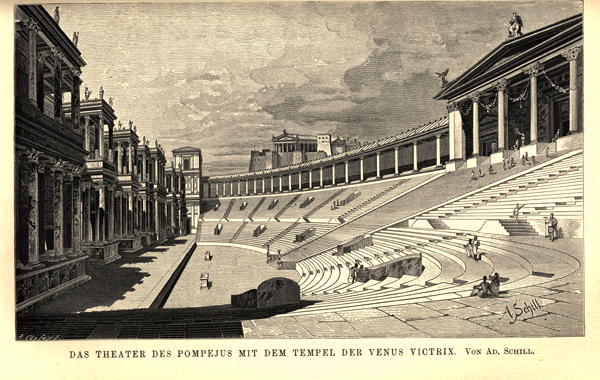
The historian Nicokaus of Damascus described the conspiracy. “The conspirators...assembled a few at a time in each other's homes....Some suggested that they should make the attempt along the Sacred Way, which was one of his (Caesar's) favorite walks. Another idea was to do it...(when) he had to cross a bridge...A third plan was to wait for a coming gladiatorial show...because...no suspicion would be aroused if arms were seen. The majority opinion, however, favored killing him while he sat in the Senate. He would be there by himself, since only Senators were admitted, and the conspirators could hide their daggers beneath their togas. This plan won the day.” And there was an appealing irony in this plan, since the Senate House had been burned down after the murder of Tribune Publious Clodius Pulcher, the Senate was now meeting in the Pompey's Theatre.
It was a massive complex (above), a multi-use facility, like a sports complex in 21st century America, and had been funded by the late Pompey the Great. Besides a magnificent stage for public performances, it also had, behind the stage, a large walled enclosure containing several meeting halls and markets, and beyond that temples, connected by shaded walks and fountains. It was a protected island of calm and beauty, separated by walls from what had become a violent and ugly city. The Senators saw no irony in the need for those enclosing stone walls, even though a large percentage of the criminal gangs that had become pervasive in Rome, were financed by their own members, and used to terrorize each other and the Plebeians, the working class citizens of Rome. Contained within the surrounding walls were meeting rooms, ringed by a covered portico. In the largest if these rooms, just behind the stage, stage right, stood a statue of Pompey the Great. That room was called the Curia of Pompey.
Curia was an ancient term in ancient Rome, referring to a gathering of the tribes of Rome. The Curia of Pompey was thus the perfect place for the Senate to meet. The only drawback, to the Senate aristocrats, was that the room shared a common wall with what the theatre patrons at the time described as a “monumental public latrine”. And it was in this room next to a toilet, that the Senate would meet with Caesar for the last time.
- 30 -

Sunday, March 07, 2021

ET TU Part Six OVER THE EDGE


I don't wish to overstate things, so speaking conservatively, the year 45 B.C. was one of the most politically revolutionary years in all of human history. To begin with it was a last year of the old Roman calendar, and the year in which Julius Caesar was elected dictator of Rome for life. Could it have been a coincidence then, that this revolutionary year was also the last year of Julius Caesar’s life?
When Cesar conquered Gaul the minute had yet to be invented, the second was a useless abstraction, and the hour a generality. The Romans marked time using the moon. 
The new moon was the first day of every month, on which bills were to be paid, known as the accounting book day - in Latin, the Kalends. Five to eight days later, on the half moon, was the Nones, and every day between was numbered as 'so many days before' (or previous) or after the Nones'.  Eight days after the Nones came the full moon, which was called the Ides, or the half. The Ides was followed by a count down to the next Kalends.
The biggest problem with this seemingly simple system was that the months were of equal length, and the year was only 355 days long.  Even two thousand years ago the earth took 365 days + to orbit the sun, and those ten missing days caused a gradual season creep. This was supposed to be addressed by adding a 13th month, the Mensis Intercalaris, every other year, usually in the dead of winter. 
But the decision of when and where to add the Mensis Intercalaris was left up to the Counsels, who were the executives who ran Rome and were elected to serve for one year each. And being politicians, most managed to justify stretching out their terms in office for that extra month. So, Rome was soon suffering from additional seasonal creep. By the time Julius Caesar crossed the Rubicon, on 12 January, 49 B.C.E, instead of that date happening in the winter, it was just the middle of autumn. Something had to be done.
The story goes that late in 48 B.C.E, at a party in Alexandria, Cleopatra 7 introduced Julius Caesar to her court astronomer, Sosigenes.  And it was during their conversation that Sosigenes suggested the Romans dump the moon and start telling time by the sun. Well, Caesar agreed in theory, but he was first and foremost a politician, and not that interested in theory. But he filed it all away for future reference. After defeating the Senate aristocratic forces in Asia Minor, Tunisia and Spain in 46 B.C., Caesar finally turned his attention to fixing things in Rome.
First he swamped the Senate with 300 new Senators, including some from outside of Italy. This gave him the votes to do just about anything he wanted. He wanted to be elected dictator for a year. This position had been created before, but Caesar also used his new majority to make the jump to Sosigenes's new calendar.  
Now, his reason for doing this was of course purely practical. In order to bring the seasons into harmony before switching to the new calendar  Caesar inserted two adjustment months; Intercalaris Prior and Intercalaris Posterior. Adding these 66 days meant that Caesar's year as dictator lasted 445 days, giving him lots of time to get the Senate to vote him dictator perpetuo - dictator for life - which they did in in February of 44 B.C. And if as of 1 January, 44 B.C., instead of an intercalaris month inserted every other year, the new Julian calendar required only one extra day be inserted every four years. But again, all of this was merely a happy side effect. The important thing was that Rome was now on Caesar Time.
For the poor little rich boys, like Senator Marcus Junius Brutus, and his brother-in-law Senator Gaius Cassius Longinus, the changes were not so happy. So many aristocratic Senators had been killed trying to stop Caesar, that the blue blood in the Senate was running thin. Then Caesar had diluted the Senate membership by 50%, by appointing a bunch of rubes and boobs - at least it seemed so to Brutus and Cassius. The  Senate chambers had now acquired all the unpleasant aspects of the audience at the Grand Old Opera..
And then, even worse, Caesar cut the welfare rolls by half. Those tossed off the public dole were offered the chance to live overseas in new cites, like New Carthage in Africa and New Corinth in Greece, or Seville in Spain. You would have thought the aristocrats would have cheered this development, but they had gotten so used to denouncing the angry mobs of poor people right outside their doors, that now that the angry mobs were reduced, they missed complaining about them. Almost in reflex they denounced the expense of building all these new “welfare” cities. Caesar was doing this, they said, just to increase his popularity. Which it did.
But what Caesar did with the banking system in 45 B.C. really ticked off the aristocrats. The country was drowning in debt, mostly owed to the aristocrats in the Senate. They were about the only people with money, and they were getting even richer because of it.  In a typical example, Brutus had made a loan to the town of Salamis in Sicily, charging 48% interest per year . They could never pay that off. But in 45 B.C. the dictator Caesar had wiped out all interest due on any principle already paid. With that one decree, one quarter of the amount owed by the 99% of the population to the top 1% was wiped out. The economy took a big breath of relief. But the 1% were outraged. Caesar was a tyrant, they said. He wanted to be King, they said.
Caesar also started rebuilding the Roman forum, including starting a new Senate House to replace the one burned down in 50 B.C. Nearby he built a new market that spurred business investment and profit in the city. He cleared out the vast wooden Subura slums and rebuilt them in cement, which put an end to the fires which regularly threatened to burn down the entire town. Caesar rebuilt the port of Ostia into a vast grain store house, to stabilize the price of bread in Rome. This ticked off the aristocrats in the Senate who had made money manipulating the price of wheat. 

He set term limits for Roman governors, and established new rules to reduce graft in the provinces. This ticked off the aristocrats who had profited from that graft. He granted Roman citizenship to millions in Italy, Spain and North Africa, which made Rome something they would all fight for. But that also gave these people rights and protections under the law against rapacious money lenders – also known as the aristocrats in the Senate. The angry rich now declared that Caesar the tyrant not only wanted to be King, he wanted to be made a god. 
And then Caesar did the one thing which sealed his fate. As election day 45 B.C. approached, Cassius, Brutus' brother-in-law, was expecting to be nominated for Praetor, mayor of Rome, for 44 B.C.. Instead, Caesar nominated Brutus again. Cassius was insulted, infuriated and frightened. His veiled hatred of Caesar was well know in the Senate chambers, but he had not thought Caesar knew. Now he must have suspected that Caesar suspected him.  And Cassius knew what he would do if he were in Caesar's position. Something had to be done.
Cassius knew if he struck back at Caesar himself, he would have little support. Even his brother-in-law Brutus (above) knew how much he hated and feared Caesar. But Cassius also knew who Brutus was. Cassius knew Brutus could be led to act if an abstract argument could be justified in concrete terms. So he took a coin out of his purse.
The design of Roman coins was determined by three men,  called the “tresviri monetales”, the 'three money men'  who decided what face or images would be carved into the molds used for the aureus (gold), denarius (silver) and the as (copper) coins used in every transaction from buying political office in Judea to a loaf of bread in Britain. One denarius was roughly the equivalent of fifteen U.S. Dollars, and traditionally they carried the images of gods and demigods representing traits the politicians wanted to be seen as embodying. But in February of 44 B.C. a new denarius was released, bearing the face of Julius Caesar (below).
It was the first coin ever created carrying the head of a living Roman. The coins were being stockpiled for Caesar's coming attack on Parthia. It had been almost ten years since Caesar's mentor and ally, Crassus, had been killed on the field of Carrhae. And it had been his death that destroyed the balance of power in Rome and brought on the civil war. It was common knowledge that Caesar was to leave Rome in a few short weeks to avenge Crassus' death by invading Parthia. And the coins bearing his face, would remind the local “barbarians” of the images of Alexander the Great who had swept aside the Persian Empire, three hundred years before. The coins were a bit of political-economic theater, and their intended audience was in Parthia, where the coins were going to be distributed. .
But, to a Roman audience, such coins spoke of arrogance and presumption. Worse, it spoke of stupidity.  No Roman politician would dare to release such coins and then leave town.  Only a fool or a child would not realize Caesar's intended use for these coins. But remember it was Brutus, who had been described as having the mind of a man but the emotions of a child.
When Cassius pressed one of Cesar's new coins into Brutus palm, his argument for the elimination of Caesar was easy to make. He just had to avoid giving Brutus time to think things through.
- 30 -

Blog Archive