August 2025

August  2025
I DON'T NEED A RIDE. I NEED AMMUNITION.

Translate

Wednesday, June 24, 2020

PIKE'S PIQUE - The Shulb Who Burned Washington, D.C.

I have been searching for the right word to describe Zebulon Pike, and I keep coming back to “Shlub”.   It is Yiddish word meaning a foolish or stupid person.  But at least he was handsome.  He stood “…5'8" tall, with a ruddy complexion, blue eyes and light hair…(was) a crack shot…(with) great physical endurance …”   He was also a teetotaler who one biographer kindly described as “an efficient but unremarkable career officer” while another put it more succinctly; “…a puffed-up little popinjay...”.   As proof of Zeb’s shlub-dom I submit his first voyage of discovery in 1805 when he was ordered to find the source of the Mississippi River.
The 27 year old lieutenant set out on 9 August, 1805 from Fort Belle Fontaine, on the south bank of the Missouri River, four miles upstream from its joining with the mighty Mississippi.  He was accompanied by what he called a “Dam'd set of Rascels,” 20 soldiers manning a 70 foot keelboat. He included on his voyage no doctor, no interpreter and no one qualified to map the voyage, including Pike himself.
Because of the low water level, Pike’s men spent as much time dragging their boat over sand bars as they did laboriously poling it northward. Two days of exhausting work brought them to the mouth of Illinois River, near present day Grafton, all of twenty miles from their starting point.
The Mississippi river has been winding and looping here for 145 million years, following a weakness in the crust now called the New Madrid Fault line. But north of the Illinois river the big river has been more influenced by ice.
A mere 130,000 years ago the “Wisconsin Ice Sheet” covered most of modern Wisconsin and Minnesota  under a lake. When that ice collapsed the lake drained catastrophically. Called the Kankakee Flood it carved a valley so deep that when a similar glacier blocked the big river 13,000 years ago the Mississippi itself chose this channel, exiting its old course at Rock Island, Illinois, some 200 miles above St. Louis.
Another 150 miles above Rock Island, Pike found a perfect place for a fort. It was a 500 foot tall bluff (locally called Pike’s Peak) across the river from Prairie du Chien, a trading post at the mouth of the Wisconsin River. No fort was ever built there but it was here that Pike finally agreed the 70 foot keel boat monstrosity was too much trouble and shifted his men to two barges, easier to handle in the low water.
At the mouth of the Minnesota River (655 miles from his starting point), on 23 September, 1805, Pike took advantage of a gathering of Sioux Indians for a little land grab. He promised to pay them less than a dollar an acre for land on which the government would eventually build a fort, which would eventually become the city of Minneapolis.
But when Congress finally paid up for their new “Fort Snelling”, in 1808, the price had been summarily reduced by 90%. And even that was actually paid to the French and British traders who had been feeding the Sioux rot gut whiskey on credit during the intervening three years. Commenting on the friendly welcome Pike received from the Sioux and the treaty Pike duped them into signing, a modern Sioux observed, “They gave him the keys (to the city), but they didn't expect him to think he owned the city”. I would say that seventy years later General Custer got the revised bill for this deal.
The next morning Pike arose to discover his personal flag was missing. He threw a fit. He had a soldier stripped to the waist and flogged for losing it. The Sioux were so disturbed by this display of pique that they dispatched two men downstream who found the flag floating in the river and returned it to the intrepid if insecure explorer.
Fifty miles further to the north Pike reached the 60 foot high St. Anthony Falls, where the river passed from the hard surface dolomites to the softer sandstone bedrock. It took three days for his men to drag their barges around the falls.  And it was here, finally, it occurred to Pike  that the local Ojibwe Indian canoes’ were lighter and more maneuverable than his barges. 
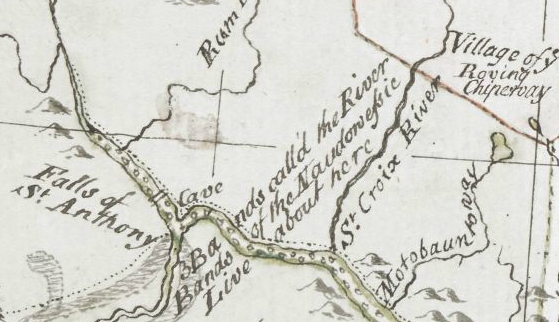
But instead of asking for help, Pike instructed his men in hollowing out a large log.  Loaded with supplies, including most of their black powder, the huge canoe was slid into the river…and immediately sank. Pike ordered all the wet powder rescued and stacked on a rack over a fire, to dry out. The resulting explosion burned down his own tent and most of his personal clothing, supplies and notes. He barely saved his trunk.
Back into the river again, with the current weakening and the channel narrowing every day, four of Pike’s men came close to physical collapse. Sergeant Henry Kennerman, “one of the stoutest men I ever knew,” according to Pike, had begun to vomit blood. Zeb wrote the men were, “…killing themselves to obey my orders.” With snow already falling, on 16 October 1805, Pike ordered the men to build a blockhouse. While they worked, he hunted, supplying them with fresh meat.
With Sgt. Kennerman in charge of the ill men left behind at the blockhouse, Pike led a small detachment overland, on snowshoes and pulling sleds, both borrowed from local British traders. They followed the river as best they could. 
On 10 December they reached the little falls of the Mississippi, and on the last day of the 1805 they camped near the mouth of the Pine River.  On the night of 4 January 1806  Pike suffered another black powder explosion. (Where was he storing his powder, in the smoking tent?)
Finally, on 12 February, 1806, “…exhausted and worn out by cold, hunger and exposure” Pike reached Red Cedar Lake (later renamed Cass Lake). 

Here, I suspect,  out of sheer desperation, Pike wrote, “This may be called the upper source of the Mississippi River.”
Pike may have called it that, but it wasn’t. Twenty- six years later, in 1832, Henry Rowe Schoolcraft followed an Anishinaabe Indian guide (another approach Pike never tried) to a small lake that he named Itasca, and which he declared was the actual source of the great river, and that is what most tourist today accept. But that isn’t the actual source either.
The actual head water of the “father of waters” is Little Elk Lake  9 miles further upstream. Little Elk Lake drains into Elk Lake, which drains (above) into Lake Itasca. 
Ninety days after a drop of rain falls on Little Elk Lake, it flows into the Gulf of Mexico.
Pike was not very concerned with such details. What concerned him was that when he got back to the blockhouse he found that Sgt. Kennerman had recovered. In fact the Sargent was feeling so well, in fact, that he had eaten or bartered away the entire companies’ supply of meat and Pike’s personal trunk as well, which had survived two explosions and at least one dumping in the river. No explanation for his actions was offered by the now Private Kennerman. But Pike lost no time in returning to civilization.
He arrived back in Fort Belle Fontaine on 30 April, 1806.  Ordered to find the source of the Mississippi, Lt. Pike had failed. In fact he had failed to locate a single stream, river or lake which had not been previously mapped.  And yet the “Lost Pathfinder” was immediately dispatched to explore the southwestern edges of the Louisiana Purchase, during which he probably spotted a mile high peak named after him, and during which the long suffering Private Kennerman deserted, never to be seen again.
Ever a self promoter, Pike rose to the level of Brigadier General during the War of 1812. And he played a crucial but little known role in that war. It was General Zebulon Pike who led the assault on the capital of Upper Canada, the city of York, (since renamed Toronto). And on 17 April, 1813, when a British mine exploded prematurely, it killed  42 British and 52 American soldiers. General Pike was hit  in the back by a falling rock, which killed him.  In retribution his soldiers burned the Parliamentary Buildings in York. And it was that act of vandalism which the British repaid by the burning Washington, D.C. on 28 August, 1814.  I would call that quite an impressive funeral pyre for a schlub.
- 30 -

Tuesday, June 23, 2020

THE PROBLEM OF GREENLAND

I think everybody has a problem with Greenland, one way or another. There are only 57,000 people living in the 299 international calling code; that’s one person for every 690 square miles. Of those precious few Greenlanders, 88% are Inuit and almost all are Lutherans. And the average Greenlander  is three times more likely to be murdered than the average European, and eight times more likely to be the victim of violence. And that is just the latest of Greenland’s problems.
Every winter a low pressure zone forms off the southeast coast of Greenland. And while this it not Greenland’s fault, it still makes them a very bad neighbor. Because lows rotate counterclockwise in the Northern hemisphere, this low draws bursts of warm moist southern air into the arctic and fuels one storm after another, creating a dully predictable pattern of lousy weather for Europe all winter long, a legacy from Greenland.
It is not an accident that Alfred Wegener (above), the scientist who first suggested what he called "Continental Drift", died on an expedition to Greenland in 1930. 
One of the first pieces of evidence which caused Wegener to suspect the world had not always looked as it does today, came when he compared longitude measurements from the 1820’s with those made in the first decade of the 20th century and found that, in a hundred years, Greenland had somehow moved a mile further away from Europe.
More than 80% of Greenland is covered in glacier ice several miles thick, which has compressed the land underneath to 1,000 feet below sea level. 
If all that ice were to melt quickly (as it appears to be doing) then a map of the largest island in the world (which Greenland is) would have to be redrawn as a sort of badly shaped donut.
Greenland represents one of the greatest marketing scams in history. Norseman Erik the Red was such a violent maniac that in the year 983 he was banished from his native Iceland for three years. When he returned he told everyone about a wonderful place he had discovered over the western sea. He called his nirvana Greenland, because if he had called it “Popcicle Land" or “land frozen solid”, nobody would have followed him there.
In fact the southern and west coasts of Greenland are indeed green during their short summer, and supported enough sheep and goats to feed an outpost of Viking fur traders for 300 years. But by the time Christopher Columbus “discovered” North America, the climate had turned and the Norsemen and Norsewomen had been starved out.
Looking at a map, Greenland is not nearly as big as you think. On the average map it looms like a center piece on a banquet table, as large as Africa or South America. 
But in fact, move it down the map to the equator and you would see Greenland  is about the same size as Mexico.
But at least we know who to blame for this particular misconception, a Belgium cartographer named Gheert Cremer. In Flemish the family name means merchant, and that was why, when, as was the custom in the Middle Ages, Gheert chose a Latin name for his professional career, he chose the Latin word for merchant; Mercator.
Because he had traveled so much, in 1544 the Catholic Gheert Mercator was arrested for suspicion of heresy. They  kept Gheert locked up for seven months. Not only was he forced to pay for his own imprisonment, but he had to watch while several of those arrested with him were tortured for information implicating him. After 7 months, Gheert was released in September of 1544, broke and still under suspicion. It took him six years of hard work, but in 1552, now recognized as the greatest cartographer in Europe, Gheert moved his family to Protestant Duisburg.  Now he had the freedom to not only earn a living, but risk his soul by doubting church dogma, if that was his choice.
It was after his moved to Duisburg, in 1569, that Gheert discovered a way to transfer the great circle routes, which are the shortest travel distance between two points on the surface of a globe, to the shortest routes drawn between two points on flat sheet of paper, a straight line. 
The system he came up with, what is today called a Mercator Projection, compressed the distances between latitudes at the equator and lengthened those nearer the poles, allowing all the lines of longitude and latitude to cross at right angles even as the surface area they are demarking expanded and shrank. 
The result makes Greenland (836,000 sq. miles) appear to be the same size as the African continent (30 million sq. miles) and twice the size of China, which is actually about the same size as the United States.
Using this projection a navigator does not have to account for the curvature of the earth, the map does it for him. You just can't use such a map when planning a trip between continents. That makes a Mercator Projection a true tool, like a ruler or a hammer. And that makes what the Catholic Church officials did to Gheert in the name of defending the faith an actual betrayal of that faith. Because it denied Gheert the use of God’s greatest tool - his brain.
The other draw back to the Mecator Projection is that it has been too successful. It has become so pervasive that it has distorted our thinking about the real world, sort of like using a hammer to repair a leaking water pipe. If you examine a Mercator map closely you will discover that the equator is actually not along the middle line. It’s lower. This makes the United States and Europe appear bigger than they actually are, which may make us Americans feel good but it makes the residents of India feel belittled, since Mercator maps show Scandinavia as big as India, when India (1,270,000 sq. miles) is three times the size of Norway, Sweden and Denmark combined.
Perhaps it is best to remember the words of one map shop owner, who wrote on his blog, “I sell this map...(But).like any good newspaper, it contains a few lies".
By the way, Gheert Cremer (Mercator) did something else for us. He dedicated his first collection of maps to the mythical African King of Mauretania, who, according to legend, built the first celestial globe to show the positions of the stars and thus balanced the whole world on his shoulders. Today we refer to all collections of maps by the name of that king; Atlas.
- 30 -

Monday, June 22, 2020

BADGERS MAKE STRANGE BEDFELLOWS, Alexander Hamilton's Mistress

I have always admired Alexander Hamilton. How could you not admire a man who could write, “A well adjusted person is one who makes the same mistake twice without getting nervous” That kind of self knowledge belies the life of a boy who was abandoned by his father at the age of ten, at twelve watched his mother die in the bed next to him, and was then adopted by a cousin who shortly thereafter committed suicide. Hamilton not only survived this horror show but within ten years became one of the most successful and powerful men in America, the man who invented the American economic system. But that childhood also goes a long way to explaining how such a smart man, a happily married man and a devoted father could fall for something as old and obvious as the Badger Game.
In 1791 in Philadelphia, twenty-three year old Maria Reynolds, a lovely and avaricious mental midget, approached Hamilton, who was the Secretary of the Treasury. She told Hamilton that her husband, James Reynolds, had abandoned her and their daughter. Could the noble and handsome Secretary Hamilton provide her with the funds to return to New York? Smitten and horny, with his wife living in far off Connecticut, Hamilton agreed to deliver $30 to her rooms that evening. Let the games began.
The original badger game involved sticking a live badger in a box and then sending in a terrier. After a few seconds the owner would pull the dog out. If the dog held the badger in its jaws, it was marked as a plus. Then the badger would be returned to the box and the dog would be sent in again. This was repeated several times in front of a crowd of Neanderthals, with the shouting and betting building to a crescendo. The similarity between the original sport (outlawed in England in 1835) and the blackmail sting performed on Hamilton is that the dog could be counted on to grab the badger every time, even though the pooch was never allowed to actually eat the badger. The same goes for The Mark in the human game.
Shortly after the Mark's - Mr Hamilton - first liaison with Mrs. Reynolds, Mr. Reynolds made his re-appearance in the role of the wronged husband. He wrote Hamilton, “You have deprived me of every thing that’s near and dear to me. … You have made a whole family miserable.” James was a born con-man who had been one of Hamilton’s commissariats during the revolution, scrounging food, clothing and ammunition for the Continental Army despite the penury of Congress. But he was also a wife beater – if we believe Maria. Although I am not sure that we should.
Eventually James got to the point. “…give me the sum of (a) thousand dollars and I will leave town and take my daughter with me…”. Hamilton paid, and James then wrote, “I have not the least objections to your calling (on my wife), as a friend to both of us”. The dog now had the scent and Hamilton continued to visit Maria and pay James regularly – in April, $135, in May and June, $50, in August, $200.
The game went on for two years, with Hamilton enjoying the nubile Maria in Philadelphia, while urging his wife to stay in Connecticut. Hamilton even borrowed from friends in order to keep James silent. But the end of the game was predictable, given James’ character.
James Reynolds and his partner Jacob Clingman were arrested for cheating revolutionary war veterans out of their back pay, which Congress had been cheating them out of for years. Naturally James expected his “friend” Alexander Hamilton, Secretary of the Treasury, to rescue him. Hamilton, however, was not willing to use his official office to cover up his personal peccadilloes. He refused to help the crook. Angry, James started singing to anybody who would listen that Hamilton had given him inside information on Government bond sales. In particular Jacob Clingman sang to Hamilton’s arch enemy, Thomas Jefferson.
Jefferson thought it was Christmas. Hamilton was his political enemy. He gleefully dispatched Congressmen James Monroe and Fredrick Muhlenberg to confront Hamilton in person. And to their stunned surprise Hamilton admitted to an affair - here-to-fore unknown -  but he denied everything else. He even provided proof in the form of letters between himself and both of the enterprising Reynolds’, James and Maria. Muhlenberg and Monroe were so nonplussed they agreed to keep the affair secret. Needless to say, Jefferson was not happy that Christmas had been canceled.
Hamilton resigned from Washington’s cabinet in January of 1795. But Jefferson had made no promise of secrecy, and he filed the information away for use at some opportune future moment, which came in 1797, which is how we know of the entire sordid tale.
Shortly after Jefferson leaked the entire story, the lovely Maria divorced her imprisoned husband James, and immediately married his partner in crime, Mr. Clingman. The newlyweds then moved to Alexandria, Virginia and dropped out of history. Maria's divorce attorney back in New York was Aaron Burr, who would in a very few years shoot down Alexander Hamilton in a duel. And that, one way or another, is the way most badger games end.
In contrast there was William A.E. Moore, a “friend” of President McKinley who appointed him U.S. Counsel to Durban, South Africa. Mr. Moore was in route to Durban with his wife, Fayne Strahan, when, while spending the night in Paris, he surprised the lovely Fayne “flagrante delecto” with a Russian nobleman. Mr. Moore offered to swallow his insulted pride for a mere $2,000, but the Russian chose instead to call the police. Mr. Moore’s diplomatic appointment was revoked and he was forced to return to the United States.  I would say in shame, but I doubt William Moore had any.
Then in 1898 the pair tried the same gag on Mr. Martin Mahon, proprietor of the New Amsterdam Hotel, in New York City. (a bit of a comedown this, from a Russian nobleman to a hotel owner.) This time, when William burst into the room he took the trouble to beat up the mark, poor Mr. Mahon, and steal $175 from his wallet. William then stuffed a cigar into Martin’s mouth and walked him up and down Fifth Avenue as if they were bosom buddies. Again, the mark went to the police and this time William Moore was sent to Sing Sing for several years, for assault and attempted blackmail. Fayne, meanwhile, went to South Dakota where she got a divorced from William. Some years later she moved to London where she took to the stage, as a chorus girl in the hit musical, “The Messenger Boy”. William was eventually released from jail and inherited $125,000 from an uncle. Last heard of, he was living in luxury. And thus were the wages of sin for what today would be called “Gifters".
And in case you are thinking that these are dusty historical footnotes, a couple of years ago, in San Antonio, Texas, Ted Roberts, attorney at law, was convicted of three counts of theft for a badger scam he ran with his wife and fellow attorney, Mary Roberts. She was convicted of 5 counts of fraud. Mary trolled the internet looking for married men who were seeking sex. She engaged them in chat rooms until they either revealed their fantasies or actually met her for sex. There upon Ted would knock on the door and quietly inform the marks that he was going to sue them for “alienation of affection”, unless they agreed to “settle” out of court.
The couple netted something around $160,000 from five marks that we know of,  before they were caught. Testifying for the defense, past president of the Texas Bar Association was Mr. Broadus A. Spivey.  No, seriously, that was his name).  Anyway, Mr. Spivey said that the badger game as played by the lawyers was not illegal because it was not substantially different than a lawsuit. Under oath Broadus insisted, “Litigation is coercive.” Neither the judge nor the jury failed to see through that little fig leaf of judicial logic, but...
...I will leave the story there, in case there is anybody left in this nation who does not already despise lawyers.
- 30 -

Blog Archive