August 2025

August  2025
I DON'T NEED A RIDE. I NEED AMMUNITION.

Translate

Wednesday, June 17, 2020

WILD CARD IN KANSAS CITY

I think if the train had been late, things might have turned out differently. Perhaps the waiting men would have attracted attention, or grown bored or been out of position. But the overnight Missouri Pacific train from Fort Smith, Arkansas was unfortunately right on schedule, pulling into Union Station on Track Twelve, at 7:15 A.M. on Saturday 17 June, 1933. And because it was punctual, the train efficiently and smoothly delivered three FBI agents, three local cops and one gangster right on time to their destination. And then there was the wild card in the deck, which turned all the eights  into aces.
It all started 24 hours before with the capture of Frank “Jellybean” Nash, “the most successful bank robber in U.S. history”.
Frank was a 20 year career thief who worked with the Barker gang and the Dillinger mob among others, and of whom it was difficult   “…to find anyone who didn't have something nice to say…”, according to Clyde Callahan, co-author of the book “Heritage of an Outlaw”. Even the cops liked "Jellybean"  
While serving a 25 year term in Leavenworth (above),  in October of 1930,  Frank walked right out the front gate, carrying a copy of Shakespeare under his arm.  No one even thought to stop him.
Frank was often employed as a bank robber after his escape, and so well paid that in the summer of 1933,  he could afford to take his wife and daughter on a vacation, to the resort town of Hot Springs (above), southwest of Little Rock, Arkansas.  And it was there, on 16 July, that two FBI agents,  Joe Lackey and Frank Smith, along with an Oklahoma police chief, Otto Reid,  captured "Jellybean"  in a Hot Springs cigar store.
Dick Galatas ran gambling in Hot Springs, and he took the arrest of an underworld tourist in his territory, personally.  The local cops,  who were paid more by Galatas than by the taxpayers,  threw up roadblocks on the highway back to Little Rock  calling Frank a kidnap victim.  But anticipating this,  the FBI took their prisoner northwest,  on the long drive to Fort Smith.  There they planned on catching  the 8:30 P.M. overnight train to Kansas City. They even wired ahead to Special Agent in Charge of the F.B.I..’s Kansas City office, Reed E. Vetterli,  to meet them at Union Station in the morning. 
But the  train was late in arriving at the Fort Smith station (above),  and a stringer for the Associated Press spotted the three men and their shackled prisoner in the waiting room. Before midnight the story broke over the wires, in time to be printed in the early addition of the Kansas City morning newspapers : “Frank Nash…was recaptured today at Hot Springs, by three Department of Justice agents…They revealed the identity of the prisoner for the first time here...”  Meaning in Fort Smith.
Galatas,  in Hot Springs, had already asked for the help of Johnny Lazia (above, coat less), who ran gambling and vice for the Pendergrast machine, which controlled Kansas City.  A newspaper editor at the time described the level of mob activity in that town, “If you want to see some sin, forget about Paris. Go to Kansas City.”
And the man Lazia assigned to this problem was an old buddy of Frank Nash’s, an ex-South Dakota Sheriff turned bank robber named Vernon Miller (above).
Miller called in at least two more gunmen to assist him,  their identities disputed to this day. The FBI claims it was Charles Arthur "Pretty Boy" Floyd and Adam Richetti,  who just happened to be passing through Kansas City that morning. But there were numerous other gangsters who would have willingly stepped up to help "Jellybean" escape.  And now might be a good time to address the question of why crime in America in 1933 was so well organized but law enforcement was not.
When J. Edgar Hoover (above) took over the Bureau of Investigation in 1924 he commanded just 400 agents.  He spent the next forty years battling small “r” republicans, who were suspicious of a big federal police agency. Hoover eventually overcame their resistance, growing the F.B.I in both numbers and budgets. And yet, until 1963, Hoover still denied the existence of any centralized crime organization in America. But it was there. During the 1920's it was a called the syndicate or the mob, but with prohibition it became the mafia, and was dominated by Italian Americans thanks to their overseas criminal contacts.
Even after the Appalachian Conference of November 1957,  where more than 60 Mafia bosses from the U.S., Canada and Italy were detained by local cops in upstate New York,  Hoover still insisted, “The F.B.I has much more important functions to accomplish than arresting gamblers all over the country.”  Whatever his reasoning,  too many people paid with their lives for his denial.
That morning of 17 June the two agents,  Frank Smith and  Joe Lackey and Oklahoma police Chief Otto Reid, left the train heavily armed. According to research done by Pulitzer Prize winner Bob Unger – “The Union Station Massacre: The Original Sin of the FBI” - agent Lackey inadvertently grabbed a pump action Winchester Model 1897 shot gun, which belonged to Chief Reid, who grabbed Lackey’s twelve gauge, also by mistake.
On the platform they were met by Agent in Charge Reed Vetterli (above)...
and agent Ray Caffrey (above),  ...
along with two K.C. police detectives, William "Red" Grooms (above)...
 and Frank Hermanson (above).
 As the seven men moved through the cavernous station they formed a "V", with their handcuffed prisoner, "Jellybean" Nash,  protected in the center.   A four door Chevrolet was parked in front of the station, head in, and K.C. policemen Grooms and Hermanson screened the car from the front. Nash was first placed in the front bench seat, behind the steering wheel. Agents Lackey and Smith and Chief Reed sat in the back. 

As Agent Caffey was about to enter in the driver’s side door, Joe Lackey noticed three men appear from behind a green Plymouth parked in the space in front of them  At least two carried machine guns. One of the gunmen called out, "Hands up! Up, up, up!"  Instead, the F.B.I. says, the gunmen opened fire. In that first burst of machine gun fire, KC police detectives Bill Grooms and Frank Hermanson were killed, and Agent-in-Charge R.E. Vetterli was wounded in the shoulder, crawling toward cover.
But according to Bob Unger's research,  it was right at the beginning that Joe Lackey (above) found himself holding the wild card.
The Winchester 1897 was a WWI army surplus shotgun and lacked a safety feature most shotguns have – a trigger disconnect, or a safety.  In the slam mode this “trench sweeper” would automatically fire if the trigger was compressed at the same time the action was pumped, forcing a round into the chamber. Unfamiliar with this feature, and without even waiting to get his weapon up,  Lackey pumped a first round into the chamber. As he did so the weapon went off and blasted a load of ball bearings into the back of Frank Nash’s head (below), just 12 inches away.  A stray pellet also went “…right into the side of the head of agent Caffrey” who just getting into the car.
As proof Unger offers an image of the Chevrolet's windshield,  taken shortly after the shooting stopped and the wounded had been removed (above) .  Shattered glass is scattered over the car's hood, indicating the shot gun pellets came from inside the car, where the FBI agents sat,  and not from outside,  where the attacking mobsters were. Also, witness Harry Orr, just feet away in his cab, testified, "I saw one man with a shotgun, and he was trying to fire it." And this was just before the shooting started. 
Panicked at the unexpected explosion, Lackey pumped the action on the shotgun a second time, and again the weapon immediately discharged.  Bill Unger described what he thinks happened next. “Hermanson is in a direct line between Lackey and the machine gun wielders. Joe Lackey gets off a second shot, which takes of the left side of Frank Hermansons’ head…. 
"So here we are in the first two seconds of shooting, and already Frank Nash – the top of his head is gone and he is dead, and Ray Caffrey is dying of a fatal wound….And Hermanson is dead. So far no one has fired a shot except Joe Lackey…"  And those shots by accident.
Continues Mr. Unger, "At this point everyone begins to shoot, and there’s massive firings by machine guns...and by the time all of this is over, Bill Grooms, the other Kansas City policeman, is also dead. (above, lying between the cars). And Reed in back seat….when they finally get to him, he has a fatal wound…”.    When one of the gunmen finally got close to the Chevy,  he glanced inside and shouted, “They’re all dead. Let’s get out of here.”
They weren’t all dead. Agent Lackey was wounded three times and barely survived, but he survived. Agent Smith, having ducked behind an adjacent car when the shooting started, was uninjured. Agent-in-Charge Reed Vetterli had made it inside the train station, bleeding from a wound in his shoulder.   The entire shootout took less than 60 seconds. And that quickly the Kansas City Massacre was over.
Five months and two weeks later, Vern Miller (above), one of the few men who could be proved to be responsible for the shootout, was found mutilated and murdered outside of Detroit, Michigan.   Rumor at the time said the syndicate running organized crime in America had issued orders that Nash was not to be helped because of the publicity surrounding him. And the press frenzie covering the Kansas City Massacre proved them right.
One week short of the first anniversary of the massacre, John Lazia (above), the man who had okayed the attempt to rescue Jellybean,  was gunned down out side of his hotel in Kansas City.  And ballistics tests run decades later indicated the gun which fired the bullets that cut down Lazia, had also been used in the massacre. So perhaps it was mob justice for not following orders.  As he lay dying in a hospital, John Lazia asked his doctor, “Doc, what I can't understand is why anybody would do this to me? Why to me, to Johnny Lazia,  who has been the friend of everybody?”
It was a question that Frank "Jellybean" Nash would probably have asked,  if it hadn't been for that wild card.
- 30 -

Tuesday, June 16, 2020

BATTLE OF BUNKER HILL - Lesson Learned

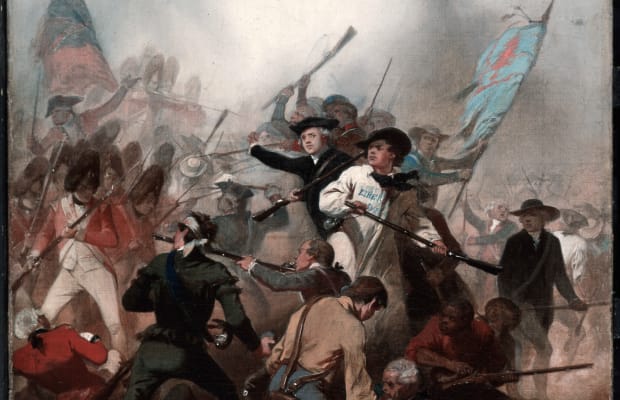
Tentatively, slowly, out of the black, the distant specter assumed solidity. The lookout, 120 feet above the weather deck, urged his eyes to coax a shape from the shadows. Just before eight bells, he called down, “Officer of the watch. Fortifications on the hill!”  There was no need to wake Captain Fredrick Maitland.  Seeing surveyors on the hill yesterday afternoon,  he had expected the rebels to be so bold as to put cannon upon the heights. 
Having paced the deck for the last hour, the 45 year old promptly ordered the starboard guns of HMS Livey (above)  run out.  Moments later the 10 iron cannon began thundering, methodically throwing 9 pound balls a quarter of a mile toward the new rebel fort on the hill. It was about 4:00am, on Friday, 16 June, 1775, and the battle of Bunker Hill had begun.
Eighteen hours earlier, on Thursday, 15 June, 48 year old “competent and cautious” Artimis Ward, commander of the 15, 000 “Patriots” who had rushed to respond to Lexington and Concord, held a council of war. Initially Ward's volunteers had outnumbered the 4,000 red coats they had trapped in Boston. But for the last two weeks the colonists had been holding a tiger by the tail. British General Thomas Gage now commanded 13,000 of the best professional soldiers in the world. And with 120 warships and transports newly arrived in Boston Harbor, the British tiger could land red coats anywhere along the 200 mile shoreline, faster then the patriots could concentrate to meet them.
The tail the patriots were holding was 40 road miles south of Ward's headquarters in Cambridge, at the only land approach to Boston, the 120 foot wide Roxbury Neck. Watching over this narrow passage was the left wing of the colonial militia, commanded by 50 year old General (and Plymouth doctor) John Thomas. But a head on breakout by the British here would be a blood bath. Instead the siege of Boston seemed certain to be decided by whoever held the high ground.
East of Roxbury, overlooking the south shore (above, left), was a swarm of 150 foot high drumlins labeled Dorchester Heights.  
And north of Boston, across the mouth of the Charles River, were 3 more drumlins. The first, adjacent to the abandoned community of Charlestown, was a 75 foot high mound reserved for grazing stock, called Breed's Hill. North and east of that rose a 110 foot elevation owned since 1720 by Ebeneezer Bunker. Smallest, at 35 feet, was Morton Point, at the southeast corner of the peninsula. None of these eminences were as yet occupied.
The Patriot council recognized it would be suicide to wait for the British to strike. So, as evening approached, Major General Israel Putnam, in command of the right wing of the Patriot army, ordered Colonel William Prescott (above) to lead 1,200 men through the narrow Charlestown neck and up Bunker Hill. 
Overnight they were to construct an earthen fort on Bunker Hill. Everything went according to plan, until the 65 year old Captain Richard Gridley got a good look at the ground.
If he had been ten years younger Richard Gridley (above) would have been the American commander. But he turned down the offer because of his age and because, as he said, he had never “seen an army so overstocked with generals and so poorly provided with privates.” Instead he was commander of artillery and chief engineer. And before work had fairly begun on Bunker Hill, the old man urged Colonel Prescott move the entire operation to the reverse slope of the lower Breed's Hill.
This advance would give the Patriot cannon a clearer field of fire, placing their guns within range of the British fleet and of the battery atop the flat 50 foot high Copps Hill in Boston itself. And operating from the reverse slope, just eye level above the crest, the Patriots would be shielded from direct British return fire. Once these advantages had been pointed out to Prescott,  the work parties were moved forward to Breed's Hill. 
Following Gridley's instructions the men began digging a 130 foot long redoubt with 6 foot high walls, raised with soil from a trench dug to their front.  A wooden shooting platform was even installed. While Gridley returned to guide the artillery to the new position, Putnam pushed forward 500 additional infantry and an additional artillery battery to continue the battle line eastward along a fence at the southern foot of Bunkers Hill, to the banks of the Mystic River.
By 10:00 am there were 128 British cannon firing on the new fort, including heated shot from the 74 guns of the HMS Somerset, (above) which started fires in the buildings of Charlestown. 
The 20 gun Glasgow and the 16 gun sloop Falcon in the Charles River concentrated their fire on the Breed's Hill redoubt, as did the 8 gun sloop Spitfire and the four 24 pound cannon in the Admiral's Battery, which shared Copp's Hill with the graves of early Puritan settlers. By now Captain Maitland had maneuvered the HMS Lively to the north, to rake the Charlestown Neck, to discourage reinforcements from trying to reach the battle line.
One of the 1,200 Patriots in the Breed's Hill redoubt explained, “fatigued by our labor, having no sleep the night before, very little to eat, no drink but rum...The danger we were in made us think there was treachery, and that we were brought there to be all slain.” In fact only one unfortunate private was killed, Asa Pollard, who was standing just beyond the walls, was decapitated by a British cannon ball. Colonel Prescott ordered his body quickly buried. Instead, his friends gave him a brief funeral service, after which several of the mourners promptly deserted.
By noon the fires in Charlestown had engulfed most of the buildings and converted the church steeples into “great pyramids of fire.” At about the same time, 2 batteries, each consisting of a pair of 6 pound guns, reached the Patriot redoubt. 
They were commanded by 27 year old Boston lawyer Captain John Callender, and 44 year old Captain Samuel “Patty” Gridley, son of Captain Richard Gridley.  Upon unlimbering, the artillerymen discovered no openings had been provided for their cannons. After desperately digging by hand at the wall, Gridley rashly pushed his barrels up to the earth walls and fired two or three shots, until an opening was forced. It was a terrible waste of powder.
Sam Gridley then tried counter battery fire on Copps hill. Observed a British officer at the receiving end, “...one shot went through an old house, another through a fence, and the rest stuck in the face of (Copp's) hill.” Sam Gridley was so disgusted with his men's performance, he inspired Colonel Prescott to send the battery to the left wing of the line.  Meanwhile, Captain Callendar had finished digging the embrasures for his cannon, and awaited the British assault.
The 2,500 red coats began landing at Morton Point about 2:00 p.m,  under a hot sun.  A committee of the House of Commons would later described the ground which lay between the British troops and the Patriot defenses, as. “....owned by a great number of different people...(and) was intersected by a vast number of fences…" And these were not the ancient well tended fields of Europe. The waist high grass hid an obstacle course of marches, stone walls, fences, hedges, gullies and animal burrows.
Each red coat soldier would have to stumble over these unanticipated barriers while carrying a 60 pound back pack,  as if they expected to march all the way to Concord.
The British commander on the spot was 46 year old General William Howe, (above) who was about to display his “absurd and destructive confidence".  He was convinced the homespun militia would run at his soldiers' approach. So Howe threw his men directly at the Patriots. The gunners aboard the British ships were forced to halt their fire as the red line stumbled toward the fence line.
Howe sent 5 regiments in a feint at the redoubt on Breed's Hill. But as Lieutenant John Waller, adjutant to the First Royal Marine Battalion, explained, “...when we came immediately under the work, we were checked by the severe fire... We were now in confusion, after being broke several times in getting over the rails...” 
At the same time the main assault, four deep and several hundred yards wide, marched over the hidden maze toward the hastily assembled fence line at the foot of Bunker Hill.
From Copps Hill Major General “Gentleman Johnny” Burgoyne noted, “Howe's corps ascending the hill in the face of entrenchments, and in a very disadvantageous ground, was much engaged...”  Two Patriot batteries, “Patty” Gridley's and the two guns under Captain Samuel Trevett, threw shell after shell into the British line. No Patriot leader said anything about “whites of their eyes”, but one officer had placed a stake 100 paces in front of the fence, telling his men to not fire until the red coats passed it.
 The British paused to fire an ineffective volley before reaching the stake, again expecting the Patriots to run. When the they did not, the regulars lowered their bayonets and advanced. Almost instantly the Patriots loosed a devastating volley. 
In Colonel Prescott's simple report, “...the Enemy advanced within 30 yards when we gave them such a hot fire, that they were obliged to retire nearly 150 yards...” Meaning, out of range. Remembered one British officer, “Most of our Grenadiers and Light-infantry (companies)...lost three-fourths, and many nine-tenths, of their men. Some had only eight or nine men a company left …" More importantly, the Patriots aimed at the officers. While the smooth bore muskets were not accurate, the toll among the officers was heavy. The British regulars fell back.
General Howe had accompanied the assault and was uninjured, although his body servant had been killed. He immediately ordered the units reformed, and within ten minutes the line of lobsters were again advancing toward the fence line and the fort. Again the Patriots held their fire until the line drew close. Neither side wavered. The red coats, marching past their wounded and dying comrades, kept advancing. The Patriots remained steadfast, even though their ammunition was running low. 
Another volley from the Patriots, and again the regulars broke and ran to the rear. At last General Howe called for a pause and ordered up reinforcements.
In the pause which followed the second repulse both Callender and Gridley's batteries broke and ran, despite Prescott's best efforts to bring them back. In the end the brave Prescott was reduced to scrounging from the abandoned artillery ammunition for powder to distribute to his infantrymen. He sent increasingly desperate pleas for more ammunition to the rear, but with HMS Lively still selling Charlestown neck, no one was willing to order men to carry supplies forward. 
While the British wounded were being evacuated, 400 fresh troops were landed. But they milled about Morton Point, unitil 47 year old Major General Sir Henry Clinton., "...without waiting for orders, (threw) himself into a boat to head them." 
General Clinton (above) gathered the reinforcements and got them organized for the third assault.  This time every man would advance up Breed's Hill toward the redoubt.
As the red lines began a third advance up the hill, 65 year old Richard Gridley organized a scratch crew to man the one cannon his son had left behind, and continued to blast shells into the British line until he was wounded in the thigh. His gunners carried the old man out of the redoubt just as Lieutenant Waller and the remnants of his Royal Marines came over the breastworks. And here, the Patriot's lack of bayonets was revealed. 
This time there was no fusillade of Patriot muskets. They were out of ammunition. Waller said his men, “drove their bayonets into all that opposed them... We tumbled over the dead to get at the living...” 
And he later wrote to a friend that inside the redoubt “...(it was) streaming with blood and strewed with dead and dying. Many of the (British) soldiers (were) stabbing some and dashing out the brains of others...)”
In his official report, Colonel Prescott told the same story. “Our ammunition being nearly exhausted....the enemy being numerous...began....(to) enter the fort with their bayonets, we (were) obliged to retreat....We kept the fort about one hour and twenty minutes after the attack with small arms...” The lobsters had carried the day.
Royal Marine John Waller estimated the cost. “We had...I suppose, upon the whole... killed and wounded, from 800 to 1000 men.” His was pretty close. Officially the British lost 19 officers killed and 62 wounded – 207 soldiers killed and 766 wounded – for a total of 1,054 casualties –almost 50% of the British troops engaged. The British force was in no condition to push across the Charlestown Neck, head-on into the muzzles of even more Patriot muskets. 
But more importantly, over 100 British commissioned officers had been killed or wounded, leaving a psychic wound so great the commanders in Boston never recovered enough to dare to occupy the  still empty Dorchester Heights.  It was not until 9 months later that the Patriots seized those heights, and occupied them with heavy cannon, forcing the British evacuation of Boston. That deep, almost mortal psychological wound would even cause the man who witnessed the bloody victory, Johnny Burgoyne,  to hesitate 2 years later at Saratoga, ensuring the British defeat there.
Major Waller could not imagine that such damage had been done by less than “... 5000 to 7000 men”. In fact the Patriots had numbered just about half the British force, and in face of 180 naval cannon. Patriot losses were 15 killed, 305 wounded and just 30 captured – about 44% of their force. And all of those captured were wounded – most badly enough that 2/3rd of them died shortly there after.
In most battles the highest casualties are suffered in retreat, and the last Patriot was killed at about 5:00 p.m.  Major Andrew McClary was cut down by the cannon aboard the HMS Lively as the Patriots were filtering into new fortifications, blocking the Charlestown neck. Johnny Burgoyne noted this withdraw was "...no flight; it was even covered with bravery and military skill...” The Patriots - the Americans - had not run at the sight of British red coats, or even British bayonets.  Even in  retreat they had showed enough military discipline to impress the British army..   
After Bunker HIll, Henry Clinton would note what Thomas Gage had noted after Lexington and Concord - “...a few more such victories would have shortly put an end to British dominion in America.”   One of the Patriots, a young Massachusetts farmer named Peter Brown, wrote to his mother after the battle. “...tho' we were but few in number, and suffered to be defeated by our enemy, yet we were preserved...”.
- 30 -

Blog Archive