August 2025

August  2025
I DON'T NEED A RIDE. I NEED AMMUNITION.

Translate

Sunday, December 08, 2013

THE LIGHT FANTASTIC

I wish I had been in the Alexandrian suburb of Eleusis, in July of 169 B.C. when for a few brief moments the past and future were divided by a line in the sand. On one side stood the royal egomaniac Antiochus IV, whose army was just four miles from capturing the Pharaoh of Egypt. Standing in his way was one old man, the Roman ambassador, Gaius Popillius, carrying a decree from “the Senate and the People of Rome”. It ordered the upstart Syrian Greek to turn his Slecuid army around, and go home. Antiochus IV was infuriated, and pleaded he had to consult his advisers.  But Gaius would have none of that. Grabbing a stick the old man drew a circle around the King and insisted, if Antiochus stepped over the line without agreeing to turn back, it would mean war with Rome. It was the original line drawn in the sand, and for one of the few times in history, it actually worked. Antiochus IV went home. It came to be called the “Day of Eleusis”, and because of that day, we celebrate a holiday – just not the one you're thinking about, probably.
Antiochus IV was King of the Slecuid Empire, centered in Syria and stretching from India on the east and now the border with Egypt on the west. He was called Epiphanes, “God Manifest” on his monuments, and Epimanes behind his back - “The Mad One”. And as he retreated eastward across the Sinai, he got madder and madder. You see, some jackass in Judea had spread a rumor that Antiochus IV had been  killed in battle. Maybe the Romans had spread the story to weaken Antiochus in his rear, and maybe Antiochus had spread it himself, to flush out any trouble makers among his conquered peoples.  But whoever spread it, the hottest hot head in Judea was a Jewish religious fanatic named Mattathias ben Johanan. And  Mattathias was eager to believe the rumor. With about a thousand of his followers, Matthathias came charging out of the hills to capture the temple in Jerusalem and drive the high priest Menelaus into the wilderness
Now, few people in Jerusalem missed Menelaus. He had become high priest because his brother Onias had been high priest before him. But when Onias had sent Menelaus to deliver the yearly taxes to Antiochus IV, Menelaus had included a little extra from himself, a bribe, and suddenly Onias was no longer high priest, Menelaus was. So you can see why Antiochus IV tended not to think of the high priests of Judisiam as particularly holy, and neither did the people of Jerusalem.  Menelaus slipped a little more in public opinion when his brother Onias died while cleaning his sword and it went off - bad luck. So the Jews of Jerusalem were not really sorry to see Menelaus gone.
But Antiochus IV(above) was sorry. Menelaus might have been a sniveling bottom feeder, but he was the King's sniveling bottom feeder. And then there was that whole “got to show them whose the boss” dynamic going on. And Antiochus IV had an army which  had been expecting a rich sacking of Alexandria, which the Romans had put the kibosh to. So in the dog days of August 169 B.C., everything was pointing toward a very bad day for Jerusalem. And it came.
It seems – oops - somebody had left the city gates open. So the Slecuid army marched right in, as Mattathias slipped out the back door. First the Slecuid  soldiers stripped the Jewish temple of everything of value -  everything not already sold to pay tribute to Antiochus IV, or stolen earlier by the Babylonians or the Egyptians when they sacked Jerusalem.  Really there couldn't have been that much left to steal. But whatever it was, Antiochus IV took it. And then, according to the holy text, Second Macabbees, “And he commanded his soldiers to cut down relentlessly every one they met and to slay those who went into the houses.”.
The primary non-religious source for what happened was the Jewish radical turned Roman informer, Josephus. He says that over three days Antiochus IV murdered 44,000 people in Jerusalem, which would have been about 10% of the population, and another 44,000 women and children were sold into slavery. Antiochus IV then built a citadel right next to the Jewish temple, which he stocked with a permanent garrison. Then he had the Jewish temple re-dedicated. On the altar where Menelaus had sacrificed goats to honor Yahweh, the Greek priests now sacrificed pigs to honor Zeus. Antiochus IV also issued a decree forbidding circumcision - (who was the lucky guy who got to check on that? ). It seemed the Jews had finally ticked off one King too many.
But, a year later human nature, or maybe it was Yahweh, intervened. In 168 BC, the rising empire of Parthia captured the Afghanistan city of Heart (Hair-it). This was an important because  the region around Herat was  the bread basket of central Asia, and sat astride the trade route with India. We're talking a major loss of taxes, here. So Antiochus IV had to turn eastward to deal with the upstart Parthians. But he did not forget the troublesome Jews.  He ordered his governor of Syria, a nobleman named Lysias  “to conquer Judea, enslave its inhabitants, utterly destroy Jerusalem and abolish the whole nation."
In 167 B.C. Lysias dispatched four divisions to accomplish this task. As they marched on Jerusalem, Mattathias, who had reappeared, now  organized the faithful.  However, because he was a religious fanatic, Mattathias insisted that all soldiers strictly adhere to Jewish law - that's what they were fighting for, wasn't it? Unfortunately the Slecuid army did not recognize the Jewish Sabbath, and on a Saturday they attacked the first Jewish village in their way. Following the law, the villagers refused to do any work on the sabbath, even refusing to lift a weapon to defend themselves. All 1,000 were slaughtered. After this Mattathias was replaced as leader of the revolt by his son, Judah. And under him, the Jews decided to fight, twenty-four, seven.
It turns out the new Jewish leader, Judah ben Mattathias was pretty good at it. In 166 B.C. Judah fell on the Slecuid supply base at Emmaus, killing its 3,000 man garrison, capturing a huge cache of weapons and food, and forcing half the Seleucid army to retreat. A year later he beat the other half of the Slecuid army at Beth-zur, forcing them, again, to retreat. It was battles like this that earned him the nickname of Judah the Hammer, or in Hebrew, Judah Maccabees. Shortly after this victory, word again arrived that Antioschus IV was dead. Except this time he really was. He'd been in Babylon, struggling to prepare a counter attack against the Parthians, when he suddenly dropped dead. He might have been sick, but I think it more likely, he'd been poisoned. In any case, his young son, Antiochus V, now inherited the empire.
Lysias immediately had himself declared Antioschus V's guardian, which put the Governor in charge of the entire empire. Lysias ordered an end to efforts to retake Heart, and in 165 B.C. he marched for a third time on Jerusalem. Third times the charm, right? This time Lysias came by the southern road, catching the Hammer off guard. This time Lysias actually laid siege to Jerusalem. This time it looked as if the clock had run out for the Jews. This time there was nobody to save them. And then out of nowhere appeared a guy named Phillip, (the royal governor of Babylon, actually), who had been with Antioschus IV when he died. Phillip claimed that on his death bed Antioschus IV had asked him, Phillip, to raise the king's son, now known as Antioschus V.  That would make Phillip the regent, not Lysias.  Lysias did not believe a word of it. Would you? But Lysias still had to deal with Philip’s army. And one morning Judah looked out from walls of Jerusalem, and saw...nobody. The entire Slecuid army had mysteriously disappeared. It was a miracle. As long as you did not notice the whole Slecuid infighting going on.
Judah Maccabees ordered a a new altar built for the temple, and declared 8 days of “sacrifice and songs” for its re-dedication. The pigs were out, Yahweh was back in. There was only one problem. Tradition said in re-dedicating the Temple required the temple's  menorah lamps to burn every night, all night, during the celebration. But there was only enough oil for one night. What to do?
Now if it was me, I would have ordered the nine lamps on the menorah to be publicly lit at sundown each night, as usual. And then a half hour after sundown,  after the faithful had gone home, the priests would quietly extinguish the lamps. This way, instead of burning through all the oil in one eight hour winter's night, the lamps would burn for a about an hour each night, for eight nights. And I think that maybe that was what the Hammer did. But then, I am a non-believer. And priest are in the business of believing, even in miracles. And the truth is, miracles don't happen without a little help from somebody. Who that help comes from depends on who and what you believe in. Anyway....
It was the first Hanukkah, the first festival of the lights. Two thousand years later it is not a very important Jewish holiday, and about the only one in which women play a leading role. Each of the eight nights a woman first lights the “shamash”, the central candle or lamp, used to illuminate the entire ritual. On each successive night , the shamash is then used to light one candle more each nigh until all are burning. In each Jewish home they are displayed in a window or an exterior door, “to illuminate the house outside” the home. And as they do so, the women recite the Hanukkah prayer.
“We light these lights for the miracles and the wonders, for the redemption and the battles that you made for our forefathers, in those days at this season, through your holy priests. During all eight days of Hanukkah these lights are sacred, and we are not permitted to make ordinary use of them except for to look at them in order to express thanks and praise to Your great Name for Your miracles, Your wonders and Your salivations.”
Lysias defeated and killed Philip in 163 B.C.. But in 162 B.C. Lysias was defeated by Demetrius I, who had been Antiochus IV's older brother and Antiochus V's uncle. Being the older brother, Demetrius was supposed to have been made King first. But when their father died, Demetrius was being held as the official hostage in Rome. So it turned out Antiochus IV had been a usurper, which made his defeat in 162 B.C.,  payback. Demetrius executed both Lysias, and the boy king Antiochus V. Demetrius then tried to reconquer the Jews, but the Fighting Maccabees  held him off for ten years, until Demetrius was killed by a new usurper in 150 B.C. It was the end of Slecuid empire.
The next empire to come marching down the coast road of Judea would be the Romans. And they and the Jews would have their own problems, strongly reminiscent of the ones the Jews and Slecuid's had shared. They say some people never learn. But I think, most people never learn, certainly not in the middle east.
- 30 -

Friday, December 06, 2013

THE REAL POLITICAL POOP

I can prove the regularity of William Blount's intestinal functions, because his enemies in the U.S. Senate depended on them. Their trap was sprung on a Tuesday morning, while Blount was visiting “The Necessity” behind Philadelphia's “Congress Hall”. The conspirators gained time because Blount had to go all the way downstairs and out to the little shed, to do his business. But they need not have rushed because he took his time – such things should never be hurried – and by the time he returned the letter had been read and William Blount's political career was toast. It was Monday, 3 July, 1797, and if he were not so arrogant (and regular) Senator Blount (below) might gone on to great things. I'll bet even the “Spitting Beast of Vermont” wished he had.
“Dear Cary”, the letter began, “I wished to have seen you before I returned to Philadelphia,...I believe the plan...will be attempted this fall...(and) in a much larger way then we talked about....I shall probably be at the head of the business on the part of the British...You must take care...not to let the plan be discovered by...any other person in the interest of the United States or Spain...I am, and etcettera, William Blount.”
The plan was the invention of John Chisholm, who owned a tavern (above) across the street from Senator Blount's Knoxville, Tennessee mansion. Chisholm figured it was only a matter of time before Spain would be forced to sell their American colonies to France. And if France controlled Louisiana and Florida, they might deny American ships access to New Orleans. That would bankrupt all the western farmers. So Chisholm planned was to use local militia and Creek Indians to capture Pensacola and New Orleans, in the name of the British Empire - who would then promise to allow Americans to use New Orleans as if they owned it.
It was a fantasy of course, but the more Senator Blount thought about this idea, the more he thought it was his idea - particularly after he had improved it by creating a well paid job for himself as a British agent. So Blount wrote the letter to James Cary, who was a translator with the Creek Indian nation in eastern Tennessee. Blount expected Cary to convince the Creeks to join the conspiracy. Instead Cary shared the letter with his bosses in the War Department, who immediately shared it with President John Adams. Adams was a Federalist and he saw a chance to embarrass his own Vice President, Thomas Jefferson, who presided over the Senate (above) and was also the leader of the opposition party, the Democrat-Republicans - of whom Senator William Blount was an important member. So Adams sent a copy of the letter to Congress, but insisted it be kept secret until Senator Blount could do nothing to stop the public reading of the “Dear Cary” letter. Blount's toilet trip provided that opportunity.
By noon half of Philadelphia (above) wanted to hang Blount as a traitor, and the other half was trying to deny they had ever met him . The President's wife even said it was too bad America did not have the guillotine. Blount was arrested trying to slip out of town. Dragged in front of the Senate he denied writing the letter, then posted bail and hightailed it back to Knoxville – where the anti-government conspiracy had made him something of a hero. A week later the Senate voted 25 to 1 to expel him. For the next six months both parties downstairs in the House of Representatives, Federalists and Democrat-Republicans, tried to make the impeachment of William Blount work for them in the upcoming 1798 Congressional elections. And that is how our story came to involve an expectorant infused Congressman from the Green Mountain State.
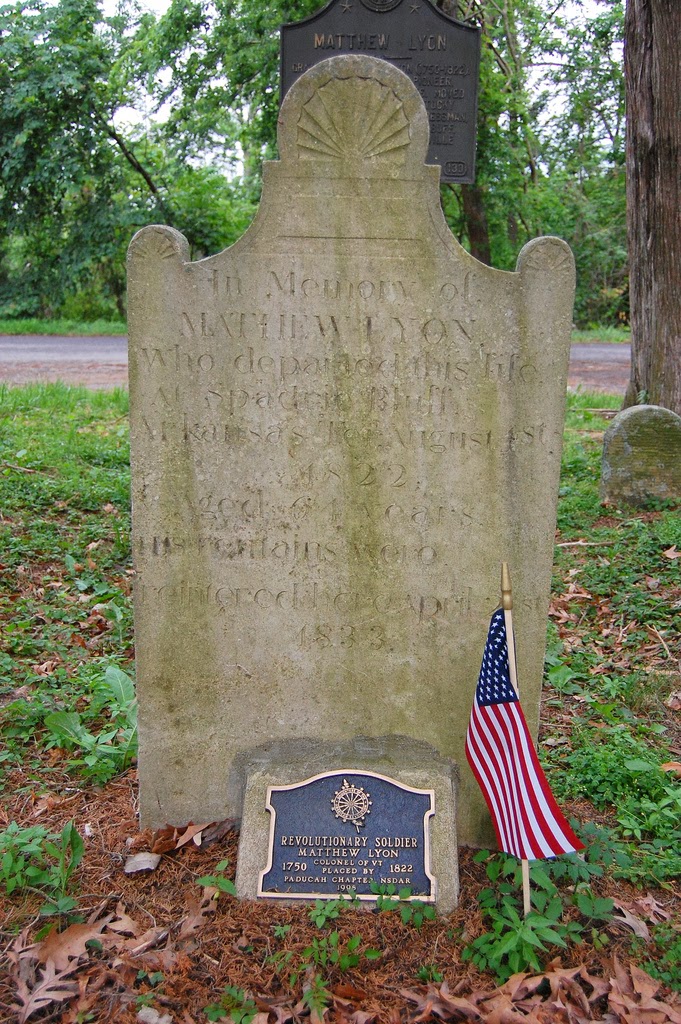
His name was Matthew Lyon, and he had been a Second Lieutenant in the Green Mountain Boys when they captured Fort Ticonderoga in 1776. The next year General Horatio Gates ordered Captain Lyon to take 60 men north to the Onion River, near the village of Jericho in what was to become Vermont. Why they were being sent so far beyond support was unclear, but the men went. Then, just as they arrived, word came of a party of 500 Indians ready to attack them. Lyon said later, “The soldiers considered themselves sacrificed”, so they decided to retreat. Lyon tried to talk them out of it, but Gates still ordered Lyon courtmartialed when the soldiers returned . He lost his command, but he was not reduced in rank. Captain Lyon later fought bravely in the battles of Bennington and at Saratoga, rising to the rank of colonel. After the war he twice ran for election to Congress from Vermont, and failed. Third time was the charm, and in 1796 he won, running as a radical Democrat-Republican. Two years later he was even re-elected.
And that was how Lyon ended up delivering a speech from the well of the House chamber on Tuesday, 30 January, 1798, chastising Connecticut Federalists for not defending the honor of their citizens by impeaching William Blount. That suggestion brought Federalist Connecticut Congressman Roger Griswald to his feet. As Lyon stepped away from the podium, Griswald, in his best snarky voice, asked if Lyon would be defending the people of Connecticut with his wooden sword.
Lyon never had a wooden sword. Occasionally, an officer convicted of cowardice would be required to wear a wooden sword, as a way of embarrassing him before the army. That had not happened in Lyon's case, because he was not even accused of running from the enemy, but was tried on orders from General Gates, and convicted, of not controlling his men. General Gates' later career provided ample evidence of his cowardice and incompetence, as Lyon's later career provided evidence of the reverse. But that was reality, and politics is about image - just ask John Kerry who was Swift Boat'ed over 200 years later.
Well, Lyon had been hearing this Federalist smear since the war. It had been used to defeat him twice in his congressional campaigns. And hit in the face with it the Irish hot head reacted instinctively. He spun on his accuser Roger Griswald, and spit in his face. We can assume it was pretty disgusting logy. The forty year old Lyon was a tobacco user, and mouth wash and dentistry were still in their infancy. And then, having expectorated his peace, Lyon turned his back on Griswald. In the words of an historian, from that moment “No man in the whole Republican party...(not even) Thomas Jefferson...was so hated and despised (by Federalists) as Matthew Lyon.”  Griswald went ape and charged at Lyon.
Cooler heads from both sides rushed to separate the two. And then, this being Congress, the argument about the traitor Blount became about the “spitting Lyon” and the hot head Griswald. Federalists wanted Lyon censured for “gross indecency” - for spitting on a college - making him the first Congressman honored with an ethics violation.  Democrat-Republicans wanted Griswald censured for the charge,  making him the second Congressman so honored. In the end, both charges were dropped. So two weeks later, it got worse.
On Thursday 15 February, Roger Griswold entered the house chamber carrying a cane he had been loaned by a friend. He walked directly to Matthew Lyon's desk, and began beating the Democrat-Republican with the stick. Covering his head, Lyon struggled to his feet, and retreated toward the fire pit, meant to take the morning chill off the chamber. He grabbed a pair of tongs from the wood pile, and began an insane fencing duel with his attacker (above). Again, cooler heads separated the two
The spitting only made the attacks on Matthew Lyon's honor louder. One bad Federalist poet even manged to include the insult into an ode to a theatrical Boston pig. “You boast your little pig can spell the hardest word; But did your little pig ever wear a wooden sword?....Though your piggy screws his snout in such learned grimaces, I defy the squeaking lout to spit in Christians’ faces...,Then tell us no more of your little grunting creature, But confess that the LION is the GREATEST BEAST in nature.”  As I said, he was a bad poet.
The Spitting Lyon so alienated the Federalists members of Congress,  it made it easier for them to pass both the Alien and the Sedition Acts, the second of which was signed on 14 July, 1798, six months after the assault by and on the “Spitting Lyon.” . It's actual title was “An Act for the Punishment of Certain Crimes” (above), the crimes being writing or publishing anything false or malicious against members of the government.  It also forbid the defendant from pleading the truth of their writing. Three months later, on 10 October, Matthew Lyons was convicted under the Sedition Act, and sentenced to four months in jail.
But Lyons had the last laugh.  Twice.  First he was re-elected from his cell, with 55% of the vote. Roger Griswald was also re-elected, but Lyon won the final revenge. The Presidential election of 1800 was a tie, and thrown into the House of Representatives. The contest became a 35 ballot knock down drag out between Democratic Republicans Jefferson and Aron Burr, engineered by the lame duck Federalist majority. The issue was finally settled on the 36th ballot, when the Federalist Representative from Vermont withdrew his vote from Burr. This allowed Matthew Lyon, the Democrat-Republican from Vermont, the cast the deciding ballot making Thomas Jefferson President of the United States.
So it turned out, William Blount's act of arrogance and bad manners did not end up preventing Jefferson from winning the White House. Unfortunately Blount did not witness the victory, having died in his home (above) during an epidemic in March of 1800. And Matthew Lyon moved to Kentucky in 1801, and won election to Congress from that new state six times, finally retiring in 1811, and dying in 1822. The Spitting Lyon, the Mountain Beast, was finally buried in the Blue Grass state. And what a shame we have allowed his memory to fade, in part because we insist upon neutering our "founding fathers" - denying them and us both our shared humanity.
- 30 -

Wednesday, December 04, 2013

YES, VIRGINIA

I know of only two moments that justifies the sin of pride. Both are a Horace Mann moment, the first, of course, when you have “won some victory for humanity”, and the second is when a child raised by you does the same. Consider the example of Philip F. O'Hanlon, who in his own life achieved wealth and professional and public recognition. In 1886, right out of N.Y. University Medical School, this sixth generation physician became the head of surgery at the new Gouverneur Community Hospital, on Manhattan’s lower east side.. He was appointed the State Medical Examiner in 1891, and in 1895 became New York City Coroner and Police Surgeon. The later two posts made him famous, and his testimony front page news in several big murder trials. But it was as a father that Philip O'Hanlon won his victory for humanity, because his daughter was Laura Virginia O”Hanlon.
Laura Virginia (above, she was named after her mother), was born July 20th, 1889, the same year the family leased a larger home, at 115 West 95th Street, between Columbus and Amsterdam Avenues, just a block west of Central Park. It was a relatively new brownstone, with a red brick front and peaked roof, having just one previous owner. As she reached the age of reason, she decided she preferred the name Virginia. And in the late summer of 1897, Virginia approached her father with a simple but profound question, belying her innocence and tender age. 
Fifty years later Virginia remembered the event this way: “Quite naturally I believed in Santa Claus, for he had never disappointed me. But when less fortunate little boys and girls said there wasn't any Santa Claus, I was filled with doubts. I asked my father, and he was a little evasive on the subject....It was a habit in our family that whenever any doubts came up as to how to pronounce a word or some question of historical fact was in doubt, we wrote to the Question and Answer column in “The Sun”. Father would always say, “If you see it in the The Sun, it's so,” and that settled the matter. “Well, I'm just going to write The Sun and find out the real truth,” I said to father. “He said, “Go ahead, Virginia. I'm sure The Sun will give you the right answer, as it always does.”
Consider for a moment this privileged Victorian child, Virginia O'Hanlon  (above) -  the daughter of a well known community leader in New York City. At eight years of age she knew children who were less fortunate than herself, knew them well enough to talk with them, to share the theology of childhood. She was raised in a home in which the family shared knowledge, and the joy of discovery. Parents and their only child learned together. And she was encouraged to seek truth on her own.
So early in September of 1897, Virginia wrote the following letter. “Dear Editor: I am 8 years old. Some of my little friends say there is no Santa Claus. Papa says, “If you see it in The Sun it’s so.” Please tell me the truth; is there a Santa Claus?” She mailed it to The Sun newspaper offices, at 280 Broadway, New York City.
The Sun (“It Shines for All”) had been published in New York since 1833, but in 1868 it was acquired by its most famous editor, Charles Anderson Dana (above). Under Dana “The Sun” was a strongly Democratic newspaper, and “a newspaper man's newspaper”, and first of the modern newspapers, introducing editorials, society news, and human-interest stories, along side the “news”, all forced into eight pages or less, two editions every weekday, and recently even a Sunday edition, with a circulation at its peak of 130,000.  Dana collected about him young, talented writers, and who followed his concisely stated revolutionary approach to news: “When a dog bites a man, that is not news, because it happens so often. But if a man bites a dog, that is news.”
But as Dana aged, “The Sun” became “notoriously inconsistent”. Others improved upon his method, like Joseph Pulitzer at the “New York World”, and built larger circulations, like William Randolph Hearst via his “Yellow Journalism”. By Charles Dana's death in 1897, and his replacement by his son Paul, “The Sun” had slipped to fourth along Newspaper Row (aka Park Row, above ) in lower Manhattan - “The World”, “The Tribune”, “The Times” and now lastly “The Sun”.
It was one of Dana's talented young writers, now an editor, Edward Mitchell, who was the father of modern Science Fiction. And in early September Mitchell handed Virginia O”Hanlon's letter to a 58 year old editorial writer, Francis Pharcellus Church (above). He was a Columbia graduate, who had reported on the horrors of the Civil War. With his brother, Church co-founded two successful magazines. According to Mitchell, “At first he pooh-poohed the subject a little. Then he took it, and in a short time handed me (the) article” And on September 21, 1897 in a standard 500 word unsigned editorial, printed in the middle of page seven, the journeyman writer responded to the little girl's letter.
“Virginia, your little friends are wrong. They have been affected by the skepticism of a skeptical age...Yes, Virginia, there is a Santa Claus. He exists as certainly as love and generosity and devotion exist, and you know that they abound and give to your life its highest beauty and joy. Alas! how dreary would be the world if there were no Santa Claus! It would be as dreary as if there were no Virginias. There would be no childlike faith then, no poetry, no romance to make tolerable this existence....Not believe in Santa Claus! You might as well not believe in fairies. You might get your papa to hire men to watch in all the chimneys on Christmas eve to catch Santa Claus, but even if you did not see Santa Claus coming down, what would that prove? Nobody sees Santa Claus, but that is no sign that there is no Santa Claus...Thank God! he lives and lives forever. A thousand years from now, Virginia, nay 10 times 10,000 years from now, he will continue to make glad the heart of childhood.”
The letter was not an instant success. It was not until the 1920's that the newspaper reprinted it annually. But by 1930, “The Sun” was receiving over 163,000 requests for reprints every year. Since then it has appeared in thousands of newspapers and books, decade after decade , and remains the most reprinted editorial in the English language. But it was not until after his death on April 11, 1906, that The Sun broke their own rules and named Francis Church as the author. Church never married and had no children. He is buried in Sleepy Hollow, New York.
In 1898, young William Randolph Hearst, in building his own newspaper empire, drove America into war with Spain. Virginia's father, Dr. Philip O'Hanlon, volunteered as lieutenant in the Medical Reserve Corps. He survived that service, and was listed as still alive in 1920, and still living on 95th street, although now on the south side of the street.
Virginia O'Hanlon  (above) received her B.A. from Hunter College in 1910, a Master's in Education from Columbia University in 1912, and the same year she began teaching underprivileged grade school children in New York City schools. In 1913 she married Edward Douglas, but he abandoned her just before she gave birth to her daughter, Laura Temple Douglas, in March of 1914. She was eventually promoted to principal, and in 1930 was even awarded her doctorate from Fordham University. Her dissertation was titled “The Importance of Play.” Her daughter had seven children.
One of those grandchildren, Virginia Rogers (above, with Virginia), remembered as a child visiting her grandmother in New York City. “Gram was a lady. Very elegant. She would dress up to go across the street (to the)...post office. At Christmastime, there would be literally box-loads of mail addressed to my grandmother.” Another granddaughter said, “She was a woman ahead of her time.”
Virginia never took credit for the column her letter inspired. She told her nephew, James Temple, “All I did was ask the question. It was Mr. Church who did something wonderful.” Virginia told an interviewer, Church's column “gave me a special place in life I didn’t deserve. It also made me try to live up to the philosophy of the editorial and to try to make glad the heart of childhood.”
What Virginia did was to teach at Brooklyn’s P.S.401, which held classes for chronically ill children confined at home or in hospitals. Eventually she became a principle at the school. Shortly before she retired she wrote another letter, this one addressed to the “Children of Yesterday.” She pleaded, “Some little children doubt that Santa still lives because often their letters ...never seem to reach him. Nurses in hospitals know who some of these children are. Teachers in great city schools will know others....Won’t you try to seek out these trusting children of today and make sure that their letters in some way reach Santa Claus so that “he will continue to make glad the heart of childhood.” Laura Virginia O'Hanlon Douglas had made that her life's work, finally retiring in 1950.
Nine years later she moved to North Chatham, 15 miles south of Albany, New York, to live with her daughter. During the Christmas holidays in 1969, heart problems forced Virginia to be admitted to the Columbia Memorial Hospital, in Hudson, New York. There she was visited by Santa Clause (above), disguised as John Harms, a hospital maintenance man, who often visited patients. He kissed Virginia on the cheek, and she whispered in his ear that she still believed. Virginia died, in the Barnwell Nursing Home, in Valatie, N.Y., on May 13, 1974. She was 81 years old.
Her original letter, which the newspaper had returned, was saved in a scrapbook by a granddaughter and somehow survived a house fire. Today, the brownstone at 115 West 95th street (above), is occupied by The Studio School, where children from “an economically diverse student body” (20% receive financial aid), “ learn to value intellectual and creative ideas, and to take pleasure in the process of discovery.” The school maintains a Virginia O’Hanlon Scholarship Fund to help students with financial needs.
Late in her life, Virginia wrote the following. “Those whom Santa visits think of Christmas as a beautiful, sacred occasion which it should be — but today seldom is. But for every child tucked into bed Christmas night with his new toy, there are hundreds, no thousands, who huddle in ragged bed clothing sobbing in the night at a fate at best cruel.” And she asked us all to “Remember the children at Christmas.”  
Will you?
- 30 -

Blog Archive