August 2025

August  2025
I DON'T NEED A RIDE. I NEED AMMUNITION.

Translate

Friday, December 06, 2013

THE REAL POLITICAL POOP

I can prove the regularity of William Blount's intestinal functions, because his enemies in the U.S. Senate depended on them. Their trap was sprung on a Tuesday morning, while Blount was visiting “The Necessity” behind Philadelphia's “Congress Hall”. The conspirators gained time because Blount had to go all the way downstairs and out to the little shed, to do his business. But they need not have rushed because he took his time – such things should never be hurried – and by the time he returned the letter had been read and William Blount's political career was toast. It was Monday, 3 July, 1797, and if he were not so arrogant (and regular) Senator Blount (below) might gone on to great things. I'll bet even the “Spitting Beast of Vermont” wished he had.
“Dear Cary”, the letter began, “I wished to have seen you before I returned to Philadelphia,...I believe the plan...will be attempted this fall...(and) in a much larger way then we talked about....I shall probably be at the head of the business on the part of the British...You must take care...not to let the plan be discovered by...any other person in the interest of the United States or Spain...I am, and etcettera, William Blount.”
The plan was the invention of John Chisholm, who owned a tavern (above) across the street from Senator Blount's Knoxville, Tennessee mansion. Chisholm figured it was only a matter of time before Spain would be forced to sell their American colonies to France. And if France controlled Louisiana and Florida, they might deny American ships access to New Orleans. That would bankrupt all the western farmers. So Chisholm planned was to use local militia and Creek Indians to capture Pensacola and New Orleans, in the name of the British Empire - who would then promise to allow Americans to use New Orleans as if they owned it.
It was a fantasy of course, but the more Senator Blount thought about this idea, the more he thought it was his idea - particularly after he had improved it by creating a well paid job for himself as a British agent. So Blount wrote the letter to James Cary, who was a translator with the Creek Indian nation in eastern Tennessee. Blount expected Cary to convince the Creeks to join the conspiracy. Instead Cary shared the letter with his bosses in the War Department, who immediately shared it with President John Adams. Adams was a Federalist and he saw a chance to embarrass his own Vice President, Thomas Jefferson, who presided over the Senate (above) and was also the leader of the opposition party, the Democrat-Republicans - of whom Senator William Blount was an important member. So Adams sent a copy of the letter to Congress, but insisted it be kept secret until Senator Blount could do nothing to stop the public reading of the “Dear Cary” letter. Blount's toilet trip provided that opportunity.
By noon half of Philadelphia (above) wanted to hang Blount as a traitor, and the other half was trying to deny they had ever met him . The President's wife even said it was too bad America did not have the guillotine. Blount was arrested trying to slip out of town. Dragged in front of the Senate he denied writing the letter, then posted bail and hightailed it back to Knoxville – where the anti-government conspiracy had made him something of a hero. A week later the Senate voted 25 to 1 to expel him. For the next six months both parties downstairs in the House of Representatives, Federalists and Democrat-Republicans, tried to make the impeachment of William Blount work for them in the upcoming 1798 Congressional elections. And that is how our story came to involve an expectorant infused Congressman from the Green Mountain State.
His name was Matthew Lyon, and he had been a Second Lieutenant in the Green Mountain Boys when they captured Fort Ticonderoga in 1776. The next year General Horatio Gates ordered Captain Lyon to take 60 men north to the Onion River, near the village of Jericho in what was to become Vermont. Why they were being sent so far beyond support was unclear, but the men went. Then, just as they arrived, word came of a party of 500 Indians ready to attack them. Lyon said later, “The soldiers considered themselves sacrificed”, so they decided to retreat. Lyon tried to talk them out of it, but Gates still ordered Lyon courtmartialed when the soldiers returned . He lost his command, but he was not reduced in rank. Captain Lyon later fought bravely in the battles of Bennington and at Saratoga, rising to the rank of colonel. After the war he twice ran for election to Congress from Vermont, and failed. Third time was the charm, and in 1796 he won, running as a radical Democrat-Republican. Two years later he was even re-elected.
And that was how Lyon ended up delivering a speech from the well of the House chamber on Tuesday, 30 January, 1798, chastising Connecticut Federalists for not defending the honor of their citizens by impeaching William Blount. That suggestion brought Federalist Connecticut Congressman Roger Griswald to his feet. As Lyon stepped away from the podium, Griswald, in his best snarky voice, asked if Lyon would be defending the people of Connecticut with his wooden sword.
Lyon never had a wooden sword. Occasionally, an officer convicted of cowardice would be required to wear a wooden sword, as a way of embarrassing him before the army. That had not happened in Lyon's case, because he was not even accused of running from the enemy, but was tried on orders from General Gates, and convicted, of not controlling his men. General Gates' later career provided ample evidence of his cowardice and incompetence, as Lyon's later career provided evidence of the reverse. But that was reality, and politics is about image - just ask John Kerry who was Swift Boat'ed over 200 years later.
Well, Lyon had been hearing this Federalist smear since the war. It had been used to defeat him twice in his congressional campaigns. And hit in the face with it the Irish hot head reacted instinctively. He spun on his accuser Roger Griswald, and spit in his face. We can assume it was pretty disgusting logy. The forty year old Lyon was a tobacco user, and mouth wash and dentistry were still in their infancy. And then, having expectorated his peace, Lyon turned his back on Griswald. In the words of an historian, from that moment “No man in the whole Republican party...(not even) Thomas Jefferson...was so hated and despised (by Federalists) as Matthew Lyon.”  Griswald went ape and charged at Lyon.
Cooler heads from both sides rushed to separate the two. And then, this being Congress, the argument about the traitor Blount became about the “spitting Lyon” and the hot head Griswald. Federalists wanted Lyon censured for “gross indecency” - for spitting on a college - making him the first Congressman honored with an ethics violation.  Democrat-Republicans wanted Griswald censured for the charge,  making him the second Congressman so honored. In the end, both charges were dropped. So two weeks later, it got worse.
On Thursday 15 February, Roger Griswold entered the house chamber carrying a cane he had been loaned by a friend. He walked directly to Matthew Lyon's desk, and began beating the Democrat-Republican with the stick. Covering his head, Lyon struggled to his feet, and retreated toward the fire pit, meant to take the morning chill off the chamber. He grabbed a pair of tongs from the wood pile, and began an insane fencing duel with his attacker (above). Again, cooler heads separated the two
The spitting only made the attacks on Matthew Lyon's honor louder. One bad Federalist poet even manged to include the insult into an ode to a theatrical Boston pig. “You boast your little pig can spell the hardest word; But did your little pig ever wear a wooden sword?....Though your piggy screws his snout in such learned grimaces, I defy the squeaking lout to spit in Christians’ faces...,Then tell us no more of your little grunting creature, But confess that the LION is the GREATEST BEAST in nature.”  As I said, he was a bad poet.
The Spitting Lyon so alienated the Federalists members of Congress,  it made it easier for them to pass both the Alien and the Sedition Acts, the second of which was signed on 14 July, 1798, six months after the assault by and on the “Spitting Lyon.” . It's actual title was “An Act for the Punishment of Certain Crimes” (above), the crimes being writing or publishing anything false or malicious against members of the government.  It also forbid the defendant from pleading the truth of their writing. Three months later, on 10 October, Matthew Lyons was convicted under the Sedition Act, and sentenced to four months in jail.
But Lyons had the last laugh.  Twice.  First he was re-elected from his cell, with 55% of the vote. Roger Griswald was also re-elected, but Lyon won the final revenge. The Presidential election of 1800 was a tie, and thrown into the House of Representatives. The contest became a 35 ballot knock down drag out between Democratic Republicans Jefferson and Aron Burr, engineered by the lame duck Federalist majority. The issue was finally settled on the 36th ballot, when the Federalist Representative from Vermont withdrew his vote from Burr. This allowed Matthew Lyon, the Democrat-Republican from Vermont, the cast the deciding ballot making Thomas Jefferson President of the United States.
So it turned out, William Blount's act of arrogance and bad manners did not end up preventing Jefferson from winning the White House. Unfortunately Blount did not witness the victory, having died in his home (above) during an epidemic in March of 1800. And Matthew Lyon moved to Kentucky in 1801, and won election to Congress from that new state six times, finally retiring in 1811, and dying in 1822. The Spitting Lyon, the Mountain Beast, was finally buried in the Blue Grass state. And what a shame we have allowed his memory to fade, in part because we insist upon neutering our "founding fathers" - denying them and us both our shared humanity.
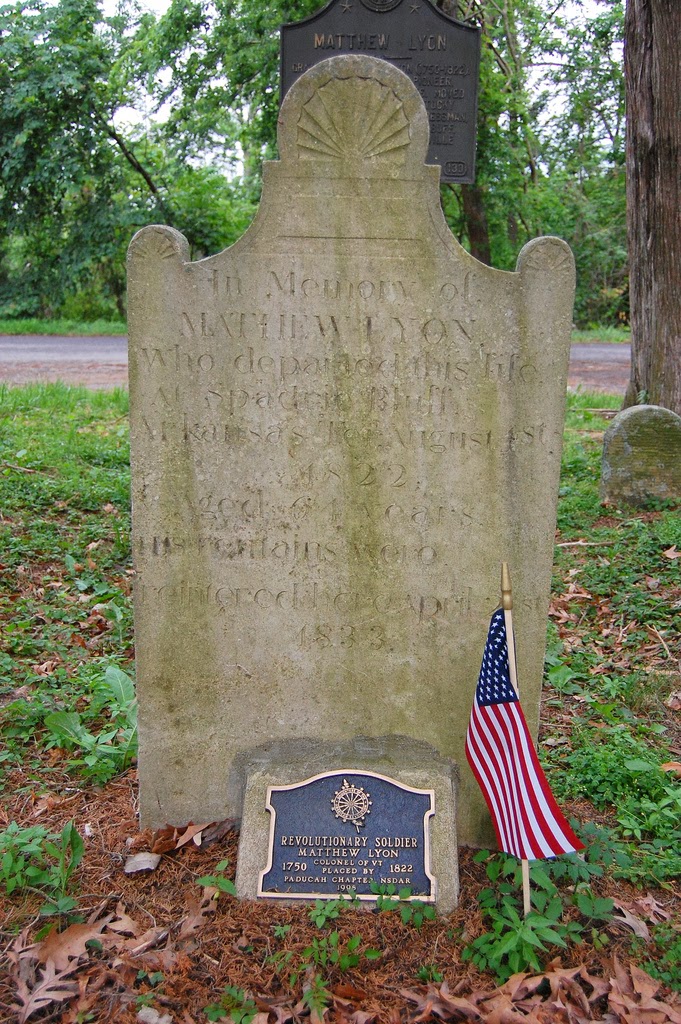
- 30 -

Wednesday, December 04, 2013

YES, VIRGINIA

I know of only two moments that justifies the sin of pride. Both are a Horace Mann moment, the first, of course, when you have “won some victory for humanity”, and the second is when a child raised by you does the same. Consider the example of Philip F. O'Hanlon, who in his own life achieved wealth and professional and public recognition. In 1886, right out of N.Y. University Medical School, this sixth generation physician became the head of surgery at the new Gouverneur Community Hospital, on Manhattan’s lower east side.. He was appointed the State Medical Examiner in 1891, and in 1895 became New York City Coroner and Police Surgeon. The later two posts made him famous, and his testimony front page news in several big murder trials. But it was as a father that Philip O'Hanlon won his victory for humanity, because his daughter was Laura Virginia O”Hanlon.
Laura Virginia (above, she was named after her mother), was born July 20th, 1889, the same year the family leased a larger home, at 115 West 95th Street, between Columbus and Amsterdam Avenues, just a block west of Central Park. It was a relatively new brownstone, with a red brick front and peaked roof, having just one previous owner. As she reached the age of reason, she decided she preferred the name Virginia. And in the late summer of 1897, Virginia approached her father with a simple but profound question, belying her innocence and tender age. 
Fifty years later Virginia remembered the event this way: “Quite naturally I believed in Santa Claus, for he had never disappointed me. But when less fortunate little boys and girls said there wasn't any Santa Claus, I was filled with doubts. I asked my father, and he was a little evasive on the subject....It was a habit in our family that whenever any doubts came up as to how to pronounce a word or some question of historical fact was in doubt, we wrote to the Question and Answer column in “The Sun”. Father would always say, “If you see it in the The Sun, it's so,” and that settled the matter. “Well, I'm just going to write The Sun and find out the real truth,” I said to father. “He said, “Go ahead, Virginia. I'm sure The Sun will give you the right answer, as it always does.”
Consider for a moment this privileged Victorian child, Virginia O'Hanlon  (above) -  the daughter of a well known community leader in New York City. At eight years of age she knew children who were less fortunate than herself, knew them well enough to talk with them, to share the theology of childhood. She was raised in a home in which the family shared knowledge, and the joy of discovery. Parents and their only child learned together. And she was encouraged to seek truth on her own.
So early in September of 1897, Virginia wrote the following letter. “Dear Editor: I am 8 years old. Some of my little friends say there is no Santa Claus. Papa says, “If you see it in The Sun it’s so.” Please tell me the truth; is there a Santa Claus?” She mailed it to The Sun newspaper offices, at 280 Broadway, New York City.
The Sun (“It Shines for All”) had been published in New York since 1833, but in 1868 it was acquired by its most famous editor, Charles Anderson Dana (above). Under Dana “The Sun” was a strongly Democratic newspaper, and “a newspaper man's newspaper”, and first of the modern newspapers, introducing editorials, society news, and human-interest stories, along side the “news”, all forced into eight pages or less, two editions every weekday, and recently even a Sunday edition, with a circulation at its peak of 130,000.  Dana collected about him young, talented writers, and who followed his concisely stated revolutionary approach to news: “When a dog bites a man, that is not news, because it happens so often. But if a man bites a dog, that is news.”
But as Dana aged, “The Sun” became “notoriously inconsistent”. Others improved upon his method, like Joseph Pulitzer at the “New York World”, and built larger circulations, like William Randolph Hearst via his “Yellow Journalism”. By Charles Dana's death in 1897, and his replacement by his son Paul, “The Sun” had slipped to fourth along Newspaper Row (aka Park Row, above ) in lower Manhattan - “The World”, “The Tribune”, “The Times” and now lastly “The Sun”.
It was one of Dana's talented young writers, now an editor, Edward Mitchell, who was the father of modern Science Fiction. And in early September Mitchell handed Virginia O”Hanlon's letter to a 58 year old editorial writer, Francis Pharcellus Church (above). He was a Columbia graduate, who had reported on the horrors of the Civil War. With his brother, Church co-founded two successful magazines. According to Mitchell, “At first he pooh-poohed the subject a little. Then he took it, and in a short time handed me (the) article” And on September 21, 1897 in a standard 500 word unsigned editorial, printed in the middle of page seven, the journeyman writer responded to the little girl's letter.
“Virginia, your little friends are wrong. They have been affected by the skepticism of a skeptical age...Yes, Virginia, there is a Santa Claus. He exists as certainly as love and generosity and devotion exist, and you know that they abound and give to your life its highest beauty and joy. Alas! how dreary would be the world if there were no Santa Claus! It would be as dreary as if there were no Virginias. There would be no childlike faith then, no poetry, no romance to make tolerable this existence....Not believe in Santa Claus! You might as well not believe in fairies. You might get your papa to hire men to watch in all the chimneys on Christmas eve to catch Santa Claus, but even if you did not see Santa Claus coming down, what would that prove? Nobody sees Santa Claus, but that is no sign that there is no Santa Claus...Thank God! he lives and lives forever. A thousand years from now, Virginia, nay 10 times 10,000 years from now, he will continue to make glad the heart of childhood.”
The letter was not an instant success. It was not until the 1920's that the newspaper reprinted it annually. But by 1930, “The Sun” was receiving over 163,000 requests for reprints every year. Since then it has appeared in thousands of newspapers and books, decade after decade , and remains the most reprinted editorial in the English language. But it was not until after his death on April 11, 1906, that The Sun broke their own rules and named Francis Church as the author. Church never married and had no children. He is buried in Sleepy Hollow, New York.
In 1898, young William Randolph Hearst, in building his own newspaper empire, drove America into war with Spain. Virginia's father, Dr. Philip O'Hanlon, volunteered as lieutenant in the Medical Reserve Corps. He survived that service, and was listed as still alive in 1920, and still living on 95th street, although now on the south side of the street.
Virginia O'Hanlon  (above) received her B.A. from Hunter College in 1910, a Master's in Education from Columbia University in 1912, and the same year she began teaching underprivileged grade school children in New York City schools. In 1913 she married Edward Douglas, but he abandoned her just before she gave birth to her daughter, Laura Temple Douglas, in March of 1914. She was eventually promoted to principal, and in 1930 was even awarded her doctorate from Fordham University. Her dissertation was titled “The Importance of Play.” Her daughter had seven children.
One of those grandchildren, Virginia Rogers (above, with Virginia), remembered as a child visiting her grandmother in New York City. “Gram was a lady. Very elegant. She would dress up to go across the street (to the)...post office. At Christmastime, there would be literally box-loads of mail addressed to my grandmother.” Another granddaughter said, “She was a woman ahead of her time.”
Virginia never took credit for the column her letter inspired. She told her nephew, James Temple, “All I did was ask the question. It was Mr. Church who did something wonderful.” Virginia told an interviewer, Church's column “gave me a special place in life I didn’t deserve. It also made me try to live up to the philosophy of the editorial and to try to make glad the heart of childhood.”
What Virginia did was to teach at Brooklyn’s P.S.401, which held classes for chronically ill children confined at home or in hospitals. Eventually she became a principle at the school. Shortly before she retired she wrote another letter, this one addressed to the “Children of Yesterday.” She pleaded, “Some little children doubt that Santa still lives because often their letters ...never seem to reach him. Nurses in hospitals know who some of these children are. Teachers in great city schools will know others....Won’t you try to seek out these trusting children of today and make sure that their letters in some way reach Santa Claus so that “he will continue to make glad the heart of childhood.” Laura Virginia O'Hanlon Douglas had made that her life's work, finally retiring in 1950.
Nine years later she moved to North Chatham, 15 miles south of Albany, New York, to live with her daughter. During the Christmas holidays in 1969, heart problems forced Virginia to be admitted to the Columbia Memorial Hospital, in Hudson, New York. There she was visited by Santa Clause (above), disguised as John Harms, a hospital maintenance man, who often visited patients. He kissed Virginia on the cheek, and she whispered in his ear that she still believed. Virginia died, in the Barnwell Nursing Home, in Valatie, N.Y., on May 13, 1974. She was 81 years old.
Her original letter, which the newspaper had returned, was saved in a scrapbook by a granddaughter and somehow survived a house fire. Today, the brownstone at 115 West 95th street (above), is occupied by The Studio School, where children from “an economically diverse student body” (20% receive financial aid), “ learn to value intellectual and creative ideas, and to take pleasure in the process of discovery.” The school maintains a Virginia O’Hanlon Scholarship Fund to help students with financial needs.
Late in her life, Virginia wrote the following. “Those whom Santa visits think of Christmas as a beautiful, sacred occasion which it should be — but today seldom is. But for every child tucked into bed Christmas night with his new toy, there are hundreds, no thousands, who huddle in ragged bed clothing sobbing in the night at a fate at best cruel.” And she asked us all to “Remember the children at Christmas.”  
Will you?
- 30 -

Friday, November 29, 2013

NOT PERFFECT

I was surprised to find on Thursday, September 10, 1846, how many of America's 18 million citizens were on the journey to our “more perfect union”.  In the pitiless Nevada desert members of the last California emigrant train of the season awoke to see the error of their ways in the snow capped Ruby Mountains. On that same day, out on the Great Plains, exhausted Mormons escaping religious persecution awoke to a violent downpour, and the commandment to rise from their sickbeds and retrace their steps. Sixty miles south of the Rio Grande River, an American invasion force was preparing to fall on the ill prepared Mexican city of Monterrey. While, at the center of this web of worry and hope, susceptible to each distant tug and pull, a 38 year old alcoholic was being chased by the shadows thrown by a flickering whale oil lamp in a Washington, D.C. hotel room.
At the foot of Capital Hill, on Pennsylvania Avenue and Third Street , and a few steps from the fetid Washington Canal, stood the three story wood frame St. Charles Hotel (above) - soon to be renamed the Capital Hotel. The establishment catered to southerners, boasting a basement room where slaves could be restrained so securely the management offered to reimburse masters should their property escape. One of the most popular resident guests was the congressman from Alabama's 7th district, Felix G. McConnell. He was known more for his biting humor, spendthrift ways and his voluminous drinking than his progressive politics. And this night he had reached the end of a hundred dollar drunk.
Tales of 38 year old McConnell's impromptu inebriated parties were legendary. During his first term, after inviting the occupants of the bar at the upscale Brown's Hotel to “Come up and licker'”, he was confronted by the scrupulously proper John W. Dade, superintendent of the District's jails. Dade had obviously been drinking for hours, and pompously inquired, “With whom have I the honor of drinking?” McConnell gave his stump speech reply. “"My name is Felix Grundy McConnell, Egad! I am a member of Congress from Alabama. My mother is a justice of the peace, my aunt keeps a livery stable, and my grandmother commanded a company in the Revolution and fit the British, gol darn their souls!” “Old Jack” Dade formally replied “Sir, I am a man of high aspirations and peregrinations and can have nothing to do with such low-down scopangers as yourself. Good morning, sir!” Dade was convinced to stay and drink with McConnell, and the two became fast friends.
But perhaps McConnell's most famous moment of public excess had come at a performance of “The Nordic Paganini”, Old Bull - Ole Bornemann Bull, the Norwegian solo violinists (above). This genius of self promotion, renowned for his “wild, unorthodox style” was already a phenom of rock star proportions in Europe and began his first American tour in late 1843. The New York Herald reported, “At the close of some of his wonderful cadences, the very musicians in the orchestra flung down their instruments and stamped and applauded like madmen.” The same critic went on to suggest the “Prince of Violinists” drew up to 4,000 people to his concerts because his “...pyrotechnic style and dramatic manner...captivated the musically uninitiated...”
Ole's bigger than life personality went over well in America. After one performance in Alabama, a westerner expressed admiration for the large diamond Old Bull had attached to his bow, and pulled a bowie knife to remove it. Bull closed the negotiations with a sharp chop to the aggressor’s throat. Witnesses insist the chastised assailant then offered his knife to Ole as a gift. The musician returned to Norway with five such knives in all. Ole's “boisterous... practical jokes” caused him to be described as a “charismatic but undisciplined...noble savage”. And he “could talk politics with even more earnestness and force than he could talk music.” All in all he seemed another natural friend for Congressman McConnell, except Ole was a tea totaler.
There is no record they ever met, but Ole played four concerts in Baltimore and Washington over the holidays in 1843, and in the midst of the Christmas Eve performance in the capital city a drunken Congressman McConnell suddenly rose and shouted, “None of your high-falutin, but give us ‘Hail Columbia’ and bear hard on the treble’! “ As a paper noted, “"Throw him out!”, people shouted, all over the house, and so they did, but the policemen had their hands full, for McConnell was a husky chap, and full of spirituous encouragement...” The officers had to resort to their night sticks, but given that most of the audience was not there for the music but for the show, it was not a significant interruption. Briefly he was charged with “rioting and disturbance”, before his high office and friends saw the charges dismissed.
In his two terms in Congress, McConnell sponsored just two pieces of legislation. In his first term he introduce a bill to annex Ireland. The bill wasn't meant to be taken seriously. It was a jibe at northern Democrats insensitively opposed the annexation of the slave state Texas, but who were sensitive to the fastest growing immigrant population then in America - the Irish. Having made his joke, Felix McConnell allowed it to quietly die. But at the beginning of his second term, he touched on something much closer to his heart.
On March 9th, 1846, just five days into the 29th Congress, McConnell introduced “A Bill to grant to the Head of a Family, Man, Maid or Widow, a Homestead not exceeding 160 acres of Land”. It was the first “Homestead Bill” introduced in the United States Capital (above). It's purpose was to democratize the frontier.
Since before the revolution money men had been bought up every tract of public land offered for sale, looking to profit by reselling it to other investors, as if it were stocks or stock derivatives Land speculation fever was so powerful, most investors eagerly went into debt to obtain as much land as possible, intending to sell before their note became due. Like Russian roulette, this game could end in only one of two ways.
Either some naive new owner would discover he now owned a swamp or a boulder field. This usually led to lawsuits and bankruptcies all around, or if the notes came due before an overextended speculator could find a bigger sucker than themselves. Either way the property would revert to the last legal owner, who was now free to re-sell the land to a new sucker. Bankrupting the unwary majority of speculators provided profit to the privileged few who were higher up on the pyramid. There has never been a shortage of optimistic suckers in America.
By the time an actual farmer obtained a tract, usually of 50 acres or less, the price was so inflated as to leave him so deeply in debt that after three or four years he would “pull up stakes”, abandon the farm and move further west to repeat the process. And again the land would revert to the last owner, who would resell to the next sucker. It was a very profitable business model, and reminds me of the current student loan system. But like the current for-profit college scams, it did not broaden the tax base, nor fund community improvements, like schools, roads or canals.
McConnell was far from alone even among southern Democrats seeking to break up this monopoly on land and money. Sam Huston from Texas wanted a homestead act. Andrew Johnson from Tennessee introduced his own version the same day as McConnell. But these southern progressives were being replaced by well funded, increasingly rabid pro-slavery politicians, who saw individual homesteaders as a block to the next generation of big slave plantations. Wrote one historian, “In spite of the undoubted earnestness of (McConnell), the bill seems to have been regarded as a jest...(and did not) elicit a respectful hearing from his fellow congressmen.” Andrew Johnson's almost duplicate bill was given a respectful hearing - before it was killed in committee.
It was the disrespect that seems to have broken Congressman McConnell's heart. Despite his reputation as a “dare-devil and a spendthrift”, McConnell was devoted to his job, missing just 8% of his floor votes in 1846, well below average. Perhaps if he had not left his wife Elizabeth and their three children back in Alabama, he would not have turned to drink in Washington. Perhaps if he had chosen to stay in a less expensive boarding house, where he could share meals and companionship with his colleges, as opposed to a $65 a month room at the St. Charles - perhaps things would have turned out differently. Except his father Perry had died at 52, also addicted to “ardent spirits”. And now it seemed, every one in every way had dismissed the young lawyer from Talladega as a joke and a drunk.
On the evening of May 13, 1846, the House of Representatives voted to go to war with Mexico – 174 to 14. The war had been sparked by the annexation of Texas by the United States, and was intended to help build a southern slave empire from Georgia through Texas to California. Congressman McConnell voted with the majority, but he knew, as did many other practical southerners, that even in the deep south, slavery was no longer economically viable. And yet, with the Mexican War, the south fell further under the control of firebrands and hot heads, determined to extend slavery at all costs.
On Tuesday, September 8, 1846 McConnell went to visit the man who had given him his first job, as Tennessee postmaster. President James K. Polk was surprised to see him, thinking McConnell had gone home to Alabama during the recess. In his meticulous diary Polk noted, “he looked ...as though he had just recovered from a fit of intoxication. He was sober, but was pale, his countenance haggard and his system nervous. He applied to me to borrow one hundred dollars (to clear up his debts) and said he would return it to me in ten days....I had known him in his youth and had not the moral courage to refuse. I gave him the one hundred dollars in gold and took his note. His hand was so tremulous that he could scarcely write his name to the note legibly. I think it probable that he will never pay me.”
Leaving the White House, McConnell settled his bill with the hackman (taxi driver), and disappeared. Where he was Tuesday night and all of Wednesday, no one could say. But early in afternoon of Thursday, September 10th, 1846, McConnell appeared in the bar of the St. Charles, inviting the few patrons to “Come up and licker”. He kept clicking gold coins between his fingers, and telling everyone he had been given them by President Polk. He even loaned the barkeep $35, although the man may have simply been trying to take the money out of McConnell's pocket before he drank himself to death. As evening approached the Congressman asked for a pen and paper, and struggled to compose a note. But after some time he rose and said he was going to his room.
Once behind his the locked door, McConnell lay upon the bed, and taking a “hawkbill knife”, stabbed himself several times in the abdomen. And when that proved ineffective, he slashed his own throat, twice. A short time later, someone was concerned enough to check in on the Congressman. Receiving no reply to a knock, a pass key opened the room, and Felix Grundy McConnell was discovered atop a blood soaked mattress.
A Washington newspaper said, “No doubt can be entertained that Mr. McConnell committed the act in a state of mental hallucination – most probably under the influence of delirium tremens, brought on by the intemperate course of his life.” According to the Baltimore Sun, “His friends say that for about a week past he had relinquished drinking, owing to indisposition, and that the absence of his usual stimulus caused great despondency...he had his watch and valuable jewelry on his person, besides a sum of money.” President Polk added to his diary, “A jury of inquest was held and found a verdict that he had destroyed himself. It was a melancholy instance of the effects of intemperance...he was a true Democrat and a trusted friend".
Having been thus safely categorized as an alcoholic and a jokester, Felix Grundy McConnell was buried in the Congressional Cemetery. Other than an occasional mention of his bill to annex Ireland, he was almost immediately forgotten. It was easier that way, to forget that he and other southerners, had once attempted to change the economics of the nation in a way that might have made the civil war unnecessary, that might have saved both of his sons, one born after his death, having to fight in that war which cost the state of Alabama almost 40% of its population, men, women and children, black and white, wise, foolish, saint, sinner, alcoholic and tea-totaler.
God bless Felix Grundy McConnell, for his journey. He did his best to do guide the people of Alabama and the nation to a “more perfect union”. He tried to lead them down a path to avoid war. He tried to lead the nation down a more just path. And if others did not notice his effort, that was their loss. And if he stumbled on the path, that was to be expected. In this journey failure is the inevitable. That is what makes success so sweet. That is why the journey must be made every day, to a “more perfect union”. Not perfect, just more perfect. And that was Felix Grundy McConnell – not perfect. Like the rest of us.
- 30 -

Blog Archive