August 2025

August  2025
I DON'T NEED A RIDE. I NEED AMMUNITION.

Translate

Friday, October 11, 2013

FIFTY-FOUR FORTY OR FIGHT

I can't help wondering why so many politicians are calling for a new approach to politics Aren't the same politics we've been using for the last 2,500 years good enough?  Maybe the real problem lies not with the lying, two faced, double dealing, back-stabbing, opportunistic, insincere politicians but with the idiots who vote for them: i.e. us. Check my math, please: politicians lie, politicians get elected; could there be a connection? Let me give you a little example from ancient history, so nobody feels insulted.
James K. Polk was America's eleventh President, serving from 1845 to 1849. He was, until Richard Nixon, our most secretive President. He did not even tell his own cabinet members what he was thinking. He was a Jackson Democrat,  and no matter what your history books tell you he did not campaign on the phrase "Fifty-Four Forty or Fight" – that came up later. During his campaign for President, what Polk was most famous for was for not branding his slaves. And trust me, this smear was so good they still haven’t figured out who did it.
The story was first published in the August 21, 1844 edition of the Ithaca New York Chronicle, (a Whig newspaper). It claimed to be a letter to the editor, quoting a three paragraph extract from an unpublished book, “Roorback’s Tour Through the Western and Southern States…” It claimed to detail Baron Von Roorback's conversations with a group of slave traders on the Duck River in Tennessee. “Forty of these unfortunate beings had been purchased, I was informed, of the Honorable J.K. Polk…; the mark of a branding iron, with the initials of his name on their shoulders, distinguishing them from the rest.” Even in 1844 the idea of branding human beings, even those treated as slaves, was appalling to many people...even in places where the economy had been built on slavery.
Which was why the story was picked up by the Albany Evening Journal, and other Whig newspapers, particularly in the 1844 “battleground states” of New York, Ohio and Pennsylvania. Many voters in those swing states were outraged that a man standing for President would do something so despicable as to brand human beings. To Whig politicians that story was almost too good to be true. And almost as quick as Republican bloggers caught Dan Rather, the Democratic press found out there was no such book and no such Baron. The details about Polk had been inserted into a real travel book, of a run in with some slave traders on Virginia’s New River. Polk’s farm was in Tennessee, so the inventor of the lie had shifted the scene to where it would do the most good. Besides, it was not common practice to brand slaves. Like whipping scars, branding tended to reduce their price of a slave,  since it would be marking the slave as having escaped before, and likely to escape in the future. Slaves were certainly whipped and branded because in America in 1844. Most Americans still believed slaves were property and would have been equally offended if some government official tried to tell them how to treat their horses or how to slaughter their hogs.
Still, embarrassed at being caught repeating what was so obviously a fabrication, the Whigs pinned the whole thing on William Linn, a lawyer and a Democratic operative in Ithaca. But why would a Democrat smear his own candidate? Well, if I were a believer in conspiracy theories, I might say that this very kind of allegation against Polk was actually a fairly safe charge to make. Polk did own slaves, but his Whig opponent in the election, Henry Clay, owned even more slaves than Polk did. And it has been suggested by some historians that the “Roorback” story was a case of nineteenth century “wedge” politics. Abolitionism was still a minor issue in 1844, but abolitionists formed a solid voting block in New York, Ohio and Pennsylvania, those key battleground states. Convince enough abolitionists in at least two of those states that the Whigs were lying to them, and they just might choose the Democrat Polk over the Whig Clay as the lesser of two evils. And the letter to the Ithaca Chronicle had been signed, “An Abolitionist”, thus adding insult to the injury.
Well, maybe....And maybe that theory implies a level of sophisticated conspiracy that did not exist in the simpler culture and times of 1844 – and certainly would not have existed in Athens in 415 B.C., when Alcibiades was accused of vandalizing statues of the god Hermes.
You see Hermes was the mythical inventor of fire, and "...a robber, a cattle driver, a bringer of dreams, a watcher by night, a thief at the gates....who protects and takes care of all travelers, miscreants, harlots, old cronies and thieves and injured athletes".  Each Greek home had an anatomically correct statue of Hermes standing on its front lawn, and it was common practice for visitors to pause at the stature and stroke his stone phallus for good luck before knocking on the front door. And when the owner left the house for the day or a business trip, they would also give the statue a tug for good luck.  And that was why it was so shocking that on the morning that Athens was launching a massive naval assault on Sicily, the city awoke to discover that every home statue of Hermes had its phallus knocked off during the night.  
It almost sounds to modern ears as if the neighborhood kids had been drinking sour wine on the street corner and started smashing phalluses as a prank. But to the devout in Athens (and there were many who believed in the gods) it was also sacrilege. And rumors began almost immediately that the person responsible was the golden boy politician who was heading the expedition, and known for his past sacrilegious opinions, Alcibiades (above). Of course Alcibiades had his own theory. He thought it had been the work of his chief political opponent and co-commander of the Sicilian expedition, Nicias.  Two thousand five hundred years later, it is impossible to know who the phallus hackers were. But whether they planned it all or just took advantage of the situation, the one thing we know for certain is, that the people arguing both sides of the scandal were all politicians.     
The point is, politicians have been gaming voters since voting was invented. And voters have been playing along, else the game would not have remained so popular for so long. And that is why when a politician tells me he is selling something new, especially when it is something I want to believe, my reaction ought to be, “Pull the other one.,”  When the American political system works  (which it has not been doing recently)  it is been based upon pragmatism, as it was in the 1844 election results: Polk won 49.5% of the popular vote to Clay’s 48.1 %, and part of that razor thin margin was victories in New York and Pennsylvania - by less than 6,000 votes each of those two states. Those two states gave Polk 62 Electoral Votes, out of his sixty-five vote margin of victory (170 to 105). It seems that if the Roorback story was a double blind trick, it worked.
Oh,... and remember the phrase “Fifty-Four Forty or Fight!” that was not used in the 1844 election? Well, it was actually invented by Ohio Senator William “Earthquake” Allen, well after the election. The number was  the Southern border (54 degrees & 40 minutes of latitude) claimed by Russia when they owned Alaska. A simple glance at a modern map will confirm that the modern border between America and Canada,  agreed upon by President Polk, was (and is) the 49th parallel. So much for the “…Or fight!” part of the slogan. Have you noticed how often politicians don’t actually mean what they seem to say? You might say they make a career out of it. And always have. And we expect them to.
- 30 -

Wednesday, October 09, 2013

EYE OF THE BEHOLDER

I wonder how many of the six million people who gaze upon her face every year know she was a 24 year old mother of two when her sat for her portrait? Her wealthy husband had been widowed twice before, and he must not have paid for the painting because he never took delivery. Instead, the artist kept it in his saddle bags, traveled with it for fifteen years, dabbing at it off and on, seeking a perfection he never found. He said, “Art is never finished. It is only abandoned.” After he died, the painting on a poplar wood panel was inherited by his long time lover, Gian Giacomo Caprotti. His heirs sold it to the King of France. Four hundred years later it was merely inventory number 779, just another renaissance masterpiece among  six thousand other masterpieces in the  Louver....until August of 1911, when it was stolen.
“She is older than the rocks among which she sits; like the vampire, she has been dead many times and learned the secrets of the grave.”
Walter Pafer. 1873
She was last seen on the wall between Correggio's “Mystical Marriage” and Titian's “Allegory of Alfonso d'Avalos”, just after seven in the morning of Monday August 1, 1911. As soon as the museum opened Tuesday morning Louis BĂ©roud, intent on lampooning the masterpiece brought his easel and paints into the gallery but found only four metal support pegs where the painting should have been. After hours of increasingly frantic searching, the police were called and 60 investigators descended upon the Louver. They found the frame and protective class in a stairwell. The Mona Lisa had been stolen.
“"Leonardo undertook to paint, for Francesco del Giocondo, the portrait of Mona Lisa, his wife...."
Giorgio Vasari 1550
The panel was sawed from a poplar tree trunk, cut radially in quarters, like fire wood, and then sliced vertically. Each 30” high by 21” wide slice of yellowish wood was dried, sanded and then “sized” - primed on both sides with up to fifteen layers of resin until its finished surface was as hard and smooth as ivory . Finally a linen cloth was stretched across the panel. This entire process might take weeks, and the panels were sold, mass produced, in speciality artists' shops. Eventually, Leonardo Da Vinci picked up one of the panels at random, quickly gauged its quality, and chose it for immortality.
“She really seems to look at us and to have a mind of her own....Sometimes she seems to mock at us, and then again we seem to catch something like sadness in her smile.”
E.H. Gombrich, 1950
The robbery made headlines worldwide. They closed the Louver for a week. The museum director was forced to resign. One leading Paris magazine, “L'Illustration” pondered, ““What audacious criminal, what mystified, what maniac collector, what insane lover, has committed this abduction?” And when the Louver reopened, the San Antonio Express noted “...more people gather to stare at the vacant space on the wall...than ever before had gathered there to see the picture.” Some in the heartbroken crowds left flower bouquets in memorial. The prefect of the Paris police admitted, “The thieves -- I am inclined to think there were more than one -- got away with it, all right.” The reward offered for her return went as high as fifty thousand francs, but for two years there were no legitimate takers. She was simply, suddenly, gone..
Mona Lisa...was the epitome of beauty for so many 19th-century writers...Yet to me she is anything but, with her chipmunk cheeks, close-set eyes and depilated face.”
Laura Cummings. 2011
First he painted the background, an odd mixture of indistinct mountain peaks, a winding road, rivers and a bridge. It is tauntingly familiar and yet specifically no place on earth, masked by “Leonardo's smoke”, or sfumato. It was not his invention, but the Mona Lisa is its highest achievement. Nothing is clearly seen, nothing has definitive edges. Only after the backdrop was as nearly perfect as he could make it, did Leonardo placed La Mona center stage. My Lady Lisa dominates the frame, sitting in a chair, its left arm supporting her's and separating us from her. Her right arm is laid across her stomach, its hand rests on her left wrist. She wears no jewelry, no makeup, no lipstick. She is dressed as befitted a wealthy Florentine lady. Her eyes look at you directly, seem to follow you about the room, and project...calm self assurance...a challenge...or inquiring. Her suggestion of a smile fades at the corners, her lips blending softly into the flesh; sfumato..
“You should make your portrait at the hour of the fall of the evening when it is cloudy or misty, for the light then is perfect.”
Leonardo Di Vinci
The myth of a wealthy eccentric paying millions for a stolen masterpiece to keep it hidden in his mountain top mansion is far older than the Mona Lisa. But no confirmed examples of such a theft have ever come to light. Another myth is that the art may be used as currency in an illegal trade. But eventually such ersatz wealth has to be converted to cash, and, again, no such examples have ever surfaced. Most stolen paintings not recovered by police are sold back to the museums from which they are taken. And those that are not returned have probably been destroyed when the frustrated thieves came to the alarming realization that art is about illusion, and either buying or stealing art is all about being fooled.
...she does not appear to be painted, but truly of flesh and blood. On looking closely at the pit of her throat, one could swear that the pulses were beating.”
Geggio Vasari
The “audacious" criminal mastermind walked into a Florence, Italy commercial art gallery two years later, on Wednesday, November 10, 1913. His name was Vincenzo Perugia (above) and he calmly told the owner that he had the Mona Lisa back in his hotel room. He was offering it for a half million lire. The quick thinking dealer agreed to the price, but said he first had to have the painting examined by an expert.
The next morning the dealer and the expert watched in amazement as Vincenzo pulled a battered trunk out from under his bed in the Hotel Tripoli-Italia (above). Vincenzo opened the trunk and removed some underwear, plastering tools, a pair of pliers, a smock, paint brushes, old shoes and a mandolin. And just as the art dealer was about to storm out in anger, Vincenzo lifted up a false bottom and revealed, wrapped in red silk, the Mona Lisa. Scrawled on the back of the panel was the magic inventory number, “779”.
“Do you smile to tempt a lover Mona Lisa, Or is it your way to hide a broken heart? Many dreams have been brought to your doorstep. They just lie there and they die there. Are you warm, are you real Mona Lisa. Or just a cold and lonely, lovely work of art?”
Ray Evens, Jay Livingston 1950
Art is an impersonation. Pigments suspended in oils give the impression of color, and by the clever combination of colors a representation of three dimensional reality can be offered. But it is obviously not reality. You can only be fooled if you wish to be fooled, An artist is a tactician in fraud, and technique is the methodology of his lies. Thus, fraud has been art's handmaiden from the instant of creation. And art shares this characteristic with politics and economics and history – you can fooled only if you are willing to be fooled.
“I have offended God and mankind because my work didn't reach the quality it should have.”
Leonardo Da Vinci
Her real name was Lisa Gherardini. At 16 she married Francesco del Giocondo. Leonardo and his lover Giacomo Caprotti referred to the painting as La Gioconda, the feminine version of the husband's last name and the lady's disposition – in French, La Jocunde – jovial. Francesco died of the plague in 1538. Lisa followed her husband in death on July 15, 1542, at the age of 63. She was buried in the convent of St. Ursula in Florence. On May 19, 2011, archaeologists reopened what they believe is Lisa's grave, unearthing “a female-sized skull”. Once DNA confirms My Lady's identify, we will be able to gaze again on the face that Leonardo di Vinci looked upon when he was inspired to create the single most famous and iconic piece of art in history, a painting that was always a masterpiece, but which became iconic only after it was stolen.
- 30 -

Sunday, October 06, 2013

ET TU Part One THE CURTAIN RISES

I believe the murder was set in motion far from the scene of the crime, in modern day Turkey, in a patch of desert about ten miles north of the border with Syria. In 53 B.C.E., this spot of emptiness was called Carrhae, and in Roman history that name is synonymous with shame. It was at Carrhae that 20,000 Legionaries died, and worse, 10,000 were captured, and even worse, it was here that the aristocrat’s aristocrat, the greedy Marcus Licinius Crassus (above), was killed. His death should not have been a great tragedy, as not many outside his immediate family had reason to mourn his demise. But within ten years of his death, the Roman Republic would collapse, and the cause of democracy would be set back two thousand years – and all that occurred because Crassus got what he deserved. I would label all that followed his death, the horrible unintended consequences of a good thing.
Crassus, the richest man in Rome, had also once been a hero. He led the right wing at the battle of Coline Gate, which made Sulla dictator of Rome. He had defeated the slave armies of Spartacus, and lined the Appian Way with 6,000 crucified slaves. Then he had turned to running the finances of Sulla' s brutal regime. Now, at 60, he wanted to be a hero again. His plan to achieve this was to invade Parthia, the empire centered upon present day Iran. But age had not made Crassus more intellectually flexible or humble of spirit. When offered assistance from the King of Armenia, Crassus chose to keep all the plunder for himself.
So, in the spring of 53 B.C., at the head of seven veteran legions and 8,000 cavalry commanded by his son, Publius, Crassus crossed the Euphrates river at Zeugma, and almost immediately started making mistakes. He hired a guide who led him deep into a treeless desert near Carrhea (above), and then vanished. And once the legions were ankle deep in sand and desperately short of water, only then did the Parthian army appear - 10,000 cavalry armed with powerful bows.
Arrows showered upon the massed legions, wounding men and sapping moral. The Roman tactical response was to form the infantry into turtles (testudos) (above), closing ranks tightly, with the center ranks marching beneath their shields, and the soldiers on the edges presenting the enemy with a moving wall. But so strong were the Parthian bows that some arrows even penetrated the turtle's shells. It went on for hours. The turtles could only march in a straight line, and not very quickly under a baking desert sun. Eventually, reasoned Crassus, the Parthian bowmen would run out of arrows. But then he spotted large camel trains approaching, each dromedary carrying a fresh supply of arrows.
In desperation Publius's cavalry charged the camels, but the Parthian's proved adept at shooting while retreating - the famous Parthian shot (above), the sting in the scorpion's tail. Publius was killed and his cavalry scattered. The Parthians closed in again and the arrows continued to shower down upon the turtles. The sun continued to beat down. Eventually Crassus was forced to retreat into the village of Carrhea. After a night without water, his officers forced Crassus to parlay with the Parthian commander. The meeting was a disaster. The deaf Crassus perceived an insult in some Parthian translation, and moved to remount his horse. A Parthian officer grabbed the horses' bridle. A proud Roman officer pulled his gladius to defend his commander's honor, and the Parthian generals slaughtered the Roman officers, including Marcus Licinius Crassus. After that, the Parthians fell upon the leaderless legions, and effectively wiped them out.
The legend is that after the slaughter, the Parthians poured molten gold into the severed head of the greedy Crassus. It sounds like a terrible waste of a precious metal, but then the war had been a terrible waste of seven irreplaceable Roman legions. But the two men in all the world who understood intuitively what a disaster Crassus' death really was for Rome, were his two greatest competitors.
The sardonic Sulla had nicknamed Gnaeus Pompeius, as Pompey the Great (above). But Sulla had meant it as a joke - whatever else he was, Sulla was a ruthless judge of character. Sent by Sulla to secure the Roman grain supplies in Sicily, the young Pompey had earned another nickname, 'the adolescent butcher'. When the citizens of one small Sicilian village argued his attack upon them was illegal, Pompey responded bluntly, “Stop quoting laws. We carry weapons!” Returning home, Pompey demanded a triumphal parade, usually reserved for military victories. After Sulla's death, the Senate dispatched Pompey to crush a rebellious general. Pompey bribed one of the rebel officers to kill the general, and then eliminated the traitor. His justification was typically blunt. “A dead man cannot bite”. And he claimed another triumph. Sent to crush pirates who were raiding Roman grain fleets, Pompey bought them off, and again, claimed a triumph - Pompey Maximus, indeed.
As the two richest and most ambitious men in Rome, Pompey and Crassus had initially cooperated to strengthen the tribunes. This was not out of some faith in the Senate, but to use the tribunes as a buffer between them. For four hundred years these 'Tribunes of the Plebs' had been a counter-balance to the aristocrats in the Senate. Elected by the whole male population, tribunes could not make laws, but they could veto any law passed by the Senate (above), and lead soldiers in battle. Sulla had reduced the tribunes to a ceremonial post. But Pompey and Crassus, increasingly driven apart by suspicion, paranoia and envy, used the tribunes to enact their policies. And one of the men supported by Crassus for tribune of the people was Gaius Julius Caesar.
Sulla had taken one look at the smart, ambitious young Caesar (above), and marked him down for elimination. Julius avoided Sulla's assassins by joining the army. Once Sulla died, Julius returned to Rome, where Crassus backed his election as a Tribune and then sent him to Spain. While there Caesar had defeated two small tribes. This earned him the right to a triumph. Instead, Caesar asked Crassus for help, meaning money, to run for Consul of Rome.
A Consulship was the executive position in the Republic, the equivalent of an American President. But Romans were so afraid of someone wanting to rule over them as a  king, that the term of office was just one year long, and there were two equal consuls elected each year. Each had the power of veto over any action by the other. This was a system designed to ensure deadlock.  As a result of the election of 60 B.C., Caesar (Crassus' man) was elected. But the other consul elected that year, Marcus Bibulus, was Pompey's man, meaning more deadlock. Every law Crassus backed, Bibulus vetoed, ever law Pompey pushed, Caesar vetoed. And it was Caesar’s political genius that he saw the way to use this deadlock to increase his own power.
In 59 B.C., Caesar pushed for a law Pompey had long supported, a land reform act that would give farms to Pompey's veterans. Bibulus, who was an aristocrat and a land owner, tried to veto Caesar’s bill, but thugs hired by Caesar drove Bibulus out of the forum, and even dumped a dung bucket on Bilbulus's head. Caesar’s bill passed, and that quickly power in Rome was changed, from a deadlocked confrontation between two men, into a more balanced government ruled by three - The First Triumvirate. At the end of his term, in exchange for his work bringing peace between Crassus and Pompey, Caesar was appointed Governor of Trans-alpine Gaul, what today is France, for ten years..
Thus the Romans divided their known world between these three men. Caesar went west, to conquer and plunder Gaul with four legions. Pompey, who saw himself as a great general, stayed in Rome, without legions, to guard and plunder the Republic. And the financier Crassus had turned eastward, to conquer and plunder Parthia with seven legions. But in 53 B.C.E. Crassus had gotten himself killed, and the Roman Republic, carefully crafted over 400 years to exist as a balance between several opposing forces, was abruptly reduced to a direct confrontation between two men. It was a contest which must result in the death of one of them.
- 30 -

Friday, October 04, 2013

PAYBACK

I should point out that when Martin Van Buren (above) was humiliatingly dumped into an Indiana hog wallow, ruining a very expensive pair of pearl gray trousers and coating his elegant frock coat with everything a happy swine leaves behind in a porcine sauna, it wasn't entirely fair. Of course “The Red Fox of Kinderhook” was far too crafty a politician to admit he had been humiliated. That would just draw more attention to his humiliation. As the venomous Virginia politician John Randolph observed, Martin Van Buren always “rowed with muffled oars.” But everybody knew this traffic accident had been staged as payback for Van Buren having insulted Hoosiers. What goes around comes around. And it was useless to point out that the insult had mostly come from Van Buren's predecessor, the still popular Andrew Jackson.
Even the frail shadow of federal authority which existed in 1828 was too much for incoming President Andrew Jackson. Over his two terms, he did his very best to weaken the Federal government, in all its endeavors except the ones he approved of. The ideology that argues against "big government" is still powerful in American politics today. Jackson vetoed a new charter for the National Bank - precursor of the Federal Reserve - which left the entire banking system unregulated. He streamlined the sale of public lands, which energized the speculators and overcharge yeoman farmers. He cut entire programs out of the Federal budget, and insisted the states take over many others. And at the same time he backed the Seminole Indian nation into a war.
But it was not until three months after Van Buren's inauguration in March of 1837 that these pigeons came home to roost. The massive real estate bubble suddenly popped. Over half of the nation's unregulated banks suddenly failed. And by January of 1838 half a million Americans were unemployed. Or to put it more simply, suddenly it was prom night and Martin Van Buren was Carrie. And like Carrie, Van Buren then made things worse by slashing out at everything in sight. Oh, he continued the unending expensive Seminole war. But he insisted on killing Federal funding for the National Road, which had reduced mail time between Washington and Indianapolis from several months to less than a week. Van Buren was so doctrinaire he even sold off the construction workers' picks and shovels. And for frontier farmers trying to get their produce to market, that made any economic recovery that much harder.
See, once across the Ohio border, the $7,000 a mile construction costs for the National Road was supposed to be supplied by land sales. But when the real estate bubble popped in 1837, that funding evaporated. Maintenance for the 600 mile road was paid for by the tolls of four to twelve cents (the equivalent of $2.50 today) for each ten mile long section, paid by the 200 wagons, horseback riders, farmers and herds of livestock that used each section of the road every day. But after 1837 that $36,000 a year (almost a million dollars today) had to do double duty, finishing the road and providing maintenance for the road  And it was not enough.
Particularly in Indiana, there were long sections beyond the two urban centers, ((Indianapolis and Richmond) where farmers using the road to drive their livestock to market faced forests of 14 inch high tree stumps. These provided clearance for the farmers' and emigrants' high riding Conestoga wagons, but between the stumps, the road bed was in such bad shape that constant repairs to their equipment bankrupted many of the 200 stagecoach lines trying to survive in Indiana. And every frontier farmer and businessman knew exactly who was to blame for all of this –“President Martin Van Ruin”.  As a result, in the election of 1840, in Hendricks County, (just southwest of Indianapolis), and along the National Road, Van Buren received 651 votes, while Whig candidate William Henry Harrison received 1,189 votes. Nationwide, Van Buren carried just 7 of the 26 states.
Normally this Hoosier hostility would not have mattered much, but just six months after taking office, the new President Harrison died of a pneumonia, and all previous assumptions had to be rethought . The Whigs had picked John Tyler as Vice President, mostly to get rid of him. Now, disastrously, he was the head of their party. The overjoyed Democrats began referring to Tyler as “His Accidency.” The adroit and dapper Martin Van Buren began thinking he could avenge his defeat and take the road back to the White House in 1844. All he needed was a cunning plan, which he just happened to have. 
In February of 1842, Van Buren (above) journeyed to Nashville, Tennessee, for an extended visit with his mentor Andrew Jackson, hoping some of Old Hickory’s popularity would rub off on him. It did not. Heading north, Van Buren then set off for a tour of the frontier states. He was well received in Kentucky, and the pro-slavery areas around Cincinnati, Ohio, but the closer he got to Indiana the more reserved the crowds became.
In early June he was met at the Indiana border by 200 loyal Democrats, and gave them a speech at Sloan's Brick Stage House on Main Street (the National Road) in Richmond, Indiana. But the vast majority of the local Quakers remained skeptical. And while Van Buren was speaking, noted the Richmond Palladium newspaper, “...a mysterious chap partially sawed the underside of the double tree crossbar of the stage...so that it would snap on the first hard pull…”
The next morning the stagecoach and its distinguished passenger headed for Indianapolis, the “Capital in the Woods”. But just two miles outside of Richmond, while bouncing over ruts and stumps, the carriage splashed into a great deep mud hole. And when the horses were whipped to yank the carriage out, the weakened cross brace snapped. Dressed in his silk finery, Martin Van Burn was forced to disembark into the foul waters and wade to shore.
There was no indication of any further sabotage on Van Buren's 74 mile ride across the mostly open prairie, which took the better part of three days. And the ex-President and candidate made it to the Hoosier capital in time to keep his appointments and make his speeches over the weekend of June 9-10. He took two more days to make political contacts, shaking hands and trading confidences, before, on Wednesday, June 13, he boarded yet another mail coach for the 75 mile journey to Illinois. But just six miles down the road, Van Buren had to pass through the Quaker bastion of Plainfield, Indiana.
The town earned its name from the “plain folk” who had laid out the town ten years earlier on the east bank of White Lick Creek. This Henricks county town was straddled by the National Road, which provided Plainfield's livelihood. Less than a quarter mile up Main Street from the  ford over the "crick", amidst a stand of Elms, the Quakers had built a camp ground and a meeting house. And here, that Wednesday morning, were gathered several hundred Wigs and Quakers, in their “Sunday, go to meeting clothes”, to see the once and maybe future President ride past. The crowd may have even been increased because the driver of this particular leg of the President's journey was a local boy, twenty-something Mason Wright. Soon, the crowd heard the blast of the horn from Mason's lips, warning of the VIP's bouncing approach down the gentle half mile slope toward White Lick Creek.
The disaster occurred abruptly. The coach rushed into view, with Van Buren's arm waving out of the coach's open window, while Teamster Wright whipped the horses to move faster. Faster? Shouldn't he be slowing down to let people get a view of the President?  And then, just as carriage came abreast of the center of the campground, the coach was forced to veer to the right to avoid a large "hog waller" mud hole in the very center of the dilapidated National Road. And as if  it had been planned, the right front wheel bounced over the hard knuckle of an exposed bare Elm root. The carriage teetered for an instant until the rear wheel clipped the same root. The teetering coach then careened past the point of no return.  Mason Wright leaped free while the coach crashed heavily onto its side into the very center of the smelly, sticky, hot black hog waller. Martin Van Buren had been dumped again.
A Springfield Illinois newspaper would note a few days later, “He was always opposed to that road, but we were not aware that the road held a grudge against him!” Wrote a more bitter Wig newspaper, “the only free soil of which Van Buren had knowledge (of) was the dirt he scraped from his person at Plainfield.”  The driver and witnesses blamed the Elm (above), which could not defend itself. Van Buren was uninjured, but once again had to extricate himself from his injured coach. After pouring the mud and other unidentified muck from his boots, Van Buren made his way on foot further west along the National Road to Fisher’s Tavern, at what is now 106 E. Main Street. There, Mrs. Fisher helped the President clean up his pants and coat, and wash the mud from his wide brimmed hat.
Back at the campground. the honest Quakers helped to right the stage, re-attach the horses, and carefully and respectfully deliver the coach to Fishers to collect the President. But it is hard to believe that, as Mr. Van Buren splashed across White Lick "crick" many of those Quakers were not smiling with the sly satisfaction of a job well done. 
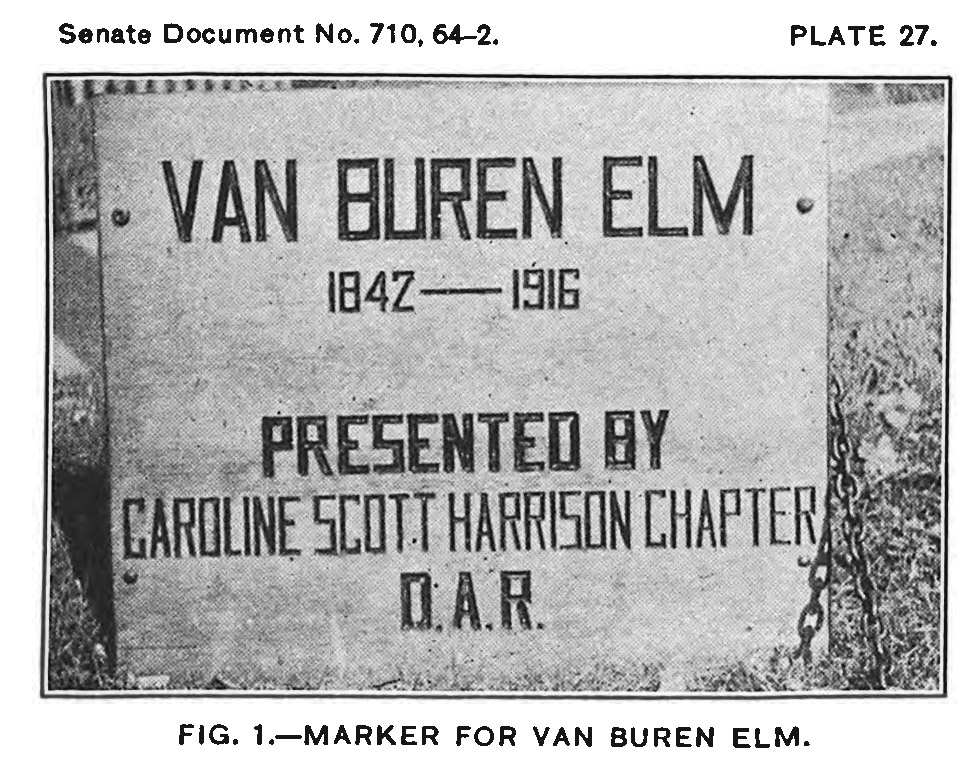
A few days later Teamster Mason Wright was awarded a $5 silk hat, although it was never explicitly stated it was for his skill in staging a stage crash - call it political slapstick. But the tree who's root had provided the fulcrum for the prank would forever more be known as the Van Buren Elm.  In 1916 (above) the Daughters of the American Revolution even gave the tree a wooden plaque of its own.
But the hard winter of 1926 brought the Van Buren Elm down, and a local doctor lamented, “The many friends of the old historic tree are loath to have it removed from their midst.”
Van Buren (above) made it safely to Illinois without further accidents. He was  met a few miles outside of Springfield by a small delegation of legislators, including the young Abraham Lincoln. But Mr. Van Buren was never elected to public office again. The judgement of Hoosiers stood firm.
The Quakers' Meeting House still stands among the stand of Elms at 256 East Main Street (corner of Vine) in Plainfield.  After the original Buchan Elm fell, a replacement was planted, and it received a bronze plaque (above).  This inspired a local grade school to be named for the dapper Democrat who stumbled in their town, and a street was named after him as well. But in Plainfield the National Road (now U.S. Route 40), is still called Main Street. That is true of many Midwestern towns bisected by the National Road. It truly was America's Main Street. And Martin Van Buren had been wrong about that.
 - 30 -

Blog Archive