August 2025

August  2025
I DON'T NEED A RIDE. I NEED AMMUNITION.

Translate

Friday, January 11, 2013

OH, HENRY!

I have long held the view that "anarchist" as a label became passé with the invention of psychiatry. Of course it has stuck around as a vestigial etymological fossil, but any current criminal shrink can now vouch that the loonies who espoused anarchy were really just pathological egotistical narcissists. As proof of this contention I now present you with the head of Emile Henri, who lost his head over the injustice he suffered because of another inarticulate Frenchman who sought to challenge the establishment and managed only to blow his nose at them.
Everything about Auguste Vaillant screams of irony. He was a kin of Lee Harvey Oswald, a little man who wanted to be important, but lacked the necessary attention span. He claimed to be the leader of a socialist group but seems to have been the only regular member. While waiting for the revolution he was ironically employed sewing expensive handbags and wallets for rich people to store their money in. 
Concerned about justice for the poor, Vaillant had abandoned a wife and two children - leaving them in poverty - and then lived with a deaf woman. For a political revolutionary to be living with a woman who could not hear his rants against capitalism passes beyond ironic into the realm of absurdity. And that is where we find Auguste Vaillant on Saturday December 10, 1893 entering the public gallery above the Chamber of Deputies, the French congress, carrying a sauce pan bomb in his overcoat. Ce n'est pas ironique, c'est le plus absurde
Auguste had constructed two sauce pan bombs, but discarded the larger one after realizing he could never sneak a 3 quart sauce pan past security. Spotting his intended target, the French President, standing on the Chamber floor, Auguste revealed and armed his 1 quart sauce pan. This attracted the attention of the woman sitting next to him. (“Excuse me, but is that a sauce pan bomb in your pocket or are you just unhappy to see me?”). She was able to deflect his throw so that the sauce pan bounced off a decorative cornice before exploding. The blast shattered Auguste’s right arm. The nuts and bolts packed around the explosive, shrapnel intended to kill 150 deputies, instead lacerated Auguste’s neck and chest. And the explosion blew his nose completely off his face. Unfortunately, the quick acting heroine was also badly wounded, as were at least 20 politicians. But the only person who died, if not immediately, was Auguste. Ce n'est pas tragique, c'est le plus absurde.
Auguste’s trial was brief. And on February 3, 1894, the guillotine finished what Auguste’s own bomb had started. His last words, before the blade severed the rest of his head from his body, were, “Mort à la société bourgeoise! Vive l’anarchie!” The translation would be, “Death to the Bourgeoisie! Long live Anarchy!” Even his last words turned out to have been ironic.
The irony developed because, of the millions who were outraged by Auguste’s departing utterance, the most significant turned out to have been another nobody anarchist fanatic, this one named Emile Henri, a 21 year old who was consumed with envy. Henri was convinced that Auguste’s noble death scene should have been his. After all, just over a year before had not Henri stricken a much more effective blow against the bourgeois but had received little of the press coverage afforded to the now headless incompetent dead man?
Henri had decided to strike his blow for striking miners. He packed 20 sticks of dynamite into a sauce pan and rigged to explode if it was jostled. He then carefully left this “infernal device” outside the second floor offices of a mining company just before lunch on November 8, 1892.
A lowly Porter noticed the sauce pan, and realized immediately it was probably not somebodies' lunch. But rather than evacuating the offices he ordered an office boy to carry the suspect sauce pan down to the street. Somehow the office boy made it in once piece, but he felt a little uneasy about just leaving it on the sidewalk, in case a passing pedestrian should be injured. So he alerted a nearby school crossing guard. She called the police, and two patrol officers responded. They tied a napkin around the bomb and then the three of them, the cops and the office boy, carried the bomb suspended between them to the local police station at the rather mis-named Rue des Bon Enfants (Street of the wonderful children.) There the bomb exploded, killing four cops and the office boy.
Henri had to lay low for awhile, but he was still living in anonymity in a crummy apartment when he opened his anarchist newspaper on February 4, 1894 to read of Auguste’s dramatic speech at his execution. And Henri was green with envy.
Now, there might be some who feel my tone slights the victims of such attacks; baloney. Murder has been anathema for at least six thousand years, when the ancient Egyptians made “Thou shalt not kill” their first commandment, predating Moses by at least a thousand years. If a human being is murdered by a serial killer, a lunatic at the controls of a hijacked jet, a deluded doctor, a drunk at the wheel of a car or a waiter too busy to wash their hands, the result for the victims is the same; tragedy. Fundamentalist Islamic-Christian-Marxist- Socialist-cultural-political justifications matter only to the perpetrator; I say again, baloney.
As if to prove my point, one week after the glorious execution of Auguste, Henri entered the restaurant at Hotel Terminus, next to the Gar Saint Lazare train station in Paris. He had stopped at two other bars earlier but, he claimed later, they weren’t crowded enough. My guess is he had not yet drunk enough courage. He nursed two drinks for an hour at the Terminus, and then as he staggered out the door, tossed his bomb back into the café, where it exploded, killing one. A waiter ran after Henri, who shot him. Two policemen took up the chase. Henri shot one of them. The other knocked him down and restrained him. Henri’s toll was now eight dead – five at the police station and three at the restaurant.
At his trial Henri was defiant and bombastic, until his attorney put Henri’s mother on the witness list. Henri objected. He told the judge, “It never occurred to me to inflict such pain on my mother.” In fact I suspect Henri was more concerned about sullying his image. It would be difficult to maintain an image as a heartless dedicated anarchist with a mommy telling stories about what crazy kid he was. 
According to the New York Times, On May 21, 1894 at “4:07 a.m.…the iron doors swung apart…Henri was ghastly white, but walked with a firm step. As he approached the platform he shouted, “Courage comrades. Long live anarchy.” His voice…trembled noticeably…As they pushed him against the plank he shouted again, “Courage comrades. Long live anarchy.”  He had evidently worked this out and wanted to be quoted exactly. The click of the knife was heard the next moment, and Henri’s head dropped to the ground. The blood from the trunk spurted high as the body revolved into the basket. (The executioner) himself picked up the head from the sawdust and threw it viciously into the basket with the body.”
Anarchy, it turned out, was not long lived. History proved it to be a temporary delusion, to join those other temporary delusions people have claimed as justification for random murder; communism, fascism, Black power, White power, the Basque Independence Party, the Irish Republican Army, the John Birch Society, the Confederacy, and the myriad other stupid self-justifications invented by humans.

 Hatred is a just another ideology in this respect - reduced to its core it is all about self.
- 30 -

Wednesday, January 09, 2013

TAKE YOUR SHOT


I keep looking at her face, and honestly, I just don't see whatever it was that captured his heart. They had the ultimate Age of Enlightenment cute-meet, but where he was a 38 year old endlessly curious bon vivant sociable genius, a doctor, a scientist and a poet, she had few friends and her only interest was religion. Her father, Anthony Kingscote, must have thought that at 27 his eldest daughter had long ago missed her chance to find a husband. And Catherine's plain face and down turned mouth (above)  hints that she had come to same conclusion. And then on a fair September afternoon, his balloon landed in a meadow near her home, and two years later she married one of the greatest men – ever - the man responsible for saving hundreds of millions of lives by applying the scientific method to an obvious problem. Clearly Catherine must have had a secret appeal. And Edward Jenner was smart enough to recognize it. Well, they also say opposites attract.
Edward Jenner had a few advantages. He was born wealthy, but not so rich he didn't have to work for a living, just rich enough he never cared more about money than about people. He never patented his great discovery, because he didn't want to add his profit to the cost of saving lives. And maybe that was Catherine's influence. And maybe it was the humanity he'd always had. And maybe it was because when he was still a child, his own father had inoculated him against small pox.
The two most deadly diseases in the 18th century were the Great Pox (syphilis) and the Small Pox (Variola – Latin for spotted). Reading the genetic code of Variola hints it evolved within the last 50,000 years from a virus that infected rats and mice, and then moved on to horses and finally people. It disfigured almost all of its human victims, leaving their features scared and pockmarked, even blinding some survivors. It killed half a million people every year – and 80% of the children who were afflicted. The chink in Variola's protein armor was that it had evolved into two strains, one which preferred temperatures of around 99 degrees Fahrenheit before it stated dividing, and the second which preferred something closer to 103 degrees.
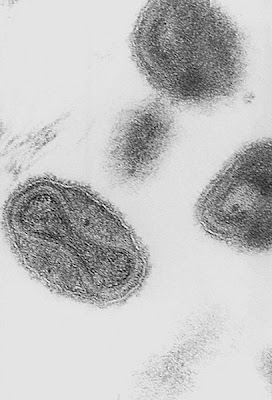
They called the lesser of these two evils the cow pox, and sometimes the udder pox, because that was where the blisters often showed up on infected milk cows. And it was the young women whose job it was to milk the cows who were the only humans who usually contracted the cow pox. They would suffer a fever, and feel weak and listless for a day or two, and, in sever cases have ulcers break out on their hands an arms. But recovery was usually rapid and complete, and there was an old wife's tale that having once contracted cow pox, the women would then never suffer the greater evil of smallpox. It was mucus from a cow pox ulcer which Richard's father had applied to his son's open flesh, in the belief it would somehow protect him from smallpox.
The working theory behind this idea was first enunciated by the second century B.C. Greek doctor, Hippocrates. Its most succinct version was “Like cures like.” Bitten by a rapid dog? Drink a tea made from the hair of the dog that bit you, or pack the fur into a poultice pressed against the wound. The fifteenth century C.E. Englishman, Samuel Pepys, was advised to follow this theory by drinking wine to cure a hangover. “I thought (it) strange,” he wrote in his diary, “but I think find it true.” And in 1765 London Doctor John Fewster published a paper entitled “Cow pox and its ability to prevent smallpox.” But he was just repeating the old wife's tale, and offered no proof. So the idea was out there. It only waited for someone smart enough to put the obvious to a scientific test.
In early May of 1796, Sarah Nelms a regular patient of Edwards, and “a dairymaid at a farmer's near this place”, came in with several lesions on her hand and arm. She admitted cutting her finger on a thorn a few weeks previous, just before milking Blossom, her master's cow. Upon examining both Sarah and Blossom Edward diagnosed them both as suffering from the cow pox. And he now approached his gardener, Mr. Phipps, offering to inoculate ( from the Latin inoculare, meaning “to graft") his 8 year old son James, against small pox. The gardener agreed, and on May 14th Edward cut into the healthy boy's arm, and then inserted into the cut some pus taken directly from a sore on Sarah Nelm's arm.
Within a few days James suffered a slight fever. Nine days later he had a chill and lost his appetite, but he quickly recovered. Then, 48 days after the first inoculation, in July, Edward made new slices on both of James' arms, and inserted scrapings taken directly from the pustules of a smallpox victim. And this time what should have killed him did not even give the child a fever. Nor did he infect his two older brothers, who shared his bed. Over the next 20 years James Phipps would have pus from a small pox victims inserted under his skin twenty separate times. And not once did he ever contract the disease. He married and had two children. And when Edward Jenner died, James was a mourner at his funeral. The original boy who lived did not pass away until 1853, at the age of 65.
Edward Jenner coined the word vaccine for his discovery, from the Latin 'vacca' for cow, as a tribute to poor Blossom, whose horns and hide ended up hanging on the wall of London's St George's medical school library. And that was the whole story, but, of course it wasn't, because it wasn't that simple, because nothing is that simple - certainly not the immune response system developed on this planet over the last four billion years.
Edward duplicated his procedure with nine more patients, including his own 11 year old son, and then wrote it all up for the Royal Society of London for Improving Natural Knowledge. And those geniuses rejected it. They refused to publish it because they thought his idea was too revolutionary, and still lacked proof. So Edward, convinced he was on the right track, redoubled his efforts. When he had 23 cases and the Society still refused to publicize his work, Edward self published, in a 1798 pamphlet entitled “An Inquiry Into the Causes and Effects of the Variolæ Vaccinæ, Or Cow-Pox”
By 1800, Edward Jenner's work had been translated and published world-wide. Problems were revealed
There was a small percentage of patients who had an allergic reaction at the vaccination sites, and eventually it would be decided not to inoculate children, as their immune systems were not yet strong enough to resist the cow pox. And without a fuller understanding of how the human immune system functioned, it was impossible to know “to a medical certainty” (to use legal jargon) how the vaccine would affect specific groups of patients. Still, the over all reaction was so positive that Edward was surprised by the reaction of the people he called the “anti-vaks”.
Opposition became centered on the Medical Observer, a supplemental publication by the daily newspaper, The Guardian. After 1807, and under editor Lewis Doxat, it condemned Jenner's introduction of a “bestial humour into the human frame”, and in 1808 its readers were assured they should not presume “When the mischievous consequences of his vaccinating project shall have descended to posterity...Jenner shall be despised.” Edward was even accused of spreading Small pox, for various evil reasons. The argument presented from the pulpit was that disease was the way God punished sin, and any interference by vaccination was “diabolical”. Under this barrage the percentage of vaccinated children and adults in England still climbed up to around 76%. But without 100% protection the Variola survived, and in January of 1902 there was yet another outbreak in England that killed more than 2,000.
About 500 million human beings world wide died of Smallpox after Edward Jenner introduced his vaccine. But the last victim was Rahima Banu, a 2 year old girl in Bangladesh, in 1975. At 18 she married a farmer named Begum, and they gave birth to four children (her again, below). And each of her children is living proof that while religion may save souls, science saves lives.
The scientists working for the World Health Organization issued a report on December 9, 1979, which announced, “...the world and its people have won freedom from Smallpox.” Variola was extinct, wiped out to the last living cell, by the dedication of scientists and those working under their guidance. It was, as Jenner himself wrote after the first successful eradication on Caribbean islands, “I don’t imagine the annals of history furnish an example of philanthropy so noble, so extensive as this.”
His dear Catherine died of Tuberculosis in 1815, and Edward followed her in January of 1823. And for his life – and her's – we all owe a great debt. He was like the bird in his poem “Address to a Robin”: “And when rude winter comes and shows, His icicles and shivering snows, Hop o'er my cheering hearth and be, One of my peaceful family: Then Soothe me with thy plaintive song, Thou sweetest of the feather'd throng!”
- 30- 

Tuesday, January 08, 2013

Sunday, January 06, 2013

PEACE- OPENING JAPANESE EYES


I am continually amazed that it wasn't until June 22nd, 1945, a year after the Tojo cabinet had collapsed - a year after Japanese leaders realized that they had lost the war -  that the Emperor finally called a meeting of his ‘Big Six" advisers, his official cabinet, to discuss how to get out of the war. He told them openly for the first time , "I desire that concrete plans to end the war, unhampered by existing policy, be speedily studied and that efforts made to implement them." Still, there was no talk of terms, and no effort to "push" the process.
The Japanese options had been reduced to just waiting for the invasion of their most southern island, Kyushu, the next logical target of the U.S. forces, where the Japanese military leaders were convinced they would win the "Big Victory" - that Okinawa was supposed to have been, that the Philippines was supposed to have been, that the Marianas was supposed to have been -  that would bleed the Americans enough to force them to offer better terms.
The terms the Japanese were seeking, at this late point in the war, were; 1) no allied occupation of Japan, or at worst only a symbolic one, 2).any war crimes trials to be in Japanese courts and prosecuted by Japanese officials, 3). retain the military in any Japanese government, and 4) to retain the Emperor, as the religious and political symbol in Japan.  For the generals and admirals, the survival of the Emperor had become a code word for the survival of their own power.
The leaders of Japan, meeting among the wreckage of Tokyo, were certain that a great enough slaughter, mostly of their own people, would drive the Americans to negotiate. And they were certain they could out-negotiate the Americans. Why such clever people were losing the war was a question never asked in public nor in private by the Japanese military leadership. In truth, none of these terms Japan was expecting to get would have been acceptable to the Americans, even a year earlier; with the possible exception of the retention of the Emperor in a symbolic role.
The Japanese plan, when it was agreed upon, was to use the Russians as a conduit to negotiate with the Americans.  And July of 1945 was spent trying to open that conduit.  It  seems never to have occurred to Japanese military leadership that the Russian dictator Stalin would see a weakened Japan, the nation which had humiliated Russia in 1905, as an opportunity too good to pass up. So the military was not suspicious when the Russian response to the requests for meetings seemed slow and dim witted, almost obstructionist. And the niceties of diplomacy slowed everything down even more. But, by the beginning of August, it seemed to the desperate Japanese leadership that some progress was being made with the Russians.
The plans of Japan's rulers did not begin to unravel until August 6th. 1945. Reports began coming in that morning that something unusual had happened in Hiroshima. First reports were of a “blinding flash and violent blast”.  Since no communications came out of the city after that first report, a staff officer was ordered to fly over and provide information. One hundred miles from Hiroshima the staff officer could see a huge cloud still rising from the blazing port ( two hours after the attack).
Surrounding villages were being swamped with vast armies of wounded, burned and simply stunned victims stumbling their way out of Hiroshima.
Relief workers began to press through to the city. Power to some parts of the town was restored the next day, and rail service the day after that. But to all intents and purposes, the core of the city of Hiroshima had been wiped off the map, the port facilities destroyed, and one of Japan's few remaining intact military bases was simply gone. There were at least 80,000 dead. Over the next five years, radiation would raise that toll to nearly 200,000.
The "Big Six" argued about what had happened, with most denying the Americans could even have such a weapon. The debate was settled sixteen hours later when Japanese monitoring posts picked up the broadcast of President Harry Truman announcing to the American people that, "The power of the sun" had been unleashed on Japan, and adding “We are now prepared to obliterate rapidly and completely every productive enterprise the Japanese have…” It did not seem to be a threat. It seemed rather, to be a promise. 
And that might have seemed a powerful threat to make to the Empire of the sun. But one of the "Big Six", Admiral Soemu Toyoda, now argued that even if the Americans really had such a bomb they could not have many more. What he based that opinion on was unclear. But at least three of the Big Six took solace from the Admiral and continued to perfect their plans for their Oriental Gotterdamurung.  It was yet another pure delusion. And in retrospect, it was a delusion that should have been expected.
Even before the Atomic bomb on Hiroshima, the Americans had crippled Japan. Hundreds of thousands had already been killed, well more than a hundred thousand in one March 1945 Tokyo fire raid alone. No train was safe in daylight, no city or factory safe.  Japanese soldiers in Korea and Manchuria were starving. Troops in Japan were spending as much time tending to rice fields as training. And the harvest so far that year had been very bad. Come winter, invasion or no, there would be mass starvation in Japan, and throughout the Japanese military.
Japan could do nothing to oppose the massive flights of B-29’s, now joined by B-17’s and B-24’s of the mighty 8th Air Force, freed from their conquest of Germany, which were together pounding Japanese cities and military bases, day and night.
And nothing hindered the mass waves of P-51's, P-47's and P-38's  based on Iwo and Okinawa, which were now doing to Japan what they had done to Germany; sweeping across the country at will, striking at "targets of opportunity", destroying and sinking everything that moved, be it a supply or passenger train, a single horse and cart or a poor fishing boat. There was almost nothing left to oppose them. What little remained of Japan's air force was being held back to oppose the landings. Japan's navy was scattered across the floor of the Pacific Ocean. Their cities were being reduced, one by one, to wastelands occupied by scarecrows.
And now, almost as an after thought, an atomic bomb had vaporized one of Japan's cities. And there was a threat of more to follow. And yet the "Big Six" council's only plan remained to wait for the American invasion of Kyushu and kill as many Americans as possible in order to force them to negotiate. About 40% of Japan's remaining military strength had been transferred to Kyushu to fight that battle. But that mass of forces was, in my opinion, and to borrow the words of historian Bruce Catton, describing the Confederate defenses of Fort Donaldson against Grant, "Too little to defend the place, and too much to lose."
Again, Japan failed to inform the Americans what their intentions now were to continue fighting for a better set of surrender terms. And to the Americans it seemed the Japanese were just insane and without logic, an entire nation of kamikazes, in love with death. And since the Japanese were not offering the Americans any alternatives, and since the Americans were not offering the Japanese any terms, there was no way for either side to consider any way out of the slaughter, without more slaughter. And this, a full year after leaders on both sides agreed that the Americans had effectively won the war.
And then, at about four AM on August 9th, 1945, the Soviet Union, which the Japanese leadership had expected to help negotiate a peace, announced they were voiding their non-aggression pact with Japan and joining the Americans in carving up the Imperial Empire. At the same moment Soviet air and ground forces invaded Japanese occupied Manchuria in great numbers and strength.  What remained of Japanese complacency began to finally collapse, not from the bomb, but from the Soviet military.
- 30 -

Friday, January 04, 2013

THROWING A PARTY


I think of him as one of those self-made right-wing technocrats, who used his fortune to finance an ultra-conservative agenda - a Ross Perot or the Koch family. In this case the technology was the telegraph, and the agenda was the 19th century version of Islamaphobia. Samuel Finley Breese Morse (above) learned to fear the 'Bavarian Illuminati' from his minister father's Sunday sermons. As an adult Samuel proselytized that the Roman Catholic Church was flooding America with Irish and German Catholic immigrants to establish a new Vatican City in the Mississippi valley. Wrote Morse, “Surely American Protestants...(will) discover...the cloven foot of this subtle foreign heresy. They will see that Popery is...a political as well as a religious system; that...differs totally...from all other forms of religion in the country.” In 1836 Morse ran for Mayor of New York City. He lost big. But the poison he was peddling (and funding) would take root.
It sprouted into full flower in the congressional elections of 1854, catching on “like measles”, according to one Democrat. The organization was officially known as “The American Party”, but commonly refereed to as the Know Nothings, because its members were coached to respond to all questions by admitting only, “I don't know”, and because, frankly, in the eyes of their critics, they just seemed to be not very bright. Membership was limited to white males of proven English heritage, and usually evangelical Protestants,. And although most of the new candidates had never been active in politics or held public office before,  they won 61 seats in the U.S. House of Representatives. They elected a governor and all the other posts open that year in Massachusetts and Maine. They controlled the state legislatures in Pennsylvania and most of New England. They gained advantage in Maryland, Delaware, Kentucky and Tennessee by taking no position on slavery. This hurt them in the south, as did violence and murders in Chicago, Philadelphia, Baltimore, St. Louis, Boston, New York, Columbus, Cincinnati and New Orleans. Still, the Know Nothings looked certain to capture the White House in 1856. And then came Bloody Monday in Louisville, Kentucky.
They held three elections in Louisville in 1855. On April 7th, voters threw out the incumbent mayor, who had converted to Catholicism, and elected a Know Nothing replacement and a majority on the city council. They followed this a month later by electing a Know Nothing majority of county court judges. Then the school board fired every Catholic teacher, save one. The Know Nothings were feeling both confident and paranoid - it was the nature of the party and the movement. Now another Know Nothing, Charles Morehead, was favored to win the governorship on yet another election, Monday August 6th. On the night before, 1,500 Know Nothings staged a torch light march through Catholic neighborhoods, warning them “to keep their elbows in” come morning.
Maybe no one other than Reuben Thomas Durrett (above) could have made the nation face the truth about the Know Nothings. Others wrote about it, but they lacked his resume. R.T., as he preferred to be known, was a defense attorney, and familiar with arguing unpopular causes. He was “intellectually and physically...a magnificent man.” More than that he was a poet, and a lover of truth and history. He had a 50,000 volume personal library. And 300 years earlier, his French Protestant ancestors had barely escaped the St. Bartholomew's Day massacre in France. So when the political spin machine tried to smother every honest voice in Louisville, it was R.T. who validated the reality. “To my mind,” he wrote, “the whole secret of the success of this disgraceful affair was...that the Know Nothing sympathizers were prepared and armed for the conflict...”
According to R.T., the thugs, hired as “special police”, formed a gauntlet in front of the polls. If a would-be voter were an immigrant from Germany or Ireland he was presumed to be Catholic, and was “... ordered by one of the bullies to leave...” And if he refused, “...he was attacked by the whole mob, severely beaten and driven away. If the man showed fight, his life was in great danger. “ Recently ousted Mayor James Speed watched the beatings on the courthouse front lawn from eight in the morning until six. “It was not fighting man to man, but as many as could fall upon a single Irishman or German and beat him with sticks or short clubs...” The clubs were specially made with lead weights in their tips, and mass produced. In the afternoon Speed was told 200 shotgun wielding “Germans” had captured a polling place. Speed knew this to be a fantasy and said so. But the informant, a judge, “replied with warmth showing that he believed it to be true.” About four in the afternoon, things went from bad to worse.
Two Catholic activists, Theodore Rhodes and David Doughtery were warning everyone in their east side neighborhood off Main Street. They stopped at Micheal O'Connor's grocery store, at the corner of 10th street and warned him to close. As they came out of the store a man ran up to them. Basil Rhodes, Theodore's father, who lived a block away, saw the man shoot his son dead. The gun shot drew Know Nothings from all directions, and it quickly became common knowledge that the reverse was true, that a Catholic had killed a Know Nothing. What followed was wholesale murder.
The worst of it was Quinn's Row, a block of 12 three story row houses along Main between 11th and 12th streets. Around eight that evening a Know Nothing mob set fire to a ground floor corner grocery run by a family named Long. Recorded a Catholic newspaper, “Seeking to escape...the wretched inhabitants reached the street only to meet death in another form. As soon as one appeared at a door he was fired at...” Mr. Long and two of his sons died that night, as did several of the residents of the upper floor apartments. “A number were taken off badly wounded, and others...returned to the burning houses, preferring rather to be burned than to meet the infuriated mob. One man escaped in woman’s clothes, was detected and shot. Another, who came out covered with a blanket, and, leaning on the arm of his wife, was torn away, and deliberately shot.”
While the first building was still raging, the feed store next door and its apartments went up, followed by a vacant house, then a tobacconist. Noted the newspaper, “How many of these miserable people thus caged in their own houses were burned alive there can be no computation.... Two men were hanged from their banisters of their own homes and also consumed in the flames.” In the last structure on the street, a rooming house, Patrick Quinn, who owned the entire block, was driven outside like the others. Recognized because of his investments around the city (and his brother who was a priest) , he was singled out, beaten to death, and his corpse was thrown back into the fire.
The official version said that 22 people had been killed in the entire city on Bloody Monday It is much more likely that the number was at least 100. The death toll would have been higher but in the German district one of the first buildings looted was Armbruster's brewery. The rioters got so drunk they could only satisfy themselves with torching the building before passing out. The new Know Nothing Mayor, John Barbee, managed to save two Catholic Churches from the rioters, but no one was ever prosecuted for the murders, the beatings or the arson. In response the despised immigrants voted with their feet. Ten thousand left Louisville over the next few months, almost 25% of the cities' population. In the city left behind businesses failed, unemployment soared and city coffers dried up. Charles Morehead was easily elected governor. but it was the classic tale of “be careful what you wish for”.
Most of the Irish moved to Chicago. Typical was ex-Mayor Speed, who became active in Republican Party politics and served in the Lincoln administration. The Germans mostly moved to St. Louis and Milwaukee, and some to Kansas City, Kansas – ensuring that state would remain in the Union come the Civil War. It was that war which put the entire Know Nothing movement into perspective.
The Civil War made the Know Nothing agenda obsolete. Immigration was the great enemy in the eyes of Samuel Morse. But the actual cause of the war was the industrial revolution, and the refusal of one half of the nation to recognize mechanization was making human slavery obsolete. The mathematician Alfred Whitehead observed, “The major advances in civilization....all but wreck the societies in which they occur.” And in his book “War and Peace in the Global Village” Marshall McLuhan explains why that is so. “When one has been hurt by a new technology, when the private person or corporate body finds its entire identity endangered...it lashes back in a fury of self-defense...But... the symptom against which we lash out may be caused by something about which we know nothing.” McLuhan calls that symptom “Phantom Pain”, and compares it to the agony amputees report they feel in missing limbs.
Although America has institutionalized such cultural revolutions, and has succeeded by taking advantage of them in the past, that does not make our politics, and did not make the politics of our ancestors, any easier to live with. Politics are never a solution. Politics are only another symptom.
- 30 - 

Blog Archive