August 2025

August  2025
I DON'T NEED A RIDE. I NEED AMMUNITION.

Translate

Friday, July 08, 2011

HOME IS THE HERO

I hate misplacing things. Because no matter what you have misplaced, the cost of finding it is always double. First there is the cost of the thing. Then because of the flaying about looking for the thing, you lose your train of throught. I find its always better to just assume I lost the thing years  ago and believe it will eventually  turn up. I learned this lesson from John Paul Jones, the pugnatious and aggressive Scotsman who founded the American Navy.
John Paul had the first requirment for greatness; luck. While serving as third mate on board a merchantman in 1768, both the captain and the first mate died of yellow fever, instantly promoting him. Over the following years Captain John Paul aquired a reputation for brutality. And just when the bad press had brought his carreer to a a dead end, luckily, his brother died in the colony of Virginia and left him a small fortune.
John Paul decided to stay in Virginia, and to confuse any hounding lawyers added a third name to his moniker. And when, luckily, the shooting started in Boston, Captain John Paul Jones packed up his resume and offered to fight for his new country as a privatier.
At first he did most of his fighting just to get a ship. But when he finally did, flying the American flag while sailing out of France, he had at last justified his luck. He raided British ports. He captured British merhcant ships in full view of the English coast. He lashed his ship to an English warship and fought it out until both ships were sinking. Offered a chance to surrender, he responded, “I have not yet begun to fight.” Then the British warship surrendered to him.
When that war was over John Paul Jones was out of work. So, with congressional approval, he hired on with the Russian Navy. But that never worked out and he even contracted pneumonia. In May of 1790 he returned to Paris. And it was there, on July 17, 1792, that the 45 year old was found lying face down on his bed, dead as a doornail. His sevents and admirers pickled the hero in rum, packed him into an iron coffin, and buried him in the old Saint Louis Cemetery, set aside for foreign protestants.
Unfortunatly, three weeks after John Paul Jones was laid to rest, a mob decended on the Royal Palace of Tuileries, and captured the King and Queen. To achieve this, they had to first butcher his Swiss guard, and their bodies were dumped into a common grave right next to Jones' resting place. What with the revolution and wars, by 1796 the cemetary was abandoned and forgotten. And unfortunatly for the next 100 years John Paul Jones floated in rum, and slowly decomposed while the mundane world went on with out him and about him. In time the land atop John Paul Jones came to be occupied by a grocery, a laundry, an apartment house and their attendant sheds, toliets, cess pools and wells.
And there he might have stayed had not, luckily, a lunatic shot American President William McKinnely in September of 1901.
That lunatic made Vice President Teddy Roosevelt, at 44, the younget man ever to take the oath as President of the United States. And when Teddy decided to run for his own term, in 1904, he was opposed by Republican National Chairman Mark Hanna (below), who protrayed his fellow Republican Teddy as a wild eyed lunatic, and called him  “that damn cowboy”.
What Roosevelt needed in 1904 was anything that would make him look like a stalwart defender of tradition. Luckily, he found what he needed when his abassador to France pointed out that one of our greatest Revolutionary War heroes had been MIA in Pais for the last one hundred years. So the order went forth in typical Teddy Roosevelt fashion, “Dig up our hero! Whatever it costs!"
General Horace Porter (above) was a civil war hero, a friend of President Grant, and now the amasador to France. He had become obsessed with finding the body of John Paul Jones in 1897 after a biography of the old salt was published. And after three years of research through old maps and confusing government records Porter found the cemetary where Jones had been buried, now adjacent to the Rue de la Grange aux Belles, or in the more prosaic English, Street of the Beautiful Barn. Because of all the construction, the only way to recover the hero now was to tunnel into the graveyard, not a pleasant occupation, but a great plot for a horror movie.
Before he could dig, Porter had to get the current owners’ permission. It took him two years to negotiate the price for a 3 month contract with all the local land owners. At the same time President Roosevelt submitted a special appropiation to pay the $35,000 price tag to dig up John Paul Jones’ corpse. John Paul would not have been surprised to discover that a hundred years had not made the Congress any more rational. On evening of Friday, February 3, 1905, Mr. Porter started the work, on his own dime. Congress had ignored the President's request.
Heading the project was M. Paul Weiss, who had been trained as a mining engineer, and he was going to need all that training. Weiss sunk the first shaft 18 feet straight down into a back yard. He discovered that the bodies had not been moved. That was lucky. Unfortunatly, despite the construction over the graves, the ground was not well compacted, and a great deal of time would have to be spent shoring up the shafts, and supporting the building walls. Noted Porter, “Slime, mud, and mephitic (fould smelling and poisonous) odors were encountered, and long red worms appeared in abundance.”
“Two more large shafts were sunk in the yards and two in the Rue Grange-aux-Belles, making five in all. Day and night gangs of work men were employed…Galleries were pushed in every direction and ‘‘soundings’’ were made between them with long iron tools,…so that no leaden coffin could possibly be missed."
The wooden coffins had long since corrided away. The bodies had been slowly decaying in the soil, and the miners introduced waves of fresh air that hastened the decay. The stench was often overwhelming. Three lead coffins were found, the first on February 22, and the second a month later. Those two had copper plates identifying their occupants. Neither was John Paul Jones.  Shortly there after they found the King’s Swiss Guard, in their mass grave, stacked one atop the next. And now Weiss knew they were on the right track.
On March 31st the miners hit the third lead coffen, without a plate The crew decided they needed more fresh air before they opened it. It was a lucky thing they did.
On April 8th they they finally struggled to pry loose the coffin lid, under the watchful eye of Ambassador Porter (above, left). The body inside was wrapped in tin foil. The stench of alcohol filled the tunnel. Rolling back the tin foil, there, with his nose bent by the weight of the coffin lid, was the recognizable face of John Paul Jones. After a hundred years he needed a shampoo, but that was to be expected.
Doctor J. Capitan performed an autopsy and determined that the heart and liver were normal, but the left lung showed signs of “small patches of broncho-pneumonia partially cicatrized” He wrote that he had come to the conclusion that “the corpse of which we have made a study is that of John Paul Jones”.
Teddy Roosevelt ordered up a fleet of 11 battle ships to escort Captain John Paul Jones back to America. On April 24, 1906, he was placed in a temporary tomb in Bancroft Hall at the U.S. Naval Academy, in Anapolis, Maryland. It was temporary tomb because Congress had yet to pass the appropiation to pay the cost to recover the body.
When the hero arrived home, Teddy Roosevelt gave a speech. He had been re-elected President without serious opposition because, luckily for Teddy, Mark Hanna had died of typhoid fever in February of 1904. So the the entire trip had been unnecessary. And Congress never did pass that authorisation to pay for the effort. Poor General Porter had to take up a collection. But at least, at last, John Paul Jones was home. I told you he was lucky.
- 30 -

Wednesday, July 06, 2011

APOCALYPSE NOT


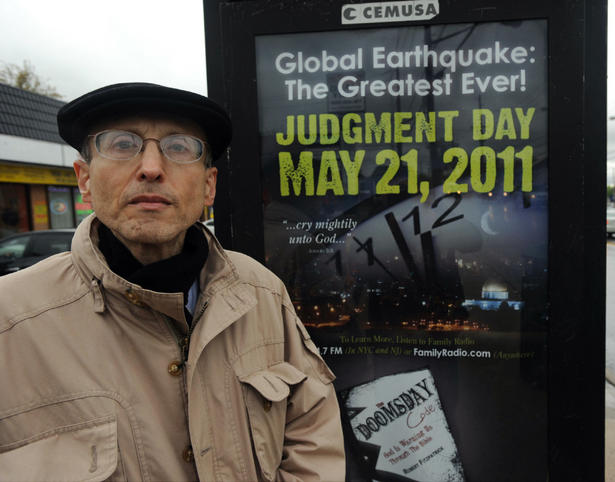
I've got to give Harold Camping credit for being original. Having predicted the end of the world on May 21, 2011 – at 6:00 pm Eastern Standard Time - the California prophet of pessimism was forced to explain as of May 22nd, why the world had not ended. Usually the mystically mistaken spend the rest of their lives rationalizing their inexplicable existence – much as the rest of us do normally. But Howard has found a new way to avoid facing up to this reality check. On May 23rd, 2011, the day after the day after doomsday, Howard went on his church's radio network and assured his confused followers that, in fact the world had ended two days earlier, just as he had predicted. The rest of us just hadn't noticed it yet. And I think that is a groundbreaking philosophical position to take.
Of course Harold then negated his achievement by declaring we will all notice when the Pearly Gates of Heaven officially slam shut on October 21, 2011. And for Harold's sake, I hope that prediction comes true. But if not, then I would suggest that Dorthy Martin could teach Harold a thing or two about dealing with cognitive dissonance, which is what happens when what you believe does not match up with what you know. You see, for Dorthy, the end of the world was just the beginning.
Dorthy Martin, a fifty-four year old housewife, received notice on August 27, 1954 that the world was going to end. She received this terminal revelation via a letter from a complete stranger – as in a stranger from the planet Clarion. And you can't get much stranger than that. The missive arrived at Dorthy's home at 847 West School Street in the north side of Chicago in the Lake View neighborhood, not by United States Postal Service - something with a return address or a postal stamp to indicate the point it entered our world - but via the mystical and untraceable communication mode of “automatic writing”, “...the process, or product, of writing material that does not come from the conscious thoughts of the writer.”
The notice sent to Dorthy explained that before dawn on Wednesday, December 21st, 1954 the sea would rise up and consume England, France and the underpants of everybody in Chicago. An inland ocean would form between the Appalachians and the Rocky Mountains, joining Hudson Bay in Canada with the Gulf of Mexico. Needless to say this geological cataclysm would doom all of humanity, and Dorthy had been singled out by The Guardians from Clarion to deliver the eviction notice.
It is interesting to note that unlike Harold's heralds, the followers of Dorthy (called Seekers) felt little compunction to spread word of the approaching apocalypse, except for a single article in a Chicago newspaper. Still the validity of the prophecy was reinforced by a stream of letters "The Guardians" mysteriously left in Dorthy's apartment over the following weeks. These helpful aliens even started calling Dorthy via the primitive technology of the Illinois Bell telephone system. In any case, as the final destination date approached the members of Dorthy's little group suffered the emotional pendulum swings between joy at meeting their savior to the horror of meeting their savior. Devotees sold their homes and belongings, and even abandoned spouses and family. And then on December 17th The Guardians of Clarion threw Dorthy and her followers a lifeline.
In a crucial phone call, Dorthy was told that at midnight on December 20th,  several pea-pod shaped space craft, each big enough to hold ten passengers, would land in the nearby suburb of Oak Park. Presumably this location was picked by  The Guardians because it was the birthplace of Frank Loyd Wright, Ernst Hemingway and the voice of Homer Simpson. Every human chosen to be saved from the coming devastation must be waiting in her apartment at the appointed hour to be transported to the Oak Park spaceport. But first they must remove all metal from their bodies, including zippers, bra straps, cigarette lighters wedding rings, ear rings, even eyeglass frames held together with tiny little metal screws. And that was what they did.
At the stroke of midnight about fifteen people were standing in Dorthy's living room wearing their overcoats, the few men holding their pants up with one hand, the majority women with crossed arms to support their belatedly liberated breasts. Their excitement grew as the minutes ticked by until...nothing happened. No Guardians appeared with boarding passes. No pea pod space ships arrived. As the hour of doomsday passed over them Dorthy's back yard remained just another random void along the space time continuum. Dorthy was observed crying. A few people walked out. By 4 AM the remaining would-be passengers were offering competing explanations as to why salvation had not yet arrived. But forty-five minutes later, they are all proven wrong when Dorthy received yet another missive from The Guardians, via automatic writing.
However, this missive was different. This one came from one Guardian in particular. He gave his name as Sananda, and his message was one of great joy. Doomsday had been canceled. Because of the devotion and dedication of the Seekers it had been decided by the “God of the Earth” to not end the Earth. It was a Christmas miracle. But, for some strange reason, when Dorthy's little group tried to spread the good word that the world was not going to end, the news media was not interested. I guess, as the old saying goes, no news is good news, and really good news is no news at all.
Dorthy retreated from Chicago to familiar territory, a Dianetics training facility in Arizona. She stayed there a short time before, after changing her name to “Sister Theda” she moved to Peru and established a religious retreat on the shores of Lake Titicaca. She called her new community the Abbey of the Seven Rays. Then in 1965 she returned the United States, to Mount Shasta, California and then in 1988 back to Arizona. Outside of Sedona, she formed “The Association of Sananda and Samat Kumara”. She preached there for a small congregation for the rest of her life, preaching of the approaching doomsday and the rescue of faithful via flying saucers, before“transitioning” to a higher plane in 1992 - 38 years after she saw the world end. And that is what you call a successful second career.
"The Association of Sananda...” has survived Dorthy. In its own words, “We are standing by in readiness to loose the ones who are of other time bands. They will be gathered up and relieved of the holocaust of coming events.” So you see, Harold, there is life after death, or at least life after Judgment Day. So pay attention Harold. Predicting the apocalypse doesn't have to be your apocalypse.  And, that's a wrapture!
- 30 -

Sunday, July 03, 2011

THE SECRET OF CAPITALISM Part One

I would like to see every PhD.. candidate in economics at an American university required to make a pilgrimage to the Unita Mountains, about 100 miles due east of Salt Lake City, Utah and about the same distance north-north west of Golden, Colorado. There, looming over tributaries of the Green River stands a lonely, wind swept conical peak, and a 7,000 foot high mesa called Diamond Mountain Plateau (above). There are no diamonds in Diamond Mountain, but amongst the scrub brush, gravel, and oppressive isolation there is a zircon of veracity for these academic acolytes to contemplate, one brilliant shinning baguette illuminating the fundamental and eternal truth behind capitalism – greed makes you stupid.
In 1846, the 17 year old Philip Arnold left his home in Elizabethtown, along with his cousin John Slack
to join 4,700 of their fellow Kentuckians serving in the Mexican war. Both men were mustered out in 1848 in Texas, and rather than returning east, they joined the California gold rush. Like the vast majority of prospectors, they found no gold. They both worked for a time at a mine in New Mexico. Philip eventually found employment in San Francisco at the new Bank of California - owned by William Ralston – as an appraiser of other prospector's gold claims. It was not the romantic life's adventure Phillip had dreamed of, and as the precipice of middle age yawned open before him, he found less physically demanding employment, as an assistant bookkeeper for “General” George D. Roberts, at his Diamond Drill Company.
From this reasonably secure pedestal Philip watched as the pattern established in California in the 1850's was repeated in the gold and silver finds in Nevada of the 1860's. Out of the thousands of prospectors who rushed in, a mere handful of the early arrivals actually found gold, and they were quickly bought out or squeezed out by the mining conglomerates. In 1869, when word spread of an 83 carat diamond picked up in plain sight on the ground by a sheep herder, hundreds of aging desperate 49'ers even boarded ship for South Africa, knowing they would arrive months too late to strike it rich. So it was no wonder then that in 1870, at forty years of age, Philip Arnold gathered his life savings, quit his job and along with his cousin, went prospecting for diamonds in America. Amazingly he found them.
In early February of 1872, two dusty unshaven prospectors carrying a battered raw hide bag walked into a San Francisco saloon, ordered drinks and sat alone. Their furtive arguing, and their sheltering of the tattered bag, immediately drew attention. Many of the denizens recognized them as John Slack and Philip Arnold. After several minutes, the pair paid their bill and left. But they repeated their argument at several saloons before finally presenting themselves, dusty and unshaven and now reeking of whiskey, at the main office of the Bank of California. Without a word of explanation, they presented their bag for deposit. It was accepted and recorded by the bank manager as filled with diamonds, rubies and other sapphires. It took about twenty minutes for the whole town to be assemble the story and to be set afire with rumors.
The manager immediatly notified his boss, William Ralston. And when Ralston made inquries about the  two men, he then urged Major George Roberts to contact his old “friend” Philip Arnold. But Philip was reluctant to talk, and John Slack was virtually mute. After plying the prospectors with whiskey for hours, Philip finally admitted that some where in the great desert wilderness of Utah territory, just before winter drove them back to civilization, they had found a mountain literally peppered with diamonds and sapphires. The bag deposited in Ralston's bank was just a sample of what they had picked up in a few hours. Arnold explained, they had filed on the claim and were now the legal owners of a diamond mountain.
It was an unbelievable story. But Ralston (above) and Roberts both knew Philip Arnold as a trustworthy and honest employee. And John Slack was also know around town as a dull but hard working man. And there was a logic to finding yet another massive, rich deposit of wealth in the American west, where everything was possible. The biggest problem at this point was getting information out of the two prospectors. Over the next few weeks banker Ralston and a small group of close investors managed to convince the pair to allow two local jewelers to examine the diamonds. They pronounced the contents as worth $125,000. This inspired Ralston to offer $50,000 for one half of one percent interest in the claim, if it were first examined by two experts, one being David Colton, part owner of the successful Amador gold mine, and the other expert was General Roberts. Reluctantly, Philip Arnold and John Slack agreed to take these experts to their claim.
In early March they traveled by railroad from San Francisco to Sacramento. There the two prospectors and their charges boarded the Central Pacific Transcontinental Train, climbing over the Donner Pass, down into the Nevada basin and across the Utah desert. After 36 hours on the train, Philip insisted the two experts put on blindfolds, and they meekly complied. They rode across the desert with their eyes covered, and then just before dawn, at a small seemingly abandoned station, the train pulled to a stop.
Philip and John helped the two men, still blindfolded, off the train and onto horseback. Immediately they continued their journey. For the next two days the experts, softened by life in San Francisco, suffered on horseback in the oppressive heat of the sun, and endured freezing temperatures each night. They were allowed to remove their blindfolds only after sunset. And starting before sunrise each morning, they were required to replace their blinders. And then, just as they had grown so frustrated they were on the verge of ripping off their blindfolds, the horses were brought to a stop, and their blindfolds were removed.
What was revealed was a flat desert mesa, covered in scrub brush and gravel, with an odd thurst of a mountain at it's foot. Colton and Roberts wandered about, staring at and kicking the nondescript terrain until, suddenly, Colton reached into what appeared to be an ant mound and pulled out a small hard brilliant crystal. In an instant the two excited experts agreed. The Great Diamond Mountain was real!
They spent several hours collecting gems – diamonds and sapphires – before Philip Arnold and John Slack re-blindfolded the men and led their horses back off the mesa. It was a two day journey back across the horrible desert, and, flagging down the transcontinental train in the dark, Colton and Roberts were accompanied by Arnold and Slack as far west as Oakland. There they collected their $50,000 payment and returned to their "diggings". But the two experts continued on to San Francisco with the two bags of jewels they had collected.
With those jewels in hand it seemed obvious to William Ralston (above) that the Diamond Mountain Claim was going to make him and his friends (such as Colton and Roberts) even richer than they were already. But first they had to squeeze Philip Arnold and John Slack out of the deal as quickly and as inexpensivly as possible. And you know, Mr. Ralston was half right.
- 30 -

Friday, July 01, 2011

WARD HEELERS

I think the end of the Good Times began on a Sunday, November 22, 1905. Marshall Fields Jr, was 38 years old at the time, but that was as old as he would ever get. He was the eldest son and heir of one of America’s greatest fortunes when he appeared at Chicago’s Mercy hospital that morning with a gunshot wound to the abdomen. He would die there, just after five o’clock in the evening, five days later, and there has never been a good explanation as to how he came to be shot. But its effect, if painfully slow, was also inevitable.

The official story was that while in his bedroom that morning Marshall (above) had been cleaning his gun, dropped it and the gun had gone off. The butler and a nurse said they had immediately rushed to his aide. But a reporter for the Daily News tried to replicate the accident and his weapon refused to discharge. The papers were afraid of losing advertising from the Marshall Fields Department stores, so the public questions  stopped there - for a time.
The Field’s mansions, father’s and son’s were on “Millionaires Row”, Prairie Avenue on Chicago’s south side. It was home to Pullman, Armour, Sears, and Fields, in fact 70 of the most powerful families in the Midwest lived within less than a square mile, and it was not a place usually visited by public scandal. After the funeral, Marshall’s widow and three children moved in with his father. But it stood no chance of being a happy home. The very next year the elder Fields died of pneumonia, and the widow returned to her native England, leaving behind an open wound - caused, many thought, by a section of Chicago called the Levee
Less than a half mile away from the Field’s mansions was the Levee District, home to sin and vice of unsurpassed depravity and popularity, bordered by 18th street on the north, 23rd street on the south, South Clark on the west and South Wabash Avenue on the east. And at its immoral center was the Everleigh Club.
For eight years Ada and Minna Everleigh were “Queens of the Levee”, running one of the most popular brothels in the Chicago. Minna (right) famously greeted each customer with a delightfully wicked, “How’s my boy?”
Their thirty girls catered to an upscale clientele, charging $50 just to get in the front door of 2131-2133 South Dearborn. Once inside the plush parlor, extras were extra. It was common knowledge that Marshall Fields Jr. had been a regular at the Everleigh Club for years, and the rumor was that Marshall had been shot at the club by one of the girls, or had shot himself because he was being blackmailed by one of the "ladies".
To the south of the Club was Ed Weiss’s bawdy house, "The Capital", and to the north was "The Sapphro", run by brother Lou Weiss. In fact, jammed into the Levee were dozens of such houses of prostitution; Dago Franks, French Em’s, Old 92, and in cutthroat competition with the Everleigh sisters was Madam Vic Shaw’s house at Dearborn and Cullerton. In between the houses were opium dens, cocaine factories, gambling joints, peep shows and bars - lots and lots of bars.
Ringmasters of this sin circus, Princes of the Levee, were two men; the big, blustery city alderman, John J. Coughlin (right), and his diminutive doppelganger, Michael "Hinky Dink" Kenna (left).
The gimlet eyed “Hinky Dink” (above) received his nickname because he stood just 5 feet tall. He was normally “…glum and quietly dressed”, and usually chewing on a cigar. He was a teetotaler, and his wife was temperance worker. He also was an Alderman, as well as owning and operating several bars and gambling houses in the Levee, the most famous of which was The Workingman’s Exchange on Clark Street.
Here barflies, bums, tramps and the homeless could find beer for a nickel, a free lunch and a job as a “repeater”, come Election Day. Given pre-marked ballots by “Ward Heelers” who walked the district, these men spread out to various polling places, where they would trade their pre-marked ballots for blanks. They then returned to the Exchange and handed in their blanks for payment of fifty cents each. While they drank a free beer, their new ballots would be marked and the game would go another round. In twenty years neither "Hinky Dink" nor "Bathhouse" John Coughlin ever lost an election.
“Bathhouse” earned his nickname because he began as an attendant of a bath house, a Levee euphemism for a gambling joint. Coughlin was oversized and overdressed and prone to outbursts of poetry, such as his infamous “She sleeps by the Drainage Canal” and “Why did they build the lovely lake so close to the horrible shore?” His typical “Signs of Spring “concluded, “There are many other signs of spring which come by wireless wire; One of which is Yours Sincerely, who is tuning up his lyre. Just to twang a song to nature 'bout the brooks and fields of green; O, I wonder if I'm understood; I wonder, yes, I ween.”
One of Chicago’s mayors asked Hinky Dink if Bathhouse was just crazy or a drug addict. Hinky Dink replied, “To tell you the god’s truth, Mayor, they ain’t found a name for it yet.” These two men had a genius for skimming protection money from the Levee. Their enforcement arm was the Chicago Police, and in addition to their weekly take of up to a thousand dollars per establishment, they sold tickets to the annual First Ward Ball. In the words of one web site, “Every employee of a house of ill-repute or gambling den, every robber, pickpocket, safe-cracker, and streetwalker, and every bartender, bawdy house entertainer, and low groggery proprietor, all were required to buy tickets…”
The Ball was held each December, and Ike Bloom, owner of “Freiberg’s Dance Hall”, was responsible for selling the tickets. Ike was half clown and half cold blooded killer, whose club was “the most notorious place in Chicago”, which was quite a charge, considering. The ball was billed as a charity, and in 1906, as the press began to unearth the Levee on their front pages, a reporter from the Tribune asked Hinky Dink where all money went. Hinky Dink replied, “Charity, education, burying the dead, and general ward benefits for the people” Asked what he meant by ‘education’, Hinky got a little testy. “It consists of hiring good halls and good speakers to teach the people of the First ward to vote the straight Democratic ticket.” And that was the end of that interview.
Each year the First Ward Ball grew in size and sank in reputation. The 1908 festivity attracted “20,000 drunken, yelling, brawling revelers” who filled the Chicago Coliseum on South Wabash Avenue and clogged the streets outside. When the Law And Order League tried to stop the orgy, they inspired Bathhouse to write, “Strike up the march, professor, and I will lead the way; We'll trip the light fantastic too, until the break of day. Who knows that ere another ball, we'll be outside the city hall; Be gay, but not too gay.” And Hinky Dink groused, “But whenever you hear one of them fellows shouting that Hinky Dink is a menace to society and that he has horns, just keep your hand on your watch. Savvy?”
One newspaper  attempted to describe the scene inside the Coliseum. “The crowd was so enormous that when women fainted – a common occurrence – they had to be passed overhead from hand to hand towards the exits. Cigar smoke settled on the floor in such thick fogs that visibility was no greater than 30 feet in any direction. The noise of shuffling feet and murmuring overpowered the sound of the dance band, and fist-fights and shoving erupted in all quarters. When Lyman Atwell, photographer for the Tribune…began setting up his flash and tripod, security notified (Bathhouse) who…personally jumped on Atwell, breaking his camera and knocking him to the ground…
"As usual, things started to get interesting at midnight, when the regiments of madams and their inmates showed up, led by the Everleigh Sisters. This caused another influx of thousands of men to attempt to enter the building…”  Hinky Dink lorded over the affair from a table off the main floor. Then, at midnight, Bathhouse, wearing a green jacket, a mauve vest, lavender pants and a stove pipe silk hat led a winding Conga Line called The Grand March. Said the newspsper, “The most infamous party in Chicago history lasted until 5 a.m., when the last drunken revelers staggered out…”
But, since the death of the Fields, the millionaires were speaking with their feet, abandoning their mansions, and moving to the safer Gold Coast and later to the northern suburbs. One newspaper observed that Prairie  Avenue had become undesirable to those who found it affordable, and unaffordable to those for whom it was desirable. At the same time it seemed the reformers were gaining power. The establishments in the Levee began to scatter. The 1908 First Ward Ball would prove to be the last.
The mayor finally ordered the Everleigh club (above) closed in October of 1911. The sisters walked away with $1,000,000 in cash. Minna took the change philosophically. “If it weren't for married men”, she admitted, “we couldn't have carried on at all, and if it weren't for cheating married women we could have made another million.” Minna died in 1948, Ada died in 1960. She was 93.
Bathhouse John Coughlin served 46 years as a Chicago Alderman. He died in 1938, $50,000 in debt. “Hinky Dink” Kenna spent the last years of his life alienated from his family, living in a suite in the Blackstone hotel, cared for only by a male nurse. He died in 1946. He left behind a million dollars…in cash. His will stipulated that $33,000 of it should be set aside to construct a mausoleum for his grave. His survivors had Hinky’s the will set aside. Instead they marked his passing with an $85 wooden tombstone.
At Hinky’s funeral, half the pews were empty, and few sent flowers. As one old First Ward lobbygog (Ward Heeler) put it, “If you don't go to other people's funerals, they won't go to yours.”
In truth it was not the reformers or the Law and Order League that put the Levee out of business. Few were foolish enough to believe that all those sinners had repented. What killed the sin of the Levee was the coming of Prohibition, which freed the Levee from its confinement, and let it spread out and multiply. The new Prince of Chicago sin was “Big Jim” Colosimo, the man who brought Al Capone to Chicago and who married Victoria Shaw. As Hinky Dink explained, “Chicago ain't no sissy town.”
- 30 -

Blog Archive