

I have been contemplating, of late, the passing of Saxon England. It died, officially, on the battlefield at Hastings in 1066, but to tell you the truth it was not badly missed. Consider Edward, the penultimate Saxon King of England. They called him “the Confessor” but that was more of a twelfth century public relations gambit than an actual description of the real ninth century King. Edward had his own mother arrested on trumped up charges of adultery just so he could seize her property, if that gives you an idea of his family life. In 1045 Edward married Edith Godwin. He was about forty-five years old at the time and Edith was all of sixteen. The only thing they had in common was that Edith’s father, Leofric Godwin, the powerful Earl of Wessex, had turned Edward’s half brother, Alfred, over to his enemies. They had him blinded. Alfred later died from his wounds and Edward was on record as saying that the only way he would forgive the Godwins is if they brought Alfred back from the dead. So I suspect that Edward’s marriage to Edith Godwin was not a love match.  Leofric owned most of southern England and his wife was Lady Godiva of naked horse riding fame. In addition to Edith they had produced five sons, in descending order of seniority and brains, Sweyn, Harold, Tostig, Gyrth and Leofwine. And by all accounts they were all trouble. In 1046 Sweyn was accused of seducing the Abbess of the monastery of Leominster. The modern translation of the Saxon term for “seduction” is “rape”, and King Edward had Sweyn banished. It took a year for Leofric to blackmail Edward into letting the little monster come home. Sweyn never forgot daddy’s delay in rescuing him, and Edward became determined to get rid of the whole Godwin family.
 In 1051 the citizens of Dover got fed up with an extended visit by some of Edward’s Norman relatives and they staged a riot. It is likely that Edward’s relatives had intended to inspire just that response because Edward immediately ordered Leofric to punish the citizens Dover. But since Dover paid rent to Leofric, he would be punishing himself. So Leofric refused. And that gave Edward the excuse he needed. He ordered Leofric and his sons banished from England, (they hid out in Ireland and France) and Edward shipped poor Edith off to a nunnery. But in this dispute, the youngest son, Leofwine Godwin, sided with Edward. It was the “smart” play for Leofwine since, as the youngest son he was never going to get rich living off his older brothers’ leavings.
 But the banishment only lasted a year before Leofric and his sons invaded England and forced Edward to return all of their seized lands and let Edith out of the monastery. And, of course, Leofric also forced his own youngest son, Leofwine, into exile in Scandinavia; after all, turnabout is fair play. Leofric died in 1055, not long after the death of Sweyn, cause unknown in either case. That made Harold the head of the family, and that made his brother Tostig his problem. Tostig was running Northumbria and had doubled the taxes while boozing it up and stealing from the local nobels. In 1065, while Totsig was out of town, the noblemen of York, Lincoln and Nottingham rose up and slaughtered Tostig’s sycophants and marched on Oxford, the local government center. King Edward decided he didn’t have the energy to fight and Harold agreed with him, and together they turned the government of Northumbria over to the rebel leader, Morkere. Totsig was out of a job and very unhappy with his brother. He immediately sailed for Scandinavia.
 Near the end of 1065 Edward fell into a coma and finally died on January the fifth, 1066. Harold, never one to waste time, was crowned King, Harold II, on January sixth, the first king ever crowned in Westminster Abby. And poor Edith, the daughter of Lady Godiva, the girl who had been a queen at 16, a divorcee and a nun at 24, and a queen again at 25, was now, at the advanced old age of 26, a widow and a nun again. Her loving brother Harold, shipped her off to a brand new abbey at Winchester, where she died in December of 1075, at the age of 36. The Saxons were very hard on their women.
Leofric owned most of southern England and his wife was Lady Godiva of naked horse riding fame. In addition to Edith they had produced five sons, in descending order of seniority and brains, Sweyn, Harold, Tostig, Gyrth and Leofwine. And by all accounts they were all trouble. In 1046 Sweyn was accused of seducing the Abbess of the monastery of Leominster. The modern translation of the Saxon term for “seduction” is “rape”, and King Edward had Sweyn banished. It took a year for Leofric to blackmail Edward into letting the little monster come home. Sweyn never forgot daddy’s delay in rescuing him, and Edward became determined to get rid of the whole Godwin family.In 1051 the citizens of Dover got fed up with an extended visit by some of Edward’s Norman relatives and they staged a riot. It is likely that Edward’s relatives had intended to inspire just that response because Edward immediately ordered Leofric to punish the citizens Dover. But since Dover paid rent to Leofric, he would be punishing himself. So Leofric refused. And that gave Edward the excuse he needed. He ordered Leofric and his sons banished from England, (they hid out in Ireland and France) and Edward shipped poor Edith off to a nunnery. But in this dispute, the youngest son, Leofwine Godwin, sided with Edward. It was the “smart” play for Leofwine since, as the youngest son he was never going to get rich living off his older brothers’ leavings.But the banishment only lasted a year before Leofric and his sons invaded England and forced Edward to return all of their seized lands and let Edith out of the monastery. And, of course, Leofric also forced his own youngest son, Leofwine, into exile in Scandinavia; after all, turnabout is fair play. Leofric died in 1055, not long after the death of Sweyn, cause unknown in either case. That made Harold the head of the family, and that made his brother Tostig his problem. Tostig was running Northumbria and had doubled the taxes while boozing it up and stealing from the local nobels. In 1065, while Totsig was out of town, the noblemen of York, Lincoln and Nottingham rose up and slaughtered Tostig’s sycophants and marched on Oxford, the local government center. King Edward decided he didn’t have the energy to fight and Harold agreed with him, and together they turned the government of Northumbria over to the rebel leader, Morkere. Totsig was out of a job and very unhappy with his brother. He immediately sailed for Scandinavia.Near the end of 1065 Edward fell into a coma and finally died on January the fifth, 1066. Harold, never one to waste time, was crowned King, Harold II, on January sixth, the first king ever crowned in Westminster Abby. And poor Edith, the daughter of Lady Godiva, the girl who had been a queen at 16, a divorcee and a nun at 24, and a queen again at 25, was now, at the advanced old age of 26, a widow and a nun again. Her loving brother Harold, shipped her off to a brand new abbey at Winchester, where she died in December of 1075, at the age of 36. The Saxons were very hard on their women.Almost as hard as they were on their men and kings; the new King Harold was facing two immediate challenges. From Normandy there was Edward’s cousin William, who claimed that Harold had promised him the throne. And on September the Eighth a Viking army under the King of Norway, landed at the mouth of the river Tyne. With the Vikings were Harold’s brothers Tostig and Leofwine. Who was it who said that family ties were the best of ties, the worst of ties? I think it was me. Harold immediately marched his army north, moving so quickly that on September twenty-fifth he caught the Vikings without their armor on, at Stamford Bridge, just North of York. According to legend, Harold met Tostig before the battle and offered him a chance to change sides - again. Tostig asked what Harold could offer the Vikings if they would peacefully go home. Harold replied that he could offer each of them six feet of English soil, or more if they were taller. Making peace and saving lives did not interest the Saxons very much. Harold’s army than fell on the Vikings and almost wiped them out. It was a great victory, spoiled only when word arrived that William and his Norman army had landed on English soil on September twenty-seventh.
 Harold now marched his exhausted men 240 miles south to meet William’s army at Hastings on October the fourteenth. There, nine hours of slaughter reduced the vaunted Godwin family to just Edith, sewing away in her nunnery. William was remembered as the “Conqueror”, and Harold as the “Conquered”. But really, history must have been glad to see the back side of such a bloodthirsty pack of cannibals as the ruling Saxons of England.
Harold immediately marched his army north, moving so quickly that on September twenty-fifth he caught the Vikings without their armor on, at Stamford Bridge, just North of York. According to legend, Harold met Tostig before the battle and offered him a chance to change sides - again. Tostig asked what Harold could offer the Vikings if they would peacefully go home. Harold replied that he could offer each of them six feet of English soil, or more if they were taller. Making peace and saving lives did not interest the Saxons very much. Harold’s army than fell on the Vikings and almost wiped them out. It was a great victory, spoiled only when word arrived that William and his Norman army had landed on English soil on September twenty-seventh.Harold now marched his exhausted men 240 miles south to meet William’s army at Hastings on October the fourteenth. There, nine hours of slaughter reduced the vaunted Godwin family to just Edith, sewing away in her nunnery. William was remembered as the “Conqueror”, and Harold as the “Conquered”. But really, history must have been glad to see the back side of such a bloodthirsty pack of cannibals as the ruling Saxons of England.- 30 -


 The first alarm was sent in from Box Number 289 on the corner of Greene Street and Washington Place, just one block East of Washington Square Park. It was just 4:40 p.m. The fire at that moment was less than five minutes old. The alarm sounded at Company #18 on 12th street. At the sound of the bells the three horses on each unit began to move on their own from their stalls. In addition the lead horse in each team had been trained to pull ropes that opened the fire house doors. The fire horses were eager to answer the alarm. Upstairs the firemen, just as eager, leapt to their lockers, pulled on their boots, baggy pants and great coats. By the time they were sliding down the brass pole all the horses were waiting in place beneath the traces, hanging from the ceiling. The traces were dropped onto the team’s backs and the crews slapped on the leather. Within moments the “steamers” (pumpers able to produce 1,000 gallons of water a minute), the hook and ladder wagon (company #20, carrying the tallest extension ladders in the city - another piece of luck), the hose wagon (company #72) and the supply wagons, all with their crews hanging on for dear life, were speeding their way toward Washington Square Park.
 In a squat block-sized building at the corner of 10th Avenue/West Side Avenue and Gransevoort Street, the same alarms sounded as well. Here, in the Granesvoort Pumping Station, was the city’s answer to the invention of the skyscraper; five Allis-Chalmers electrical centrifical pumps, able at the flick of a switch to send 300 gallons of water a minute into the pipes. The new High Pressure System was less than five years old and was designed to increase water pressure at each fire hydrant in the district from 25 to at least 90 pounds per square inch. In tests this system had been able to send a stream of water as high as a ten story building. As soon as the alarm sounded on that Saturday afternoon the pumps were turned on. Within three minutes the lines were fully pressurized, before the pumpers had even arrived on the scene . But it was already too late.
 It was 4:44 p.m. As the first pumper turned the corner onto Greene Street, the horses heading on their own toward the fire plug, reared and suddenly stopped. The firemen on board were almost thrown to the ground. One fireman dismounted to see what had spooked the horses. He saw a bolt of cloth lying in the street. He moved to pick it up before he realized it was a woman’s body, crumpled on the pavement.
 At about the same moment “Hook and Ladder Company # 20” barely made the turn onto Washington Place, when the horses here also reacted with horror to the carnage on the street. Firemen grabbed blankets and nets, designed to catch people leaping out of buildings. But these women, some as young as 13, were dropping from the ninth floor and they ripped right through the fabric and thudded onto the concrete. The rescue nets and blankets were useless.
 Immediately upon arrival fireman from Company 18 began to fight their way up against the stream of frantic civilians, pouring down the stairs. The firemen found fire on the 8th floor, and per their training they stopped to fight it. To have gone higher would have put them above the fire, a suicidal position in a building blaze.But one floor above them, the fast majority of victims died, some leaping to their deaths as the flames began to engulf their clothing.


 Four years later, in the spring of 1805, it was Berthier, a Marshal of France now, who meticulously directed the lightning strike of Le Grande Armiee's swing across the Rhine to crush the Austrians at Ulam, capture Vienna, and defeat the combined Austrian and Russian armies at the Emperor of France’s greatest victory, "Austerlitz". In 1806 Berthier oversaw Napoleon’s crushing of Prussia at "Jena", and the frozen bloodbath against the Russians at "Eylau", followed by the decisive victory over the Czar at "Friedland". By the summer of 1807 Napoleon was the master of Europe, referred to by his implacable English foes as "The Beast of Europe". And he would not have been so accomplished if it were not for the efforts of ugly little Berthier. And so it was obvious that when the Emperor sought an afternoon’s diversion, a summer picnic and a hunt in the countryside outside of Paris, it would be Berthier who would organize the entire affair. Surely the man who could plan the conquest of nations could arrange a simple afternoon’s hunt.
 They arrived en masse, like a column of revolutionary infantrymen swarming a defensive position. The Emperor went nowhere alone anymore. A regiment of cavalry stood guard. Messengers arrived and were dispatched forth, for an Empire run by one man cannot survive long without assurance that the master is always watching.
 Berthier had prepared this too, down to the smallest detail. (That's him in an 'offical' painting above, with the reality edited out of him.) In regard to the hunt, Berthier tried to obtain wild rabbits captured on local farms, but the local peasants had been taxed so heavily to pay for the 'Grande Army' and all that gold braid that they had stripped the local woods and fields of wild game.
 Thirty-thousand Leporidae Oryctolagus cuniculus (European bunny rabbits) charged desperately toward the first human they had seen in 24 hours; humans being the source of all food and warmth in their entire sheltered lives, and the answer to a domesticated rabbit’s hopes and prayers after an endless cold night in the strange, forbidding emptiness of a field; the Emperor Napoleon Bonapart.
 Where they afflicted? Where they part of a devilish English plot to murder him? Napoleon had no way of knowing, and little time to decide. But even if the Emperor suspected the actual cause behind the stamped of cottontails, hunting is not a sport when the prey rush you and offer themselves up to be butchered en masse. The servants thrashed at the rabbits with whips, the ambassadors and royalty snickered behind their lace cuffs and the generals and Marshals of France threw their gold braid between the homesick bunnies and their Emperor. But in the end Napoleon was forced to retreat to his royal coach, and then to withdraw back within the walls of his palace, his afternoon sport spoiled. It was prescience of the night after Waterloo, of the snowy road home from Moscow, of the voyage to exile on Elba and Helena. At a time when no force could stand up to the 'Beast of Europe', Napoleon had been defeated by an army of bunny rabbits. Vive la Peter Cottontail!


 It was at this point in the evolution of the idea that chance intervened, in the form of a love sick 22 year old woman in far off Bristol, England. On May 8, 1885 Miss Sara Ann Henley received a note from her boyfriend breaking off their engagement. In a fit of pique Miss Henley walked half way across the Clifton Suspension Bridge, above the Avon River Gorge, and threw herself off. As she plummeted the 245 feet toward oblivion her crinolined petticoats caught the air like a parachute and slowed her descent. Luckily she landed in shallow waters along the shore, where her landing was softened by thick forgiving mud. She was badly injured, but she lived. Her extraordinary survival made all of the English papers, and was picked up and republished in America.
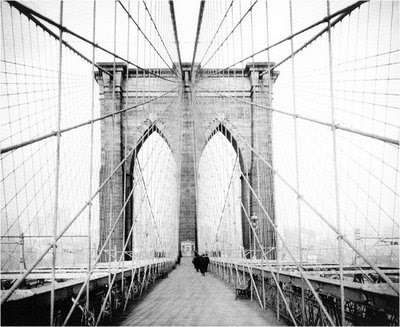
 A week after Miss Henley’s great fall the New York police got word that ‘Professor’ Odlum had been inspired to give the Brooklyn bridge another “go”. They alerted the toll collectors, and on Sunday afternoon, May 19, 1885 (ten days after Miss Henley’s plunge) a collector reported a suspicious cab lingering on the bridge. Officers found it parked against the outside rail half way across the span. But it was a decoy. While they were searching the cab, two wagons further back "Professor" Odlum leapt from beneath a covered flatbed wearing a swimsuit emblazoned with his name, clambered over the railing and before the cops could reach him, threw him self into space.
 Imagine Robert Odlum’s surprise when he discovered that the cops had been right. He entered the water feet first (as was the accepted diving position at the time) and shattered every bone in his frame from heel to skull. He was pulled from the river unconscious and died a half hour later. His friends shipped his body home, and Robert’s sister came to town ten days later to demand that the coroner explain what had become of her brother’s liver and heart. She never got a satisfactory answer, but my guess is they had both been reduced to jelly by the impact. A little math shows that “Professor” Odlum hit the water going sixty-three and a half miles an hour. At that speed water is as fluid as cold concrete.
 But it was Robert Odlum’s tragic foolishness that was the catalyst for the Irish hero of our bad idea. He was 23 years old by this time making his living as a newsboy and a bookie amongst the denizens of the Bowery. Like a certain actress he had worked with, Steve Brodie needed to escape the chorus, except in his case the chorus was a carcophony of poverty. The story that he later told was that a friend, James Brennan, had dared him on a $100 bet that he would not jump off the Brooklyn Bridge, and survive. But I doubt that Mr. Brennan had ever seen $100 in his life.
 Brodie parleyed his 15 minutes of fame into his own bar, with a little theatre in the rear where he re-enacted his alledged dramatic plunge into the East River several times a week for the tourists. In 1891 promoters built a Broadway melodrama (“Mad Money”) around his dive and another in 1894, (“On the Bowery”).
 In 1895 Mrs. Clara McArthur, married to a disabled railroad worker and mother to a young daughter, jumped off the bridge at 3:30 in the morning. She was seeking a share of Steve Brodies’ pot of gold for her destitute family. The desperate Clara was wrapped in an American flag. She had water-wings strapped under her arms and a punching bag tied to her back to keep her afloat after landing. Her socks were filled with sand to keep her feet below her head (again the accepted best attitude to enter the water). But she hit the water on her side, spreading the impact over the length of her body. Still, the impact ripped the water wings under her arms, to shreds. She struggled to the surface but the punching bag kept flipping her over, onto her face, and the socks kept pulling her down. Clara finally passed out, face down in the water.
 Steve Brodie is not counted as one of those ten. He was always an agreable fellow. If he had money, his friends and family shared in it. He gave generously to charity his entire life. But it is extremely doubtful that he actually made the jump. He tried to extend his fame by claiming to have lepted off a railroad bridge in upstate New York, and later claiming to have gone over Niagara Falls wrapped in inner tubes and metal bumpers. The Niagara stunt, real or not, almost killed him. He settled in Buffalo, New York, and operated a bar there for a few years before his asthma forced him to move to San Antonio, Texas, where he died in 1901 of complications of diabetes. Steve Brodie was all of 38 years old. He is buried in Calvary Cemetery, in Woodside, Queens, New York. Thankfully the idea of jumping from the bridge for fame and fortune died with him.
 The longest living survivor of all these daredevils was the accidental one. Sara Ann Henley (below), the woman who tried to commit suicide in 1885 by jumping 240 feet off the Clifton Suspension bridge, finally earned her angel’s wings in 1948. She was 84 years old, married but with no children, perhaps because of injuries sustained in her fall into the Avon River Gorge. Such feats, for fame or to protest fortune, are never good ideas.


